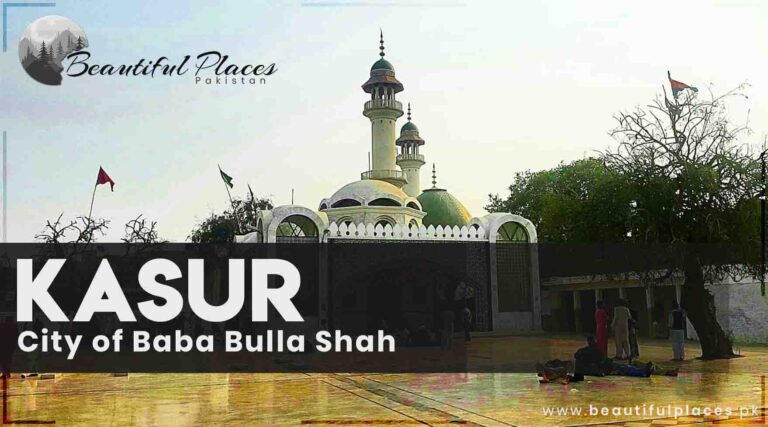
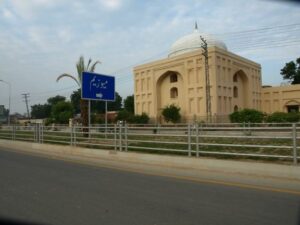
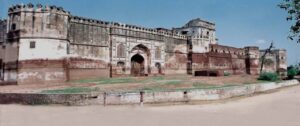
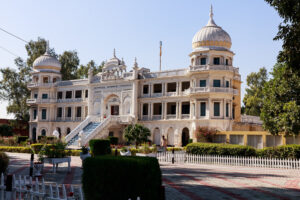
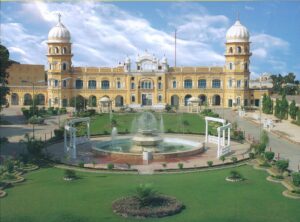
It is one of the oldest cities in Pakistan. Situated 53 km away in the south of Lahore, it is famous worldwide for its daily flag-raising ceremonies on the border with India.
It is well-known for the variety of food. Fried fish, Falooda (a dessert), Andrassy, and Kasuri Fenugreek are famous items. It is a city of renowned personalities. Baba Bulleh Shah and the queen of melody Noor Jahan belonged to this city. She sang national songs during the Indo-Pak war of 1965 and represented the people of Kasur and Pakistan
Key information about Kasur
Heading
Information
Location
Punjab, Pakistan
Coordinates
31.1151° N latitude, 74.4462° E longitude
Establishment
Ancient city with a history dating back to the Mughal era
Area
Approximately 3,995 square kilometers
Population
Over 3 million
District Capital
Kasur City
Languages
Punjabi, Urdu, English
Geography
Situated on the border with India, fertile agricultural land
Agriculture
Known for the cultivation of crops like rice and citrus fruits
Industries
Agriculture-based, with emerging sectors in textiles and manufacturing
Education
Numerous schools, colleges, and a university campus
Transportation
Well-connected by road, with Kasur Railway Station
Historical Sites
Kasur Fort, Tomb of Bulleh Shah, and various Mughal-era structures
Tourist Attractions
Shalimar Gardens, Shrines, and Kasur’s vibrant bazaars
Economy
Agriculture remains a primary economic driver, with emerging industrial sectors
A brief History of Kasur
Before the creation of Pakistan, Sikhs were living in the suburbs villages of Kasur while there was the majority of Muslims in the Kasur city. The Sikhs migrated to India after the separation. Different stories are famous about the name “Kasur”.
It is said that the son of King Ram led the foundation of this city and gave it the name Kasur after his name. His brother settled the city of Lahore after his name. According to another folk tale, the Afghan city was established in the Mughal king Akbar’s regime. The immigrants from Kabul built 12 forts there. The word fort has the meaning of “Qasr” in the Persian language. Therefore, it was named “Kasur” meaning the city of many forts.
Famous Places of Kasur
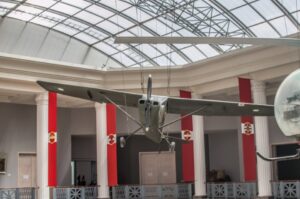
Kasur Museum
This museum is situated 2 km away from Kasur city on the highway going from Lahore to Kasur. Five galleries have been established there.
Kasur Museum, Punjab-Pakistan
Greek coins, models of Gandara civilizations, fossils of Chakwal, different items related to the Sikh era, handwritten Quran-e-Pak, Holy Quran written in Nastalik by Hafiz Murtaza Afghan Kasuri, weapons of Muslim regime, jewelry, and other valuable items are exhibited there.
Noor Jahan gallery is under construction here.
Baba Bulleh Shah
His real name was Abdullah Shah. He was a great Sufi poet and a philosopher who love humanity. He was born in 1680 in Uch Sharif near Bahawalpur. According to history, his forefathers immigrated from Uzbekistan.
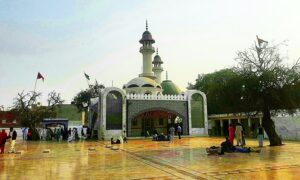
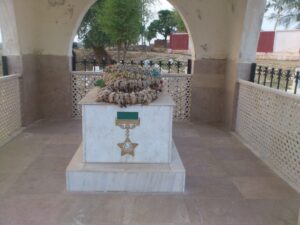
Tomb of Baba Bulleh Shah
His spiritual teacher was Sufi Inayat Shah Qadri. He did spiritual poetry by following Punjabi poets like Shah Hussain (1538-1599), Sultan Baho (1629-1691), and Shah Sharaf (1640- 1724). Baba Bulleh Shah and Shah Abdul Latif Bhatti are contemporaries.
He died in 1757 and was buried in Kasur city.
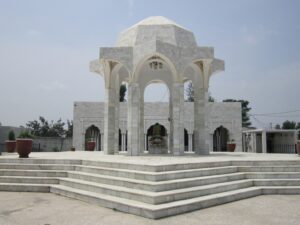
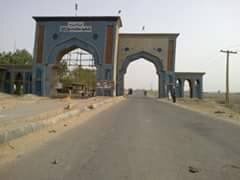
Ganda Singh Border
Ganda Singh is the last village in Pakistan on the Indian Border. It is in front of village Hussaini wala district Feroz Pur of Eastern Punjab. It is named after army officer Ganda Singh (1830-1903).
It was opened for transportation in the decades of 1960 and 1970. However, it was closed and opened at the Wahga frontier near Lahore. The flag-raising ceremony is organized daily in the afternoon.
It is alike the ceremony held at the Lahore Wahga border. The river Sutlej flows near Ganda Singh.
Kasur Fort
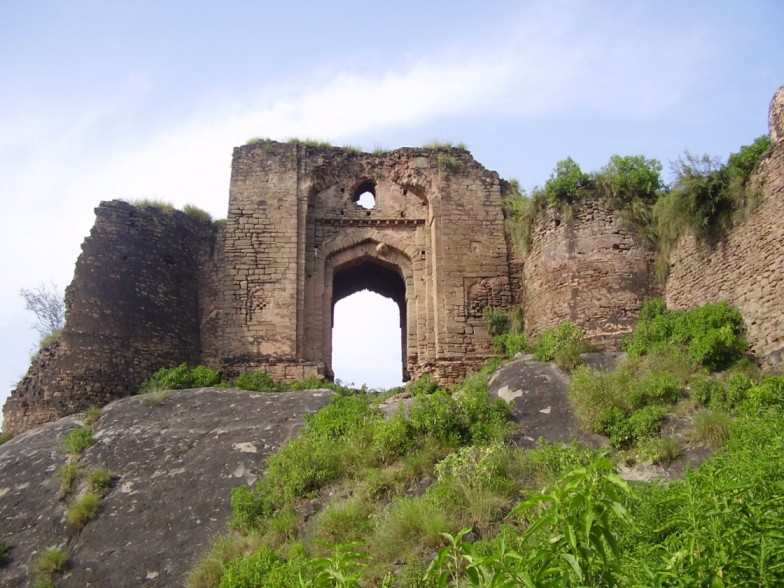
Also known as Raja Jagat Singh Fort, this historical fort dates back to the 17th century and serves as a reminder of the city’s past.
Changa Manga Forest
A vast man-made forest, Changa Manga offers a natural escape with picnic spots, walking trails, and a lake for boating.
Nishat Cinema
An iconic cinema in Kasur, known for its architectural design and role in local entertainment.
Sheikhupura Fort
Although located in nearby Sheikhupura, this historic fort is often included in visits from Kasur. It showcases impressive Mughal architecture.
Gurdwara Sachcha Sauda
A significant religious site for Sikhs, commemorating Guru Nanak’s visit to Kasur.
Shrine of Sultan Bahu
This Sufi shrine is dedicated to the renowned Punjabi Sufi saint Sultan Bahu, attracting pilgrims and devotees.
Kasur Railway Station
A historic railway station showcasing colonial-era architecture and serving as a transportation hub for the region.
Schools in Kasur
Beaconhouse School System, Kasur Campus
The Educators, Kasur Campus
Government Comprehensive High School, Kasur
Notable Colleges in Kasur
Government Postgraduate College Kasur
Punjab College Kasur
Superior College Kasur
Prominent Hospitals in Kasur
District Headquarters Hospital Kasur
Shifa Medical Center Kasur
Chaudhry Hospital Kasur
Popular Restaurants in Kasur
Lahori Chatkhara Restaurant
Haveli Restaurant Kasur
City Grill and Barbecue Kasur
Food Street Kasur
Frequently Asked Questions (FAQs)
What is the historical significance of Kasur?
Kasur boasts a rich history dating back to the Mughal era, evident in structures like Kasur Fort and the Tomb of Bulleh Shah. These historical landmarks contribute to the city’s cultural identity.
How important is agriculture in Kasur’s economy?
Agriculture plays a pivotal role in Kasur’s economy, with the cultivation of crops like rice and citrus fruits. The city’s fertile lands contribute significantly to Punjab’s agrarian prosperity.
What are the notable educational institutions in Kasur?
Kasur hosts a range of educational institutions, including schools like Beaconhouse and colleges like Government Postgraduate College. The University of Kasur is a notable higher education landmark.
Are there healthcare facilities in Kasur?
Yes, Kasur provides healthcare services through hospitals like District Headquarters Hospital and Shifa Medical Center, ensuring access to medical facilities for residents.
What are the popular tourist attractions in Kasur?
Tourists can explore historical sites like Kasur Fort and the Tomb of Bulleh Shah. Shalimar Gardens and vibrant bazaars add to the city’s appeal.
Is there a railway station in Kasur?
Yes, Kasur has a railway station, contributing to the city’s transportation connectivity.
What are some famous restaurants in Kasur?
Lahori Chatkhara, Haveli Restaurant, and City Grill and Barbecue are popular dining spots, offering a variety of local and traditional cuisines.
Tell me about Kasur’s cultural landmarks.
Kasur has cultural landmarks like Arts Council Kasur and community centers that promote cultural activities and events.
How has Kasur evolved economically in recent years?
While agriculture remains a significant economic driver, Kasur has seen the emergence of industrial sectors, particularly in textiles and manufacturing, contributing to economic diversification.
What role does education play in Kasur’s identity?
Education is integral to Kasur’s identity, with numerous schools, colleges, and a university campus fostering intellectual growth and contributing to the city’s educational landscape.
Famous for the production of rice, it is the sixteenth largest city in Pakistan. It is one of the oldest cities settled in the Mughal regime. Sheikhupura Fort and Hiran Minar are some famous historical places. It is famous for the production of rice.
Key information about Sheikhupura
Name
Information
Location
Punjab, Pakistan
Coordinates
31.7131° N latitude, 73.9783° E longitude
Establishment
Historical city with roots dating back to the Mughal era
Area
Approximately 5,960 square kilometers
Population
Over 3 million
District Capital
Sheikhupura City
Languages
Punjabi, Urdu, English
Geography
Situated on the fertile plains of Punjab, rich agricultural land
Agriculture
Known for the cultivation of crops like wheat, sugarcane, and citrus fruits
Industries
Agriculture-based, with emerging sectors in manufacturing and textiles
Education
Hosts numerous schools, colleges, and a university campus
Transportation
Well-connected by road and rail networks
Historical Sites
Hiran Minar, Sheikhupura Fort, and various Mughal-era structures
Tourist Attractions
Qilla Sheikhupura, Sheikhupura Stadium, and local markets
Economy
Agriculture remains a key economic driver, with growing industrial sectors
Famous Historical Places of Sheikupura
Sheikhupura Fort
In 1620, king Jahangir hunted in the royal hunting ground of Jahangir Abad (Hiran Menaar) on his return from Kashmir. He settled a village there after his name and built a building. He gave this building under the supervision of Sikander Sabin.
After the enthronement of Jahangir, this village was gifted to Sikander Sabin as Jagir (A jagir was a type of feudal land grant in South Asia bestowed by a monarch to a feudal superior in recognition of his administrative services).
Sheikupura fort – an eye witness of history
The king ordered to build a pond, Minaret, and a fort. After the death of Sikander, this Jagir was awarded to Iradat Khan and he completed the project. It was completed at a cost of 1.5 lacs. The building is dilapidated due to a lack of maintenance.
It surrounds an area of 65 Canals and has five floors. Small bricks are used in the construction of high walls. Beautiful paintings on its walls enhance its beauty.
You have to go to Sheikhupura, 37 km away from Lahoreto visit this fort. From where the road leads to the fort on Shah Jamal Road on the left side from Saddar Chowk on Sargodha Road.
A memorial to animal’s love / Hiran Menaar
Noor-Ud-Din Salim Jahangir, the son of Mughal monarch Jalal-ud-din Akbar was born on 20th September 1569. In 1605, he became King. He was fond of hunting. A special hunting ground was established in Sheikhupura for him. He used to come there for hunting very often.
One day, he saw a deer in the thick forest. He fell in love with the deer. He ordered his servants to catch the deer. They did so and took it to the king. He loved this deer so much that he gave it the title of “Royal Deer” and named it Hassan Siraj.
Whenever he came here, this deer would be the center of his special attention. In this way, the love between a man and this animal continued to grow.
One day he went out hunting. He took Siraj Hassan with him. During the hunt, the deer came at his target and died in agony before his eyes. He felt gloomy for the deer. To compensate for this loss, he ordered to build a beautiful minaret there and banned hunting.
This project was initiated under the supervision of Sikander Mueen. After that in 1620, Iradat Khan worked near this minaret. After the death of Jahangir, Shah Jahan built a pond near the minaret to make this place more beautiful.
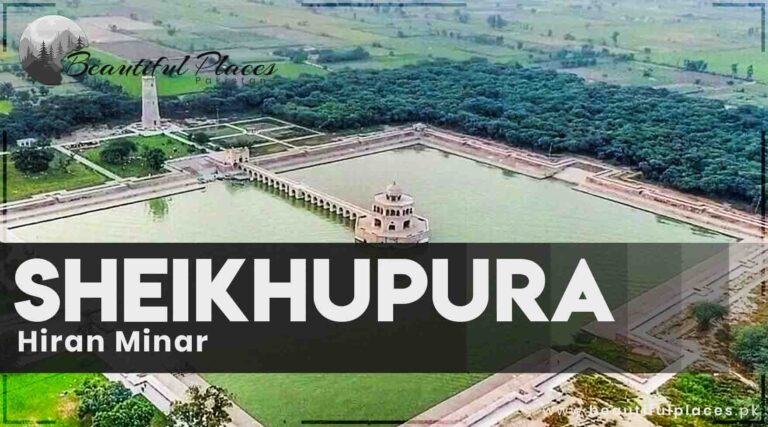
A two-story building is built in the center and a special path ends at Bara Dari which is built in the center of the pond. This building is a model of classical Mughal Art.
A captivating site of Hiran Minar – a memorial to Emperor Jahangir’s beloved deer
This Hiran Minaret complex with a pond and a Bara Dari stretches at an area of 16 acres. This minaret has a height of 110 feet with 108 stairs. This minaret is in a round shape. Its diameter is 33 feet at the base and decreases gradually towards the top. Its diameter is reduced to 23 feet at the top.
Enjoy the swings in the park and sailing in the center of the lake. It is included in the UNESCO World Heritage Site. You have to go to Hafiz Abad Road which is 8 km away from Sheikhupura.
Waris Shah, The great Sufi Poet of Punjabi
The great Sufi poet of Punjabi language and writer of Heer’s poem, Waris Shah was born in 1150 AH in Jandiala Sher Khan (a suburb of Sheikhupura). He got his early education from his father and went to Kasur and Pakpattan.
He came to Thatta after gaining inner grace and spirituality. He fell in love with Bhag Bhari and when the story of love spread around, he went to Malka Hanis. He wrote the story of Heer and Ranjha there.
In his poetry, he has summarized the love story of Heer Ranja along with injustice, cruelty, the political conditions culture and tradition of Punjab, lifestyle, industry, and agriculture.
Syed Waris Shah’s tomb – a true depictor of Punjabi Culture
According to folk tales, Waris Shah and Bulla Shah were class fellows and colleagues.
His tomb is located in a spacious garden that is 10 km away from Hiran Minaret and in Jandiala Sher Khan.
There is a library and a complex adjacent to the shrine. This tomb is the only one that is under the supervision of the Arts Council. Every year on the 15th of Sawan (5th month in the Hindu Calendar), the Jashen Heer Khawni competition is held.
Khushboo-e-Madinah Museum Farooq Abad
Haji Riaz Shahid (late) belonging to Farooq Abad, established a personal museum with a collection of Islamic blessed items. It is located on Sargodha Road 15 km away from Sheikhupura.
Khushbu-e-Madina Museum, a place of sacred and holy gifts
The holy hair of Hazrat Muhammad ﷺ, Hazrat Usman R.A, and Hazrat Bilal R.A., letters of Hazrat Muhammad ﷺ, the calligraphy of Sahaba (companions of Hazrat Muhammad ﷺ), valuable and holy items from Makkah and Madinah, models of Islamic sites, and many other things are exhibited in showcases in air-conditioned halls.
Islamic history is revealed with the help of pictures, charts, and maps. Photography, audiographer, and videography galleries are also established.
It is open in the evening for two hours. You can find out the timetable by contacting on 0300-4476786
Sacha Suda
The beautiful building of Sacha Sauda
The old name of Farooq Abad was Chohar Khana. You can also visit Sacha Suda Gurdwara of Baba Guru Nanak which is 3 km from Khushboo-e-Madinah Museum.
Famous Schools
Beaconhouse School System, Sheikhupura Campus
The Educators, Sheikhupura Campus
Government Comprehensive High School, Sheikhupura
Notable Colleges
Government Postgraduate College Sheikhupura
Punjab College Sheikhupura
Superior College Sheikhupura
Prominent Hospitals
Sheikhupura District Headquarters Hospital
Hameed Latif Hospital Sheikhupura
Social Security Hospital Sheikhupura
Popular Restaurants
Al-Nakhal Restaurant
Butt Karahi House
Food Street Sheikhupura
Frequently Asked Questions (FAQs)
What is the historical significance of Sheikhupura?
Sheikhupura has a rich historical heritage, with landmarks like Hiran Minar and Sheikhupura Fort reflecting its Mughal-era roots.
What role does agriculture play in Sheikhupura’s economy?
Agriculture is a key economic driver in Sheikhupura, with the cultivation of crops like wheat, sugarcane, and citrus fruits contributing significantly.
Are there notable educational institutions in Sheikhupura?
Yes, Sheikhupura hosts various schools, colleges, and a university campus, fostering educational growth and development.
What are some famous visiting places in Sheikhupura?
Famous places include Hiran Minar, Sheikhupura Fort, local markets, and Sheikhupura Wildlife Park.
Tell me about healthcare facilities in Sheikhupura.
Sheikhupura provides healthcare services through hospitals like District Headquarters Hospital and Hameed Latif Hospital.
Are there transportation facilities in Sheikhupura?
Yes, Sheikhupura is well-connected by road and rail networks, facilitating easy transportation within the city and to neighboring regions.
What are the popular restaurants in Sheikhupura?
Al-Nakhal, Butt Karahi House, and Food Street Sheikhupura are popular dining spots offering a variety of local cuisines.
Is there a university in Sheikhupura?
Yes, Sheikhupura is home to the University of Sheikhupura and Sheikhupura Institute of Technology.
Tell me about Sheikhupura’s cultural landmarks.
Cultural landmarks include Arts Council Sheikhupura and community centers that promote cultural activities and events.
How has Sheikhupura evolved economically in recent years?
While agriculture remains prominent, Sheikhupura has seen the emergence of industrial sectors, contributing to economic diversification.
Last Thoughts on Sheikhupura
The city is enriched with historical landmarks. In addition to this, it is linked to urban cities through railways which means there are more chances of development in both agriculture and industrial sectors.
Nankana Sahib, located in the Punjab province of Pakistan, holds profound spiritual significance as the birthplace of Guru Nanak, the founder of Sikhism and the first of the Sikh Gurus.
Revered by millions worldwide, Nankana Sahib is a sacred pilgrimage site for Sikhs, attracting devotees and visitors who come to pay homage to the revered Guru and immerse themselves in the spiritual aura of this historical city.
Beyond its religious importance, Nankana Sahib boasts architectural gems such as Gurdwara Janam Asthan, the birthplace of Guru Nanak, making it a site of cultural and historical significance.
Key Info About Nankana Sahib
Category
Information
Location
Nankana Sahib, Punjab, Pakistan
Population
Approximately 80,000
Area
1,376 square kilometers (531 sq mi)
Coordinates
31.4475° N latitude, 73.6978° E longitude
District
Nankana Sahib District
Language
Punjabi, Urdu, and English
Religious Significance
Birthplace of Guru Nanak Dev Ji, the founder of Sikhism
Economy
Agriculture, small-scale trade, and commerce
Major Crops
Wheat, sugarcane, cotton, and rice
Transportation
Road connectivity, with the N-35 highway passing through
Education
Educational institutions, including schools and colleges
Healthcare
Hospitals and medical facilities
Notable Places
Gurdwara Janam Asthan, a prominent Sikh shrine; other gurdwaras and historical sites
Local Festivals
Guru Nanak Gurpurab, Baisakhi, and other Sikh religious festivals
Culture
A rich Sikh cultural heritage with traditional music, religious processions, and festivals
Administration
Nankana Sahib is divided into several Union Councils for local governance
Industries
Agriculture, retail, and small-scale businesses
Tourism
Significant religious tourism due to the birthplace of Guru Nanak Dev Ji
Climate
Hot and arid, with extreme temperatures in summer
Major Highways
N-35 (also known as the Grand Trunk Road) is a prominent highway
Nearest Airport
Allama Iqbal International Airport in Lahore (around 85 km away)
Guru Nanak (Founder of Sikh Religion)
Baba ji Guru Nanak was born on 21st November 1469 in Rai-Bhoi-Di-Talwandi Nankana Sahib. He was born to a mathematician family.
His father’s name was Kalyan Das Ji and the alias was Kalu Ji. His cast was Khatri, tribe Badi, and his family profession was farming. He was not interested in Business. He learned Hindi, Sanskrit, and Persian.
On 12th September 1487, he married Mulchand’s daughter Mata Salakhni of Gurdaspur. She gave birth to two sons. In 1497, he detached from the Worldliness and started tourism with three of his friends. He was a saint who was engaged in meditation.
He was a true believer in one God. He hated idolatry. He was against Racism. Baba Guru Nanak led the foundation of the Sikh religion and most of his teachings were in accordance with Islam.
According to his teachings, Allah is one. He is the Sole Creator of everything, Al-Mighty, and All-Knowing. We should worship only one Allah. The persons who find Allah are blessed with eternal life.
It is said that he went for Hajj two times. He was a great poet. He combined and collected the poetry of Baba Fareed Ganj Shahkar and Bhagat Kabeer.
His poetry and sayings are included in the religious book of Sikhs “Granth Sahib”. in 1504, he settled a town near the river Ravi named it “Kartarpur”. In his old age, he used to live in Kartarpur and died there.
An aerial view of the historical landmark, Nankana Sahib
The Gurdwara
Baba Guru Nanak, the founder of the Sikh religion was born to mathematician Kalu Khatri in 1469 in the Talundi district of Punjab which is 16 km away from FaisalabadRoad, 32 km from Sheikhupura.
He was against idolatry and discrimination. He believed in monotheism and believed in the oneness of one God. He had deep love and devotion toward Islam and Prophet Muhammad ﷺ. He had admired him (ﷺ, Peace be upon him) in many Janam Sakhis.
A beautiful building is constructed at his birthplace and the religious book of Sikh (Granth Sahib) is placed there. This place is called “Harmandir Sahib”.
Muslims use the word “Sharif” with their sacred books and places, Hindus use “Shiri” with holy places, and Sikhs use the word “Sahib” with their religious books and sites.
The Gurdwara built at the birthplace of Baba Guru Nanak is “Gurdwara Janam Asthan”. This area is transformed into a spacious building. There are seven Gurdwaras related to the early life and miracles of Baba Guru Nanak.
Their names are Hall ji, Sacha Suda, Tanbu Sahib, Panchiwi Badshahi, Nihanga, Bal Lela, and Janam Asthan. That’s why Nankana Sahib is called the “City of Gurdwaras”.
There is a big festival organized on the fourteenth day of the rising moon in the month of Baba’s birthday in Nankana Sahib.
Sikhs walk around the city in procession, barefoot, with drummers, singing religious hymns with tongs. Fireworks are displayed at the end of the festival.
Famous Places in Nankana Sahib
Gurdwara Janam Asthan
The heart of Nankana Sahib, Gurdwara Janam Asthan is the birthplace of Guru Nanak. Pilgrims and devotees gather here to pay homage to the revered Guru and absorb the spiritual energy that permeates the surroundings.
Gurdwara Bal Leela
Situated in close proximity to Gurdwara Janam Asthan, Gurdwara Bal Leela is where Guru Nanak spent his childhood. The gurdwara encapsulates the divine innocence of Guru Nanak’s early years, making it a cherished site for visitors.
Nankana Sahib Railway Station
Beyond its spiritual sites, Nankana Sahib boasts the historical Nankana Sahib Railway Station. This station played a role in the life of Guru Nanak and serves as a testament to the historical development of the region.
Gurdwara Malji Sahib
Another significant gurdwara in Nankana Sahib, Gurdwara Malji Sahib is associated with Guru Nanak’s early education. Pilgrims visit this place to connect with the educational journey of Guru Nanak.
Gurdwara Tambu Sahib
Gurdwara Tambu Sahib is dedicated to Guru Nanak’s marriage. The site holds historical and cultural importance, and visitors can explore the surroundings to learn more about this aspect of Guru Nanak’s life.
Panj Tirath
Panj Tirath is a historical site in Nankana Sahib associated with the five Pirs (Muslim saints) who were impressed by the divine aura of Guru Nanak. The site symbolizes the harmonious coexistence of different faiths.
Bhai Lalo’s Shrine
Bhai Lalo was a close companion of Guru Nanak, and his shrine is a place of reverence. Pilgrims visit to pay their respects to Bhai Lalo, who exemplified Guru Nanak’s teachings through his way of life.
Shrine of Pir Buddhu Shah
Pir Buddhu Shah was a Muslim saint who supported Guru Gobind Singh during the Battle of Chamkaur. His shrine in Nankana Sahib is a symbol of the unity that transcends religious boundaries.
Educational Institutions
Guru Nanak College of Education
Nankana Sahib Public School
Guru Nanak Dev Engineering College
Khalsa College, Nankana Sahib
Government High School, Nankana Sahib
Healthcare Facilities
Guru Nanak Dev Hospital
Civil Hospital Nankana Sahib
Fateh Memorial Hospital
Nankana Sahib Dental Clinic
Guru Nanak Charitable Hospital
Restaurants and Eateries
Langar Hall (At Gurdwara Janam Asthan)
Desi Zaika Restaurant
Nankana Zaika
Guru Nanak Restaurant
Friends Food Point
Frequently Asked Questions (FAQs)
What is the significance of Nankana Sahib in Sikhism?
Nankana Sahib is the birthplace of Guru Nanak, the founder of Sikhism. It holds immense religious importance and is a major pilgrimage site for Sikhs worldwide.
How many gurdwaras are there in Nankana Sahib?
Nankana Sahib is home to several gurdwaras, with Gurdwara Janam Asthan and Gurdwara Bal Leela being the most prominent ones associated with Guru Nanak’s life.
Are there educational institutions in Nankana Sahib?
Yes, Nankana Sahib has several educational institutions, including colleges and schools, fostering both modern and traditional education.
What are some popular restaurants in Nankana Sahib?
Visitors can enjoy local and traditional cuisine at places like Langar Hall (at Gurdwara Janam Asthan), Desi Zaika Restaurant, and Nankana Zaika.
Are there healthcare facilities in Nankana Sahib?
Nankana Sahib is equipped with healthcare facilities such as Guru Nanak Dev Hospital, Civil Hospital, and other medical centers to cater to the health needs of the community.
How can I reach Nankana Sahib?
Nankana Sahib is well-connected by road and rail. The nearest major city is Lahore, and from there, one can travel by road or train to reach Nankana Sahib.
Are there historical sites to explore in addition to gurdwaras?
Yes, besides gurdwaras, Nankana Sahib has historical sites like the Nankana Sahib Railway Station, adding to the city’s cultural and historical charm.
What festivals are celebrated in Nankana Sahib?
Nankana Sahib celebrates various religious festivals with great enthusiasm, including those associated with Sikhism. The city comes alive with vibrant festivities during these occasions.
Last Thoughts on Nankana Sahib
Nankana Sahib is not just a city; it’s a spiritual haven, a repository of history, and a cultural gem. It welcomes visitors with open arms, offering an immersive experience that goes beyond the physical and enters the realm of the spiritual. As pilgrims and tourists traverse the streets of Nankana Sahib, they are not just traversing physical landscapes; they are embarking on a journey of the soul.
Formerly known as Sandal, and Layellpur, Faisalabad is the third-largest city in Pakistan. It is situated 137 km from Lahoreand it is connected to the country through a motorway, railways, and an airport.
Key information about Faisalabad PK
Category
Information
Location
Faisalabad, Punjab, Pakistan
Population
Approximately 3.2 million
Area
1,230 square kilometers (473 sq mi)
Coordinates
31.4182° N latitude, 73.0772° E longitude
District
Faisalabad District
Language
Punjabi, Urdu, and English
Nicknames
“The Manchester of Pakistan” due to its textile industry
Economy
Industrial and commercial hub, known for its textile and manufacturing industries
Major Industries
Textiles, manufacturing, agriculture, and trade
Transportation
Well-connected with a network of roads and railway lines
Education
Home to numerous schools, colleges, and universities
Healthcare
Several hospitals and medical facilities
Notable Places
Clock Tower, Jinnah Garden, and Lyallpur Museum
Local Festivals
Eid, Basant (spring festival), and various cultural celebrations
Culture
Rich cultural heritage with traditional music, dance, and local cuisine
Administration
Faisalabad is divided into several Union Councils for local governance
Climate
Hot and dry, experiencing extreme temperatures in summer
Major Highways
M-3 Motorway and Faisalabad-Pindi Bhattian Road
Airport
Faisalabad International Airport (Lyallpur Airport)
Industries
Textiles, manufacturing, agriculture, and commerce
Commerce
Wholesale markets, industrial zones, and commercial centers
Sports
Cricket and field hockey are popular sports in the city
A Brief History of Faisalabad
It was a deserted area. Its settlement plan was drawn up in the last quarter of the nineteenth century. Its urbanization was initiated in 1890. And in 1906, the settlement plan of the city was completed.
This uncultivated area was an open pasture. In 1982, this area came under cultivation due to the construction of the various canal. In 1985, the foundation of the city was laid.
It was named “Lyallpur Pur” after the name of the Governor of Punjab Sir James B Layal. Its design was made by Desmond but the final design was put into practice by the famous town planner Sir Ganga Ram. He was given a plot of 5 acres as a gift.
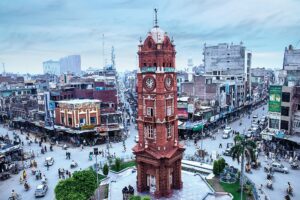
The map of Faisalabad is a duplication of the British Flag Union Jack. There is a clock tower in the center and 8 Bazaars or markets are established around the circle. They are linked to each other through a round Bazaar.
A beautiful aerial sight of Clock Tower Faisalabad
Earlier, there was a well at the place of Clock Tower. Its construction was done under the supervision of Gulab Khan, who belonged to the family of architects who built the Taj Mahal Agra.
The clock was given by a watchmaker in Bombay. In 1910, a railway line was established. And in 1920, the first colony named Daglas Pura was established. The industry was revolutionized after 1930. The Lyall Pur Cotton mill was completed in 1934. This city progressed by leaps and bounds as time passed.
Today’s Faisalabad
At the time of the creation of Pakistan, its area was 3 square miles and now it is the third-largest city in Pakistan. In 1997, it was named after King Faisal of Saudi Arabia.
On 1st July 1982, it become the capital of the Division. It is also the third-largest hub of trade and industry in Pakistan. At the time of the creation of Pakistan, there were about two dozen small and big factories. At this time, they have reached thousands of industrial units.
Faisalabad has the largest textile industry in Pakistan. That’s why it is called the Manchester of Pakistan. Besides textile, there are other factories of the different industrial departments. They are playing a major role in the economy of Pakistan.
Some Famous Places to visit in Faisalabad
Faisalabad Agricultural University
Faisalabad Agricultural University, often referred to as the University of Agriculture Faisalabad (UAF), stands as a cornerstone of agricultural education and research in Pakistan. Situated in the bustling city of Faisalabad, Punjab, it has earned a distinguished reputation for its pivotal role in advancing agricultural sciences and contributing significantly to the country’s agricultural sector.
UAF is a prominent academic institution known for its academic excellence in agriculture and related fields. Established in 1906 as the Punjab Agricultural College and Research Institute, it has evolved into a comprehensive university with an array of academic programs encompassing agriculture, animal sciences, food sciences, and environmental management.
The university’s research endeavors have a profound impact on agricultural practices and policies in Pakistan. Its researchers are at the forefront of addressing the challenges faced by the agricultural sector, such as increasing crop productivity, improving livestock management, and enhancing food security. UAF’s innovative research contributes not only to the local agricultural landscape but also on an international scale.
UAF boasts state-of-the-art laboratories, research centers, and experimental farms that provide students and faculty with a conducive environment for hands-on learning and groundbreaking research. These facilities play a crucial role in fostering innovation and technological advancements in agriculture.
Recognizing the importance of knowledge dissemination, Faisalabad Agricultural University actively engages in extension activities. It collaborates with farmers, government agencies, and the private sector to share research findings, provide training, and transfer modern agricultural techniques to local communities.
UAF’s role in shaping the agricultural landscape of Pakistan cannot be overstated. It has contributed to the development of high-yield crop varieties, improved livestock breeds, and sustainable farming practices, all of which have been instrumental in increasing agricultural productivity and livelihoods in the region.
The university has forged collaborations with renowned international institutions and universities, fostering exchange programs, joint research initiatives, and a broader global perspective for its students and faculty.
UAF celebrates its deep-rooted connection to agriculture and rural culture with events like the Faisalabad Agri Expo and the Barani (Rainfed) Agricultural Show. These events showcase innovations and best practices in agriculture and provide a platform for knowledge sharing.
Agriculture University Faisalabad, a masterpiece of grandeur
Jinnah Garden
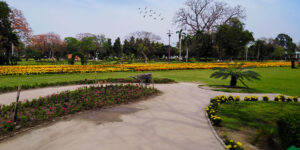
Jinnah Garden, located in the heart of Faisalabad, is a well-maintained urban park named after Pakistan’s founding father, Quaid-e-Azam Muhammad Ali Jinnah. It provides a serene escape from the bustling city life, featuring lush greenery, walking paths, fountains, and a beautiful floral clock.
A charming scenery in Jinnah Gardens, Faisalabad
Clock Tower Faisalabad
The Clock Tower, also known as Ghanta Ghar, is an iconic landmark in Faisalabad. It stands tall at the city’s center, dating back to the British colonial era. This majestic structure serves as a symbol of the city’s rich heritage and history.
A closer look at the clock tower of Lyallpur, Faisalabad
Gat wala or Gutwala Park
Gatwala Park is a sprawling recreational area on the outskirts of Faisalabad. It offers a peaceful environment for picnics, family outings, and outdoor activities. The park is known for its green expanses, a lake with boating facilities, and an amusement park for children.
Gatwala Park
Lyallpur Museum Faisalabad
The Lyallpur Museum, named after the city’s former name, showcases a diverse collection of artifacts, cultural exhibits, and historical items. It offers visitors insights into the heritage and history of Faisalabad, making it an enriching cultural experience.
Faisalabad Lyallpur Museum, a place of archaeological remains
Faisalabad Arts Council
The Faisalabad Arts Council is a cultural hub where various forms of art, including visual arts, performing arts, and literary activities, are celebrated and promoted. The council hosts art exhibitions, music performances, and literary events, fostering creativity in the city.
Faisalabad Arts Council named after the late singer Nusrat Fateh Ali Khan
Hockey Stadium
Faisalabad’s Hockey Stadium is a sporting venue where field hockey enthusiasts gather to watch and participate in this beloved sport. It has witnessed numerous local and national hockey matches, showcasing the city’s passion for the game.
Hockey Stadium. Hockey, the national game of Pakistan
D- ground
D-Ground is a bustling commercial area in Faisalabad, famous for its vibrant markets and shopping streets. It’s a prime destination for shopping, dining, and experiencing the lively atmosphere of the city.
Darul Ehsan of Sufi Barkat
It is located on the left side of Sahiyanwala Interchange on Faisalabad Pindi Bhattian Motorway.Darul Ehsan is a revered Sufi shrine dedicated to Sufi Barkat Ali, a spiritual figure of significance. Devotees visit the shrine to seek blessings, offer prayers, and partake in the spiritual ambiance.
The Holy Place of the Quran Mahal
The Quran Mahal is a religious and cultural center where people come to recite the Quran, seek religious guidance, and participate in various Islamic activities. It is a significant religious space in Faisalabad.
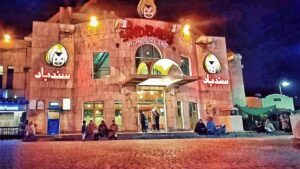
Sindbad
Sindbad is a popular amusement and entertainment center in Faisalabad. It offers a wide range of indoor and outdoor activities for people of all ages, including arcade games, rides, and a food court, making it a favorite spot for family outings and recreation.
Sindbad Wonderland, is an amusement place for families
Ganga Ram
The village Chak# GB-591 of Tehsil Jaranwala of district Faisalabad is famous as the “Ganga Ram”. Renowned architect and civil engineer Sir Ganga Ram belonged to this village.
It is said that he was the landlord and owner of the village. He made this village a model village.
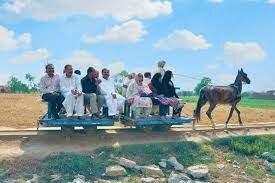
At the end of the nineteenth century, the latest machinery was introduced for the development of the agriculture sector. A heavy-duty motor was imported from Lahore through rail for Gogera Branch Canal. This canal water was used for irrigation.
There was a facility of railway line till Bachiyana. But there was no proper track from which the motor can be taken between Bachiyana to Gangapur. At that time, Sir Ganga Ram ordered the building of a narrow railway track between Bachiyana and Gangapur.
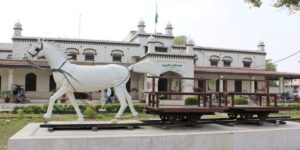
And the motor was brought to Gangapur through a horse trolley. After the installation of the motor, this trolley was used by people as local transport.
About after 100 years, this horse trolley track was closed due to its poor physical condition and economic issues.
At last, on 9th March 2010, this rare horse trolley was again started, and nowadays it is known as Ganga Ram.
A real horse train, a gift by Sir Ganga Ram to his village
To enjoy this unique ride, you have to go to Bachiyana from Jaranwala.
Ganga Ram built the Lahore Museum, National College of Arts, General Post office, Mayo Hospital Lahore, Aitchison College, Ganga Ram Hospital, Hailey College of Commerce, and many other buildings and welfare agencies.
He started a campaign for the marriage of widow Hindus. He established an association for this purpose. This association has arranged the marriage of 39,500 widows in 18 years.
Mirza Sahiba
Mirza Khan was a handsome young man of the Kharal tribe situated near the river Ravi. He was the son of the chief of village Dana Abad, Tehsil Jaranwala district Faisalabad.
The maternal uncle of Mirza had two sons (Ameer and Sher) and a daughter named Sahiba. Sahiban was a sculpture of beauty. At a young age, Mirza and Sahiban used to study in the same institution. They fell in love with each other.
Their love story became popular among the villagers. When Khewa Khan came to know about it, he called the elders of the tribe. They decided to marry Sahiba to another man according to society’s norms.
They engaged Sahiban to a prosperous young man Tahir Khan. According to some folk tales, it was that Chanda tribe that turned into Chiniot City.
The day of marriage arrived. Everyone in the family was happy. But the Sahiban was gloomy. She sent a message to Mirza through his servant Kamoo.
When Mirza came to know about Sahiba’s marriage, he got miserable. He rode on his faithful mare Bukki and reached Sahiba’s village.
He stayed at her aunt’s home. He changed his appearance and flee away with Sahiba. On their way, he felt exhausted and slept on the knees of Sahiban.
Sahiba thought that if his brothers there chasing them, Mirza will kill them with his excellent skill in archery. She hung his arrow and bow on the tree. Their uncle first came to know about their escape.
He took Sahiban’s brothers with him and chased them in the Jungle. She heard the voice of horses around her. She awakened Mirza. He got up and searched for his arrow and bow. Suddenly, an arrow stuck in his chest and he died. She was shedding tears wrapped around him when an arrow pierced her too.
In this way, both of them left this world. Renowned Historian Asif Khan has set the era between 1625 to 1676 as Mirza Sahiba Era.
Educational Institutions
University of Agriculture Faisalabad (UAF): A renowned agricultural university.
GC University Faisalabad: A prestigious public research university.
Chenab College Faisalabad: A prominent college known for academic excellence.
The Educators School: A chain of quality educational institutions.
Allied School: A well-recognized school offering quality education.
Restaurants
Faisalabad Serena Hotel: Offers a variety of dining options.
Nando’s: Known for its peri-peri chicken and international cuisine.
Pizza Hut: A popular pizza chain.
Bundu Khan: Famous for its barbecue and traditional Pakistani dishes.
Ginsoy: Offers Chinese and Thai cuisine in an elegant setting.
Hospitals
Allied Hospital Faisalabad: A well-equipped medical facility.
Faisalabad Institute of Cardiology (FIC): Specialized in heart care.
National Hospital Faisalabad: Known for its medical services.
Aziz Fatimah Hospital: Offers a range of healthcare services.
Faisalabad International Hospital: Provides comprehensive medical care.
Frequently asked questions (FAQs)
What is the history behind the name “Faisalabad”?
Faisalabad was originally named Lyallpur, but it was renamed in 1977 in honor of King Faisal of Saudi Arabia.
What is Faisalabad known for?
Faisalabad is famous for its textile industry and is often referred to as “The Manchester of Pakistan.”
What are the popular tourist attractions in Faisalabad?
Tourists can explore places like Jinnah Garden, Clock Tower, and Lyallpur Museum, among others.
How do I get to Faisalabad?
Faisalabad is accessible by road and has an international airport, Faisalabad International Airport, connecting it to major cities in Pakistan.
Is Faisalabad a good place for shopping?
Yes, Faisalabad is a great place for shopping, especially for textiles and garments. D-Ground is a popular shopping area.
What are the major industries in Faisalabad?
The city is primarily known for its textile industry, but it also has a significant presence in manufacturing, agriculture, and trade.
Are there renowned educational institutions in Faisalabad?
Yes, Faisalabad is home to esteemed institutions like the University of Agriculture Faisalabad and GC University.
What is the climate like in Faisalabad?
Faisalabad experiences a hot and arid climate, with extreme temperatures during the summer months.
What cultural events are celebrated in Faisalabad?
Festivals like Eid and Basant, a spring festival with kite-flying, are celebrated in the city.
Is Faisalabad known for its food and restaurants?
Yes, the city has a variety of restaurants offering both local and international cuisine.
What is the significance of Clock Tower in Faisalabad?
The Clock Tower is an iconic historical landmark and symbol of the city’s heritage.
Can tourists visit historical and cultural sites in Faisalabad?
Yes, tourists can explore cultural sites like the Lyallpur Museum and the Darul Ehsan of Sufi Barkat.
Last Thoughts on Faisalabad
Faisalabad is a masterpiece of rich history, culture, and traditions. Clock Tower, the village of Mirza Sahiban, and Lyell Pur Museum are witnesses to its glorious past. In addition to this, it is a center of Pakistan’s textile industry thus playing a key role in the economy. It has many shopping sites, recreational places, and food courts making it a good spot for tourists.
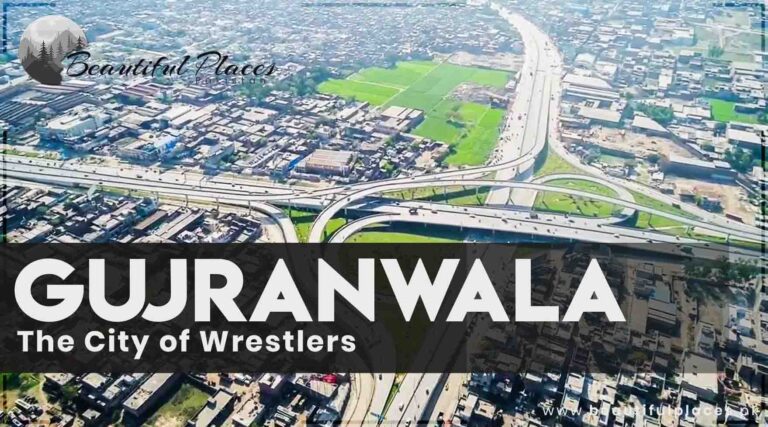
This city is located 10 km from Eimanabad and 65 km from Lahore in the North on the G.T Road. It is one of the historical and major cities of the Punjab Province.It is not an old city. This city is not even quoted in the books of the Mughal Era.
Key Info About Gujranwala PK
Category
Information
Location
Gujranwala, Punjab, Pakistan
Population
Approximately 2,200,000
Area
3,198 square kilometers (1,234 sq mi)
Coordinates
32.1612° N latitude, 74.1883° E longitude
District
Gujranwala District
Language
Punjabi, Urdu, and English
Economy
Industrial and commercial hub, known for its manufacturing and trade
Major Industries
Metalworking, textiles, rice milling, and ceramics
Transportation
Well-connected by road and rail to surrounding cities
Education
Several schools, colleges, and the University of the Punjab, Gujranwala Campus
Healthcare
Hospitals and medical facilities
Notable Places
Gulshan Park, Gujranwala Cricket Stadium, and Gondal House
Culture
Rich cultural heritage with traditional music, dance, and local cuisine
Administration
Gujranwala is divided into several Union Councils for local governance
Climate
Hot and arid, experiencing extreme temperatures in summer
Major Highways
M-2 Motorway, Grand Trunk Road (GT Road), and others
Airport
Sialkot International Airport (about 40 km away) serves the region
A Brief History of Gujranwala
Sheranwala Bagh Gujranwala, A place where the leaders of the subcontinent delivered their speeches
Eimanabad and Hafizabad were settled in Akbar’s regime. This area was deserted in the eighteenth century. Then, the Gojar people were expelled by Jat from Amritsar and they got settled here.
This Dera (place) of Gojar’s is called Gujranwala. At last, the grandfather of Ranjeet Singh, Charat Singh Jat occupied this area and declared Gujaranwala the capital of the state.
This place was also the residence of the son and grandson of Charat Singh. The graves of Charat Singh and his son of Mahan Singh and the birthplace of Ranjeet Singh still exist.
Wrestlers of Gujranwala
Gujranwala is not only known for the export-driven industrial units but also for the internationally recognized wrestlers. This city is honored to raise wonderful wrestlers that prove themselves around the globe. The wrestlers of Gujranwala won many grand titles ever won by any city in the world. There are about 25 bouts for wrestling in Gujranwala. Therefore, it is called the “Land of Wrestlers” and “Pahalwana da Shehar”.
Different terms are used in Gujranwala for wrestling. The style of wrestling is “Pahalwani”, the bouts are called “Dangal” and the sport is called “Kushti”. The wrestlers are named “Pahalwans”.
Rahim Baksh Sultani Wala, Muhammad Afzal (Goga Pahalwan), Yonous Pahalwan (Sitara-e-Pakistan), Meraj Pahalwan, Acha Pahalwan, Shahid Pehlwan Atty Wala, and Babar Sher-e-Punjab are some worth mentioning wrestlers in the history of Gujranwala.
Rahim Baksh Sultani wala was a great wrestler in Gujranwala with a tall height of 7 feet. He defeated the wrestlers of Lahore and Amritsar.
Yonous Pahalwan was a student of Rahim Baksh. Sitara-e-Pakistan Yonous was born on 30th December 1925 in Gujranwala. He fought at the age of 16 for the first time. He won the title of “Rustum-e-Punjab” at a very young age.
Shahid Pervaiz Butt – the pride of Punjab was born in 1964 in Gujranwala. His father and many famous wrestlers trained him. He was entitled to “Rustum-e-Gujranwala” in 1984 after defeating Aslam Pehlwan in Lahore.
Pakistan has won the most medals in wrestling since 1952. And many of the wrestlers belong to Gujranwala.
Inam Butt is one of the wrestlers of Gujranwala who is undefeated for the past many years. Despite the difficulties and inadequate facilities, he won medals for his land and nation. He won the first gold medal against India in Commonwealth Games. Pakistan won this title after 40 years.
He defeated Kenya and South Africa too. He also won the title of “Rustom-e-Pakistan”. He gained popularity as an international player in 2019 when he won a medal in World Beach Wrestling Championship. He received “Pride of Performance” by the Government of Punjab.
Haider Ali, Talha Talib, and Nida Dar are among the heroes of Gujranwala.
Haider Ali has the honor of achieving Pakistan’s first gold medal in the history of the Paralympics.
Nida Dar is the first Pakistani cricketer to complete a century of wickets in T20 matches.
Talha Talib is a young weight lifter from Gujranwala Pakistan. He made the nation proud with his excellent performance in Olympics. Coached by his father, this young wight lifter represented Pakistan in the Olympics after 45 years. He stood 5th in the 67kg category.
You can also enjoy wrestling in the local training centers. They are open in the evening. Pakistani youth have great talent. If proper training centers, gyms, grounds, and sponsorship are provided for these sports, Pakistan can win many titles in near future.
Today’s Gujranwala
Gujranwala City
This city is the seventh-largest city in Pakistan and is located at a height of 744 feet. The old city is located on a circular road. It had doors all around this city. Traces of some doors are still present.
The historical Sheranwala garden is in the center of the city. This garden plays the same role in Pakistan’s movement as the Lahore Manto Park did.
Quid-e-Azam, Liaqat Ali Khan, Mohtarma Fatima Jinnah, Sardar Abdul Rab Nishter, Allama Mashriqi, Atta Ullah Shah Bukhari, Pandit Nehru, and other leaders delivered their enthusiastic speeches in front of a huge crowd there.
There is a beautiful Baradari in the garden built by Raja Ranjeet Singh.
It is also a city of Body Builders and wrestlers who gave birth to Rustom Hind wrestler. The old Bazaars of Gujranwala are considered among the best Bazaar in Pakistan.
Today, this city is known for iron cupboards, closets, electric fans, electronics, furniture, utensils of copper and aluminum, ceramics, stainless steel, sports, leather, and textile industries.
Bestowed with fertile land, the soil of Nandi Pur Gujranwala barrage has been laid in cricket stadiums around the world.
Famous Places of Gujranwala
Eimanabad/Aimanabad Gurdwara Rori Sahib
This Gurdwara is located in Eimanabad city, four miles to the right side on G.T Road, ten miles before Gujranwala on the way from Lahore to Gujranwala.
It is said that the cornerstone of this historical city Aimanabad was led by the king of Sialkot Salbahun in the first century B.C. This city was settled and ruined too many times. General of Humayun Aiman Baig burnt this city and settled it again as Eimanabad.
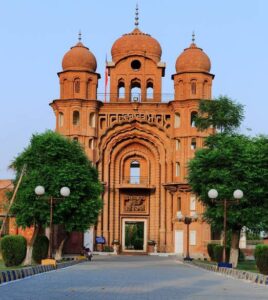
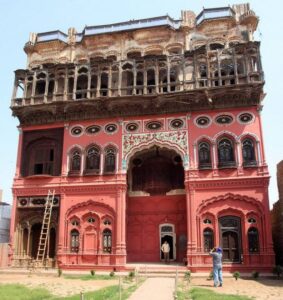
Gurdwara Eimanabad Gujranwala, A magnificent piece of architecture
This ancient city has many historical sites in which Gurdwara Rori Sahib is one of the most sacred places for Sikhs.
It is stated that Baba Guru Nanak stayed here for some days. He didn’t find a proper place for taking a rest. He leveled the ground with small stones and slept there.
After that, Sikhs considered this place a holy place. A Gurdwara was constructed at this place and the largest Beshaki fair in United Hindustan was held there. Its redecoration continued after the creation of Pakistan. The present building is a splendid piece of architecture.
Parks
Model town park, Liaqat Park, Jinnah Park, and Iqbal Park on G.T Road have enhanced the beauty of Gujranwala. It has playgrounds, picnic spots, sailing, and playland recreational areas.
A memorial to the martyrs of Pakistan’s army is built in the Nishan Manzil Park.
Nishan-e-manzil park, Gujranwala
The food of Wrestlers and food streets
This world-famous city of wrestlers is also renowned for its delicious food variety. Kebab, Chicken Tikka, and Chops are famous dishes. Traditional breakfasts are a specialty of this city.
In addition to Shahbaz Tikka, Allah Rakha Chicken Karhai, there are lots of restaurants and food courts at Sialkot Darwaza, androon city, and Chan da Qila Lahore Road.
Gakhar Mandi
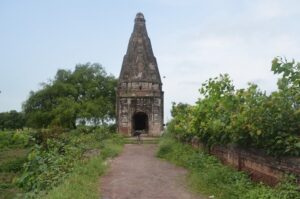
It is a few kilometers away from Gujranwala and famous for the manufacturing of mats. There is an ancient temple of Hindus near Gakhar Mandi built on the architecture of Hiran Menaar. This locality contributes to the economic vitality of Gujranwala through diverse commercial and possibly industrial activities. Embedded in the rich cultural fabric of the region, Gakhar Mandi likely features local markets, fostering community life and offering residents access to educational and civic facilities. As an integral part of Gujranwala, Gakhar Mandi reflects the broader urban dynamics and historical narratives of this thriving city.
Toomri Temple, Gujranwala, an eyewitness of history
Famous Schools
Beaconhouse School System: A well-known chain of private schools with a branch in Gujranwala, offering quality education.
City School Gujranwala Campus: Another prominent private school contributing to the educational landscape of the city.
Govt. Comprehensive High School: A notable government school with a long-standing history in Gujranwala.
Famous Colleges
Government College University (GCU) Gujranwala: An esteemed institution offering a range of undergraduate and postgraduate programs.
Punjab College Gujranwala: A widely recognized private college providing intermediate and bachelor’s degree programs.
Famous Hospitals
CMH (Combined Military Hospital) Gujranwala: A reputable military hospital known for providing healthcare services to civilians as well.
Civil Hospital Gujranwala: A major public hospital offering a range of medical services to the local population.
Famous Restaurants
Salt Bae Grill: A popular restaurant known for its grilled dishes and a variety of cuisines.
Bundu Khan Restaurant: Renowned for its Pakistani and barbecue specialties, offering a vibrant dining experience.
Food Street Gujranwala: A lively area with numerous local eateries, providing a diverse range of Pakistani and international cuisines.
Frequently Asked Questions (FAQs)
Q: Why is Gujranwala known as “The City of Wrestlers”?
A: Gujranwala earned this title due to its deep-rooted wrestling culture, historical significance in producing skilled wrestlers, and a strong tradition of wrestling training centers.
Q: Are there specific training centers for wrestlers in Gujranwala?
A: Yes, Gujranwala is home to numerous Akharas, traditional training centers where aspiring wrestlers undergo rigorous training regimens to hone their skills.
Q: What role do Pehlwans (wrestlers) play in the community?
A: Pehlwans in Gujranwala hold a special place in the community, serving as sources of pride and inspiration. They often become local icons, and their achievements are celebrated with enthusiasm.
Q: Has Gujranwala produced wrestlers of national and international acclaim?
A: Absolutely. Gujranwala has produced legendary wrestlers who have not only excelled nationally but have also represented Pakistan on the international stage, gaining recognition globally.
Q: How is wrestling integrated into the culture of Gujranwala?
A: Wrestling is not just a sport; it’s a cultural phenomenon in Gujranwala. The city’s festivals and celebrations often feature wrestling competitions, intertwining the sport with local cultural events.
Q: What challenges does Gujranwala’s wrestling culture face in the modern era?
A: While the wrestling culture in Gujranwala has thrived, it faces challenges from modernization and the rise of other sports. However, the community has shown resilience in adapting while preserving the essence of the tradition.
Q: Are there any famous annual wrestling events in Gujranwala?
A: Yes, Gujranwala hosts various wrestling events throughout the year, drawing large crowds. These events are not only sporting competitions but also cultural celebrations.
Q: How does the wrestling legacy contribute to Gujranwala’s identity?
A: The wrestling legacy is an integral part of Gujranwala’s identity, shaping the city’s history and reflecting the resilience, strength, and determination of its people.
Q: Can visitors experience wrestling culture in Gujranwala?
A: Absolutely. Visitors can witness wrestling events, visit Akharas, and explore the cultural fusion of wrestling with local festivities, providing an immersive experience into Gujranwala’s unique identity.
Last Thoughts on Gujranwala
Gujranwala is an industrial city that is flourishing by leaps and bounds. Furthermore, it has a lot of historical places, shopping centers, food streets, and tourist spots which make it a favorite place to travel.
Gujranwala’s designation as “The City of Wrestlers” is not just a label; it is a living, breathing testament to the enduring spirit of its people and their commitment to a tradition that transcends generations. As the city evolves, its wrestling legacy remains etched in the collective memory, a source of pride and inspiration for all who call Gujranwala home.
Chiniot is a historical city in Punjab Pakistan. This city is the homeland of many famous personalities. It is located on the bank of river Chenab.
This city is 58 km from Lahoreand is famous for its high-quality wood furniture. The skill of workers is depicted in doors, windows, balconies, and stone windows (Jharoka). There are some worth watching places for tourists.
It is said that the word Chiniot is derived from two words “Chin” and “Ot”. It has the meaning of “dark before the moon”.
Key information about Chiniot
Category
Information
Location
Chiniot, Punjab, Pakistan
Population
Approximately 240,000
Area
160 square kilometers (62 sq mi)
Coordinates
31.7196° N latitude, 72.9787° E longitude
District
Chiniot District
Language
Punjabi, Urdu, and English
Economy
Known for its skilled craftsmanship and woodworking
Major Industries
Woodworking, furniture, and cottage industries
Transportation
Well-connected to surrounding cities by road
Education
Several schools and colleges
Healthcare
Hospitals and medical facilities
Notable Places
Shah Burhan Tomb, Ramban Park, and various mosques
Culture
Renowned for intricate woodwork and craftmanship
Climate
Hot and arid, experiencing extreme temperatures in summer
Major Highways
Faisalabad-Chiniot Road (N-70) and others
Airport
Nearest airport is Faisalabad International Airport (about 75 km away)
Prehistoric Chiniot
According to Doctor Amjad Saqib’s research, Chiniot is mentioned in Maha Bharat. According to another study, this area was named Chandan Wat after the name of Rani Chandan before Christ.
It changed to Chiniot as the time passed. These facts were verified when archeologists found traces of B.C. construction in the Punj Peer area on the bank of river Chenab.
It is also assumed that there was a university of Buddhism. The department of archaeology is still researching it.
It is situated adjacent to small hills mountain range near Chenab’s seashore and 38 km away from the highway directed from Faisalabad to Sargodha.
Chinioti
Some traditions and personalities become the special identity of their area. The richest man in Pakistan Mian Muhammad Mnsha (Nishat Group) belonged to Chiniot. Famous comedian Nasir Chinioti is a brave son of this city. A craftsman of Chiniot Haji Atta Muhammad has received Pride of Performance for his art.
The local food of Chiniot is so delicious. The Chinioti Kunna (mutton cooked in mud utensil) is a special dish here. There is a wide range of handicrafts in this city. Please don’t forget to enjoy the aerial view of this city from a cliff in the northwest of the city.
Some Famous Places to Visit
Umar Hayat Palace
This wonderful palace is a masterpiece of the finest woodwork of the nineteenth century and is called the Taj Mahal of Chiniot. Now, this Mahal is called Gulzar Mahal.
Umar Hayat Palace , Chiniot Pakistan
Sheik Umar Hayat (his forefathers shifted to Chiniot from Kolkata) decided to build a palace in the happiness of the birth of a son. Syed Hassan Shah was appointed as a supervisor for this purpose.
He gathered different skilled craftsmen from different areas. They import wood from Rangoon and Burma, tiles, glass, and colors from Europe.
The artisans of Chiniot amalgamated Muslim, European, and local architecture. The stone windows depict the Hindu style. The designs are so beautiful that one forgets to blink his eyes while visiting this palace.
The art of well-known carpenter Elahi Bakhsh and architect Jan Muhammad truly came to the fore. A bathroom has been built based on the Royal Bathrooms in Lahore. A specialty of this palace is that the design of every room is different.
In 1935, Sheikh Umar Hayat died. His widow Fatima Bibi married his son Gulzar with such pomp and splendor that there is no precedent in the history of Chiniot. But destiny had decided something else.
The very next morning, when Gulzar entered the bathroom, he died of suffocation due to the poisonous gas of the coal-fired for hot water. He was buried in the courtyard of the Palace. After some time, Fatima Bibi died and was buried alongside his son. Their graves are present in the lower courtyard.
The ground floor is utilized as a Library. It is open to tourists.
Shahi Mosque
This mosque is situated in the center of Chiniot and it was constructed by the prime minister Nawab Saad Ullah Khan Thaheem in the era of Shah Jahan.
In 1645, when Nawab Saad was appointed as Prime Minister, he was awarded 3 million and lots of other presents. He led the foundation of this beautiful mosque in 1646 in his hometown with that money.
For the construction of this mosque, stones from the nearby mountains were used. The construction was completed under the supervision of Nazar Hussain, Muhammad Yaqoob, and Ustaz Khair Muhammad.
Shahi Mosque in Chiniot
They were the craftsmen who built the Taj Mahal Agra, the Kashi Ram temple of Banaras, and the Wazir Khan Mosque.
The beautiful intricating designs on the walls have elevated its decoration. This mosque standing on 21 pillars was completed in 9 years. It is also called Masjid-e-Larza (a trembling mosque). The pillars are replicated from the Khirka mosque in Delhi.
Rekhti Fort
This fort was built in 1326 by Gias-Ud-Din Tughluq son of Sultan Muhammad Tughluq. It is said that it was situated on the right bank of river Chenab. However, the historical city Chiniot was settled on the left seashore. The traces of this fort can be found in front of Umar Hayat Mahal.
Chilla Gah and Mosque Bu Ali Qalandar
Shah Sharaf bu Ali qalandar Chiniot Pakistan
The saint Sharf-ud-Din Bu Ali Qalandar used to meditate on the seashore of river Chenab for 12 years. He belonged to Pani Pat India.
A few years ago, a beautiful mosque is constructed there that attracts tourists because of its unique architecture. It is built like the Badshahi Mosque in Lahore.
The shrine of Sai Sikh
These shrines are of Ahmad Mahi alias Sai Sikh and his wife Ayesha Bibi. They immigrated from Madh Ranjha to Chiniot.
They initiated the construction of the shrine in his life. From 1950, the third generation of artisans is busy in the construction of it. The architecture and the decoration in the shrine and adjacent area are worth watching.
There are two verandas outside the two tombs. Moreover, there are two splendid domes inside and outside the mausoleum.
The memorial
In the Indo-Pak war of 1971, the Indian army attacked to demolish the bridge on the river Chenab to stop the supply line of the Sargodha airbase of the Pakistan Airforce.
The army troop crashed the plane with a tiny anti-aircraft gun. A part of this plane is fixed on the left side of the old bridge as a memorial. On the riverbank, a TDCP resort, and an information center are located as picnic spots.
From Chiniot to Pindi Bhattian is a village called Daleki, 6km away on Lahore Road, which is the hometown of the famous freedom fighter Abdullah alias Dilla Bhatti. And an ancient mosque of the Khaleji era is located 21 km from Pindi Bhattiyan Interchange on Hafiz Abad Road.
Educational Institutions
Chiniot Islamia School and College
Government Degree College Chiniot
City Grammar School Chiniot
The Educators – Chiniot Campus
The Superior College Chiniot Campus
Healthcare Facilities
Chiniot General Hospital
DHQ Hospital Chiniot
Aziz Medical Complex
Ali Hospital Chiniot
Zainab Memorial Hospital
Restaurants and Eateries
Chinioti Dera Restaurant
Al-Kareem Bakers & Restaurant
Karachi Haleem & Fast Food
Food Street Chiniot
Pizza Hut Chiniot
Frequently Asked Questions (FAQs)
What makes Chiniot renowned for its craftsmanship?
Chiniot is celebrated for its exceptional woodwork and furniture craftsmanship, passed down through generations. The city’s artisans are known for intricate designs and meticulous attention to detail.
Are there notable historical landmarks in Chiniot?
Yes, Chiniot boasts historical landmarks such as Chiniot Fort, Shahi Masjid, and Qila Takh-i-Bahi, each narrating tales of the city’s rich past and cultural evolution.
How diverse is the economic landscape of Chiniot?
Chiniot’s economy is multifaceted, with agriculture, industry, and crafts playing pivotal roles. The city’s skilled craftsmen significantly contribute to the local and global furniture markets.
What educational institutions are present in Chiniot?
Chiniot hosts educational institutions like Chiniot Islamia School and College, Government Degree College Chiniot, and others, fostering intellectual development within the community.
Tell us about the healthcare facilities in Chiniot.
Chiniot is equipped with healthcare facilities such as Chiniot General Hospital, DHQ Hospital Chiniot, and Aziz Medical Complex, ensuring the health and well-being of the local residents.
Is Chiniot easily accessible?
Yes, Chiniot is well-connected by road, with convenient accessibility from the nearby city of Faisalabad. This facilitates both local residents and visitors in exploring the city’s cultural and historical offerings.
What is the significance of local cuisine in Chiniot?
Chiniot’s culinary scene is enriched with traditional Punjabi dishes, offering a delightful blend of flavors that reflect the city’s cultural vibrancy.
Apart from historical sites, what else does Chiniot offer to tourists?
In addition to historical sites, Chiniot’s craft markets and museums provide an immersive experience, allowing tourists to witness artisans at work and explore the city’s cultural evolution.
Last Thoughts on Chiniot
Chiniot is relatively a small city in Punjab Pakistan with many honors and rich history. It is one of the best tourist spots for history lovers and explorers.
Sargodha city is one of the three cities of Pakistan that were settled by a plan. It used to be a small town in the British era, and an army airport was established there because of its geographical importance.
After the creation of Pakistan, it was given under the control of the Pakistan Airforce (PAF). It is a remount depot and the eighth-largest city in Pakistan.
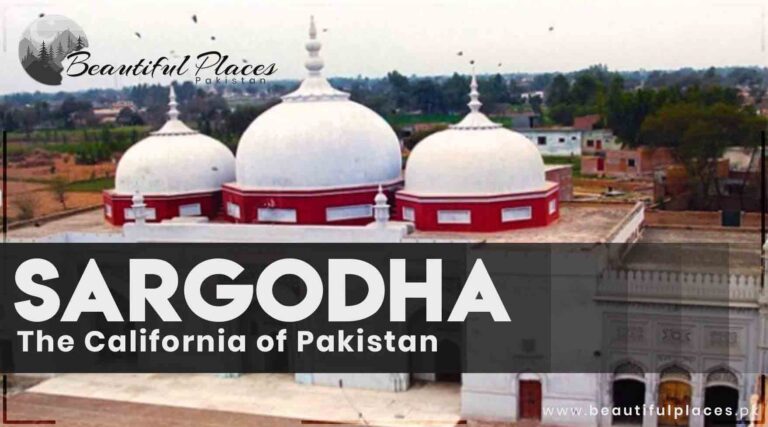
Furthermore, it is known as the California of Pakistan because of the production of Kinno Citrus.
It is 121 km from Jhang, 55 km from Lahore, and 185 km from Islamabad. It is equipped with the latest facilities and is one of the best Business Hubs.
Key information about Sargodha
Category
Information
Location
Sargodha, Punjab, Pakistan
Population
Approximately 660,000
Area
5,854 square kilometers (2,259 sq mi)
Coordinates
32.0836° N latitude, 72.6711° E longitude
District
Sargodha District
Language
Punjabi, Urdu, and English
Economy
Agriculture, trade, and commerce
Major Crops
Citrus fruits, wheat, sugarcane, and cotton
Transportation
Well-connected by road and rail to surrounding cities
Education
Home to several schools, colleges, and the University of Sargodha
Healthcare
Hospitals and medical facilities
Notable Places
Sargodha Fort, Jinnah Hall, and Kirana Hills
Culture
Rich cultural heritage with traditional music, dance, and local cuisine
Administration
Sargodha is divided into several Union Councils for local governance
Climate
Hot and arid, experiencing extreme temperatures in summer
Major Highways
M-2 Motorway, Lahore-Sargodha Road, and others
Airport
Sargodha has a domestic airport for regional flights
Honors of Sargodha
In the war of 1965, the fighter jet of the Pakistan Airforce took off from Sargodha to destroy the airbase of the enemy. Our brave soldiers fought against the enemy with great courage and defeated them. Iqbal wrote for them
پلٹنا جھپٹنا، جھپٹ کر پھر پلٹنا
لہو گرم رکھنے کا ہے اک بہانہ
The hawks (armed forces) of this city aimed at the enemy’s military bases and this city become a strong wall against the enemy. Due to this bravery, this city is also called “a city of Eagles”. In addition to this, it is also awarded “Hilal-e-Istaqlal”.
If you fix the Sargodha city as a center and move the compass at a distance of about 35 km to 40 km in the circle, this whole area produces the world’s best quality Kinnow or Kinno and orange.
The first-ever asexual reproduction of orange by grafting method was done in Tehsil Bhalwal of Sargodha. Fish of Alam Deen and beans of Jhal Chakiyan are famous dishes.
The largest tree in Pakistan
The largest tree in Pakistan is 40 km away from Sargodha city on Madh Ranjha road. Its branches are spreading over 3 acres. According to locals, this city is 400 years old.
Famous Places of Sargodha
Bhera
In ancient times, it was famous as Jobnath at the name of Raja Jobnath. It settled and deserted many times in history. Alexander also this area when he came to Punjab.
Ameer Taimoor became its chief. Sher Shah Suri looted this city. His looted Bhera is still existing on the other bank of river Jhelum. The present city is located at the boundary of Punjab.
The Kohistan Namak range starts from its ends. The old Bhera city is built inside the walls of eight doors just like Lahore and Peshawar.
The three-dome mosque in this city is built on the Delhi Mosque, Agra, and Shahi Mosque Lahore architecture style. A 200 years old library is located adjacent to the mosque.
Sher Shah Suri Mosque, Bhera
Pheniyan
(layered vermicelli), Pateesa (a confectionary item), Mehandi / Henna, and Vadiyan (made of green mong beans) are delicious dishes of Bhera.
There is a signboard for a mosque on the Bhera motorway interchange. Also, visit this place if you have spare time.
Sillanwali
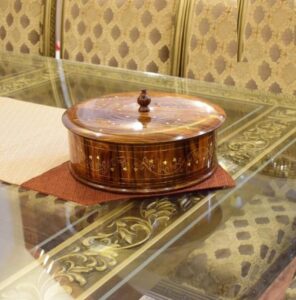
This Tehsil of Sargodha is well-known for its fine-quality woodwork. It is a center of a wide variety of wood engraving, mosaic, doors, windows, furniture, wall-clock, and handicrafts.
A wooden Handicraft by the artisans of Sillanwali
About 10,000 to 11,000 thousand people’s employment is related to this 150-year-old industry. Sheesham (Indian Rosewood) wood is used in most cases.
About 70% of demand for it is fulfilled from Sillanwali. Mostly, handicrafts are exported. They include a Table lamp, Jewelry box, trolley, table set, and models of animals and famous buildings.
Mona Depot
This depot was established in 1903. It is located 50 km away from Sargodha and near Kot Momin Interchange. It is famous for the best breeding of horses.
Mona depot, a place for the world’s best horses
Stretching an area of more than 11000 acres, this farm produces and prepared world-class horses. There is a Bird watching site and a riding training school for the Pak army training.
Historical Places in Sargodha
Jinnah Hall
Jinnah Hall, named after the founder of Pakistan, Muhammad Ali Jinnah, is a historical landmark in Sargodha. It stands as a testament to the city’s cultural and architectural heritage and is often used for public events and gatherings.
Sargodha Fort (Shergarh Fort)
Shergarh Fort, also known as Sargodha Fort, is a historical fort that dates back to the 19th century. Its strategic location and imposing structure make it a key historical site in the region.
Company Bagh (Company Gardens)
The Company Bagh is a well-maintained garden with historical significance. It was established during the British colonial period and has been a recreational and cultural space for the residents of Sargodha.
The Clock Tower
The Clock Tower is a prominent structure in the heart of Sargodha, symbolizing the city’s historical and architectural character. It has been a central point for locals and visitors alike.
Rabwah Monument
Although technically located in Chiniot, not far from Sargodha, the Rabwah Monument is an important historical site. It commemorates the establishment of Rabwah, which was once the headquarters of the Ahmadiyya Muslim community.
Shahpur Dam
While more known for its scenic beauty, Shahpur Dam also holds historical importance as it was constructed during the British era to provide water for irrigation in the region.
Famous Schools
Sargodha Grammar School
Beaconhouse School System, Sargodha Campus
Divisional Public School, Sargodha
Prominent Colleges
Sargodha Medical College
University College of Agriculture, Sargodha
Government College Sargodha
Notable Hospitals
DHQ Teaching Hospital Sargodha
Combined Military Hospital (CMH) Sargodha
Fatima Jinnah Women University Hospital
Well-Known Restaurants
Salt Bae Grill
Zaytoon Grill
Saima Food Point
Frequently Asked Questions (FAQs)
What is the historical significance of Jinnah Hall in Sargodha?
Jinnah Hall is a historical landmark named after Muhammad Ali Jinnah, the founder of Pakistan. It holds cultural and architectural importance and is often used for public events.
Tell me about the historical background of Sargodha Fort (Shergarh Fort).
Sargodha Fort, also known as Shergarh Fort, dates back to the 19th century. Its strategic location and imposing structure make it a key historical site in the region, reflecting the city’s historical roots.
What is the Company Bagh, and why is it historically significant?
The Company Bagh is a well-maintained garden established during the British colonial period. It has historical significance as a recreational and cultural space that has been enjoyed by the residents of Sargodha for many years.
Why is the Clock Tower in Sargodha considered a notable structure?
The Clock Tower is a prominent structure in Sargodha, symbolizing the city’s historical and architectural character. It has served as a central point for both locals and visitors.
What is the significance of the Rabwah Monument near Sargodha?
Although technically located in Chiniot, the Rabwah Monument is relevant to Sargodha’s history. It commemorates the establishment of Rabwah, which was once the headquarters of the Ahmadiyya Muslim community.
Why is Shahpur Dam considered historically important?
Shahpur Dam, known for its scenic beauty, was constructed during the British era to provide water for irrigation in the region. Its historical importance lies in its role in supporting agricultural activities.
Last Thoughts on Sargodha
This city is a place of honors. It is famous for the production of wheat, rice, and sugarcane. Thus playing a major role in the economy of Pakistan. It is the district headquarter of Sargodha and one of the fastest-growing cities in Pakistan.
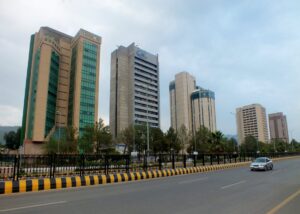
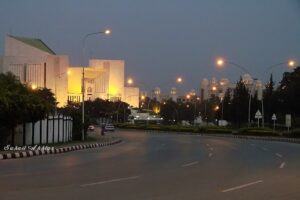
Islamabad is a beautiful modern city of Pakistan and a masterpiece of architecture. It is divided into different zones and areas. It is one of the modern capitals in the world.
It attained the rank of Gamma world city. According to an international survey report, it is included in the five world’s most beautiful capitals.
A large number of beautiful green belts, fountains, gardens, parks, avenues, and shopping centers on its road’s edges have made this unique from the others.
An alluring sight of Islamabad
Islamabad which is 1663 feet high from sea level and the ancient city of Ghagras are located side by side. Therefore, they are called twin cities. Situated at the foot of river Kurang, Rawal dam, Margalah hills, and Rawalpindi, this city stretches about 906 square kilometers.
Queen of mountains and famous picnic point Muree is settled on one side and Taxila – the city that witnessed thousands of years old history is located on the other side.
Being the capital of Pakistan, it is the head office of all the government agencies and departments. The embassy of many countries in the world is established in Islamabad to represent their country.
Islamabad is the center of all government activities while Rawalpindi is the pivot point of industrial, trade, and military activities. Its weather is quite pleasant because of the three artificial dams named Rawal, samli, and Khanpur.
The internationally recognized institutes such as Allama Iqbal open university, Quid-e-Azam University, International Islamic University, and national university of science and technology (NUST) have increased their dignity.
Establishment of Islamabad
Former President of Pakistan Field Marshal Muhammad Ayub Ahmad Khan devised a plan to settle a new city Islamabad (this name was suggested by Qazi Abdul Rehman of Sahiwal) in the north of Rawalpindi on the bank of Potohar Plateau, in between the Margala hills and in the plains of Syed Pur and Noor Pur.
It is now the Capital of Pakistan. Maulana Ismail Zabih has written in his book that Quid-e-Azam selected Pind Malkan village in the suburbs of Islamabad to establish the Capital.
It is also the homeland of Lance Naik Muhammad Mehfooz Nishan-e-Haider.
In 1947, Karachi was selected as the Capital of Pakistan. But there was a chance of attack since it is on the edge of the Arabian sea. So, a site was designated that is accessible to all Pakistani and has a strong defense.
The Federal Capital Commission took a geological survey of different areas’ locations, weather, weather changing patterns, logistics, and geological structure. They choose this place and gave a master plan near zero point in Shakarparain hills.
A detail is written on a podium in Shakarparian as a memorial that is still present there.
The memorial of Islamabad Master Plan in Shakarparain
In October 1961, all the stages from the beginning to the end of the project are present in the form of pictures in the temple hall of Syedpur village.
The capital was not shifted from Karachi to Islamabad directly. Rather, it was shifted to Rawalpindi temporarily. After the completion of Islamabad, the capital was formally transferred to Islamabad.
Famous Places of Islamabad
1- Faisal Mosque
Faisal Mosque, is the identity of Islamabad, the largest mosque in Pakistan and in South Asia, and the sixth-largest mosque in the World.
From 1986 to 1993, it was the largest mosque in the world. But, the Hassan-II in Casablanca took the honor of the world’s largest mosque after its completion.
The construction of this mosque is a gift from late Saudi monarch Prince Shah Faisal for Pakistanis. This mosque is named after him. (The Lyallpur is also named Faisalabad after his name). Completed with a huge cost of 50 million American dollars, it is declared the national mosque of Pakistan.
Pleasant View of Shah Faisal Mosque, Islamabad.
17 expert architects of the world gave 43 maps and designs for this mosque. After the observation and conversations for 4 days, the design from Turk Architect Vedat Dalokay was selected.
Its construction was started in 1975 and completed in 1986. There is a space for more than 3 lac worshippers. It is the third mosque after Masjid Haram and Masjid Nabi that has the largest capacity for worshippers.
This mosque has four minarets each with a height of 260 feet. And these minarets have the record of highest minarets in South Asia. The Chandelier of the central hall weighs 6.5 tons. This chandelier has 1000 bulbs.
An Islamic research center, a library, press center, lecture hall, museum, cafeteria, and the Sharia law department are located below the courtyard of the mosque on two floors.
2- Saidpur Village
This village is 400 to 500 years old. It is at foot of the lush green Margala hills range and enrich with many historical tales and traditions.
Hindus narrated that Ram Chand jee stayed in Syedpur. It is named after the name of Ghaghar chief Syed Khan who was the son of Sultan Sarang Khan. Mughal commander Raja Man Singh transformed it into a Hindu worship place.
CDA started a project with an initial investment of 400 million rupees and changed all the mosques, temples, and Gurdwaras into the old state. The streets, houses, and environment depict the lifestyle of the rural area.
Saidpur Village: A Visit to the History
Modern restaurants have been set up in old-style houses. They are the source of attraction for visitors.
The incidents during the construction and renovation of Islamabad and Saidpur are exhibited in a hall to enhance the information of tourists.
Please visit the skilled pottery makers Rahim Dad Khan and Niaz Muhammad whenever you go to Saidpur. You will be surprised to see the train made of mud and other stuff.
On the zoo road, you will see the Saidpur village from a distance where a gate made of mud bricks will welcome you.
3- Daman-e-Koh
It is an enthralling place located in the north Margala mountain range. A spacious road will take you to the height of 7th Avenue.
You will reach Daman-e-Koh at a distance of 3 km from the zigzag road between the thick green trees. You will see monkeys dancing on your way to this place. Don’t try to disturb them. You can reach the lobby via a small golf course car from the parking.
Daman-e-Koh; A worth watching place in Islamabad
There are corridors in between the green lawns where you will see peacocks and other animals.
You can enjoy an aerial view of Islamabad from the terrace of the lobby and gallery.
British princess Lady Diana said on her visit to this place that it is one of the most fascinating sceneries she had ever seen in her life. There is a map of Islamabad on the other side of the terrace.
People can see the Rawal lake and Islamic university on the left side of the terrace. The scenery becomes more beautiful in the floods of lights at night.
There is a track for the adventurers. A pathway goes from the zoo to Daman-e-Koh at a height. Different shops and restaurants are there for refreshment. A PTDC restaurant staff is there for welcoming tourists.
4- Peer Sohawa
At a height of 5500 feet, it is the highest point in Islamabad. It is a part of district Haripur. But it looks like a part of Islamabad since it is close to Islamabad.
Before the establishment of the city, Peer Sohwa was the way to reach Haripur. The temperature here is even less than in Islamabad. Therefore, the holidaymakers come here for a picnic.
The splendid sight of the highest point in Islamabad , Pir Sohawa
Since it is located at a height, it is sometimes surrounded by clouds. There is a restaurant named Monall completed in 2006. It compelled both national and international tourists for its charming views.
Peer Sohawa gives a clearer scenery of Islamabad than Shakar Parian and Daman Koh.
It will be a nice idea to stay here from evening till night.
5- Marghzar zoo
It is located at the foothills of Margala. Cheetah, deer, bear, peacocks, and many others are kept there. It is not too big but best for animal care and the environment.
Daman Koh and Peer Sohwa’s ways start here. There is a Japanese-style park and playland adjacent to it. It is a gift from Japanese children to Pakistani children.
A display center of the Pakistan national museum of natural history is also there.
6- Blue Area
It is the center of trade, and shopping in Islamabad and is linked to the road going to important government departments.
A glimpse of the Skyscrapers of the modern city, Blue Area Islamabad
This area is represented with blue color on the map of Islamabad. That’s why it is called Blue Area.
A complex is under construction named The Centaurus with international investment. It is a hub of trade and will boost the economy.
7- Constitution Avenue
You can watch the beautiful buildings of Parliament house, president house, Supreme court of Pakistan, Pakistan broadcasting House, National Library of Pakistan, Foreign office, Auditor General of Pakistan, and Grand Hayat Islamabad via traveling this avenue.
The glorious building of the Supreme Court of Pakistan, Constitution Avenue Islamabad
8- Super Market and Jinnah Super Market
It is an expensive city as compared to the other cities in Pakistan. These two markets have branded shops where you can buy high-quality products, garments, jewelry, handicrafts, and rugs.
Besides, there are restaurants and food streets for refreshment.
9- Fatima Jinnah Park
It is also called F-9 park. It is named after the sister of Quid-e-Azam Mohtarma Fatima Jinnah in the acknowledgment of his services.
A memorial to Mohtarma Fatima Jinnah
It is one of the largest parks in South Asia. Lakes, rock gardens, monuments, fountains, and aquariums are the source of its charms.
It was designed by Michael Jasper.
10- Sports complex and Aabpara Market
It is one of the oldest markets in Islamabad located near the Lal Mosque on Khayaban Soharwardi. It is dedicated to “Aab Para” who has the honor of being the firstborn in Islamabad.
The prices are a little bit low here. You will find everything for daily use there. The splendid building of Islamabad Sports Complex is on the other side of the Kashmir Highway. There is a Liaqat Gymnasium for indoors and a Jinnah Stadium for outdoor games.
11- Shakar Parian
It is located between Faizabad and zero point at a height of 1998 feet. The scenery of Islamabad and Rawalpindi is clear from this small hill.
The fountains terrace and park situated in the East and North part of Shakar Parian enhance the beauty of this place. People can easily watch and enjoy the Jinnah sports complex, Rawal lake, Margala, and Muree hills.
An aerial view of Shakar Parain Islamabad
According to the tradition, the international ministers plant a sapling there that grows into a tree as a symbol of friendship. On 24th May, General Ayub Khan formally approved the master plan of Islamabad. A monument is also built there.
12- Lok Virsa /Folk heritage
It is one of the best cultural museums in Pakistan. It is also known as folk heritage. It is under the administration of the National Institute of Folk and Traditional Heritage.
Lok Virsa is the best source for becoming familiar with Pakistani foods, clothes, and lifestyles. The Lok Virsa fair is the largest cultural activity in Pakistan for the last 22 years.
Different actors, singers, and skilled craftsmen come here every year to show their talent. Furthermore, the different international delegation also participates in this fair. At this fair, the artists welcome guests by wearing their cultural dresses and signing their local music.
This fair portrays the lifestyle of all the provinces of Pakistan along with different zones. The celebrations continued for 10 days.
Lok Virsa Museum, A gate to Pakistani culture, traditions, norms, and lifestyle
However, the museum remained open the whole year.
Its building has a display center related to embroidery, clothes, dresses, shawls, jewelry, wood, metalwork, block-printing, and ivory. Traditional architecture, marble, fresco, glasswork, and other models are displayed.
There is a library adjacent to Lok Virsa Museum. Different kinds of things are sold in souvenir shops. Moreover, these products are available in the Lok Virsa shop in Super Market.
13- Nargis Jheel (Lotus Lake)
A road on the right side near Lok Virsa goes to Lotus Lake. This small lake is crowded with flowers.
There are balconies for walking. You can enjoy the charming flowers with pleasant by walking in these galleries.
A charming view of flowers in the lotus lake, Islamabad
14- Rose and Jasmine Garden
Situated on Shakar Parain hills, it surrounds an area of 150 acres. About 250 kinds of roses and dozens of jasmine flowers are enhancing the beauty of this garden.
Many Flower Exhibitions are held by Government. You can enjoy a picnic at a nearby camping site. The weather is quite pleasant at the start of the summer and winter seasons. It is an adventure to travel to this garden in these times.
15- Pakistan’s Monument
This project costs more than 850 million and started on 25th May 2004. It was opened to the Public after its completion on 23rd March 2007.
Pakistani Culture has been portrayed in this monument. Situated in the west of Shakar Parain, the design by Arif Masood was approved for this monument. Its map is like a blooming flower.
The large four petals represent four provinces and three small petals Fata, Gilgit Baltistan, and Azad Kashmir. The artists have worked 111,900 hours on these petals.
A captivating sight of the Pakistan Monument
These petals have pictures of Badshahi mosque Lahore, Rohtas fort, Gwadar, Faisal Mosque, Quid-e-Azam, Fatima Jinnah, Minar-e-Pakistan, Shah Jahan Mosque, Karakorum highway, the shrine of Shah Rukh-ne-Alam, Shahi fort Lahore, Delta River Indus, Shalamar Gardens, the tomb of Uch Sharif, Islamia College Peshawar, Ziarat residency, Khyber Pass, and Polo match pictures.
It looks like the moon and star of the Pakistani flag from the top. The scenery of Rawalpindi and Islamabad looks beautiful since it is located at a height. The beauty of these twin cities is intensified by the floods of light at night.
16- Monument Museum
It is located inside the Pakistan Monument. It was inaugurated in September 2010. This museum contains deep information about Islamic History and the struggle of Muslims of the Subcontinent for a separate state.
17- Museum of Natural History
It is located on Garden Avenue. Different things related to human history, geology, and Pakistan’s wildlife are places there. They are a source of attraction for children.
18- National Art Gallery
It is located on a small hill in front of the president’s house and Parliament. It was opened to the public on 26th August 2007. A contest was organized in the country for the selection of its design.
The designs by Naeem Pasha and Sohail Abbasi got selected. Surrounded by an area of 1800 square feet, this gallery has four floors. These four floors have 14 galleries, a lecture hall, a theatre, and an auditorium with a capacity of 400 people.
19- Shrine of Imam Bari
The real name of the famous pious Sufi saint Hazrat Imam Bari was Shah Abdul Latif Kazmi. He is also called Imam-ul-Faqr. He was born to Syed Mehmood Shah in 1617 in Chakwal. His father shifted to Bagan (Aab para, Islamabad).
Hazrat Imam Bari traveled to Gor Ghasti (Attock) for gaining knowledge. He learned about Hadith, mathematics, medicine, and other subjects.
The tomb of Hazrat Imam Bari
When he returned to Aab Para, this area was under the dacoits. This area was called Chor Pur. Those dacoits were impressed by his teaching and left robbery. The name of this area was changed to Noor Pur.
Mughal monarch Aurangzeb renovated his tomb. A wagon goes to his shrine from Aab Para.
20- Karwan Park
This small park is a short distance from Shakar Parian. It is for foreigners only. Its purpose is to protect them and give them special care. This park provides foreigners with great facilities so they do not feel homesick.
21- Rawal Lake
This lake is the aged fellow of Islamabad. It is built on a large barrage for providing water facilities to the twin cities. The water from the river Korang and small streams of Margala hills mix into this lake.
It stretches at an area of 8.8 square kilometers and is located within the boundary of Margala Hills National Park. The surrounding of this lake is beautified with fruit trees and orchards.
Rawal Dam and Rawal lake view
It is transformed into the best picnic spot through the facilities of fishery and sailing. There is an Islamabad club on the west of this lake. They provide services for different sports.
A PTDC Jaltrang restaurant is there for tourists. Rawal Dam is located on the right side of Rawal chowk.
22- Lake View Park
This worth watching park of splendid landscapes, gardens, picnic spots, and galleries is constructed by CDA. This amusement park has a motorbike safari, roller coaster, and many other thrilling games for people of every age.
Staircase garden, sailing, and fishery facilities have made this park a crowded park. Different water sports contests are organized in the lake of the park.
Lake view Park Islamabad
Islamabad Sports club also provides opportunities for different sports. The motion ride set up in this park is the largest motion ride in Pakistan.
This park is on Murree Road about three kilometers away from the Convention center.
23- Shahdara
This splendid and captivating spot is a favorite place for locals and foreigners. It has not been given special attention at the government level but it is the best picnic site for tourists.
Very few locals know about this place. It is located 8km away from Quid-e-Azam University. A way goes to Shahdara on the road directed to Muree near Bhara Kau.
24- Simly Dam
This lake and dam are located 30 km away from Islamabad. The water comes from the springs in the mountains of Murree. This water is used by the citizens of Islamabad.
There is a facility for sailing and fishery in the lake. There is a rest house of CDA. There are two ways to reach this Dam. One from the Lehtrar road and the other from Bhara Kau.
25- Railway Museum
This unique museum is in the southeast of Margala Hills in the E-11 sector of Islamabad and in the east of Taxila. It is 1994 feet high from sea level and located on the platform of Golra Sharif Railway station near the railway line going from Rawalpindi to Peshawar.
Constructed with small stones, it is built in Victorian architecture style. It is useful as a junction. The train going to Karachi, Peshawar, Rawalpindi to Multan through bisal, Jhung, Mianwali, Kundiya, and Layyah turn from this railway station.
This railway station was established in 1862, it is the only museum in the world that is located on the platform of a railway station.
Surrounded by thick green 130 years old banyan trees it is built to create awareness among the youth about the history and culture of railways.
The museum was established in 2001 by converting an inn into a museum. This railway station was built for the pilgrims who used to come to the shrine of Pir Mehar Ali Shah Golarvi.
There is a 115-year-old steam engine on the Nero gauge railway line. An old handling crane is also there. this 115-years-old engine was operational till 1990. It is still functional. A hand pump of 1901 is positioned here.
Golra Sharif Railway Museum
A 7MM gun used by a safety guard, kerosene oil lamps of different sizes, Ampere meters, pendulums, watches, gate signals, navigation stuff, crockery of railways offices, fans, weapons, railway emergency bogies, surgical instruments, historical pictures, piano and a time table of 1943 are exhibited in the museum.
At the time of separation, a train came from India with 500 passengers. The bogies of the train were locked from inside to keep the passengers safe within the boundary of India. Those historical keys of bogies are displayed in the museum.
An interesting fact is that there is a signboard of tea in five different languages. These languages are Urdu, English, Bengali, Devanagari, and Gurmukhi languages.
A local Suzuki van from Raja Bazaar Chowk Fowara to Goltra Sharif.
Schools:
Beaconhouse School System: A well-known private school with several branches in Islamabad, offering quality education from pre-school to higher grades.
Roots Millennium School: An international school with a strong academic curriculum and a focus on extracurricular activities.
Islamabad Model College for Boys/Girls: A government institution providing education from the intermediate level to higher education.
Westminster School and College: A prestigious institution offering both Cambridge and local educational systems.
Froebel’s International School: A respected school following a progressive educational approach.
Colleges:
Quaid-e-Azam Postgraduate College: Offers a wide range of undergraduate and postgraduate programs in various disciplines.
Federal Government College: A government college with a strong academic reputation.
Preston University Islamabad: A well-established private university offering undergraduate and graduate programs.
Universities:
Quaid-i-Azam University: One of the top universities in Pakistan, known for its strong academic programs.
National University of Sciences and Technology (NUST): A leading technical university offering a wide range of undergraduate and postgraduate degrees.
International Islamic University Islamabad (IIUI): Focused on Islamic studies and offering a diverse range of programs.
COMSATS Institute of Information Technology: Known for its IT and engineering programs.
Hospitals:
Pakistan Institute of Medical Sciences (PIMS): A major public-sector hospital providing a wide range of medical services.
Shifa International Hospital: A private hospital known for its high-quality healthcare services.
Aga Khan University Hospital: Part of a prestigious medical institution, offering world-class healthcare in Islamabad.
Restaurants:
Monal Restaurant: Located at Daman-e-Koh, it offers spectacular views of Islamabad along with a variety of Pakistani and international cuisines.
Savour Foods: A popular spot for traditional Pakistani dishes, especially their delicious biryani.
Street 1 Café: A trendy café in F-6 sector known for its great coffee and continental menu.
Tuscany Courtyard: A fine-dining Italian restaurant serving authentic Italian dishes.
Khyber Dodai: A restaurant offering traditional Pakistani and Afghan cuisine in a cultural setting.
FAQs
What is Islamabad known for?
Islamabad is known for its modernity, beautiful architecture, and being the capital city of Pakistan. It is often praised for its lush greenery, parks, and pleasant weather.
Why was Islamabad chosen as the capital of Pakistan?
Islamabad was chosen as the capital due to its central location, accessibility, and strategic defense advantages compared to the initial capital, Karachi. It was carefully selected by the Federal Capital Commission.
Tell me about the Faisal Mosque in Islamabad.
The Faisal Mosque is the largest mosque in Pakistan and one of the world’s largest. It was a gift from Saudi Arabia, named after King Faisal. The mosque’s construction was a collaborative effort of international architects and took place from 1975 to 1986.
What are the top tourist attractions in Islamabad?
Some popular attractions include Faisal Mosque, Saidpur Village, Daman-e-Koh, Peer Sohawa, Rawal Lake, Pakistan Monument, and Lok Virsa Museum, to name a few.
What is unique about Saidpur Village in Islamabad?
Saidpur Village, located at the foot of Margala Hills, boasts a rich history and features old-style houses turned into modern restaurants. It offers a glimpse into the traditional rural lifestyle.
What can visitors expect at Daman-e-Koh in Islamabad?
Daman-e-Koh offers a breathtaking view of Islamabad, with peacocks and green lawns. British Princess Lady Diana once described it as one of the most fascinating sceneries she had ever seen.
What is the significance of Peer Sohawa in Islamabad?
Peer Sohawa is the highest point in Islamabad, known for its cool climate and picnic spots. The area is often surrounded by clouds and offers stunning panoramic views of the city.
What is unique about the Golra Sharif Railway Museum?
The Golra Sharif Railway Museum is the only museum in the world located on a railway station platform. It showcases historical artifacts, railway memorabilia, and the history of Pakistan’s railway system.
Are there any shopping areas in Islamabad?
Yes, Islamabad has shopping areas like Blue Area and Super Market, known for branded shops and high-quality products. Visitors can find garments, jewelry, handicrafts, and more.
What natural attractions can be found in Islamabad?
Islamabad offers natural attractions like Rawal Lake, Lake View Park, Rose and Jasmine Garden, and Simly Dam, which are perfect for picnics and outdoor activities.
Last Thoughts on Islamabad
Islamabad is one of the most beautiful cities in the South Asia region and the second most beautiful capital in the World. It is progressing city in terms of economy, tourism, technology, population, and urban development.
It is under the administration of the Pakistan Federal Government. Besides this, its rich green areas and historical places make it a favorite place for holidaymakers.
It is commonly known as Pindi and is the fourth largest city in Pakistan.
It is the most important City on the Pothohar plateau and the twin city of the Federal Capital Islamabad. The Pakistan Army Headquater is also located here.
The original city of Rawalpindi is the old fort in the middle of the contemporary city. This fort is a splendid masterpiece of ancient architecture style.
It is of great importance as it is the central connecting location of Azad Kashmir, Khyber K.P.K, and Gilgit Baltistan.
Almost all the areas of Azad Kashmir, Murree, Galiyat, and Gilgit Baltistan are connected to Rawalpindi for trade.
It is the first station for tourists coming from all across Pakistan. It is connected to all areas of Pakistan through highways, railways, and airports. Therefore, there are transport and hotels for almost every class.
Foreign tourists on their arrival in Pakistan booked transport from Rawalpindi for the trip to northern areas according to their tour plan. The weather is pleasant here as it is close to Murree.
Key information about Rawalpindi PK
Attribute
Rawalpindi
Location
Punjab Province, Pakistan
Population
Approximately 2.1 million (as of 2021)
Coordinates
33.6007° N latitude, 73.0679° E longitude
Founded
1493 (historical origin)
Climate
Hot and dry in summers, cold in winters
Major Language
Punjabi and Urdu
Economy
Commercial and industrial hub, with a focus on trade, manufacturing, and services
Landmarks
Rawalpindi Cricket Stadium, Jinnah Park, Raja Bazaar, and Pakistan Army Museum
Transportation
Well-connected by road and rail, Benazir Bhutto International Airport
Educational Institutions
Home to several universities and colleges
Military Presence
Headquarters of the Pakistan Army
Tourism
Proximity to Islamabad, the capital of Pakistan, and various historic sites
Notable Fact
Known for its vibrant bazaars and the Pindi Food Street offering diverse cuisine
A brief history of Rawalpindi
A beautiful aerial view of Rawalpindi Metro Station
River soan is the oldest river there. Its caves have the signs of the age of stones. These millions of years old archaeological signs have proved Punjab to be the first birthplace of humans in the world.
At the time of the attack of Alexander the Great, it was called Amanda. According to the Guinness Book of World Records, Rawalpindi, located near one of the oldest universities in the World Takshashila was settled in 1000 B.C. The Mughal regime called it “Sindh Sagar”.
During the invasion of the Mughals, it was destroyed completely and deserted for a long time. At last, a chief Jhunday Khan Rawal of the Ghakhar tribe settled this city and named it “Rawalpindi”.
In 1765, Sikhs seized this city. in 1849, the Britishers defeated them and included them in their government. In 1851, it was transformed into army Head Quarters.
In 1960, it become a temporary capital of Pakistan when Islamabad was under construction.
In the Suburbs of Rawalpindi
Stupa
Stupas are those tombs in which the remains of the follower of the Mahatma Buddha were buried. After the death of Mahatma Buddha, his remains were divided into 8 parts and buried in different places.
Maharaja Ashok dismantled all the burials and took off all the remains. He spread these remains in every corner of his empire and built a stupa at every remain.
Mankiala Stupa
It is narrated that this stupa belonged to 128-151 B.C. this stupa was established in the Kanishka era. It is said that the Mahatma Buddha sacrificed his body parts to fulfill the hunger of seven cubs.
Mankiala Stupa, A place of Buddhas
In 1930 excavations, gold, copper, silver coins, and bronze boxes have been discovered. They are engraved in the Kharosthi language.
The largest stupa in this area is 32 km before Rawalpindi on the right side of Makayla village. Makayla village is 2km from G.T road. Stupa can be seen from G.T Road.
Rawat Fort
Rawat has a meaning of Inn. It was built by the brave Ghaghar chiefs of the Potohar plateau at the beginning of the 16th century.
It is located 8km away from Makayla on the G.T road. It was an Inn, built at the beginning of the 15th century for tourists, and government officials.
Rawat Fort Rawalpindi, is a majestic fort with a deep history
It is also dedicated to Masood the son of Mehmood Ghaznavid. The rebellious soldiers of his Army arrested him in this fort. And they killed him in the Giri fort near Taxila.
There are rooms and large doors in the east and north around the wall. There is a tomb, a mosque, and some graves surrounding the fort. This fort is located alongside the street of Rawat Bazaar.
Sawar Muhammad Hussain Shaheed (Nishan-e-Haider)
Muhammad Hussain Dhodak Peer Baksh (Gojar Khan) was born on 18th June 1948. Before his matriculation, he joined the army as a driver in an Armored core.
During the Indo-Pak war of 1971, his regiment was posted in Shaker Garh. He went into the enemy’s battlefield with only one stun gun. He analyzed the enemy’s checkpoint and told his colleagues.
Sawar Hussain destroyed 16 tanks alone. He created a disturbance on the frontline of the foe. He ran and pointed his comrades at the enemy’s tanks and troops.
The grave of Sawar Muhammad Hussain Shaheed, the recipient of Nishan-e-Haider
He was assisting one of his comrades when a bullet pierced his chest. In this way, he martyred while supporting his companions and safeguarding his country.
He was bestowed “Nishan-e-Haider”, the highest military award. He was the first soldier recipient of this honorable reward.
Before this, it was given to officers only. His tomb is located in Dhodak Muhammad Hussain Janjoa which is 6km on the right side from Jatli and 23 km away from Chakwal Road.
Captain Muhammad Sarwar Shaheed (Nishan-e-Haider)
A memorial to the brave captain of Pakistan Muhammad Sarwar Shaheed
He was born to constable Raja Muhammad Hayat on 10th November 1910. He did his matriculation from Layal Pur Faisalabad. In 1929, he joined the army as a soldier and got a commission in 1942.
He was promoted to captain rank at the time of the creation of Pakistan. In 1948, the foe captured a sensitive area of Kashmir and established a frontline there. The enemy wanted to move forward.
Captain Muhammad Sarwar’s regiment was ordered to stop the enemy. When he reached the mountain top with his battalion, the enemy’s troops bombarded his battalion with cannons and machine guns.
Muhammad Sarwar strongly defended his country and moved forward. He faced hurdles due to iron wires around the enemy’s frontline.
During this, a bullet hit him and he couldn’t survive. His comrades attacked the enemy and took revenge for their caption.
He was awarded Nishan-e-Haider in acknowledgment of his unparalleled services. He is the first caption to receive this honor.
He was buried inTilpatra. In 1971, the Tilpatra was in Pakistan’s land. In the Indo-Pak war, India captured this area. Singhroi Sarwar Shaheed village is beyond mandra and Gojar Khan.
The memorial to this Shaheed is 2km from this village.
Famous Places in Rawalpindi City
Ayub National Park
Stretching an area of 2,300 acres it is one of the unique parks of its kind. As you enter the park, you will find carts, camels, and horse riders looking for you. They will travel you to the whole park.
There is a Jungle World amidst swathes of thick green meadows. It has a zoo, playland, snake house, and a reptile world.
A heritage house is established there focusing on the Muslim and Pakistani military history. Different sculptures, maps, pictures, and models in the museum reflect the golden and brilliant history of military achievements.
An eye-catching pleasant sight of Ayub National Park
A Garden café, an open-air theatre, an aquarium, and a Japanese Garden hold glory. There is a lake with sailing facilities.
The pictures of the recipients of the Nishan-e-Haider are engraved on the rocks in front of the lake which is called ideal rock.
A jogging track and a Bara Darri are there for the people fond of walking.
A food street with a variety of continental foods, Jungle Barracks rest house, and Topirakh auditorium make it a worth-watching site.
Army Museum
It was established on 24th April 1962 and shifted to the present building in 1993. There is a sculpture of constable Khuda Dad Khan in uniform (the person who received the first-ever Victoria Cross in World War-I).
Tanks, cannons, helicopters, and cars used in different wars are exhibited in the courtyard of the museum. A centurion and Sherman tank of the enemies is also displayed.
There are two Cadillac cars, weapons, pictures, uniforms, and other rare pieces placed near the reception camp.
The artifacts are beautifully decorated in the Infantry Gallery, Nishan-e-Haider gallery, uniform gallery, general gallery, and armed and services gallery.
Army Museum, an airplane in the courtyard
The sword of king Jahangir, a battle-ax of Ameer Khan, and the arrow and bow of Sultan Tipu Shaheed are worth notable artifacts.
You can also see the pictures of martyrs, uniforms, personal use things, letters, clothes, tributes, and rewards. There are also embossed pigeons and red flags presented by China on the inauguration of Resham Highway.
It is located on the highway going to Rawalpindi GHQ adjacent to the army central library.
Jinnah Park
Fascinating fountains in Jinnah Park
It is a well-known park in Rawalpindi. It is close to jail road and MacDonalds and has a playground, fountains, green lawns, playlands, and a jogging track.
Besides this, DHA jungle park, Rumi Park, Shah Baloot Park, Racecourse, Nawaz sharif Park, Children Park, and Liaqat National Bhag are the beauty of Rawalpindi.
Pharwala Fort
Gate of Pharwala fort Rawalpindi
It is located on Kahuta road, 40 km from Pindi in a semi-mountain range. It is surrounded by a small Himalaya range on one side and river Soan on the other side. So, it is naturally defended.
In 1002 A.D, its construction was started by Chief Ghaghar Shah and it was the first Islamic fort.
In 1012, Data Ali Hijvari R.A stayed here. In 1519, Mughal king Babur conquered this fort. After some time, he gave it back to Ghaghar. After that, Sikhs defeated them and captured the fort.
Tanaza Dam
It is located on Diamial road about 35km away in the southwest of Rawalpindi. It is a good place for a family trip.
The fact that Tanaza Dam is nestled in the southwest of Rawalpindi suggests that it offers a picturesque and natural setting. The surrounding landscapes likely include hills, greenery, and potentially a water reservoir, making it an attractive spot for nature enthusiasts and families seeking a peaceful escape from urban life.
Dams often provide opportunities for recreational activities such as picnicking, hiking, and boating. Visitors can enjoy quality time with their families, indulge in outdoor activities, and appreciate the beauty of the surroundings.
Your mention of Tanaza Dam as a good place for a family trip implies that it’s a suitable destination for people of all ages. Family-friendly locations often have amenities like picnic areas, play areas for children, and facilities for making the visit enjoyable for everyone.
Being just 35 kilometers from Rawalpindi makes it a convenient destination for a day trip. Visitors can plan a visit without the need for an extended journey, making it accessible for families with young children or those looking for a quick getaway.
The captivating view of Tanaza dam Rawalpindi make it a perfect place for holidaymakers
Misriot Dam
It is also located in the southwest of Rawalpindi at a distance of 12 km. There is a facility for sailing and fishery in the lake. A permission letter is required from the guard. The charming view of the lake will capture your heart.
One of the notable attractions of Tanaza Dam is the provision for sailing and fishery in the lake. This means that visitors can not only enjoy the serene beauty of the lake but also actively engage in activities like sailing and fishing. These activities can add an element of adventure and recreation to your visit.
It’s important to note that, according to the information provided, visitors may require a permission letter from the guard to participate in activities at Tanaza Dam. This requirement is typical for many recreational areas to ensure the safety and management of the site. Be sure to inquire about the specific process and requirements for obtaining the permission letter.
The charming view of the lake, as you’ve described, captures the heart of visitors. The scenic beauty of the lake, combined with the surrounding landscapes, makes Tanaza Dam an attractive destination for those who appreciate the tranquility and natural beauty of such locations. It’s an ideal place for individuals and families seeking a break from the hustle and bustle of city life.
Tanaza Dam’s proximity to Rawalpindi, just 12 kilometers away, makes it a convenient and accessible local attraction. It’s an excellent option for a day trip, weekend excursion, or a brief escape to enjoy the natural surroundings, recreational activities, and the charm of the lake.
Shopping and Food Points
Raja Bazaar, Bara market, Sarafa Bazaar, Saddar Bazar, Mall Road Saddar, Muree Road, and Commercial market are big shopping sites.
You can buy the best hair oil from the shop of Hafiz Yaseen named Jamil perfume which was established in 1947 in Raja Bazaar.
Lasania Restaurant, Usmania Restaurant, Lavish restaurant, and Savor food are famous for their quality foods. Former Prime Minister of Pakistan Mian Muhammad Nawaz Sharif often visits Raja Bazar Dilbar Hotel.
You can also enjoy the taste of Haleem Ghar of Kohauti Bazar, Aziz Tikka from babu Bazar, and Bhabra’s Nihari.
A food street is also established near the cricket stadium and Nawaz Sharif Park on Muree Road.
The branches of all good restaurants are there. It is the best place to enjoy food of different kinds.
Schools
Army Public School and College
Beaconhouse School System
Sadeeqa’s Learning System (SLS)
Roots Millennium Schools
Froebel’s International School
Colleges
Gordon College Rawalpindi
Punjab College Rawalpindi
FG Postgraduate College
Fazaia Inter College Rawalpindi
Rawalpindi Medical University
Restaurants
Monal Restaurant Rawalpindi
Savour Foods
Virsa BBQ and Restaurant
Usmania Restaurant
Pappasallis
Hospitals
Rawalpindi Medical University Teaching Hospital
Benazir Bhutto Hospital
Holy Family Hospital
Military Hospital (MH) Rawalpindi
Rawalpindi Institute of Cardiology (RIC)
FAQs
Q: What is Rawalpindi’s significance in Pakistan?
A: Rawalpindi is one of Pakistan’s major cities, known for its historical, cultural, and economic importance, often referred to as the “twin city” of Islamabad.
Q: What is the population of Rawalpindi?
A: The population of Rawalpindi was approximately 2.2 million as of 2021. Population figures may change over time.
Q: How far is Rawalpindi from Islamabad?
A: Rawalpindi and Islamabad are neighboring cities and part of the same metropolitan area, with a distance of approximately 10-15 kilometers (6-9 miles) between them.
Q: What is the history of Rawalpindi?
A: Rawalpindi has a rich history dating back to ancient times, with influences from various empires, including the Mughal and British periods. It played a significant role during the partition of India in 1947.
Q: What are the main economic activities in Rawalpindi?
A: Rawalpindi’s economy is diverse, with trade, manufacturing, and services sectors. It’s home to major markets and commercial areas.
Q: Are there educational institutions in Rawalpindi?
A: Yes, Rawalpindi has numerous schools, colleges, and universities, making it an educational hub in the region.
Q: What are some famous landmarks in Rawalpindi?
A: Notable landmarks include Rawalpindi Cricket Stadium, Raja Bazaar, Liaquat Bagh, Rawalpindi Arts Council, and many more.
Q: How is the healthcare system in Rawalpindi?
A: Rawalpindi has several hospitals and healthcare facilities, including government and private institutions, to cater to the medical needs of the local population.
Q: What is the cultural scene in Rawalpindi like?
A: Rawalpindi’s culture is diverse and influenced by various ethnic groups. It hosts festivals, art exhibitions, and musical performances.
Q: How can I explore Rawalpindi’s suburbs and nearby attractions?
A: Rawalpindi’s suburbs offer a mix of scenic beauty, quiet neighborhoods, and outdoor activities. Nearby attractions like Murree are ideal for a day trip from Rawalpindi.
Last Thoughts on Rawalpindi
Maize, Barley, millet, and wheat are the main crops that are grown in the neighboring rural areas. It is also known for its oil refineries, brewery, cotton, and textile industries. It has gained popularity due to tourism, administrative, commercial, industrial, cultural, and educational activities.
Dadu is an old and historic city of Sindh. The area of the district is 19,070 square kilometers. Wheat, rice and gram are famous crops. Most of the population lives in rural areas. The Prodigious sites of Dadu are Manchar lake, Rani Kot fort, Kirthar National Park and Khuda Abad mosque.
Dadu
Key Info About Dadu PK
Attribute
Information
Location
Dadu, Sindh, Pakistan
Area
Approximately 19,073 square kilometers
District
Dadu is the headquarters of the Dadu District
Population
Approximately 406,335
Geography
Situated in the arid plains of Sindh, with the Indus River flowing nearby
Climate
Arid climate with scorching summers and mild winters
Economy
Predominantly agrarian, with agriculture, livestock, and fishing as the primary economic activities
Culture
A rich blend of Sindhi traditions and customs, with a diverse population
Education
Home to various schools, colleges, and the Shaheed Benazir Bhutto University of Veterinary and Animal Sciences
Landmarks
Mohenjo-Daro, an ancient archaeological site, is located nearby
Transportation
Connected to other cities by road, with the Indus Highway passing through Dadu
Languages Spoken
Sindhi, Urdu, and English are commonly spoken
Notable Features
Known for its cultural festivals and traditional music, including folk songs and dances
Local Cuisine
Offers a variety of Sindhi dishes, with Sindhi biryani and sajji being popular
Biodiversity
The region features diverse flora and fauna adapted to the arid conditions
Challenges
Faces water scarcity and irrigation issues, which impact agriculture and livelihoods
Tourist Attractions
Mohenjo-Daro, Shrine of Lal Shahbaz Qalandar, and various Sufi shrines
Prodigious sites of Dadu
Khuda Abad Masjid
This beautiful mosque is situated on the highway, 136 km from Larkanaand 10 km south of Dadu, in Khuda Abad town. This mosque was built by Mian Muhammad Yar Kulhora of the Kulhora family from 1700 to 1718. They nominated Khuda Abad as capital but after some time the capital was shifted to Hyderabad.
Khuda-Abad Mosque
This exquisite mosque holds a unique status because of Kashi Kari, beautiful domes, and alluring tile work. The Shrine of Mian Muhammad Kulhora and some others mosques are noteworthy places.
Shahbaz Qalandar
Shrine of Lal Shahbaz Qalander
His real name was Usman and he was a resident of Maiwand (marond) town situated near Tabrez (the current capital of Azerbaijan). That’s why he was famous as Maiwandi (marondi). His year of birth is 573 Hijri.
He chose Sewan Sharif Sindh and started guiding and preaching Islam. He was a high-ranking Sufi saint and a very eloquent Persian poet. He was also proficient in the Arabic Language and Grammar. He died in 673 Hijri and was buried in his chamber (room).
Manchar lake
Machar lake is the largest lake of sweet water in Pakistan and one of the largest lakes in the world. In the district Dadu, in the south of the river Indus and Sewan Sharif, this lake has a perimeter of 350 square kilometers and goes up to 520 km depending upon the quantity of water.
The water is collected in the lake from the Kirthar mountains and other water channels. This lake came into being in 1930 when Sukkar Barrage was constructed on the river Indus.
Manchar lake
Two canals Aral and Danister are the sources of connection between the lake and the river Indus. Some time ago, due to the sweetness of the water, a lot of fish were caught. But nowadays it is reduced because of the mixing of salt in the lake water.
The result is that the Siberian birds don’t stay here for food in the winters. The Winter season is best for visiting this lake. In this season, thousands of birds can be seen around this lake. This lake is located 25 km from Sewan Sharif.
Amri
Amri Harappa’s archeological sites belonged from 3300 B.C to 3600 B.C. 88 km from Dadu, these archeological sites are located near the Kirthar mountain range. Amri is located near Baluchistan’s area that was thickly populated with skilled farming men (4000 B.C. to 6000 B.C.).
On the western bank of the river Indus, an eight-hectare ancient mound has been extensively excavated. During the excavation, signs of a massive fire have been found. In addition to this, the utensils found there are of exceptional designs. They are given the name of “Amri Ware”.
Rani Kot Fort
Despite being the largest fort in the world, this fort, despite its individuality, is of interest to the people because it is not mentioned anywhere in history. This fort is known as “Super Natural Wonder of Sindh”. It is a memorial to ancient times in the gigantic desert.
The Great Alexander Chander Gapat Moria took part in its construction. At the entrance of the fort, two castles are seen constructed on each other. The underneath fort is called “mary” and the higher castle is known as “Sher Gash”.
These are built at the height of 1480 feet. It is assumed that this fort is established in the era of Arias. They brought the architectural style of the “China Wall” with them to the Sub-continent along the way of Gilgit and Taxila. Too many similarities are found in the height of the China Wall and the wall of this citadel.
The height of the China wall is about 26 to 30 feet while that of Rani Kot’s fort is 30 feet. The length of the Rani Kot wall is 32 km. Stupa, At the entrance of the fort, reminds visitors of the Hindu period. Phrases are written in ancient language on the fine quality yellow stone.
The walls are made of gypsum, lime, and rocky stones. Travel Sun from Dadu. The 20 km beyond Sun is a sandy path. The ride through Jeep is better.
Gorakh Hill Station
The Kirthar mountain range is situated on the boundary of Sindh and Balochistan. This mountain range is spreading like a wall from Jacob Abad to Karachi. Gorakh hill station is an under-developed hill station of Sindh. It is situated in the Kirthar mountain range about 93 km in the northwest of Dadu city.
At the height of 5688 feet from sea level, covering up to 32 to 40 square km of the area it is the highest plateau of Sindh. Surrounded by the hot plain areas, it is the only hill station of Sindh, where it snows in winter.
The temperature goes beyond in winter, and in summer it is less than 20. It is the reason; Gorakh hill station is known as the “Murre of Sindh”. It is the best place for people in search of natural beauty.
Gorakh Hill station Dadu
In 1935, the British government decided to build a Sanatorium but this project was not initiated. Former Governor Sindh, Sir Ghulam Hussain Hidayat Ullah gave the idea of making it the winter capital. Now, the project of turning this natural rocky garden into the first Hill Station of Sindh is in progress.
From Dadu to Johi, come to Wahi Pandi, which is the base camp of Gorakh Hill Station. Here at this point, one can find the 4×4 vehicle and a guide easily. On the way to the top of the hill, almonds, pistachio, and olive trees in a massive volume make your path memorable. The cold breeze keeps blowing there.
Take your warm clothes when you travel to this station. It is 421 km from Karachi at a height of 5688 from sea level (close to the height of Murree). The distance remains 260 km if one travels along the way of Krachi to Baluchistan.
Butta Quba
It means a tomb without a dome. This graveyard is situated in the historic area of Johi near district Dado. This momentous place is related to the Talpurs family. They ruled over Sindh in the past.
Kirthar National Park
This park was established in 1974 by the Department of Wild Life. This park is the second-largest park after Hungol National Park. And it is one of the four parks included in the UNO list of National Parks. Cheetah, Hyenan with strips, ships, Chinkara dear, Sindhi goats, Ratels, flying animals, nightingales, Ghazal, and lots of other animals are kept here.
Kirthar National Park
This place is specially made as to the habitat of rare animals. The black tigers of Texas America gifted to the state of Bahawalpur, are also kept here. A hub lake is present in the park. The park becomes rich green during the Monsoon rainy season. However, October to February is the best season for a picnic.
A rest house of Sindh Wildlife management is present. Two tourists spot named Kharadar and Karchat is located inside the park. Rest houses and guides facilities are available for vacationers. One must see the designs on the rocks discovered from the Kirthar Mountain Ranges.
Schools
Dadu Public School
Government Boys High School Dadu
Happy Home School Dadu
Colleges
Government Degree College Dadu
Sindh Law College Dadu
Dadu Institute of Science and Technology
Hospitals
Civil Hospital Dadu
Liaquat Medical Center Dadu
Fatima Medical Center
Restaurants
Al-Habib Restaurant
Foodie’s Haven
Oasis Restaurant and Grill
Frequently Asked Questions (FAQs)
Q: What is the population of Dadu?
A: As of the 2017 census, the population of Dadu is approximately 408,733.
Q: What is the primary language spoken in Dadu?
A: The primary languages spoken in Dadu are Sindhi and Urdu.
Q: Which are the major crops cultivated in Dadu?
A: Dadu is known for the cultivation of major crops such as cotton, rice, and wheat.
Q: What is the climate like in Dadu?
A: Dadu experiences a hot desert climate with high temperatures, typical of the Sindh region.
Q: Are there any famous landmarks in Dadu?
A: Yes, Dadu boasts notable landmarks such as Gorakh Hill Station and Dadu Fort.
Q: What is the economic focus of Dadu?
A: The economy of Dadu is primarily agrarian, with a focus on agriculture. Trade and services also contribute to the economic landscape.
Q: Which festivals are celebrated in Dadu?
A: Residents of Dadu celebrate festivals such as the Urs of Lal Shahbaz Qalandar and Sindhi Topi Day with enthusiasm.
Q: Are there educational institutions in Dadu?
A: Yes, Dadu is home to various educational institutions, including schools, colleges, and universities.
Q: What is the administrative setup of Dadu?
A: Dadu is subdivided into talukas and union councils for administrative purposes.
Q: Are there tourist attractions in Dadu?
A: Yes, besides historical landmarks, tourist attractions in Dadu include Gorakh Hill Station and the shrine of Lal Shahbaz Qalandar.
Q: Can you recommend some hospitals in Dadu?
A: Some hospitals in Dadu include Civil Hospital Dadu, Liaquat Medical Center, and Fatima Medical Center.
Q: Which are some famous restaurants in Dadu?
A: Popular restaurants in Dadu include Al-Habib Restaurant, Foodie’s Haven, and Oasis Restaurant and Grill.
Last Thoughts on Dadu
The historical places of Dadu Sindh such as Shahbaz Qalander, Manchar lake, Gorakh Hill Station, Rani Kot Fort not only enhanced the importance of Pakistan on a geographic level but also promoted tourism. The government must take the steps to renovate and promote these places.
Mohan Jodaro is a word of the Sindhi language that means men’s Mound. Mohen Jo Daro was the center of the old civilization of Mehran Sindh. According to archaeological experts, this city was present in 2600 B.C and demolished in 1700 B.C due to some unknown reasons.
However, floods, the changed path of the river Indus, and earthquakes may be the reasons for its destruction. According to experts, this city was settled and destroyed seven times. Its reference is also given in the old Hindu Book “Rag o vaid”.
Moen Jo Daro’s archeological site was discovered by sir Jon Marshal in 1922. According to researchers, Moen Jo Daro was first discovered by the Indian historian R.K Bhandar in 1911. He took the overview of the things and declared this place as a sacred place for Buddhists. After one decade, Sir John Marshal started regular excavations. The car of Sir John Marshal is placed in the boundary of Moen Jo Daro.
Marshalls Mohen Jodaro
According to the archaeological discoveries that have been made, the city has been settled on a large scale with a high degree of planning. The roads were vast and straight. Drainage was well managed while in some places drainage was underground.
About 35,000 people were living there. While constructing houses in the city, special care was taken to ensure that the structure of the building collapsed in the event of an earthquake. Near these archeological remains, a museum is located. Different things obtained in the discovery, are exhibited there. These include jewelry, weapons, sculptures, everyday things, pictures engraved on stones, and transcripts are exhibited here.
According to archeological experts, the transcripts proved that there is a link between Moen Jo Daro’s old language and the present Sindhi language. This city is included in the “World Heritage” by UNESCO (United Nations Educational, Scientific and Cultural Organization). About six years ago, an exhibition was held in Paris (capital of France) to demonstrate the remains of Moen Jo Daro.
For the promotion of tourism in Pakistan, an airport is already located in Moen Jo Daro. Now, the national airline is planning to establish a planetarium and aviation gallery. This will help in understanding the history of Moen Jo Daro and promote tourism in Pakistan.
If the tourists and researchers want to stay here, a rest house of the archeology department, PTDC hotel, Cafeteria, Handy craft shop, and other facilities are available. Pictures are also existing on ten- and twenty-rupee notes
Mohenjo Daro Sculptures
To sum up the discussion, the Indus Valley Civilization named Mohen Jodaro is a miraculous place for researchers, philosophers, and tourists. That is the reason, it is included in the World’s Heritage. People can visit this place to see the magnificent glory of the site.
Overview Of Mohen Jodaro
Attribute
Information
Location
Sindh Province, Pakistan
Designation
UNESCO World Heritage Site
Age
Approximately 4,500 years old
Civilization
Indus Valley Civilization
Discovery Year
1922
Excavation Status
Ongoing
Importance
Major urban center of ancient civilization
Architectural Features
Advanced city planning, intricate drainage systems
Notable Finds
Great Bath, Granary, Seal Impressions
Current Condition
Some structures preserved; ongoing preservation efforts
Architectural Marvels
Mohenjo-daro boasts advanced architectural features that reflect a sophisticated understanding of city planning. The city’s streets were laid out in a grid pattern, and it possessed an intricate drainage system, showcasing a level of urban planning that was unparalleled in its time.
Notable Structures
Among the notable structures discovered at Mohenjo-daro, the Great Bath stands out. This large, well-designed public bath is believed to have had ritualistic and symbolic significance. The Granary, a massive structure, points to the advanced storage systems employed by the ancient residents.
Cultural Artifacts
The site has yielded a trove of cultural artifacts, including seal impressions featuring a script that is yet to be fully deciphered. These seals, often depicting animals and human-like figures, provide valuable insights into the symbolic language and trade practices of the civilization.
Challenges and Preservation
While Mohenjo-daro offers an unparalleled window into the past, it faces challenges of preservation. Environmental factors, including flooding from the nearby Indus River, and human activities threaten the structural integrity of the site. Ongoing preservation efforts aim to protect and conserve this invaluable heritage for future generations.
Famous Places in and Around Mohenjo-daro
Great Bath: A remarkable structure believed to have had ritualistic and symbolic significance, showcasing the advanced engineering skills of the ancient inhabitants.
Granary: A massive structure indicating the sophisticated storage systems employed by the ancient residents, shedding light on their agricultural practices.
Mohenjo-daro Museum: Located near the archaeological site, the museum houses a collection of artifacts unearthed during excavations, providing deeper insights into the daily life and culture of the Indus Valley Civilization.
Stupa at Mohenjo-daro: An archaeological discovery representing the Buddhist influence on the region during a later period, adding layers to the city’s historical narrative.
Culinary Delights of the Region
Sindhi Biryani
A fragrant and flavorful rice dish, often prepared with aromatic spices, tender meat, and sometimes potatoes, reflecting the local culinary richness.
Sai Bhaji
A nutritious and savory dish made with spinach, lentils, and various local vegetables, showcasing the traditional flavors of Sindhi cuisine.
Sindhi Karhi
A tangy and spicy yogurt-based curry, typically served with rice, providing a delicious taste of the region’s culinary heritage.
Kheer
A popular dessert made with rice, milk, and sugar, garnished with nuts and flavored with cardamom, offering a sweet conclusion to Sindhi meals.
Healthcare Facilities
Mohenjo-daro Hospital: Serving the local community, this hospital provides essential healthcare services, contributing to the well-being of residents in the region.
Larkana Medical Complex: While not directly in Mohenjo-daro, the Larkana Medical Complex, located in the nearby city, is a significant healthcare facility offering a range of medical services.
Educational Institutions
Mohenjo-daro Model School: Catering to the educational needs of the local community, this school contributes to the intellectual development of students in the region.
Schools in Larkana: While Mohenjo-daro itself may not host extensive educational institutions, the nearby city of Larkana is home to several notable schools, fostering a culture of learning and knowledge.
Frequently Asked Questions (FAQs)
Q: What is Mohenjo-daro, and why is it significant?
A: Mohenjo-daro is an ancient archaeological site in the Sindh Province of Pakistan, representing one of the major cities of the Indus Valley Civilization. Its significance lies in its well-preserved urban planning and artifacts, providing insights into an advanced ancient civilization.
Q: What are the famous places to visit in Mohenjo-daro?
A: Key attractions include the Great Bath, Granary, Mohenjo-daro Museum, and the Stupa. These sites offer a glimpse into the advanced architecture, daily life, and cultural practices of the ancient inhabitants.
Q: What is Sindhi Biryani, and why is it famous in the region?
A: Sindhi Biryani is a flavorful rice dish prepared with aromatic spices, meat, and sometimes potatoes. It’s famous for its unique taste and is a staple in Sindhi cuisine, reflecting the rich culinary heritage of the region.
Q: Are there healthcare facilities in and around Mohenjo-daro?
A: Yes, there are healthcare facilities, including the Mohenjo-daro Hospital and the Larkana Medical Complex in the nearby city. These facilities cater to the healthcare needs of the local population.
Q: Tell us about the educational institutions in Mohenjo-daro and Larkana.
A: Mohenjo-daro has the Mohenjo-daro Model School, contributing to local education. Larkana, in proximity, hosts various schools fostering a culture of learning and knowledge.
Q: What is the significance of the Granary in Mohenjo-daro?
A: The Granary is a massive structure in Mohenjo-daro believed to be a storage facility. Its significance lies in revealing insights into the advanced storage systems and agricultural practices of the ancient inhabitants.
Q: Can visitors explore Mohenjo-daro Museum?
A: Yes, the Mohenjo-daro Museum, located near the archaeological site, houses a collection of artifacts unearthed during excavations. It offers a deeper understanding of the daily life and culture of the Indus Valley Civilization.
Q: What is the age of Mohenjo-daro, and when was it discovered?
A: Mohenjo-daro is approximately 4,500 years old, dating back to around 2600 BCE. It was discovered in 1922 by R.D. Banerji, and excavations have been ongoing since then.
Q: What challenges does Mohenjo-daro face in terms of preservation?
A: Mohenjo-daro faces preservation challenges due to environmental factors such as flooding from the Indus River and human activities. Ongoing preservation efforts aim to protect and conserve this invaluable heritage.
Q: Is there a Buddhist influence in Mohenjo-daro?
A: Yes, the presence of a Stupa at Mohenjo-daro indicates a later Buddhist influence in the region, adding layers to the city’s historical narrative.
Last Thoughts on Mohen Jodaro
In the shadow of the present-day city of Larkana, Mohenjo-daro stands as a testament to the ingenuity of ancient civilizations. It invites historians, archaeologists, and curious minds alike to unravel the mysteries of a bygone era. As we explore its streets and dwellings, we bridge the gap between the past and the present, appreciating the enduring legacy of Mohenjo-daro, a cornerstone in the mosaic of human history.
Situated 163 km from Quetta, this city has significant importance in history.
This city is an eyewitness of the Great Alexander, MehmoodGhaznavi, Naseer ud Din qabacha, and other triumphers and emperors.
Sibi Balochistan
Britishers built residency and a memorial hall which is known as “Jirga Hall”. This hall has been changed into a museum. The museum has archaeological samples discovered from the Mehar Garh.
Sibi is famous for its summer season and Sibi fair.
Key Info Of Sibi District – Balochistan
Aspect
Details
Location
Sibi is located in the Sibi District of Balochistan, Pakistan. It is situated on the eastern bank of the River Bolan.
Geography
The city is surrounded by hills and is part of the arid and semi-arid landscapes of Balochistan. The terrain is characterized by rugged mountains and vast plains.
Climate
Sibi experiences a hot desert climate. Summers are extremely hot with temperatures soaring, while winters are mild.
History
Sibi has a rich historical background, with evidence of ancient settlements. It was an important junction for trade and travel in the region, serving as a transit point on the historic Bolan Pass.
Culture and Demographics
The population of Sibi is diverse, with a mix of various ethnicities, including Baloch, Pashtuns, and others. The city reflects the cultural richness of Balochistan.
Economy
The economy of Sibi is primarily based on agriculture and trade. The fertile plains along the Bolan River support cultivation, and the city serves as a commercial center for the surrounding areas.
Transportation
Sibi is well-connected by road and rail. The Bolan Pass Road and the Sibi-Khost Highway are crucial transportation routes. The Sibi Railway Station is an important railway junction.
Notable Events
Sibi hosts the annual Sibi Mela, a famous traditional festival that attracts people from across Balochistan. The festival showcases local culture, handicrafts, and agricultural products.
Landmarks
Sibi Fort: A historic fort that stands as a testament to the city’s strategic importance. Bolan Pass: An iconic mountain pass that has played a significant role in the region’s history.
Education
Sibi has educational institutions that cater to the local population, providing schooling and higher education opportunities.
Healthcare
The city has healthcare facilities to address the medical needs of its residents, including hospitals and clinics.
Tourist Attractions
Apart from its historical landmarks, Sibi offers natural beauty, especially along the Bolan River, making it an attraction for nature lovers.
Challenges and Opportunities
Like many cities in Balochistan, Sibi faces challenges such as water scarcity and infrastructural development. However, there are opportunities for economic growth, particularly in agriculture and trade.
Exploring The Sibi District – Balochistan
Geography and Landscape
Sibi District is situated in the eastern part of Balochistan, bordered by the Bolan Pass to the west and the Suleiman Range to the east. The district’s topography is diverse, featuring arid plains, mountainous terrain, and the meandering Bolan River. The landscape, though challenging, is endowed with a rugged beauty that captivates both residents and visitors.
Historical Significance
The history of Sibi can be traced back to ancient times when it served as a crucial junction on the historic Bolan Pass, connecting South Asia with Central Asia. The city’s strategic location made it a hub for trade and commerce, with merchants, travelers, and conquerors passing through its gates. The remnants of the Sibi Fort, a historic structure, stand as a silent witness to the city’s storied past.
Cultural Diversity
Sibi District is home to a diverse population, reflecting the broader cultural mosaic of Balochistan. Baloch, Pashtuns, and other ethnic groups coexist harmoniously, contributing to the vibrant tapestry of local culture. Traditional events like the Sibi Mela bring people together, showcasing the region’s traditional music, dance, crafts, and agricultural practices.
Economic Pillars
The economy of Sibi revolves around agriculture and trade. The fertile plains along the Bolan River support the cultivation of various crops, while the city itself serves as a commercial center for the surrounding areas. Traditional markets, or ‘souks,’ bustle with activity, offering a colorful array of goods reflective of the district’s cultural diversity.
Transportation Hub
Sibi’s strategic location is not only historical but also critical in modern times. The city serves as a transportation hub with the Bolan Pass Road and the Sibi-Khost Highway facilitating the movement of goods and people. The Sibi Railway Station, a vital railway junction, further connects the district to the national rail network.
Natural Beauty
Beyond its historical and cultural significance, Sibi District boasts natural beauty that enchants nature enthusiasts. The Bolan River, winding its way through the plains, provides a serene backdrop for those seeking respite from the arid surroundings. The district becomes a palette of colors during spring when wildflowers carpet the landscape.
Challenges and Opportunities
While Sibi District has a rich tapestry, it faces challenges such as water scarcity, inadequate infrastructure, and socio-economic disparities. However, the region is not without opportunities. There is immense potential for agricultural development, tourism, and sustainable practices that can uplift the living standards of the local population.
Educational Institutions
Government Boys High School Sibi: A notable educational institution providing quality education to young boys in Sibi. The school plays a vital role in shaping the academic landscape of the district.
Government Girls High School Sibi: Committed to empowering young girls through education, this school is a cornerstone of female education in Sibi, contributing to the educational upliftment of the community.
Sibi Law College: Catering to those pursuing legal education, Sibi Law College is a significant institution providing a platform for students to study law and contribute to the legal profession.
Hospitals and Healthcare Centers
Civil Hospital Sibi: Civil Hospital Sibi is a key healthcare facility, offering a range of medical services to the residents of Sibi and the surrounding areas. It plays a crucial role in addressing the healthcare needs of the community.
Rural Health Center (RHC) Sibi: Focused on providing healthcare services to rural areas, RHC Sibi is instrumental in ensuring that medical assistance is accessible to those in remote parts of the district.
Restaurants
Sarhad Hotel and Restaurant: A popular eatery in Sibi, Sarhad Hotel and Restaurant is known for serving local and traditional Balochi cuisine. It provides a taste of authentic flavors to both residents and visitors.
Javed Sajji House: Renowned for its Sajji, a traditional Balochi dish, Javed Sajji House is a go-to place for those looking to savor local culinary delights. The slow-cooked meat dish is a specialty of the region.
Khyber Hotel and Restaurant: Khyber Hotel and Restaurant offers a diverse menu, blending local and international flavors. It is a popular spot for those seeking a variety of dishes in a comfortable setting.
Frequently Asked Questions
Q: What are some prominent educational institutions in Sibi?
A: Sibi hosts notable educational institutions such as Government Boys High School, Government Girls High School, and Sibi Law College, contributing to the academic development of the district.
Q: Which hospitals are significant in Sibi for healthcare services?
A: Civil Hospital Sibi is a key healthcare facility providing a range of medical services, along with the Rural Health Center (RHC) Sibi, which focuses on catering to healthcare needs in rural areas.
Q: Are there any renowned restaurants in Sibi?
A: Yes, Sibi boasts several popular restaurants, including Sarhad Hotel and Restaurant, known for local Balochi cuisine, Javed Sajji House, specializing in traditional Sajji, and Khyber Hotel and Restaurant, offering a diverse menu of local and international dishes.
Q: What is the specialty of Javed Sajji House?
A: Javed Sajji House is renowned for its Sajji, a traditional Balochi dish. Sajji involves slow-cooking marinated meat, usually lamb or chicken, resulting in a flavorful and tender delicacy.
Q: Which hospital addresses the healthcare needs in rural areas of Sibi?
A: The Rural Health Center (RHC) Sibi is focused on providing healthcare services to rural areas, ensuring that medical assistance is accessible to those in remote parts of the district.
Q: How does Civil Hospital Sibi contribute to the community’s health?
A: Civil Hospital Sibi is a significant healthcare facility that plays a crucial role in addressing the healthcare needs of the community by providing a range of medical services to residents in and around Sibi.
Q: Which schools are noteworthy for education in Sibi?
A: Government Boys High School and Government Girls High School in Sibi are notable educational institutions contributing to the academic development of young boys and girls in the district.
Q: What type of cuisine does Sarhad Hotel and Restaurant offer?
A: Sarhad Hotel and Restaurant is known for serving local and traditional Balochi cuisine, providing residents and visitors with an opportunity to savor authentic flavors.
Q: Are there any institutions providing legal education in Sibi?
A: Yes, Sibi Law College is an institution in Sibi that caters to students pursuing legal education, offering a platform for the study of law and contributing to the legal profession.
Last Thoughts on Sibi
Sibi, a captivating force of nature, is like the wind that gracefully sweeps through the tapestry of life, leaving behind an indelible mark of charm and charisma. With an aura that whirls with both mystery and warmth, Sibi is the gentle breeze that whispers tales of resilience and strength. Like the wind-up of a cherished melody, Sibi’s presence is the final note that lingers in the hearts of those fortunate enough to have crossed paths, a symphony of grace and enduring spirit.