
Home Blog

Islamabad – The Most Beautiful Capital of the World

A Capital Designed to Breathe, Not Just Function

Among the world’s capital cities, very few were built with beauty as a primary objective rather than an afterthought. Islamabad stands apart precisely for this reason. Conceived as a purpose-built capital, it was planned to harmonize nature, governance, culture, and daily life in a way that feels deliberate, calm, and enduring.

Nestled at the northern edge of the Potohar Plateau and framed by the forested Margalla foothills, Islamabad is not simply the political heart of Pakistan—it is one of the rare capitals where landscape defines the city, not the other way around. This intrinsic relationship between urban planning and nature is what consistently places Islamabad among discussions of the most beautiful capital cities on Earth, a distinction explored in depth in The Most Beautiful Capital of the World.

Detailed Statistical Profile of Islamabad, Pakistan

Aspect Verified & Updated Information
Official Name Islamabad
Status Federal Capital of Pakistan
Administrative Unit Islamabad Capital Territory (ICT)
Country Islamic Republic of Pakistan
Established Planned in 1959; officially became capital in 1967
Master Planner Constantinos Apostolou Doxiadis (Greece)
Total Area 906 km² (350 sq mi)
Urban Area Approx. 220 km²
Elevation ~ 540–610 meters above sea level
Population (City) ~ 1.3 million (2024–2025 estimate)
Population (Metro – Islamabad–Rawalpindi) 5+ million
Population Density ~ 2,000 persons per km² (urban core)
Geographic Location Northern Pakistan, Potohar Plateau, foothills of the Margalla Hills
Topography Rolling plains, forested hills, seasonal streams
Climate Type Humid Subtropical (Cwa)
Average Summer Temperature 30–38 °C
Average Winter Temperature 3–18 °C
Annual Rainfall ~ 1,100–1,200 mm
Seismic Zone Moderate seismic risk (Zone 2B)
Time Zone Pakistan Standard Time (UTC +5)
Official Language Urdu
Widely Used Language English (administration, education, diplomacy)
Other Spoken Languages Punjabi, Pashto, Hindko, Potohari
Government Role Seat of Federal Government, Parliament, Supreme Court, Diplomatic Enclave
Number of Foreign Embassies 100+ diplomatic missions
Economic Base Government services, diplomacy, education, IT, real estate, services sector
GDP Contribution High per-capita contribution relative to population
Major Universities Quaid-e-Azam University, NUST, COMSATS, PIEAS, IIUI
Literacy Rate 85–90% (one of the highest in Pakistan)
Healthcare Infrastructure Public & private tertiary hospitals, research institutes
Major Hospitals PIMS, Shifa International, Federal Govt. Services Hospital
Transportation Motorways, Islamabad International Airport, Metro Bus, ride-hailing
Airport Islamabad International Airport (ISB)
Green Coverage One of the highest green-area ratios among Asian capitals
National Park Margalla Hills National Park
Major Water Body Rawal Lake
Iconic Landmarks Faisal Mosque, Pakistan Monument, Daman-e-Koh, Lok Virsa Museum
Major Urban Parks Fatima Jinnah (F-9) Park, Shakarparian, Lake View Park
Urban Planning Model Sector-based grid system
Safety Ranking (Pakistan) Consistently among the safest major cities
Cost of Living Higher than national average, lower than global capitals
Tourism Role Gateway city to Northern Pakistan
Overall Reputation Clean, green, planned, calm, high quality of life

Geographic Setting: Where the City Meets the Hills

Islamabad’s Natural Location Advantage

Islamabad occupies a uniquely privileged position in northern Pakistan, sitting at the junction of Punjab and Khyber Pakhtunkhwa. To the north rise the Margalla Hills—part of the Himalayan foothill system—while the south opens into the plains that historically connected the subcontinent’s trade routes and civilizations.

This placement gives the city an immediate visual identity:
green ridgelines, seasonal mist, monsoon-fed streams, and long sightlines where urban neighborhoods dissolve into forested slopes.

The surrounding terrain connects seamlessly with historically significant regions such as the Potohar Plateau, a landscape that has hosted ancient settlements, Buddhist monasteries, and early human habitation for thousands of years.

Climate That Shapes the City’s Rhythm

Islamabad’s moderate, humid subtropical climate further reinforces its livability and visual appeal:

  • Warm summers moderated by elevation and monsoon rainfall

  • Cool winters with crisp mornings and light fog

  • Spring and autumn marked by blooming trees, flowering parks, and clear skies

Unlike many dense capitals, Islamabad’s climate encourages outdoor life—walking trails, viewpoint cafés, lakeside parks, and forest hikes are woven into everyday routines rather than reserved for weekend escapes.

A Master-Planned Capital with Human Scale

The Vision Behind Islamabad’s Design

Islamabad was officially designated as Pakistan’s capital in the early 1960s, created to replace Karachi and establish a centrally located, secure, and purpose-built seat of government. Greek architect and urban planner Constantinos Apostolou Doxiadis designed the city using a grid-based sector system, ensuring balance between administration, residential life, and green space.

Unlike organic cities that grow chaotically, Islamabad was planned to feel spacious, with:

  • Clearly defined residential sectors

  • Wide tree-lined avenues

  • Separate commercial and diplomatic zones

  • Dedicated green belts and national parks

This structured planning still defines the city today and is explored in detail in Islamabad – Capital of Pakistan: History & Famous Places.

Sectors That Feel Like Neighborhoods, Not Blocks

Each sector functions as a small, self-contained neighborhood with schools, markets, mosques, parks, and cafés. This human-scale design prevents the anonymity and congestion common in mega-capitals, making Islamabad feel livable rather than overwhelming.

The result is a city where residential calm exists minutes away from government offices, hiking trails, and cultural landmarks—an urban experience few capitals manage successfully.

The Green Identity of Islamabad

A Capital Built Around Nature

Islamabad is one of the greenest capitals in Asia by design, not accident. Forest reserves, national parks, and open spaces were embedded into the city’s blueprint long before urban sprawl could threaten them.

At the heart of this identity lies the Margalla Hills National Park, a protected area offering hiking trails, wildlife habitats, and panoramic viewpoints that overlook the entire city. These hills form a natural northern wall, shielding Islamabad from unchecked expansion and preserving its visual harmony.

This connection between city and wilderness echoes across northern Pakistan, from the forests surrounding Murree to the mountainous corridors leading toward Khyber Pakhtunkhwa.

Parks, Lakes, and Urban Breathing Spaces

Islamabad’s beauty is not confined to its outskirts. Inside the city, green spaces dominate daily life:

  • Vast urban parks that function as social centers

  • Tree-covered boulevards that soften traffic corridors

  • Lakeside retreats offering calm within city limits

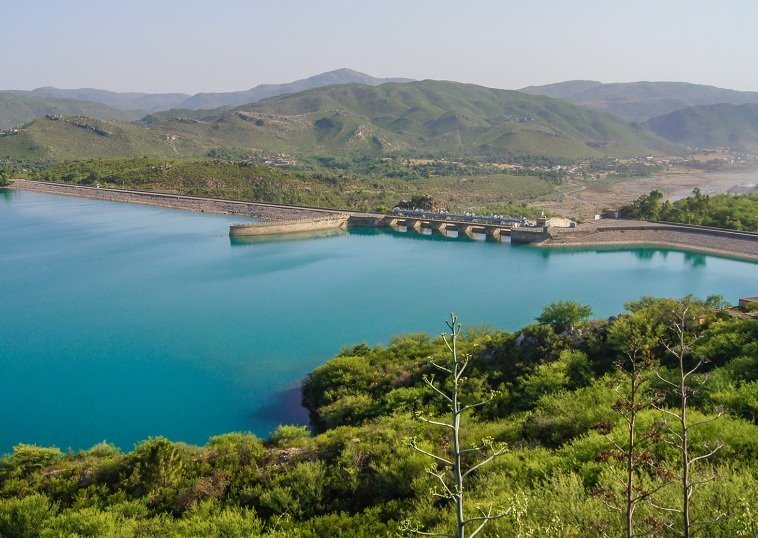
Rawal Lake, a major reservoir and recreational hub, anchors the city’s southeastern edge, while central parks create continuous green corridors across multiple sectors. This intentional greenery reinforces Islamabad’s reputation as a capital that prioritizes well-being alongside governance.

Islamabad’s Visual Landmarks: Where Identity Takes Form

Architecture That Complements the Landscape

Islamabad’s most iconic structures were designed to enhance, not dominate, their surroundings. Rather than competing with nature, architecture here often frames it.

The city’s skyline is deliberately restrained, allowing hills, forests, and open skies to remain visually dominant. This restraint distinguishes Islamabad from capitals defined by dense high-rise clusters or aggressive monumentality.

A Capital That Feels Calm, Not Crowded

What visitors often notice first is not a single monument, but the overall atmosphere—quiet roads at dawn, mist drifting over hills, birdsong in residential sectors, and uninterrupted views across valleys.

This calm is rare among world capitals and is a direct result of Islamabad’s planning philosophy, environmental protections, and geographic placement.

Where a Young Capital Inherits an Ancient Civilization

Although Islamabad is one of the world’s youngest capitals, its cultural depth is anything but shallow. The city stands on land shaped by ancient Gandharan civilization, Mughal-era routes, and centuries of migration flowing between Central Asia and the plains of Punjab. This layered inheritance quietly informs Islamabad’s identity, giving it a cultural gravity often overlooked by those who focus only on its modern design.

Just a short drive west lies Taxila, a UNESCO-recognized archaeological landscape that once housed Buddhist universities attracting scholars from across Asia. This proximity places Islamabad within one of South Asia’s oldest intellectual and spiritual corridors, linking it historically to regions such as Peshawar and the ancient trade routes of the northwest.

Faisal Mosque: The Architectural Heart of the Capital

More Than a Mosque – A National Symbol

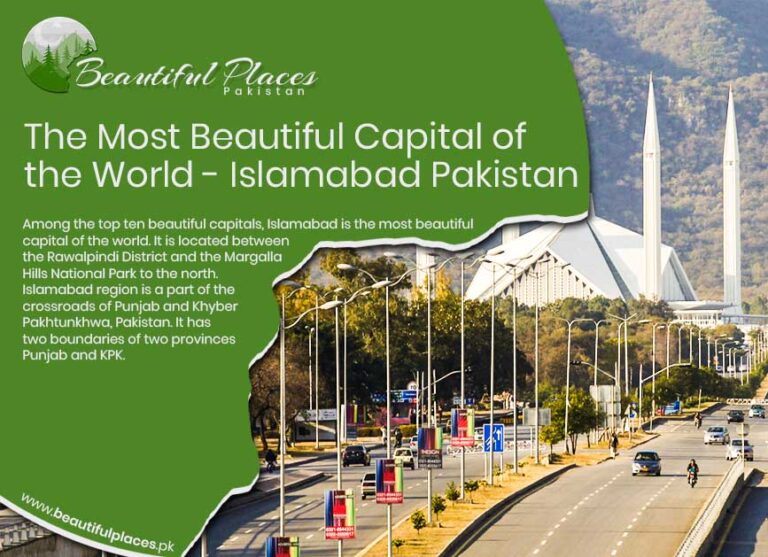
No structure defines Islamabad more powerfully than the Faisal Mosque. Set against the Margalla Hills, its stark white geometry rises not as an ornament, but as a visual anchor between the city and the mountains.

Unlike traditional domed mosques, the Faisal Mosque embraces a modernist design inspired by a Bedouin tent, symbolizing openness, unity, and faith without excess. Its scale, among the largest in the world, is matched by its restraint—an architectural philosophy deeply aligned with Islamabad’s broader aesthetic.

The mosque’s placement reinforces the city’s spatial intelligence: visible from multiple sectors, framed by natural slopes, and never isolated from its surroundings. This harmony between sacred space and landscape is a defining characteristic of Islamabad’s beauty and a key reason the city consistently earns global admiration as explored in The Most Beautiful Capital of the World.

Pakistan Monument and Shakarparian: Symbolism in Stone and Space

A Narrative of Unity Overlooking the City

Perched above the city at Shakarparian Hills, the Pakistan Monument stands as Islamabad’s most symbolic landmark. Designed to represent the four provinces and three territories of Pakistan, it transforms abstract national identity into physical form.

The surrounding parkland offers sweeping views across Islamabad, Rawalpindi, and beyond—views that reveal how deliberately the city was laid out. From here, the contrast between Islamabad’s structured sectors and Rawalpindi’s organic sprawl becomes immediately apparent, highlighting the intentional planning that defines the capital’s character.

This elevated landscape connects Islamabad not only to Rawalpindi but also to the broader Potohar region, historically linking the capital to cities such as Attock and the ancient forts guarding the Indus crossings.

Lok Virsa Museum: Pakistan’s Cultural Memory Preserved

A Living Archive of Traditions

If Islamabad’s architecture reflects modern aspirations, the Lok Virsa Museum preserves the soul of Pakistan’s past and present. This ethnographic complex showcases traditional crafts, regional music, folk architecture, and daily life from across the country—from the deserts of Tharparkar to the valleys of Gilgit-Baltistan.

Walking through Lok Virsa is less like visiting a museum and more like traveling through Pakistan’s provinces in condensed form. It reinforces Islamabad’s role as a cultural meeting point, where diverse identities coexist rather than compete.

This cultural inclusivity mirrors the capital’s diplomatic character, hosting embassies and international institutions while remaining rooted in indigenous traditions.

Daman-e-Koh and the Viewpoints of Perspective

Seeing Islamabad from Above

Few capitals offer such easy access to elevated viewpoints within city limits. Daman-e-Koh, nestled halfway up the Margalla Hills, provides panoramic views that reveal Islamabad’s spatial clarity—straight avenues, green belts, and sector grids unfolding below.

At dusk, when city lights emerge and the hills darken into silhouette, Islamabad reveals a quieter beauty—calm, measured, and unhurried. This experience is inseparable from the broader mountain culture of northern Pakistan, connecting Islamabad emotionally to destinations like Murree and the forested routes leading toward Abbottabad.

Saidpur Village: Where Time Slows Inside the Capital

A Village Older Than the City Itself

Hidden at the foothills of the Margalla range, Saidpur Village predates Islamabad by centuries. Once a Hindu settlement, later shaped by Sikh and Muslim influences, it now stands restored as a cultural enclave within the capital.

Stone pathways, old temples, and traditional eateries coexist here, offering a rare sense of continuity between Islamabad’s modern identity and the region’s pre-capital past. This coexistence reflects the broader historical layering found across northern Punjab, from Gujrat to Jhelum.

A Capital of Education, Diplomacy, and Thought

Intellectual Life Beyond Monuments

Islamabad’s cultural depth is reinforced by its role as an educational and intellectual hub. Major universities, research institutions, and think tanks attract students and scholars from across Pakistan, contributing to a cosmopolitan yet grounded social fabric.

This academic atmosphere links Islamabad conceptually to historic centers of learning such as Lahore while maintaining its own quieter, research-oriented identity.

Diplomatic enclaves, international cultural centers, and literary festivals further enrich the city’s cultural calendar, ensuring Islamabad remains globally engaged without sacrificing its calm character.

A City Experienced Slowly, Not Consumed Quickly

What ultimately sets Islamabad apart from other capitals is how it invites experience. It does not overwhelm with spectacle or density; instead, it reveals itself gradually—through sunrise over hills, afternoon walks in shaded sectors, museum courtyards echoing with folk music, and viewpoints that encourage reflection.

Islamabad’s beauty lies not in excess, but in balance.

Islamabad Is Not an Endpoint — It Is a Beginning

What ultimately elevates Islamabad from a beautiful capital to a pillar destination is not only what exists within its boundaries, but what it connects you to. Islamabad functions as Pakistan’s most strategic travel gateway, linking plains to mountains, heritage to wilderness, and urban comfort to raw landscapes within a few hours’ drive.

For travelers, Islamabad is rarely consumed in haste. It is absorbed slowly—often as a base city—before journeys fan out toward the north, the plateau, or deeper into Punjab’s historic heartland.

How to Reach Islamabad: Routes That Shape the Experience

By Road: The Capital as a Crossroads

Islamabad is one of Pakistan’s best-connected cities by road, and the journey itself often feels scenic rather than exhausting.

  • From Lahore and central Punjab, the motorway passes through the rolling terrain of the Potohar Plateau, dotted with salt ranges, lakes, and historic settlements.

  • From Khyber Pakhtunkhwa, access routes descend from the Hazara region, linking Islamabad naturally with Abbottabad and onward to the mountain valleys.

  • From Rawalpindi, the transition is almost seamless—two cities functioning as one metropolitan system, yet sharply different in mood and structure, a contrast explored in Rawalpindi: History, Suburbs & Famous Places.

By Air: Pakistan’s Most Convenient Arrival Point

Islamabad International Airport serves as the country’s most efficient international gateway, especially for travelers heading north. Many journeys toward Gilgit-Baltistan, Kaghan Valley, or Azad Kashmir begin here after a night or two in the capital.

Best Time to Visit Islamabad

Seasons That Transform the City

Islamabad’s beauty is seasonal, and each phase offers a distinct personality:

Spring (February–April)

Perhaps the most visually pleasing time, spring brings blossoms to parks, mild temperatures, and clear views of the Margalla Hills. Outdoor cafés, hiking trails, and cultural events peak during this period.

Summer & Monsoon (May–September)

While summers can be warm, monsoon rains turn the hills deep green, waterfalls appear along Margalla trails, and Rawal Lake feels alive. This season often coincides with onward travel to cooler northern destinations like Swat Valley or Naran Valley.

Autumn (October–November)

Clear skies, crisp evenings, and golden foliage make autumn ideal for photography and city exploration.

Winter (December–January)

Cool mornings and misty landscapes dominate winter. While snowfall remains rare in Islamabad itself, nearby hill stations such as Murree offer quick alpine escapes.

Islamabad as a Base for Northern Pakistan

Gateway to Mountains, Valleys, and Glaciers

Few capitals in the world offer such immediate access to dramatic landscapes. From Islamabad, travelers can easily branch out toward:

This makes Islamabad not just scenic, but strategically indispensable for Pakistan tourism.

Food Culture: Subtle, Global, and Evolving

A Capital’s Culinary Identity

Islamabad’s food scene reflects its diplomatic and multicultural character rather than regional dominance. You’ll find:

  • Traditional Pakistani cuisine from every province

  • Afghan, Central Asian, Turkish, and Middle Eastern influences

  • Modern cafés and fusion restaurants catering to a young, global audience

Unlike food-centric cities such as Lahore or Karachi, Islamabad’s dining culture emphasizes ambience, view, and experience—hilltop restaurants, garden cafés, and lakeside seating.

This understated culinary approach aligns with the city’s broader philosophy: refined rather than excessive.

Safety, Cleanliness, and Quality of Life

Islamabad consistently ranks as one of Pakistan’s safest and cleanest cities. Wide roads, regulated development, and lower population density contribute to a sense of order rarely associated with South Asian capitals.

For first-time visitors to Pakistan, Islamabad often feels like the most approachable introduction—calm, navigable, and visually reassuring—before venturing into denser cultural centers or remote landscapes.

Why Islamabad Endures as a Global Benchmark?

Islamabad does not compete with the spectacle of Paris, the density of Tokyo, or the historical saturation of Rome. Instead, it defines beauty through balance:

  • A capital shaped by geography, not conquest

  • Architecture that respects nature rather than dominating it

  • Urban life designed for breathing space and human rhythm

In this sense, Islamabad is not just Pakistan’s administrative heart—it is its most thoughtful expression of modern nationhood, where identity, environment, and aspiration converge quietly.

That is why, when discussing the world’s most beautiful capitals, Islamabad is not a claim—it is a conclusion earned through design, restraint, and landscape.

And once experienced, it is rarely forgotten.

Famous Schools in Islamabad:

  • Beaconhouse School System
  • The City School
  • Islamabad Model College for Boys/Girls
  • Froebel’s International School
  • Roots Millennium School

Famous Colleges in Islamabad:

  • Islamabad Model College
  • Federal College
  • F.G. College for Women
  • Punjab College
  • OPF Boys College

Famous Universities in Islamabad:

Famous Hospitals in Islamabad:

  • Shifa International Hospital
  • Aga Khan University Hospital
  • Pakistan Institute of Medical Sciences (PIMS)
  • Ali Medical Center
  • Federal Government Services Hospital

Famous Restaurants in Islamabad:

  • Monal Restaurant
  • Tuscany Courtyard
  • Chaaye Khana
  • Des Pardes
  • Street 1 Café

General & Global Perception FAQs

Why is Islamabad called the most beautiful capital of the world?

Islamabad is often regarded as the most beautiful capital due to its unique blend of modern urban planning, abundant greenery, scenic mountain backdrop, clean environment, and calm lifestyle—features rarely found together in a capital city.

Is Islamabad officially ranked as the most beautiful capital?

There is no single official global ranking, but Islamabad is frequently cited by travel writers, tourists, and international publications as one of the most scenic and well-planned capitals in the world.

What makes Islamabad more beautiful than other capitals?

Unlike many capitals, Islamabad was purpose-built with nature integrated into its design. Forested hills, wide roads, organized sectors, and protected green zones create a visually harmonious city.

How does Islamabad compare with capitals like Paris, Tokyo, or Rome?

While Paris excels in historic grandeur and Tokyo in modern density, Islamabad stands out for natural beauty, serenity, and urban balance rather than monument density or population scale.

Geography & Natural Setting FAQs

Where is Islamabad located geographically?

Islamabad is located in northern Pakistan at the foothills of the Margalla Hills, on the Potohar Plateau, near the boundary of Punjab and Khyber Pakhtunkhwa.

What natural features surround Islamabad?

Islamabad is surrounded by the Margalla Hills National Park, Rawal Lake, forest reserves, and seasonal streams that contribute to its lush environment.

Is Islamabad close to the Himalayas?

Islamabad lies near the Himalayan foothills, specifically the Margalla range, which is considered part of the outer Himalayan system.

Why is Islamabad so green compared to other cities?

Green belts, protected forests, planned parks, and strict zoning laws were built into Islamabad’s master plan from the beginning.

City Planning & Urban Design FAQs

Who designed Islamabad?

Islamabad was designed by Greek architect and urban planner Constantinos Apostolou Doxiadis.

Why was Islamabad built as a new capital?

Islamabad was built to replace Karachi as the capital for better security, central location, climate, and long-term urban planning.

What is unique about Islamabad’s sector system?

The city is divided into self-contained sectors, each with residential areas, markets, schools, parks, and mosques, ensuring balanced urban living.

Is Islamabad a planned city?

Yes, Islamabad is one of South Asia’s most systematically planned cities, designed before large-scale settlement.

Parks, Hills & Outdoor Life FAQs

What are the main natural attractions in Islamabad?

Major attractions include Margalla Hills National Park, Rawal Lake, Daman-e-Koh, Shakarparian, Fatima Jinnah Park, and Lake View Park.

Can you hike within Islamabad city limits?

Yes, Islamabad offers multiple hiking trails within city limits, especially in the Margalla Hills.

Is Islamabad good for nature lovers?

Islamabad is one of the best cities in Pakistan for nature lovers due to its forests, trails, lakes, and wildlife.

Does Islamabad have wildlife?

Yes, the Margalla Hills host monkeys, deer, leopards, wild boars, and numerous bird species.

Landmarks & Cultural FAQs

What is Islamabad’s most famous landmark?

The Faisal Mosque is Islamabad’s most iconic landmark and one of the largest mosques in the world.

Why is Faisal Mosque architecturally unique?

It features a modern, tent-inspired design without a traditional dome, blending contemporary architecture with Islamic symbolism.

What does the Pakistan Monument represent?

The Pakistan Monument symbolizes national unity, representing the country’s provinces and territories.

What is Lok Virsa Museum famous for?

Lok Virsa Museum preserves Pakistan’s folk traditions, crafts, music, architecture, and cultural diversity.

Travel & Tourism FAQs

Is Islamabad worth visiting for tourists?

Yes, Islamabad is ideal for tourists seeking scenic beauty, safety, cleanliness, and access to northern Pakistan.

How many days are enough for Islamabad?

Two to four days are sufficient to explore Islamabad’s main attractions at a relaxed pace.

Is Islamabad a good base for northern travel?

Islamabad is the primary gateway for travel to northern Pakistan, including valleys, mountains, and hill stations.

Can Islamabad be visited year-round?

Yes, Islamabad is a year-round destination, though spring and autumn are the most pleasant seasons.

Climate & Best Time FAQs

What is the best time to visit Islamabad?

Spring (February–April) and autumn (October–November) offer the best weather and scenery.

Does Islamabad get snowfall?

Snowfall within Islamabad city is rare, but nearby hill stations receive snow in winter.

Is Islamabad hot in summer?

Summers can be warm, but greenery, elevation, and monsoon rains moderate extreme heat.

Transport & Accessibility FAQs

How do you reach Islamabad?

Islamabad is accessible by air, motorway, and national highways from all major Pakistani cities.

Is Islamabad easy to navigate?

Yes, Islamabad’s grid system, wide roads, and clear signage make navigation simple.

Is public transport available in Islamabad?

Yes, Islamabad has buses, ride-hailing services, and a metro bus system connecting to Rawalpindi.

Safety & Lifestyle FAQs

Is Islamabad safe for tourists?

Islamabad is considered one of the safest cities in Pakistan for both locals and tourists.

Is Islamabad clean compared to other cities?

Yes, Islamabad is widely regarded as one of Pakistan’s cleanest cities.

Is Islamabad expensive?

Islamabad has a higher cost of living than many Pakistani cities, but it remains affordable by global standards.

Food & Culture FAQs

What kind of food is Islamabad known for?

Islamabad offers diverse cuisine, including traditional Pakistani food and international options.

Is Islamabad a street-food city?

Street food exists, but Islamabad is better known for cafés, restaurants, and scenic dining spots.

Education & Intellectual Life FAQs

Is Islamabad an education hub?

Yes, Islamabad hosts some of Pakistan’s top universities, research centers, and schools.

Why do students prefer Islamabad?

Students value Islamabad for safety, academic institutions, calm environment, and quality of life.

Comparative & Intent-Based FAQs

Is Islamabad better than Lahore for tourists?

Islamabad is better for nature and calm travel, while Lahore is better for history and food culture.

Is Islamabad better than Karachi?

Islamabad is quieter and greener, while Karachi is larger, busier, and economically driven.

Is Islamabad good for family travel?

Yes, Islamabad is one of the best cities in Pakistan for family-friendly travel.

Conceptual & Curiosity FAQs

Why does Islamabad feel different from other capitals?

Because it was designed for balance, not density—prioritizing space, greenery, and long-term livability.

Is Islamabad a modern or traditional city?

Islamabad is modern in infrastructure but culturally rooted through museums, heritage villages, and national symbolism.

What kind of travelers love Islamabad most?

Nature lovers, photographers, families, slow travelers, and first-time visitors to Pakistan.

Legacy & Identity FAQs

What does Islamabad represent for Pakistan?

Islamabad represents Pakistan’s vision of a modern, orderly, and environmentally integrated capital.

Will Islamabad remain beautiful in the future?

Due to zoning laws and protected natural areas, Islamabad is better positioned than most cities to retain its beauty.

Why do visitors remember Islamabad differently?

Because its beauty is subtle—experienced through calm mornings, mountain views, and spatial harmony rather than spectacle.

Final Thoughts on Islamabad

Islamabad’s beauty does not announce itself loudly. It does not rely on centuries-old monuments packed into narrow streets, nor does it overwhelm with scale, density, or spectacle. Instead, its distinction lies in something far rarer among world capitals: intentional balance.

This is a city where nature was not pushed aside to make room for power, but deliberately preserved to coexist with it. Where governance operates alongside forests, hills, lakes, and open skies. Where urban life unfolds at a humane pace, shaped by space, silence, and scenery rather than congestion and chaos.

What makes Islamabad exceptional is not just how it looks—but how it feels.

It feels calm without being empty.
Modern without being sterile.
Planned without being rigid.
Green without being artificial.

As a capital, Islamabad represents a forward-looking vision—one where national identity is expressed not through excess, but through restraint; not through domination of land, but through respect for it. It serves simultaneously as Pakistan’s administrative heart, cultural meeting ground, academic center, and the most natural gateway to the country’s most dramatic landscapes.

For travelers, Islamabad offers clarity and comfort before exploration.
For residents, it offers livability without compromise.
For Pakistan, it offers a quiet statement of what thoughtful urban design can achieve.

In a world where many capitals struggle under the weight of their own growth, Islamabad stands as proof that a capital city can remain beautiful, breathable, and meaningful—not by accident, but by design.

And that is why Islamabad is not merely called one of the most beautiful capitals of the world.
It lives up to the title-every single day.
A Complete Travel Guide to Pakistan

0

A Complete Travel Guide to Pakistan

Residential Hotels

The rental rates of hotels in Murree Guliyat, Kaghan Valley, Swat Valley, Chitral Valley, Gilgit Skardu and Kailash Valley are not stable, but fluctuate depending on the season, weekly holidays and festivals. However, PTDC and government rate house rents are fixed

Jhang

Vicky hotel 0477-613557

Dera Ismail Khan

Rose Hotel 0966-711515
Hilton Hotel 0966-710378
Mid Way Hotel 0966-732100

Sukkar

Mehran Hotel 071-5613792
Al-Madinah Hotel 071-5618484
Red Carpet 071-5631136

Larkana

New Mehran Hotel 074-4046077
Sapna Inn Hotel 074-4044446

Basham

PTDC motel 0996-400301
Continental hotel 400475-400226

Crore Bisham Alpuri Road

Ittifaq Hotel 897053

Bitgram

Shangrilla Hotel 0300-8111176

Karachi

Al-Harman Tower Hotel 021-35223970
Sarawan hotel 021-35216001
Shalimar hotel 021-35211104

Multan

Shab-o-roz hotel 061-4544224
Firdos Hotel 061-4582159
Shehzan 061-4782236
Ramada 061-4540877
Hotel Al-Sana 061-4542601

Islamabad

Al-Umar hotel 051-2204798-99
Islamabad Mereit 051-111223344
Islamabad Serena Hotel 051-111133133
Hotel D-Papa 051-111000505

Lahore

Ambassador Hotel 042-36316820-32
Bakhtawar International 042-36302846
Clifton Hotel 042-36366740-42
Hospitality Inn 0800-90971005
Park Way 042-36365908-12
Hafiz hotel 042-36372052-3
New Hotel  042-36363123-4
Shah Taj Hotel 04236279175
Gulistan hotel 042-38581329

Jhelum

Tulip hotel 0544-652555
Raja Hotel (Pind Dad Khan) 0544-210499

Bahawalnagar

City Top Hotel 063-2271886

Burewala

Serene hotel 067-3365087

Murree

Red carpet hotel 051-3412555-6
Al-Maaz hotel 051-3413682
Mountain tower hotel 051-3410850
Kings’ hotel 051-3410002
Moon light hotel 051-3411594
Al-badar hotel 0300-4289643
Java international hotel 051-34129505
Hotel Murree continental 051-3413729
White rose hotel 051-3410234
Hotel Mehran 051-3410280
Hotel Lalazar 051-3410150
Grand residency 051-3411434
Hotel Al-Saud 051-3410250
Hotel Orient 051-3410155

Nathia Gali

New Pines Hotels 0992-355009
Sun Rise Guest house 0300-5617573
Galiyat Inn hotel 0992-355214

Changla Gali

Surry Continental 0300-5638735
Mukesh Puri Hotel 0992-355287

Ayubia

Mount View Hotel 051-4842078
Ayubia Palace Hotel 0323-5857009

Quetta

Islamabad Hotel 081-2824006
Quetta Serena Hotel 081-111133133
Shees hotel 081-2823015
Royal City hotel 081-2836201

Rawalpindi

Akbar International 051-5532001-4
Sun way hotel 051-4414996
Pearl Continental 051-111505505
Kashmir Inn hotel 051-5563742
Green Palace 051-4841297-8
Sky ways hotel 051-4416633&44
Hotel Alpine 051-4416980-1

Gujrat

Akbar Kinara hotel 0533-589111-555

Peshawar

Bala Hissar hotel 091-2584850
Ameen hotel 091-2218215-9
Greens hotel 091-5270182-5
North west h heritage 091-2561602
Hotel grand 091-5844358
Hidayat hotel 091-2566635
Rose Hotel 091-2550755-6

Balakot

PTDC Motel 0997-500208
Pine Track hotel 0997-360143
Evergreen hotel 0997-360444
Paradise Inn 0997-500391

Shogran

Punjab hotel 0997-432326
Paradise Inn 0997-432210-1
Pine Park hotel 0997-432333

Kaghan

Lala Zar hotel 0997-420022

Mahandri

Green Valley Hotel 0345-9622514

Naran

Gate way hotel 0997-43077
Linux hotel 0997-43018-430186
PTDC Motel 0097-430002
Manila Huts 0997.430333
Kanhar View hotel 0997-430124

Mianwali

Adeel hotel 0459-231132
Royal Inn hotel 0459-223575
Shahzad hotel 0459-232416

Bannu

Paradise hotel 0928 624130

Bahawalpur

Koh-e-Noor hotel 062-2774251
Abaseen hotel 062-2877596
Pak Continental 062-286093
Luxury hotel 062-2888401

Rahim Yar Khan

Al-Mashriq hotel 068-5872478
White Palace hotel 068-5886553
Sherton hotel 068-5878053

Sadiqabad

Damam Hotel 068-5771431

Abbottabad

PC hotel 0992-334717
Zain hotel 0992-335763

Ayubia

Royal Dream hotel 0992-359227

Balakot

PTDC Motel 0997-500208

Chitral

PTDC Motel Booni 0943-470611
PTDC Motel Mastuj 0943-486034

Bhurban

Pearl Continental 051-3355700-28

Fairy Meadows Chilas

Fairy Meadows Cottage 0300-5053507

Hyderabad

Faran Hotel 022-2780194
New Hotel 022-2728351-3
Indus hotel 022-2781903
Diamond hotel 022-2617174

Sialkot

Koh-e-Noor hotel 052-4293777
Spring heights 052-4261910

Umar Kot Tharparkar

Karonjhar Guest house 052-4264913

Mitthi Tharparkar

Desert rest house 0333-2624461
Marvi Guest house 0332-2082334
Tharparkar guest house 0343-3710900
Desert guest house 0333-262-4461

Miandam (Swat)

PTDC motel 0946-616333
Imperial hotel 0946-616201
Panorama hotel 0946-616231

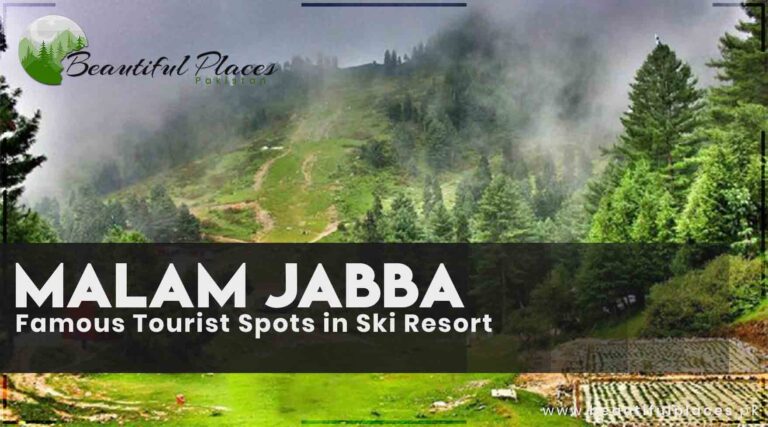
Malam Jabba

Falak sher hotel 0333-9480522

Bahrain

Dim Sun hotel 0946-780047
Bolan hotel 0946-780126
Decent hotel 0946-780163
Imran pearl hotel 0946-781288

Sargodha

Pak continental hotel 048-3724415
Cuze hotel 048-3721914

Swat

PTDC motel 0946-9240156-57
Hotel hills city 0946-815608
Lala Zar hotel 0946-812005
Pak hotel continental 0946-816614
Hotel white palace 0946-865272-3
Swat residency 0946-816444-6
Hotel D papa 0946-725362
Hotel Diamond 0946-710321

Madyan

Al- Madina hote 0946-780596
Madin hotel 0946-780034-5
Zareen palace 0306-5763000

Faisalabad

Faisalabad Serene hotel 041-1111331332
Riz hotel 041-262006
National hotel 041-8780864
Hotel the continental 041-8546584-5

Sahiwal

Sea rose hotel 040-4227377

Gujranwala

Lipari hotel 055-4235701-4
Shelton hotel 055-3259501-3

Chitral hotel

Hindukush heights 0943-413151
Tirich mir view hotel 0943-414545
Pamir river hotel 0943-412525
Mountain inn hotel 0943-412581
PTDC motel 0943-412683
Dream land hotel 0943-412806
Tourist lodge 0943-412454
Chanar Inn hote 0943-412582

Bumburet (Kalash)

PTDC motel 0943-412683
Hotel Alexander 0943-404158
Peace hotel 0943-404034

Barir (Kalash)

Irfan guest house 0943-302091

Gwadar

Zewar pearl continental 086-4212223-3

Mirpur

Usman guest house 0346-5420999
Metropolitan hotel 05827-434907
Abdullah hotel 05827-443541
Kalyal hotel 05827-451638

Muzaffarabad

Agha g hotel 05822-447383
Tayyaba hotel 05822-445886
Akbar hotel 05822-448428-9

Kotli

Tourism inn hotel 05826-448404
Gulistan international hotel 05826-447760
Hotel stay inn 05826-445543

Bagh

Al-noor 05823-442282
Bahar guest house 0300-5556849
Hotel Dewan Aziz 05823-443209

Gilgit

PTDC motel 05811-452562
Serena hotel 05811-455894
Park hotel 05811-452379
Jamal hotel 05811-453788

Astore

PTDC motel 05817-59049

Khaplu

Karakoram lounge 05816-450433
Khaplu palace & residence 05816-450890
Ghanche palace 05816-450500

Diamir – Chilas

Panorama hotel 05812-450661
Shangrilla hotel 05812-450539
Karakoram Inn hotel 0355-5201375
Mount view hotel (Dasu) 407198

Ghizer

Green palace hotel 05814-451121
PTDC motel Gupis 05814-922250
Ghizer tourist cottage single 0355-5178340
Hotel green palace Gakuch 05814-51121

Skardu

PTDC motel 05815-450291
Masherbrum hotel 05815-450395
Shaangrilla hotel 05815-458515
Hilton international 05815-455581
Pakiza hotel 05815-450008
Karakoram Inn hotel 05815-455431
Ghzai hotel (Upper Katchura) 0343-4057623
Tibet hotel (Kachura) 05815-458414

Shigar

Shigar fort residence 05815-467107

Hunza

Darbar hotel 05812-457105
PTDC motel 05821-457069
Serena hotel 05813-457012

Mansehra

Karakoram hotel 0997-303163-5
Ashiyana hotel 0997-303685

Vehari

Sky view hotel 067-3360419

Taxila

Royal sun hotel 051-4548400


Northern Areas Transport Corporation

Head Office 05811-920829
Gilgit 05811-920684
Hunza 05813-920111
Sust 05813-928409
Skardu 05815-452188
Chilas 05812-920150
Tangir 05812-460118
Ghizer 05814920377
Astore 05817-450215
Rawalpindi 051-9278441-2
Islamabad 051-5467360
Karachi 021-35418142

Karachi

Al Aziz Coach 021- 34945778
Japan Coach 03333033361
Awan Coach 021-32790880
Pindi Coach 021-32790576
Manthar Coach 0334-7316511
Al-Makka Coach 021-35657350

Mithi Tharparkar

Al-Nouman Sitara Hilal Coach 0333-2510602

Larkana

Al-Madina Coach 074-4055073
Karachi Coach 074-4055656

Sukkar

Daewoo Express 071-565856-9
Baloch Brothers 0301-3436709

Quetta

Sada Bahar Coach 081-2452290
Al-Aziz Coach 081-2450607

Sadiq Abad

Al-Makkah Coach 068-5700987
Falcon Travel 068-111597597
Bilal Daewoo Express 068-111287444
President Line 068-5700950
Sadiq Abad Coach 068-570629

Rahim Yar Khan

New Al-Makkah Coach 0300-9678753
Falcon Lines 068-111597597
Sadiq Abad Coach 068-5885995
Mnathar Coach 068-5888695

Bahawalpur

Niazi Express 062-2288158
Faisal Movers Express 062-2884557
Bilal Daewoo Express 062-111287444
Faisal Movers Express 062-111224488

Multan

Madina Flying Coach 061-6774863
Golden Bus Service 0300-6302644
Shalimar Express 061-4232002
Ahbab Express 0300-7197255
Bilal Daewoo Express 061-111287444
Faisal Movers Express 061-111224488

Sahiwal

Faisal Movers Express 040-4229237
Bilal Daewoo Express 040-111287444
Modern Flying Coach 040-4220801

Vehari

Power International 067-3362561

Lahore

Niazi Express 042-111223399
Niazi Express 042-111287999
Faisal Movers Express 042-111224488
Rehbar Travels 042-37521777-888
Sky ways Express 042-111555567
Billal Daewoo Express 042-111287444
Al-Makkah Coach 0301-4235921
Awan Express Soon Sakesar 0331-4980996
Srinagar Coach Muzaffarabad 0333-4213056
Kashmir Ways Bagh 0333-4504394
Varyam Coach Mirpur 0300-4776298

Faisalabad

Subhan Travellers 041-2634950
Khawaja Travelers 041-2656100
Kohistan Travelers 041-111776444
Bilal Dawewoo 041-111287444

Sargodha

Al-Makkah Coach 0300-6020796
Sky Ways 048-3210082
Pindi Coach 048-321008

Mianwali

Pindi Coach 0459-237086
New Khan Transport 0459-232955

Esa Khel

Niazi Express 0459-285695

Chiniot

Sardar Bilal travelers 0301-7940393

Gujranwala

Star Travelers 055-4273910

Sialkot

Malik Travelers 052-4263725

Sheikhupura

Work Travelers 0332-8447384

Rawalpindi

Chitral Ways Travelers 051-5481462
Chitral Travelers 0347-2371772
Masherbrum Tours Gilgit Skardu 051-5163895
Ghizer Travelers 0312-8377799
K2 Travelers 051-8474112
Faisal Movers Express 051-111224488
Bilal Daewoo Express 051-111287444
Sky Ways Express 051-4455242-3
Al-Makkah Coach 0300-5094786
Mahfooz Coach Astore 0333-5427814
Sargon Travelers 0347-5353210

Murree

Bilal Daewoo Express 051-3410171-3
Niazi Express 051-3411475

Muzaffarabad

Srinagar Coach 05822-47333

Bagh

Fakhr Kashmir Coach 05823-43095

Mirpur

Kashmir Ways Travel 05827-45405
Waryam Travles 05827-442895

Attock

057-2603904-6

Abbottabad

Sky Ways Coach 0992-335293
Pakistan Coach 0992-336897

Mansehra

Masherbrum Tours 0997-300382
Sky Ways 0997-301499

Naran

Perfect Travels 0344-5228789

Peshawar

Bilal Daewoo Express 091-111287444
Tanko Transport 091-2260023-4.
Niazi Express 091-111223399

Bannu

Blue Airline 0928-62542
Mundan Coach 0928-620466

Dera Ismail Khan

Pindi Coach 0966-719691
Jahanzaib Coach 0966-717138
Pakistan Coach 0966-719191

Swat

Shahid Coach 0946-812355
Swat Coach 0946-725175

Chitral

Chitral Ways 0334-5522522
Chitral Travelers 0347-9062409

Jaglot

Masherbrum Tours 05811-400750

Astore

Mahfooz Travelrs 03555-108614

Gilgit

Masherbrum Tours 05811-452784
Ghizer Travelers 0344-9442425
K2 Travlers 05811-451103
Zafar Travelers 0344-5228789
Silk Route Travelers 05811-455234

Hunza

Sargon Travelers 0311-9574610

Skardu

Masherbrum Tours 05815-455195
K2 Travlers 05815-455584
Zafar Travelers 0344-5228789
Ittehad Gilgit Baltistan 05815-457779
K2 Himalaya  Travelers 05815-450655
Indus Travelers 05815-457791
New Karakoram Travelers Khaplu 05815-452888

Khaplu

New Karakoram Travelers 05816-45088

Thagas

New Karakoram Travelers 0355-410786

Gakuch

Silk Route Travelers 0315-7902684

DAEWOO Bus Service

Abbot abad, Bahawalpur, D.G. Khan, D.I Khan, Hyderabad, Karachi, Lahore, Multan, Peshawar, Rawalpindi, Sadiq abad, Sialkot, Swat and Sukkur.

U.A.N 111 007 008


City Phone Number
Bakkar 0453-515574
Bat khaila 0932-415923-4
Bhalwal 048-6644772
Chiniot 047-6331166
Gujranwala 055-3892311
Gujrat 053-3534794-5
Haripur 0995-610151
Islamabad 051-28921234
Jhang 047-7627688
Karak 0927-211917
Khaniwal 065-2558586
Kohat 0922-554544
Mansehra 0997-306922
Mardan 0937-876113-6
Moro 0242-413085
Murree 051-3412185
Nowshera 0923-611190
Sahiwal 040-4010150

PAKISTAN TOURISM DEVELOPMENT CORPORATION

TOURIST INFORMATION CENTRES

Abbottabad Club Avenue Jinnah Road                                                                      Phone_9310186-0992

Bhawalpur – PTDC Motal Club Road                                                                          Phone_9250168-062

Gilgit PTDC Mall with Babar Road                                                                             Phone_454262-05811

Islamabad. 6-F Supermarket                                                                                       Phone: 051-9202766

Islamabad Airport. International Departure Lounge                                               Phone. 9280563-051

Karachi Shafi Chamber Club Road Saddar                                                                 Phone. 0219202971

Lahore. 1/66D Gulberg 3                                                                                           Ph. 042-35756737

Lahore Airport. International Arrivals Lounge                                                      phone 042- 9240023

Mohen Jodaro, Opposite Mohan Jodaro Museum                                              Ph. 074- 4080082

Multan LMQ Road Fiesta Inn                                                                                  Ph. 0614572968

Peshawar Benevolent Fund Building Saddar Road                                             phone 091-9211826

Quetta Muslim Hotel Jinnah Road                                                                       Phone 081-2825826

Rawalpindi Flashmen the hotel                                                                               Ph.051-9272017-8

Saidu Sharif – PTDC Motel, Opp Serena                                                               Ph.   0946-9240159

PTDC Motel, K2 Skardu                                                                                                   Ph. 05831- 50291- 2-

PTDC Complex, Thatta                                                                                             Ph. 0298- 920039

PTDC Motel near taxila Museum                                                                           Phone- 051-9314206

PTDC MOTELS, HOTEL & RESTAURANTS

Ayubia District Abbottabad                                                              Phone: 0992-359004,359200

Astak Jaglot Skardu Road Gilgit Baltistan

Bumburet  Kalash Valley Chitral                                                      Ph. 0943 -490433

Bahawalpur near DCO Office                                                          Ph. 062-9250169-70

Balakot  (Restaurant) Kaghan Valley                                              Ph. 0996-400301

Gilgit Chinaran ba Burroad Phone.

Barmo Gulshat Chitral

Boney Chitral                                                                                     Phone. 0943-470661

Chitral City Chitral                                                                            Phone. 412683-0943

Chaman Pak Afghan Border Baluchistan

Gilgit Chanar Inn Babar road                                                        Ph. 05811-452562, 454262,

Gupis Gilgit Chitral Road, District Ghizer                                                 Phone. 05815-458019

Hunza Karakoram Highway                                                          Phone. 05821-457069

Kalam Swat Valley                                                                           Phone. 0946-830014

Khaplu Baltistan                                                                                Phone 05832-450146-7

Mastuj, Chitral                                                                                 Ph. 0943 – 486034

Myandam Swat Valley                                                                    Phone. 0946-840656, 616333,

Moin Jodaro Larkana                                                                      Ph. 074-4080585

Naran Kaghan Valley                                                                       Ph. 0997-430111, 430002

Panahkot                                                                                             Ph. 0944-880900

Phander Gilgit Chitral Road                                                          Phone 05815-458019

Rama Lake Astore Gilgit-Baltistan                                              phone: 05817-459049

Hotel The Mall Phone, Rawalpindi Flashman                        Phone  051-9272004-13

Saidu sharif Swat valley                                                                 Phone 0946-9240156

Sat Pak-China border, Karakoram highway.                           Ph. 05823- 451030

Skardu K2 Motel Baltistan                                                             Ph. 05831- 450291

Taxila Opposite Taxila Museum                                                  Ph. 051-9314204

Wahga Pak-India border Lahore                                                                 Ph. 042-36583072

Ziarat Balochistan                                                                            phone. 0833-560356

Tourism corporation Khyber Pakhtunkhwa

Tourist information center

Peshawar. Peshawar Museum                                                   Ph. 091-9213762

Islamabad. SIDB Plaza 7-F Center                                               Phone. 051- 2655614

Galiyat, Donga Gali Chowk                                                           Phone 0992- 355173

Abbottabad. Royal Hotel                                                               Ph.0992-335876

Chitral. Near Hotel Mountain Inn                                              Phone 0943-413540

The tourism development corporation of Punjab

Head office 151. Abubakar Block Garden Town Lahore                                     Phone 042-99231006-7

TIC. Farid Plaza Temple Road Lahore                                                                        Phone: 042-37661123-5

TIC. Lahore International Airport Lahore                                                                Phone: 042-99240021

TIC Androon  Delhi Gate Lahore                                                                                 Ph.042-37676750

44 Mall Plaza, Mall Road Rawalpindi                                                                        Ph.051-9273214-5

Holiday Resort, Cart Road Murree                                                                            Phone .. 051-3410729

TIC Mall Road Murree                                                                                                    Phone-051-3412331

TIC District Court Complex Sahiwal                                                                           Phone 040-9200210

Old Press Club Building Stadium Road Bahawalpur                                            Phone. 061-2874241

Noor centre Katcheri Road Multan                                                                            Ph. 061-9200955

TDCP Resorts / stop-overs

Tourist Resort Jalu Park Lahore

Tourist Resort Changa Manga Lahore

Tourist Resort Sarwar Dera Ghazi Khan

Tourist Resort Fort Munro Dera Ghazi Khan

Watersports Project Haran Mainar Sheikhupura

Tourist Resort Lal Sohanra National Park Bhawalpur

Tourist resort, Charra Pani, Murree

Tourist Resort Ghora Gali,  Murree

Tourist Resort Salgran Murree

Tourist resort is located near the river Chenab Chiniot

TDCP Bhajot 27 km Islamabad Expressway Rawalpindi

Tourist Resort Patriata Murree

TDCP Resort Kallar Kahar motorway Interchange District Chakwal

Tourist Resort GT Road Kharian Gujarat

Soft Wheel Train Kashmir Point Murree

Sindh Tourism Development Corporation

Head Office: 115-114 Block Sea Breeze Plaza Shahrah Faisal Karachi    Phone: -021-99206081,99239134

Keenjhar lake Resort, Thatta.

Shah Jahan Rest House Shah Jahan, Thatta.

Halchi rest house, halchi Lake Thatta.

Marvi Rest House Mithi Tharparkar.

Sambar Inn Hotel,Larkana.

Kai Inn, Sewan Sharif Jamshoro

Tourism Department Gilgit Baltistan

Khomer Chowk Highway Quaid-e-Azam Niz Dar and Plan, Khomer Gilgit

Ph. -05811-920574,920173

Directorate of Tourism Cheeta Colony Highway, Quaid-e-Azam Near General Bus Stand

Jutial Gilgit, Phone. 05811-920573 920690-91

AD Gilgit      05811-920690

AD Skardu    05815-920663

AD Ghanche 05816-920185

AD Diamer   05812-920183

AD Astore 05817-922068

AD Ghizer 05814-920327

Before you go!

Get the full information about your desired destination in advance to save your precious time and money.

Whenever you want to visit an area especially Murree, Gulyat Hawat, Naran, Gilgit-Skardu, Chitral, you must first check the weather conditions of the respective area on the website of the Meteorological Department www.Pakmet.com.pk. So that you can organize your program in such a way that your program is not affected due to landslides.

Take toilet paper, water bottle, jogger, p- cap, black glasses, bed sheet with cover pillow and towel. Whether the climate is cold or hot, take warm clothes according to the weather. Because the weather is unreliable in the mountainous region, the forecast is clear, suddenly, the weather will cool down immediately due to rain.

For mild cuts and bruises, take it with you as general medicine. Women should not wear jewelry and men should carry more valuable items.

During tourism!

Travel in these areas fearlessly. The people of these areas are very friendly and hospitable. But, never involve too much in their religious activities.

Try to get accommodation (hotel, etc.) before evening so that you don’t have to worry if it’s late when there are fewer available rooms. Especially in the northern regions, there are some difficulties due to the increase in the number of tourists during the summer season and snowfall.

As a precaution, write the names and phone numbers of some hotels in some areas as given so that you should contact them first and ask them.

If the matters are not settled on this matter, then take the number of other hotels from them.

The rental rates of hotels in  Murree and Northern Regions are not fixed but vary depending on the season, weekly holidays, and festivals.

Although the people of all regions are hospitable, the rejection of some greedy people may cause you trouble. You can take a guide anywhere. Ride a camel or a horse.

Always settle the charge first when taking pictures. Choose a local driver for a full day with all point details where you want to go. By telling the first point, they will choose the best route for you.

Agent-like gentlemen will escort you to the hotel for hotel booking in different areas. You should avoid this and arrange the fare by contacting the hotel directly.

Try to travel in a big car instead of a small car during snowfall.

Whenever you climb a hill, take your breath slowly. And using your normal pace instead of running up the hill will make you feel less tired.

Whenever you go on a day trip, always keep a bottle of water with you, especially in the paddy areas, it is needed more. Because sometimes there is a lack of air due to the high altitudes.

Water is the best solution for shortness of breath from walking.

People from northern areas are generally more religious, so try not to wear short or tight clothing that exposes your body parts. Especially, short dresses for women can sometimes cause difficulties and problems.

If you go to the northern regions, be sure to drink water from cold natural springs and waterfalls, whether you are thirsty or not.

Do not leave leftover food items, shopping bags, etc. dispose of them in a suitable place.

Do not make a stranger your guide, talk to your hotelier about it.

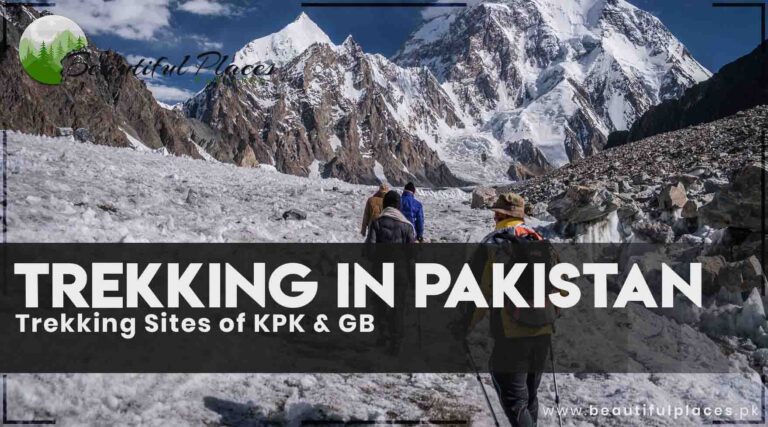
56 Trekking Areas in Pakistan | Trekking Sites of KPK & GB

0

Pakistan, with its diverse landscapes, towering peaks, and pristine valleys, is a trekker’s paradise. From the rugged mountains of Khyber Pakhtunkhwa (KPK) to the enchanting valleys of Gilgit-Baltistan (GB), this country offers an array of trekking opportunities for both beginners and seasoned adventurers. In this guide, we’ll explore 56 trekking areas that make Pakistan an exceptional destination for trekking.

Trekking Areas in Khyber Pakhtunkhwa (KPK)

KPK boasts some of the most stunning trekking sites in Pakistan, with its high peaks and lush valleys. Here’s a list of 33 trekking areas in KPK:

Trekking Area Highlights
Naran Valley Saif-ul-Mulook Lake, Lulusar Lake
Swat Valley Malam Jabba, Ushu Forest, Mahodand Lake
Hunza Valley Rakaposhi Base Camp, Passu Glacier
Kaghan Valley Shogran, Siri Paye, Makra Peak
Kalam Valley Ushu Forest, Kundol Lake, Bashigram Lake
Dir-Kohistan Jahaz Banda, Kumrat Valley, Katora Lake
Galiyat Region Nathiagali, Ayubia, Thandiani
Fairy Meadows Nanga Parbat Base Camp
Shimshal Valley Lupghar Sar, Minglik Sar, Braldu Glacier
Buner District Spin Khwar, Kund Malir, Pir Baba
Karakoram Range Spantik Base Camp, Rush Lake
Diran Base Camp Diran Peak, Chillinji Pass
Terich Valley Terichmir Base Camp, Karambar Lake
Bilchar Valley Rupal Face of Nanga Parbat, Latbo Glacier
Torghar Bagan, Miandam, Dharial
Chitral District Garam Chashma, Kalash Valley, Shahi Masjid
Shandur Pass Shandur Polo Festival, Shandur Lake
Buner and Swat Elum Valley, Chagharzai, Pir Sar
Malakand Division Malakand Pass, Jambil Valley, Jarogo Waterfall
Lower Dir Komrat Valley, Samar Bagh, Sheringal
Basho Valley Basho, Bashigram, and Bodigram Lakes
Marghazar Valley Marghazar, Jaba, and Malam Jabba
Upper Swat Matiltan, Shahi Bagh, Gabin Jabba
Lower Swat Landakai, Bagh Dheri, Badwan
Upper Dir Kumrat Valley, Jahaz Banda, Kala Pani
Kumrat Valley Thall, Kumrat Forest, Panjkora River
Tirich Mir Base Camp Terich Mir, Zani Pass, Karambar Lake
Garam Chashma Valley Garam Chashma, Sheshi Koh Valley
Chitral Kalash Valley Kalash Culture, Bumburet and Rumbur Valleys

Trekking Areas in Gilgit-Baltistan (GB)

Gilgit-Baltistan is a trekkers’ paradise, offering a stunning array of trails amid towering peaks. Here are 23 trekking areas in GB:

Trekking Area Highlights
Hunza Valley Rakaposhi Base Camp, Passu Glacier, Borith Lake
Skardu Valley K2 Base Camp, Concordia, Deosai Plateau
Shigar Valley Shigar Fort, Satpara Lake, Arandu
Astore Valley Rupal Face of Nanga Parbat, Rama Lake
Nagar Valley Rush Lake, Bualtar Glacier, Hopper Valley
Diamer District Fairy Meadows, Raikot Glacier, Nanga Parbat Base Camp
Shimshal Valley Lupghar Sar, Minglik Sar, Braldu Glacier
Khunjerab Pass Khunjerab National Park, Sost
Hushe Valley Masherbrum Base Camp, Snow Lake
Baltoro Glacier Concordia, Gasherbrum Base Camps, Trango Towers
Biafo Glacier Snow Lake, Hispar Pass, Karfogoro
Barpu Glacier Snow Lake, Sim Gang Base Camp
Shandur Pass Shandur Polo Festival, Shandur Lake
Ghizer Valley Phander Valley, Gupis Valley, Shandur Pass
Yasin Valley Darkot Pass, Darkot Village, Torkhow
Gilgit Valley Kargah Buddha, Gilgit Fort, Naltar Valley
Astak Nala Rush Lake, Kamri Pass, and Chillinji Pass
Shigar District Kharpocho Fort, Rama Lake, Nansoq Village
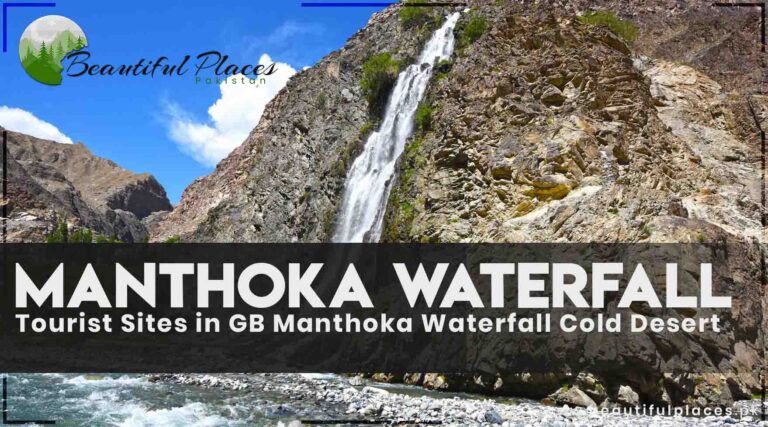
Khaplu Valley Khaplu Fort, Shyok River, Manthokha Waterfall
Phander Valley Phander Lake, Broghil Valley, Karambar Lake
Rupal Valley Nanga Parbat Base Camp, Laila Peak
Darel Valley Chillinji Pass, Brep, Taus Valley
Chapursan Valley Baba Ghundi Ziarat, Borith Lake, Wakhan Corridor

FAQs

1. When is the best time for trekking in Pakistan?

The best time for trekking in Pakistan is during the summer months, from May to September, when the weather is generally mild and the trails are accessible.

2. Are there trekking guides available in these areas?

Yes, many local guides and trekking companies offer their services in these areas. It’s advisable to hire a guide for safety and to navigate the routes effectively.

3. What should I pack for a trek in Pakistan?

It’s essential to pack appropriate clothing for changing weather conditions, sturdy trekking boots, camping gear, first-aid kits, and essential trekking equipment.

4. Are there any permits required for trekking in these areas?

Some trekking areas may require permits. It’s important to check the local regulations and obtain the necessary permits before your trek.

5. Are these trekking areas suitable for beginners?

While there are treks suitable for beginners, many routes are challenging and require prior trekking experience. It’s crucial to choose a trek that matches your skill level.

6. Are there accommodations available in these trekking areas?

Accommodations vary from basic guesthouses to camping. It’s advisable to plan your accommodations in advance, especially during the peak trekking season.

7. What should I do to ensure my safety while trekking in Pakistan?

It’s important to trek with a group or hire local guides, stay updated on weather forecasts, carry necessary safety equipment, and inform someone of your trekking plans.

Wrapping Up

Pakistan’s trekking sites in KPK and GB offer a mesmerizing blend of natural beauty, cultural diversity, and adventure. Whether you’re an experienced trekker or a beginner, there’s a trail waiting for you in the stunning landscapes of Pakistan. As you embark on your trekking journey, immerse yourself in the grandeur of these majestic mountains, pristine lakes, and rich local cultures, making every step a memorable experience.

About Warrior Sultan Shahab-ud-Din Ghori

Sultan Shahab-ud-Din Ghori

His real name was Muhammad Bin Sam. He was born to Bahauddin Sam bin Hussain in 1150. He got high ranks in Army because of his skills.

In 1175, he captured Multan and Uch Sharif by invasion. In 1179, he raided Gujrat. In 1181, he attacked Lahore and set the foundation of the Ghori empire by defeating Sultan Mehmood Ghaznavid. In 1911, he built the Sialkot fort. The armed troops of his army defeated Rajput Prithvi Raj Chohan and his allies, the emperors of Delhi and Ajmer military. They again won the battle in 1192.

He became the king after the death of his elder brother Gias-ud-Din. In 1206, he traveled to Lahore to crush a rebellion. He stayed in Dhamiak village district Jhelum after the eradication of the rebellion. A Hindu attacked him and his three guards while he was offering evening prayer. They were all martyred.

He was buried on the death spot according to his will.

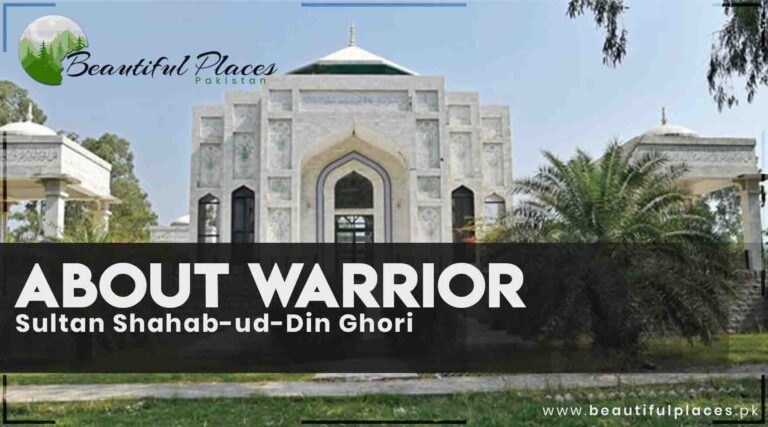
The Indian army named their missile after Prithvi Raj since Shahab-ud-Din had defeated him two times, the Pakistan army named their medium-range ballistic missile Ghori Missile to give him a tribute. The tomb of this brave general is beyond Dina, 13 km on the right side of the Chakwal motorway in Dhamiak village.

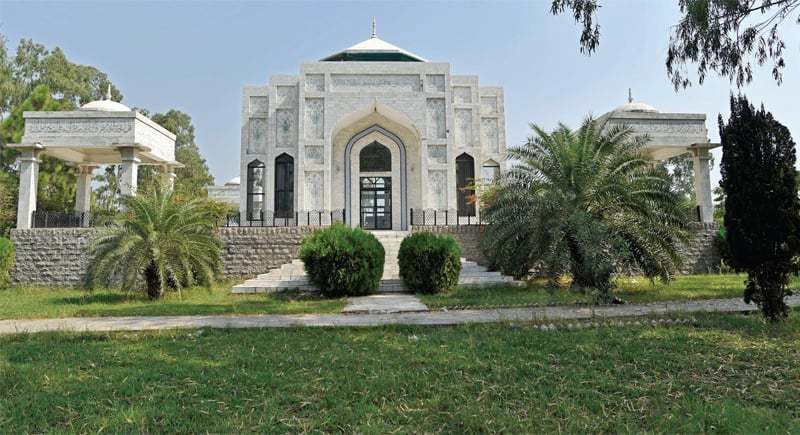
 tomb-of-sultan-shaha-ud-din-ghori
Beautiful shrine of brave sultan Shahab-dd-din Ghori who conquered Delhi

Key information about Warrior Sultan Shahab-ud-Din Ghori 

Attribute Warrior Sultan Shahab-ud-Din Ghori
Full Name Shahab-ud-Din Ghori
Title Sultan
Born 1149
Died 15 March 1206
Birthplace Shywa, Ghor Province, present-day Afghanistan
Dynasty Ghurid Dynasty
Role Founder of the Ghurid Empire, military leader
Notable Campaigns Conquest of Ghazni (1173), Expansion into Northern India
Contribution Played a key role in the establishment of the Delhi Sultanate in Northern India
Major Battles Battle of Tarain (1191), Battle of Tarain (1192) against Prithviraj Chauhan
Death Assassinated in 1206 by Khokhar tribesmen
Legacy Laid the foundation for the Ghurid Empire and influenced the political landscape in Northern India

Warrior Sultan Shahab-ud-Din Ghori

In the annals of history, the name Shahab-ud-Din Ghori resonates as that of a formidable warrior and the founder of the Ghurid Empire. Born in 1149 in Shywa, Ghor Province (present-day Afghanistan), Shahab-ud-Din Ghori left an indelible mark on the medieval world through his military prowess and strategic acumen. This article delves into the life and legacy of this warrior sultan, exploring his conquests, major battles, and the lasting impact he had on the political landscape of Northern India.

Early Life and Rise to Power

Shahab-ud-Din Ghori hailed from the Ghorid tribe, a group with a strong martial tradition. Little is known about his early years, but by the late 12th century, he emerged as a prominent figure in the region. Ghori, along with his brother Ghiyath-ud-Din, seized control of the Ghurid dynasty after the death of their uncle.

Military Campaigns and Conquests

The military campaigns led by Shahab-ud-Din Ghori were marked by audacity and strategic brilliance. In 1173, he captured the city of Ghazni, a significant center in the region. This conquest laid the foundation for the expansion of the Ghurid Empire into the Indian subcontinent.

Expansion into Northern India

Shahab-ud-Din Ghori’s most notable and consequential campaigns were in Northern India. The Battle of Tarain, fought in 1191 against the formidable Rajput ruler Prithviraj Chauhan, showcased Ghori’s tactical prowess. Although he faced defeat in this battle, Ghori returned the following year in 1192 for the Second Battle of Tarain, where he emerged victorious. This victory paved the way for the establishment of the Delhi Sultanate, with Ghori as its first Sultan.

Legacy and Impact

Shahab-ud-Din Ghori’s legacy lies not only in the territories he conquered but also in the political structures he established. The Delhi Sultanate, which endured for centuries, was a testament to his vision and leadership. Ghori’s conquests in Northern India laid the groundwork for subsequent Muslim rule in the region, influencing the course of Indian history.

Major Battles and Assassination

The Battle of Tarain, both in 1191 and 1192, are pivotal chapters in Ghori’s military career. His victory in the latter battle solidified his control over Northern India. However, his reign was cut short when he was assassinated in 1206 by Khokhar tribesmen while on an expedition.

Sultan Shahab-ud-Din Ghori

Sultan Shahab-ud-Din Ghori, born in 1162 in the Ghor region of present-day Afghanistan, emerged as a formidable warrior and a key figure in medieval Islamic history. Founder of the Ghurid dynasty, Ghori’s influence extended far beyond his birthplace, shaping the destiny of the Indian subcontinent.

The Battle of Tarain (1191)

Ghori’s military prowess came to the forefront in the Battle of Tarain in 1191, where he secured a decisive victory over Prithviraj Chauhan. This historic battle marked the beginning of Islamic rule in Northern India and showcased Ghori’s strategic brilliance in navigating the diverse terrains and challenges of the subcontinent.

Visionary Leadership

Beyond conquest, Ghori was a visionary ruler committed to establishing a stable and enduring empire. His strategic governance included the appointment of trusted governors to oversee different regions, fostering unity among the diverse populations. This laid the foundation for the Delhi Sultanate, leaving a lasting impact on the cultural and architectural landscape of India.

Clash of Titans

Ghori’s encounters with the legendary Indian warrior Prithviraj Chauhan added a complex layer to his legacy. Their rivalry, celebrated in historical accounts and epic poetry, symbolized the clash of civilizations and highlighted the intricate interplay of power, ambition, and cultural exchange in the medieval period.

Legacy and Enduring Impact

Sultan Shahab-ud-Din Ghori’s life and achievements constitute an intriguing chapter in Islamic and Indian history. His legacy extends beyond mere conquest, encompassing the enduring impact of institutions and cultural exchanges that characterized his reign. Ghori’s story serves as a testament to the complexities of historical narratives, where warriors are not only agents of conquest but also architects of enduring civilizations.

Frequently Asked Questions (FAQs)

Who was Sultan Shahab-ud-Din Ghori?

Sultan Shahab-ud-Din Ghori, born in 1162 in the Ghor region of Afghanistan, was a formidable warrior and the founder of the Ghurid dynasty. He played a crucial role in medieval Islamic history, particularly in the establishment of Muslim rule in Northern India.

What was the Battle of Tarain, and why is it significant?

The Battle of Tarain (1191) was a historic clash between Sultan Ghori and Prithviraj Chauhan. Ghori’s decisive victory marked the beginning of Islamic rule in Northern India, shaping the course of regional history. It showcased Ghori’s strategic brilliance and military prowess.

How did Sultan Ghori contribute to the establishment of the Delhi Sultanate?

Sultan Ghori was a visionary leader who aimed for stability in his empire. He appointed trusted governors to oversee various regions, fostering unity among diverse populations. This governance model laid the foundation for the Delhi Sultanate, contributing significantly to the cultural and architectural development of India.

Can you elaborate on the rivalry between Sultan Ghori and Prithviraj Chauhan?

The rivalry between Ghori and Prithviraj Chauhan is legendary, celebrated in historical accounts and epic poetry. It symbolizes the clash of civilizations and reflects the intricate dynamics of power, ambition, and cultural exchange in the medieval period.

What is Sultan Ghori’s lasting legacy?

Sultan Shahab-ud-Din Ghori’s legacy goes beyond military conquest. His visionary leadership and governance model left an enduring impact on the Indian subcontinent. The Delhi Sultanate, established under his influence, became a significant cultural and architectural force in the region.

How is Sultan Ghori remembered in historical narratives?

Sultan Ghori is remembered as a complex figure in historical narratives. While celebrated for his military achievements, his legacy also encompasses the nuanced interactions and cultural exchanges that characterized his reign. He is seen as a key architect of enduring civilizations in the medieval period.

What are some key cultural and architectural contributions attributed to Sultan Ghori?

Sultan Ghori’s governance and establishment of the Delhi Sultanate contributed to the cultural and architectural development of India. The fusion of Islamic and Indian styles in art and architecture is one of the notable contributions attributed to his reign.

Wind Up Lines

Sultan Shahab-ud-Din Ghori, a figure etched in the sands of time, emerges as a legendary warrior whose valor resonates through history. His tales wind through the annals of bravery, each battlefield conquered adding a stroke to the grand tapestry of courage. As the curtain falls on the stage of war, Ghori’s legacy stands tall, a story winding up like a scroll of conquest. In the symphony of battles, his victories crescendo, echoing as a timeless melody across epochs. Sultan Shahab-ud-Din Ghori, a name carved into the mosaic of warriors, leaves behind a lasting imprint, his saga winding up with each chapter of valor, a mark on the canvas of bravery and conquest.

All About Pakistan – An Overview

0

A glimpse of Pakistan

Islamic Republic of Pakistan (اسلامی جمہوریہ پاکستان)

Capital Islamabad
Total area 881,888 sq. km
Punjab Province’s area 205,344 sq. km
Sindh Province’s area 140,914 sq.km
Khyber Pakhtunkhwa Province’s area 74,521 sq.km
Gilgit Baltistan Province’s area 72,496 sq.km
Fata’s area 27,220 sq. km
Province Balochistan’s area 347,190 sq. km
Islamabad’s total area 906 sq. km
Total Population About 22 crores
Religion 95% Muslims 5  % other religions
Currency Pakistan Rupee
National Language Urdu
Official Language English

A look at the history of Pakistan

  • 8000 B.C,  Mehrgarh is an ancient city built with red bricks
  • 3000 B.C,  Indus Valley Civilization, Mohen Jodaro, and Harappan Civilizations
  • 1700 BC, the Arrival of Aryans from Central Asia. Arya wrote Rigveda Maha Bharat
  • 516 B.C., Gandhara civilization. Pushkalavati (Charsadda) and Taxila are is to be its capital.
  • 325 B.C., The arrival of Alexander the Great in Hund, Taxila, Salt Range, and returning through  Makran Desert.
  • 321 B.C., Chandragupta Maurya founded the Moorish Empire. His grandson Ashoka converted to Buddhism and spread Buddhism in the subcontinent.
  • 60 AD, the Arrival of Kashan from Central Asia. They made Kabul their main capital while Peshawar was called their winter capital
  • 711 A.D,  Muhammad Bin Qasim entered Pakistan till Multan and Islam flourished in that era.
  • In 870 AD, Hindu Shahi made Hund the capital and ruled for about 1020 days.
  • During 979-1030, Mehmood Ghaznavid attacked the subcontinent for 17 times.
  • 1129 A.D,  Shahabuddin Ghori, Khilji, Tughluq, Lodhi and Suri dynasties.
  • 1221 AD, the Arrival of Genghis.
  • 1469,  Birth year of Baba Guru Nanak of Sikh religion
  • 1526, defeating Ibrahim Lodhi in the field of Panipat and Zaheer Uddin Babar set the foundation of
  • the Mughal Empire.
  • 1540-45, Sher Shah Suri and Babur fight
  • 1556-1605, Mughal Emperor Jalaluddin Akbar took over the government.
  • 1605-1627, Jhangir’s era ( A true lover of art) He promoted the Persian language and worked for it.
  • 1627-1658, Mughal Emperor Shah Jahan built the Taj Mahal, Agra, Shalimar Bagh, Lahore, Jahangir tomb, and Shahi mosque Thatta.
  • 1658-1707 AD, Aurangzeb Alamgir’s reign. Shahi Masjid Lahore was built
  • In 1739 D, Arrival of Nader shah from Iran.
  • In 11740-1773, Ahmad Shah Durrani, the ruler of Afghanistan, conquered Punjab, Kashmir, and Sindh.
  • In 1799-1 839, Ranjit Singh ruled as Maharaja.
  • In 1843, Sir Charles Napier captured Sindh.
  • In 1846, The British gave Kashmir to Gulab Singh.
  • In 1849, the British occupation of Punjab.
  • In 1857, the war of independence was fought.
  • In 1858, British rule was established.
  • In 1877, Queen Vitoria assumed the title of” queen of India “.
  • In 1887, Balochistan came under the control of the British.
  • In 1906, the All India Muslim League was established.
  • In 1940, The Pakistan resolution was presented.
  • In 1947, On August 14, the Islamic state of Pakistan came into being on the world map.
  • 1948, Death of Quaid-e-Azam. Pakistan and India fought over the Kashmir issue.
  • In 195, Prime Minister Liaquat Ali Khan was martyred in Liaqat Bagh Rawalpindi.
  • In 1956, The Constitution was passed.
  • In 1965, On September 6, India attacked Pakistan in the dark of night.  (The war ended after 17 days with the intervention of the United Nations).
  • In 1969, Yahya khan took over the government.
  • 1970-1977, Zulfiqar Ali Bhutto was the Prime Minister.
  • In 1972, The region of East Pakistan separated from West Pakistan and became Bangladesh,
  • 88, General Zia-ul- Haq imposed martial law.
  • In 1979, Prime Minister Zulfiqar Ali Bhutto was hanged.
  • In 1988, General Zia-ul-Haq died in a plane crash along with top military leadership.
  • During 1988-1990, Ms. Benazir Bhutto was elected as the first woman Prime Minister.
  • 1990-1993, Mian Muhammad Nawaz Sharif assumed the post of Prime Minister.
  • 1993-1996, Mrs, Benazir Bhutto became the Prime Minister for the second time.
  • During 1997-99 Mian Muhammad Nawaz Sharif became the Prime Minister for the second time.
  • In 1998, Pakistan responded to India’s five nuclear blasts with seven blasts and received the honor of being the first ever atomic power among the Muslim States.
  • 1999-2008 General Pervez Musharraf took over the elected government of Mian Muhammad Nawaz and he was sent to Saudi Arabia.
  • In 2001, 9/11 happened.
  • On 8th September 2005, more than 80,000 People lost their lives to severe earthquakes.
  • In 2007, Mian Muhammad Nawaz Shan returned from Saudi Arabia.
  • In 2008, Ms. Benazir Bhutto left the world at Liaquat Bagh Rawalpindi and Asif Ali Zardari was elected President.
  • During 2008-2013, Syed Yusuf Raza Gilani became the prime minister.
  • In 2013, Mian Muhammad Nawaz Sharif will be elected Prime Minister for the third time with a huge majority.
  • In 2013 ‘Mamnoon Hussain was elected as the President of Pakistan.

Languages & Dialects

Urdu, English, Punjabi, Sindhi, Balochi, Pashtu, Saraiki, Shina, Balti, and Khwar in northern areas.

Major Cities

Archaeological Sites or Traces

Mohan Jodaro, Harappa ,Taxila, Digikot, Mahar Garh, Takht Bhai, Swat

Ancient & Modern Masterpieces of Architecture

  • Faisal Mosque Islamabad
  • Shah Jahan Mosque Thatta
  • Makli Graveyard Thatta
  • Rani Kot Fort Dadu
  • Shrines or cemeteries in Uch Sharif
  • Badshahi Mosque in Lahore
  • Shahi Qila Lahore
  • Shalimar Garden Lahore
  • Masjid Wazir Khan
  • Jahangir’s tomb in Lahore
  • Rohtas Fort Jhelum
  • Derawar Fort in Cholistan, Bahawalpur
  • Noor Mahal Bahawalpur
  • Bhong Mosque in Rahim Yar Khan

Famous Glaciers

Glacier’s Names

Region

Length (Km)

Siachen Karakoram – Baltistan 72.4
Hispar Karakoram – Nagar 61.2
Biafo Karakoram – Shigar 59.5
Balturo Karakoram -K2 57.7
Batura Karakoram – Hunza 64.4
Yanganta Karakoram – Baltistan 35.4
Chia Hindukush – Chitral 33.8
Tirich Hindukush – Chitral 29
Atrak Hindukush – Chitral 29
Karombar Hindukush – Chitral 25.5

Large Rivers

Rivers

Length (km)

River Indus 2896
River Jhelum 825
River Chenab 1242
River Ravi 901
River Sutluj 1551
River Beas 398

Elevated Peaks (more than 8000 meters)

Peak’s name

Height (meters)

K-2 8611
Nanga Parbat 8126
Gasherbrum – I 8068
Broad Peak 8047
Gasherbrum – II 8035

Famous Passes in Pakistan

Passes’ Name

Site / Province

Khyber Pass Khyber Paktunkhwa (KPK)
Kurram Pass Khyber Paktunkhwa (KPK)
Tochi Pass Khyber Paktunkhwa (KPK)
Gomal Pass Khyber Paktunkhwa (KPK)
Khunjerab Pass Khyber Paktunkhwa (KPK)
Bolan Pass Gilgit Baltistan
Lowari Pass Balochistan

 Deserts in Pakistan

Name of the desert

Location/City/Province

Thar Desert Tharparkar Sindh
Cholistan Desert Bahwalpur Division Punjab
Thal Desert Layyah, Jhang, Punjab

Beautiful Lakes in Pakistan

Lakes’ Name

Location/ City/ Province

Lake Manchar Thatta Sindh
Keenjhar Lake Sindh
Hanna Lake Quetta, Balochistan
Saif-ul-Malook Mansehra KPK
Lulusar Lake Mansehra KPK
Mahodhand Lake Swat KPK
Shangrilla Lake Skardu Baltistan

Museums of Pakistan

  • Museum of natural history (Bahawalpur zoo) (1942) Bahawalpur
  • Archaeological Museum (the 1960s) Bhumbore Thatta
  • Bhatt Shah Cultural Museum. Local art and musical instruments (1962) Bhat Shah
  • Dir Museum Archaeological Chakdra. Dir
  • Agricultural Museum (University of Agriculture) Agriculture(1909) Faisalabad
  • Gaddu Barrage Museum (Barrage-related items)
  • Archaeological Museum (1926) Harappa Sahiwal
  • Education Museum (University of Sindh) (1959) Hyderabad
  • Sindh Provincial Museum (related to Indus Civilization, Islamic and British), Hyderabad
  • Talpur Museum (Fort Museum) Talpur Family Items Hyderabad
  • Folk and Heritage Museum (Folk Heritage, Culture of Pakistan) (1973) Islamabad
  • Pakistan Railway Heritage Museum (Golra Station) History of Railways Islamabad
  • National Museum of Natural History Islamabad
  • Pakistan monument museum Reflecting the History of Pakistan Islamabad”
  • Aiwan Rifaf and Art Gallery Painting Karachi
  • Maritime Museum Karachi Associated with Pakistan Navy
  • PAF Museum Karachi Associated with Pakistan Air Force
  • Archaeological Museum (Karachi University) (1955) Karachi
  • Karachi Municipal Aquarium (Clifton) Karachi
  • Karachi Zoological Gardens (Mammals, Reptiles, Birds, and Fish)
  • National Museum of Pakistan (1950) Karachi
  • Natural History Museum (Karachi University) (1950 ) Karachi
  • Quaid-e-Azam Birth Palace (Wazir Mansion) (1953) Karachi
  • Quaid e Azam Museum (Personal belongings of the founder of Pakistan)
  • State Bank Museum (Information from the beginning of currency to today’s) Karachi
  • Fort Museum (Shahi Qila) (1928) Lahore
  • Chaughtai Museum Artworks of painter Abdul Rahman Chaghtai (1977 Lahore)
  • Lahore Faqir Khan Museum ( brought rare art pieces of Muslim, British and Sikh eras)
  • Natural History Museum (Jaloo Park) (1987) Lahore
  • Allama Iqbal Museum ( Personal items of Allama Iqbal (1976)) Lahore
  • Lahore  Archaeological Museum ( Muslim, Buddhist, and English period items (1864)) Lahore
  • Islamic Museum (Badshahi Masjid),(Islamic holy objects) Lahore
  • Science Museum (Engineering University Lahore
  • Natural History Museum (Government College University) (1910) Lahore
  • Shah Karmii Museum Personal belongings of artist Shakir Ali (1975) Lahore
  • Mangla Dam Site Museum Mangla Dam related to the construction of Mangla Dam
  • Archaeological Museum (1925) Moin Jo Daro
  • Air Force Museum (1964) Peshawar
  • Archaeological Museum (University of Peshawar) Peshawar
  • Islamia College University Museum (1934), Peshawar
  • Air Force Museum (1962), Peshawar
  • Archaeological Museum (Muslim, Buddhist Periods (1907 AD)) Peshawar
  • Archaeological Museum (1972) Quetta
  • Botanical Museum (Garden College) (the 1930s) Rawalpindi
  • Forest Museum (1962), Peshawar
  • Army Museum (1961), Rawalpindi
  • Swat Museum (Muslim, Gandhara Civilization (1959))
  • LAYOD Museum Sukkur, related to Sukkur Barrage
  • Talpur House Museum Personal Items – Tando Muhammad Khan – Hyderabad
  • Taxila Museum Gandhara Civilization (1918) Taxila
  • Umarkot Museum Umarkot related to the reign of King Akbar
  • Allama Iqbal Museum (at Allama Iqbal Birthplace) Sialkot

Windup Lines

Pakistan is not only a land of diverse landscapes and rich history but also a nation with a vibrant culture and a hospitable population. From its ancient archaeological sites to modern architectural marvels, the country offers a unique blend of heritage. Its towering peaks, majestic glaciers, and breathtaking lakes make it a paradise for adventure seekers.

As you explore this remarkable nation, you’ll encounter the warmth of its people and the echoes of a history that spans millennia. Whether you’re trekking in the northern mountains, wandering through the bustling cities, or admiring the cultural treasures, Pakistan offers an unforgettable journey.

Fascinating Tourist Destinations in Kaghan Valley

Kaghan Valley

Kaghan valley is one of the most beautiful valleys in Pakistan. It is renowned for its high mountains and blue water lakes. Sky-high snow-capped mountains, lush green forests, jumping streams, glaciers, and melodic waterfalls, are the identity of this valley.

It has an area of 1627 km stretching from Balakot to Babusar Pass. This valley with a length of 161km has Gilgit in the north, heavenly beautiful Azad Kashmir in the east and the south, and Kohistan range in the west.

Load more ATTACHMENT DETAILS Danna-Meadows-kaghan-valley-kpk.
Animals grazing in the rich green meadows of Danna Valley -Kaghan KPK

The climate is cold. The tourist season is from May to mid-October. While May to September is an ideal season because the temperature ranges from 5 centigrade to 20 centigrade. The moon soon season is from mid of July to the mid of mid-August. Therefore, it is land sliding in these areas during rain. The roads are blocked as a result.

Check the details about the weather of Kaghan valley from www.pakmet.com.pk before visiting.

Details of Kaghan Valley

Attribute Information
Location Northern Pakistan, in the Hazara region
Area Approximately 1,627 square kilometers
Geographical Features Sky-high snow-capped mountains, lush green forests, rivers, glaciers, waterfalls
Climate Cold, with the tourist season from May to mid-October
Accessibility Well-connected by road from major cities like Karachi, Peshawar, Faisalabad, Lahore, and Rawalpindi
Transportation Public transport and jeeps available; some areas accessible only by jeep
Tourist Attractions Bala Kot, Mountain Biking, Jeep Safari, Horse Riding, Shogran, Siri Meadows, Paye Meadows, Koh Makra, Paras, Sharan, Darshi, Musa Ka Musalla, Shino, Jared, Mahandri, Manoor Gali, Khanian and Danna Meadows, Kaghan Town, Shangri Top, Glaciers
Unique Features Lush green meadows, towering mountains, and a diverse range of adventure activities
Notable Events Kaghan Valley Festival, local fairs, and cultural celebrations

Travel Guide

Public Transport of every kind is available for Mansehra from Karachi, Peshawar, Faisalabad, Lahore, and Rawalpindi. A wagon can be booked from Mansehra to Kaghan valley. You can stay during your journey. It is better to reach there via a jeep from Mansehra or Bala kot.

The jeep can take you to the areas where it is impossible to reach by car or wagon. Besides this, Suzuki vehicles will take you to Babu Sar top. But you will have to hire a jeep for Siri Paye, Shogran, Lala zar, and Saif-ul-maluk lake. You will have to pay the rent per day. It is advantageous to visit these areas by a jeep, as you can stay where you want. PTDC coster leaves at 9 am daily from Flash Main hotel Rawalpindi for Naran.

Tourist Destinations & Adventures in Kaghan Valley

1- Bala Kot

The historical city of Bala Kot at a distance of 40km from Mansehra is called the door to Kaghan valley. Bala Kot has a meaning of high fort. It is also called Bala Kot since it is located on a high hill. It is spreading over an area of 10 square kilometers.

Bala Kot city with an altitude of 3226 feet above sea level is located on both sides of the river Kahnar (Kunhar). The river Kanhar flows from the north to the south by playing tricks, shaking its head, blowing foam, and swinging. The river is wide before the Bala Kot boundary on the right side. The river is calm here. There are many picnic spots near the river. You can enjoy it there too.

Kaghan-balakot-kunhar-river-kpk.
River Rafting is a thrilling experience in river Kunhar Balakot

When the Mujahideen movement started in the Sikh era, the Maharaja Ranjeet Singh had to face a lot of trouble because of this movement. Its founders were Syed Ahmad Shaheed and Shah Ismail Shaheed. Their graves are in Bala Kot. These graves were destroyed in the earthquake of 2005.

2- Mountain Biking

Bala Kot to Babusar Top Trekk is the best trek for adventurous tourists fond of cycling. This track with ice-capped sky-kissing mounts, dancing streams, and singing rivers has its own charm.

3- Jeep Safari

You can go to Kaghan Valley in your own vehicle. But, there are some areas where you cannot reach by car. Therefore, it is an ideal site for Jeep Safari. You can go Bala Kot to Babusar top, Shogran, Paye, Upper Kaghan, Shatran, Lake Saif-ul-Malok, Lala Zar, Noori Top, and other places to enjoy the thrill and adventure of Jeep Safari.

4- Horse riding

Kaghan valley is a perfect place for horse riding. Horses can be found easily from Naran, Lake Saif-ul-malook, Lala Zar, Siri Paye, and Siri. You can enjoy yourself there with your family. You will remember the horse ride in the Kaghan valley, around the Saiful Muluk Lake, and from Basil to Dudipatsar.

 horse-riding-kaghan-kpk
Horse Riding is an unforgettable experience in Kaghan Valley

5- Kewai

Kewai town is 26km from Balakot on the Naran main highway. Its old name was Kewari. Kwari has a meaning of door or gate in the Hindi language. A trail goes to Shogran and Siri Paye from the right side of Kewai.

6- Shogran

Shogran is 8km from Kiwai at an elevation of 7750 feet above ocean level. Shogran has a meaning of beautiful place or settlement. A slopy climbing road from Kewai will take you to the captivating Shogran site by passing through Pines and Sanober trees.

 shogran-kagahn-kpk.
An alluring sight of snow clad mountains of Shogran attracts the holidaymakers

The charming sight of the route will take refresh you. Ice-tipped mountains and luxuriant plains will give you a pleasant feel. The climate keeps changing here. The sky is clear. Gradually, dark grey clouds will surround you. Light rain will start in a few moments. The sky will be fair in no time. This repeats many times in a day.

Stay here for at least two days to fully enjoy the weather. There are hotels for residence, and markets for shopping. Special vehicles are required to reach Shogran as it is situated on the height. Hire a jeep from Kewai and park your car there. The jeeps from here will take you to Siri and Paye Meadows.

7- Siri Meadows

The enchanting Siri Meadows is 5km from Shogran at a height of 8500 feet from sea level. It is extremely attractive because of its thick tall trees, lush green grass, and captivating clean environment. There is a lake between velvet flowers and fertile green plains too. You can enjoy camping. You must have foodstuff along with you. One can reach there via jeep or on foot because of the difficult path.

 Siri-paye-lake-Shogran
A heavenly beautiful lake in between the lush green Siri Meadows

8- Paye Meadows

A beautiful meadow of Paye is situated on the foothills of the Makra mountains at an altitude of 9500 above sea level. It is 3km beyond Siri. The alluring pastures of the Paye are compared with the Melbourne Cricket Stadium of Australia (It is said that this stadium is the most beautiful green ground in the World).

You will forget Melbourne after visiting Paye Meadows. Stay for a day in this valley to enjoy the thundering clouds and varying weather. You can buy some stuff from here but it is better to have all the belongings from Shogran. A lake has been formed due to rain. A plant is also found there similar to the shape of a snake.

 makra-peak-kaghan-paye-meadows
Makra Peak Paye Meadows is among the favourite trekking sites for hikers

9- Koh Makra

Above Paye, at an altitude of 14,000 feet is the peak of Koh Makra. This area has an abundance of wildflowers, herbs, and shrubs. Physicians and medical herbalists are seen here in search of herbs.

10- Paras

A giant tree of Deodar Cedar is on the way to Kaghan from Kewai. According to locals, this tree is 2000 years old. Paras Town is famous for its apple orchards at a distance of 5km from Kiwai. It is said that there found a special stone that changed into gold after hitting by iron. But no one has found it yet. The river is too close to the road here. It seems that they are embracing each other.

11- Sharan (Shatran)

Sharan is located at an elevation, 15km away from the highway on the left side of Paras. It is at an altitude of 7,500 feet above sea level. One can reach there in 1.5 hours by jeep. It is a place of velvet green grounds fenced by lush green thick forests. Wildlife and beautiful birds are there too. There is a rest house and a youth hostel for a stay.

12- Darshi

Darshi’s forest is 4km from Sharan. There is a pedestrian track. A folk tale of Darshi and Munshi is famous about this forest. A local will tell you the story.

13- Musa (A.S) ka Musalla (prayer mat)

Musa Ka Musalla (Musalla has a meaning of prayer mat) is at a height of 13,500 feet from ocean level. You can reach this spot on foot from Darshi’s forest via Nadi Bangla. Two narrations are associated with this site. It is said that Prophet Hazrat Musa (A.S) offered a prayer here. According to a second narration, a pious man named Musa used to worship here on musalla (prayer mat).

 musa-ka-musalla-kaghan-kpk
Musa ka musalla Kaghan Valley

14- Shino

Shino Town is beyond Paras. Shino has a meaning of sacred water. There is a hatchery department for trout fish by the fisheries department of Khyber Pakhtunkhawa (KPK). The trout from here are left into Dodipatsar lake, Saiful Muluk Lake, and the river Kunhar.

15- Jared

Jared is forward to Shino at a distance of 40km from Balakot. There are domestic industries for walnut wood furniture. In addition to this, there are Numda, mats, rugs, carpets, woolen shawls, and blankets Khadi. A handicraft development center and a shop are established there by the government of Pakistan.

16- Mahandri

Mahandri Town is at an elevation of 5050 feet above ocean level at a distance of 4km from Jared. Mahan is the name of a place where two rivers confluence in the local language. Here, the river Manoor convergences with the river Kanhar. The curd of Mahandri and the cold water of the river Manoor are famous. The jeep travels along the Manoor stream (coming from the east) towards the Valley Manor. The Kach Gali, Biari, and Bela points come the way to the jeep track and pedestrian. This same beautiful track reaches Lake Saiful Muluk. Take a guide, camping stuff, and belongings to enjoy this captivating pedestrian.

 Mahandri_kaghan-valley
Snowy tracks of Mahandri are ideal for snow sports

17- Manoor Gali

Manoor Gali is at a height of 12,200 feet from sea level. A trail goes to Saif-ul-Malook Lake and Ansu Lake from the right side of Mahandri. Splendid sights will travel along with you on this track. You will not find the scenery of this route anywhere else in Kaghan Valley. The government doesn’t pay heed to the development of this point. Therefore, it is not famous among holidaymakers.

18- Khanian and Danna Meadows

Khanian point is at an elevation of 7626 feet above ocean level. The river’s waves are so noisy and fast here because of the narrow valley at this point. A jeep track on a solid road from Khanya will take you to the height of Danna Meadows.

This point at a distance of 15km is a 1-hour drive track and 3 hours pedestrian track. There are dangerous turns too. But the beauty of these meadows above 9500 feet will mesmerize you. Danna Meadows is renowned for the production of Golden, Umber, and King golden apples.

 riverside-khanian-resort-kaghan-
A beautiful tourist resort in Khanian, Kaghan Valley

19- Kamal Ban

Kamal Ban forest is 6km from Danna. There is a rest house by the UK in this area. This forest rest house was established in 1924 at a height of 6,500 feet from sea level. It is one of the oldest rest houses in this area.

20- Kaghan Town 

Kaghan Town is 59km from Balakot and 6km from Khanya on the main highway. This whole valley is recognized because of this Kaghan Town at an altitude of 6650 feet above ocean level.

According to ancient tales, the ruler of this valley was a Hindu female Kagi. The name of this site was Kagan after her name. It transformed into Kaghan with the passage of time. Sarwal peak is the highest top in the suburb of Kaghan at an elevation of 13,529 feet. There are spacious meadows in the northeast and beautiful villages are situated around.

There are facilities for staying and dining for the tourists. Vacationers on a long trip stay here for at least one day. Honey and cow’s ghee are considered among the best gifts of Kaghan. When the mountains are snow-clad in the winter, then Kaghan is the last point to reach via transport.

21- Shangri Top

The beautiful point of Shangri is at an altitude of 12,700 feet in the north of Kaghan Town. One can reach Khuli Gatti via jeep. And then a journey of two hours will take you to an extremely attractive site of Shangri. People can enjoy the scenery of Musa ka Musalla, Danna Meadows, Kaghan, Koh Makra, and Naran mountain ranges from the Shangri top.

22- Glaciers

It was difficult to cross three to four huge glaciers on the way to Naran from Kaghan a few years ago. But now a proper track has been built by cutting glaciers through modern technology. The thrill of those moments will be remembered for a long time as you sit in the car and pass through the high walls of snow on both sides of the road. You will see such high snow walls from Naran towards Batta Kundi.

FAQs

1. What makes Kaghan Valley a popular tourist destination?

Kaghan Valley is renowned for its stunning natural beauty, including snow-capped mountains, lush forests, and vibrant meadows. It offers a range of adventure activities, making it a favorite among tourists.

2. What is the best time to visit Kaghan Valley?

The ideal time to visit Kaghan Valley is from May to mid-October, with the peak tourist season from May to September. The monsoon season is from mid-July to mid-August, but landslides can occur during heavy rain.

3. How can tourists access Kaghan Valley?

Kaghan Valley is accessible by road from major cities like Karachi, Peshawar, Faisalabad, Lahore, and Rawalpindi. Public transport and jeeps are available for transportation within the valley.

4. What are the adventure activities available in Kaghan Valley?

Kaghan Valley offers adventure activities such as mountain biking, jeep safaris to remote areas, horse riding, and trekking. Visitors can explore meadows, lakes, and mountain peaks.

5. What are some of the must-visit locations within Kaghan Valley?

Must-visit locations include Bala Kot, Shogran, Siri Meadows, Paye Meadows, and Shangri Top. These areas are known for their natural beauty and unique attractions.

6. Are there accommodations and dining facilities available in Kaghan Valley?

Kaghan Valley offers a range of hotels and restaurants to cater to the needs of tourists. Visitors can find suitable places to stay and enjoy local cuisine.

7. What are the unique features that set Kaghan Valley apart from other destinations?

Kaghan Valley’s unique features include its captivating landscapes, adventure opportunities, and a diverse range of activities for nature enthusiasts and thrill-seekers.

8. Is there a famous festival or event that tourists can attend in Kaghan Valley?

Kaghan Valley hosts the Kaghan Valley Festival and local fairs, providing tourists with a chance to experience the local culture and traditions.

9. How can tourists make the most of their visit to Kaghan Valley?

To make the most of their visit, tourists are encouraged to explore the diverse attractions, engage in adventure activities, and immerse themselves in the valley’s natural beauty.

10. Are there any safety precautions that tourists should be aware of when visiting Kaghan Valley?

Visitors should be cautious during the monsoon season, as landslides can occur. It’s advisable to check weather conditions and travel advisories before planning a trip.

Wind Up Lines

Kaghan Valley is like a paradise on Earth. It’s charming valleys, snow-capped mountains, luxuriant pastures, and plains, and trekking sites attract tourists and climbers.

Tourist Sites of Mansehra | Dadar Valley | Sirikot | Ashoka Rocks

Mansehra

Manshera city and district is ahead of Hazara Valley at a distance of 22km from Abbottabad. It was settled by Sikh ruler Man Singh of this area. It is named Mansehra after him.

 Mansehra_Snow_fall.
An alluring aerial view of Mansehra covered in snow

This centuries-old city is related to the Buddhism religion too. The proof of this is Ashoka Rocks. The Resham Highway or Karakoram highway goes straight from here. While the Kaghan valley is on the right side. Mansehra is the base camp for Kaghan Valley. You can book a jeep or Suzuki for the valley. However, Jeep is a better option.

Details of Mansehra

Attribute Information
Location Located in the Hazara region of Pakistan
Province Khyber Pakhtunkhwa
Altitude Approximately 1,020 meters (3,350 feet) above sea level
District Mansehra District
Population Approximately 98,000 (as of the last available data)
Major Language Urdu, English, and Hindko (local language)
Geography Surrounded by picturesque mountains and natural beauty
Historical Sites Shahi Mosque, Gurdwara Siri Guru Singh Sabha, and more
Nearby Attractions Kaghan Valley, Naran, Shogran, and Saif-ul-Mulook Lake
Economic Activities Agriculture, tourism, and trade
Transportation Connected by road and accessible from major cities
Notable Events Kaghan Festival, local fairs, and cultural celebrations

Historical and Tourist Spots in Mansehra

1- Gurdwara Siri Guru Singh

This beautiful Gurdwara holds significant importance in the center of Mansehra city. It is situated on Kashmir Road. This building is being utilized as a municipal library these days. It is renovated by the locals.

 gurdwara-siri-guru-singh-mansehra-kpk.
Gurdwara Siri Guru Singh is an asset for Sikh community

2- Ashoka Rock Edicts

A new monarch Chander Gapat Morya, established a state in the north of Ganga, 20 years after Alexander the Great left the Subcontinent. His reign lasted for 100 years in different areas of the Subcontinent. His grandson Ashok become the king in 274 B.C. He was the first ruler who issued orders for the nation and engraved them on the stones.

 Upper_Boulder_with_Inscriptions_-_Mansehra_Rock_Edicts
Upper Boulder with Inscriptions Mansehra Rock Edicts

When he converted to Buddhism, the pain and suffering inflicted on human beings by human hands had a profound effect on his heart that he became against killing not only human beings but also animals. As a head of state, he worked a lot for the progression and promotion of Buddhism. The Morya state tore into pieces after the death of Ashoka in 232 B.C.

His sayings engraved on the stones can be found in different parts of the subcontinent. His orders can be seen on the left side of Bhat Bridge and in the Park in Mansehra.

3- Petra Valley

You can enjoy an aerial view of Mansehra and neighboring areas from the Petra Point hill near Bala Kot Bypass. The day and night view from this top is fascinating.

4- Dadar Valley

A Suzuki van will take you to the Dadar Valley from the Mansehra bus stand which is recognized for the area of Stupas built in the Ashoka era. The sun’s rays on the shiny water of the river Sirin spread like a gold net in the whole valley.

 Dadar_Mansehra_KPK
A wonderful sight of Dadar Valley after rain

It was the favorite of the Britishers because of its healthy and clean environment. They also established a TB (tuberculosis) sanitorium. The trees in the woods in the suburb of the valley at the foothills of sky-scraping mountains, rich green fields, sounds of cascades, and the aroma of Chappal Kebab and Qahwa are awaiting you. Enjoy the thrilling waves of the river Sirin during the fishing.

Two central routes separate from Mansehra. The right turn is directed to Kaghan valley and the left side will take you to Karakoram or Resham highway, Gilgit, Hunza, and Khunjerab Pass.

5- Atter Shisha

A small village is named Atter Shisha on the Balakot Kaghan road a few distances away from Mansehra. It is well known for the story of Mughal King Jahangir and his wife Noor Jahan. They stayed here for some days during their visit to Kashmir.

The queen forgot her perfume and mirror here. It was named Atter Shisha (the name of perfume and mirror in the local language). A track is directed to Muzaffarabad (capital of Azad Kashmir) from Garhi Habib Ullah.

6- Sirikot

When you reach Tilli village from Garhi Habib Ullah via Dargha Sharif the pointed mountain of Sri Kot from the turn shows its appearance wrapped in fog. You will feel like it is December in July since it is located on the peak.

Coming here one realizes that the sweet fragrance of the soil is so much more than the money and it is better to lean against the trees here than to walk under hard sidewalks and modern buildings.

There are signs of Shiv Maharaj Temple and Barari Devi in a nearby village. A rest house, plum, and walnut trees are awaiting you there. The roads are blocked here from January to March because of the snowfall.

img Mansehra Shiva Temple
Mansehra Shiva Temple

FAQs

1. Where is Mansehra located, and why is it known for its tourist sites?

Mansehra is a city in the Hazara region of Pakistan’s Khyber Pakhtunkhwa province. It is renowned for its diverse tourist attractions.

2. What are the most prominent tourist sites in Mansehra, and what makes them special?

Mansehra boasts several tourist sites, each with its unique charm. Could you provide an overview of the key attractions and what sets them apart?

3. How accessible are these tourist sites in Mansehra for visitors, and what transportation options are available to reach them?

Accessibility is crucial for travelers. Can you share information on how tourists can reach the various sites in Mansehra and the transportation options available?

4. Are there any historical or cultural landmarks in Mansehra that visitors should explore?

Mansehra’s history and culture are rich. Are there specific sites or landmarks that offer insights into the region’s heritage?

5. What is the best time to visit Mansehra and its tourist sites for the most enjoyable experience?

Weather and seasons can impact the travel experience. When is the ideal time to explore the tourist sites in Mansehra?

6. Are there any accommodations, restaurants, or facilities available for tourists in Mansehra and its vicinity?

Convenience is essential for travelers. Are there hotels, restaurants, and other amenities to cater to the needs of tourists in the area?

7. What outdoor activities, adventure opportunities, or natural beauty spots are available in Mansehra for visitors to explore?

Nature enthusiasts and adventure seekers often look for outdoor activities. What options are available for them in Mansehra?

8. How do these tourist sites contribute to the overall tourism and economy of Mansehra and the surrounding region?

Tourism can have economic significance. How do the tourist sites in Mansehra benefit the local economy and support the tourism industry?

9. Are there any cultural events, festivals, or traditions in Mansehra that visitors can participate in or witness during their visit?

Local culture and traditions can enhance the travel experience. Are there any specific cultural events, festivals, or traditions in Mansehra that visitors might encounter?

10. Can you recommend any specific itineraries or routes for visitors looking to explore the tourist sites of Mansehra efficiently?

Itineraries and routes can help travelers make the most of their visit. Do you have recommendations for planning a trip to Mansehra’s tourist sites?

Wind Up Lines

Mansehra is a historical city of Khyber Pakhtunkhwa (KPK). It has many traces of the Gandhara civilization and the Buddhism era. Besides this, it is known for its beautiful sights, mountains, and lush green meadows

Abbottabad – A Historical & Beautiful City of KPK

Abbottabad

Abbottabad has situated 71km from Hassan Abdal at an altitude of 4120 feet above sea level. It is spreading over an area of 1967 square kilometers. Fenced by rich green mountains, it was settled by Caption James Abbott.

This city is renowned for its pleasant environment, quality educational institutes, and as a center of educational & training institutes for the Pakistan Army. You will see the defense offices of the Pak Army in different areas of the city since it is the headquarter of the Pakistan Military.

 Harnoi-river-abbottabad-dolores-park.
A splendid view of Dolores Park near Harnoi River Abbottabad

There are facilities of every kind as it is the largest trade center in the region. It has remained the base camp for the tourist visiting Gilgit, Chilas, Kaghan, Naran, and Skardu. The temperature never goes beyond 30 centigrades even in summer.

A beautiful lady garden, Public Library, Pakistan Military Academy (PMA), ancient grand buildings of the British era, Abottabad Museum, St. Luke’s church (the oldest building of Abottabad), Ayub Medical Complex, and Jalal Baba Auditorium are worth watching places.

Shimla is located at the edge of the city on a hilltop. You can enjoy the hiking and beautiful scenery around. This top gives a different view of Abbottabad during the day, night, and in rain. The city looks more beautiful after the rain. The river Harnoi is a good picnic spot there.

Details of Abbottabad

Information Details
Location Abbottabad is located in the Hazara region of Khyber Pakhtunkhwa province, Pakistan. It is situated in the northwestern part of the country.
Altitude The city is at an altitude of approximately 4,120 feet (1,256 meters) above sea level.
Population According to the last available data, the population of Abbottabad is over 1 million. However, it’s essential to verify the most recent population figures for accuracy.
Geography Abbottabad is surrounded by hills and lush greenery, making it a picturesque and relatively cool area compared to other parts of Pakistan. It is known for its scenic beauty.
Climate The city experiences a moderate climate with mild summers and cold winters. It’s an attractive destination for those seeking relief from the extreme heat of other regions in Pakistan.
History Abbottabad has a rich history and was established during the British colonial period. It is named after Major James Abbott, who played a significant role in its development.
Economy The economy of Abbottabad is diverse, with agriculture, trade, and services being the primary contributors. The city has a growing business and commercial sector.
Education Abbottabad is known for its educational institutions. It hosts the Pakistan Military Academy (PMA), which is the premier military training academy in the country. The city also has several universities and schools.
Tourism The city and its surroundings offer numerous tourist attractions, including natural beauty, hiking, and historic sites. Abbottabad serves as a gateway to various hill stations and scenic spots in the region.
Notable Landmarks – Ilyasi Mosque – St. Luke’s Church – Shimla Hill – Thandiani – Harnoi Lake – Jinnah Road (Main bazaar) – Comsats University Abbottabad Campus
Transport Abbottabad is well-connected by road to major cities like Islamabad, Rawalpindi, and Peshawar. The nearest airport is Islamabad International Airport, approximately 120 kilometers away.
Local Cuisine The local cuisine includes traditional Pakistani dishes, as well as regional specialties. Various restaurants and eateries offer a wide range of culinary options.
Culture The culture of Abbottabad is influenced by the ethnic diversity of its residents. Pashto, Hindko, and Urdu are commonly spoken languages. The city hosts cultural events, festivals, and markets that showcase its vibrant culture.

Famous Tourist Spots in Abbottabad

1- Ilyasi Mosque

Nawa Sher Town at the foothills of a cliff below Thandiani in Abbottabad city is renowned internationally for Ilyasi Mosque. There was a natural water spring. Hindus wanted to build a temple there, while Muslims argued to construct a mosque. There was a conflict between them for some time. At last, Muslims succeeded in establishing a mosque there.

People gave a lot of funds for its construction. This splendor mosque is a masterpiece of beautiful architecture. Its walls, roofs, ceilings, and minarets represent Islamic culture and architecture. The weather is pleasant in summer. It is crowded during vacations. Fritters (pakora) shops are considered the best street food outside the mosque.

 Ilyasi-mosque-abbottabad.j
Ilyasi Mosque is a masterpiece of Islamic architecture

2- Sarban

Sarban is a long and heightened mountain of Abbottabad in the east of the valley. It looks charming during the rainy season. Allama Muhammad Iqbal went to Abbottabad before leaving for England for his higher education. He wrote a poem with the name “Abar”. He mentioned Sarban in the first couplet.

اٹھی پھر آج وہ پورب سے کالی کالی گھٹا

سیاہ پوش ہوا پھر، پہاڑ سربن کا

 sarban-abbottabad-pakistan
Beautiful Sarban mountains attracts the tourists

3- Galiyat

Galiyat (also written as Galyat or Galliat) is an attraction for tourists because of its lush green pastures, and high mountains in Abbottabad city. It is rich in natural beauty, sky-kissing trees, and fragrant flowers. Bara Gali, Nahtia Gali, Kala Bagh, Donga Gali, Kala Pani, Shangla Gali, and Khaira Gali are situated from the east of Abbottabad to the West. This same route goes to Murree.

 Galyat-abbottabad-kpk
Luxuriant green meadows of Galyat captivate the vacationers

4- Nathia Gali

It is the official residence of the Khyber Pakhtunkhwa (KPK)‘s Governor for the summer. Specimens of nature’s craftsmanship and ingenuity, the dense forests, the lush greenery, and the trails running right through the middle of the rainforest urge nature-loving tourists to trek and hike. The sunset in this area is mesmerizing.

 Galyat-abbottabad-kpk
Snow capped mountains of Nathia Gali

5- Thandiani 

Thandiani has a meaning of Cold in the local language. In fact, this area is known for its cold. The nights in Thandiani are cold at the time when the air conditioners stop functioning due to the heatwave in South Punjab.

The structure of the mountains around it is such that when the sun rises here it does not rise completely in one go but comes to the fore intermittently and rises completely. This view of the sunrise cannot explain in words.

This site is 2700 meters above sea level and 24km from Abbottabad. It is located at a height on a road. You can reach there via a road. It is a natural hill station. You will always remember the mountain peaks surrounded by lush green forests and cloudbursts.

There are caves on the path to the height. These caves are the residents of wild animals. You will feel as if you are moving towards the sky when you go to Thandiani for the first time. A private wagon from Abbottabad will take you to Thandiani. You can see Peer Panjal’s hills in the east and Nanga Parbat in the north if the sky is clear.

 Thandiani-abbottabad-kpk.
Sky-high rich green mountains of Thandiani

In the Suburbs of Abbottabad

This is Abbottabad too

A historical Gurdwara is in the Gurdwara Bazaar where Maharaja Ranjeet Singh used to come for religious activities. Dhamtour village is in the suburb of the city and in the southeast of Abbottabad.

Cloth is knit by conventional and traditional methods. Relationships of boys and girls for their marriage are established in a conference room (Jirga) adjacent to the mosque. There is no change in the customs and traditions of this area. This village reflects the lifestyle of the Hazara region.

The famous village Satora is 15km from Abbottabad in a valley surrounded by woods. It is a favorite place for nature lovers. The most beautiful villages are near Banda Phagwarian and Dobather Shimla.

FAQs

1. Where is Abbottabad located, and what makes it historically significant?

Abbottabad is located in the Khyber Pakhtunkhwa (KPK) province of Pakistan. It is historically significant due to its establishment during the British colonial period.

2. What is the significance of Abbottabad’s name, and who was Major James Abbott?

Abbottabad is named after Major James Abbott, a British officer who played a key role in its development. He is known for his contributions to the region.

3. How is the climate in Abbottabad, and why is it a popular destination for tourists?

Abbottabad has a moderate climate with mild summers and cold winters. Its pleasant weather and scenic beauty make it a popular tourist destination.

4. What are some of the notable landmarks and attractions in Abbottabad?

Abbottabad is home to various landmarks, including Ilyasi Mosque, St. Luke’s Church, Shimla Hill, Thandiani, Harnoi Lake, Jinnah Road, and Comsats University Abbottabad Campus.

5. How does Abbottabad contribute to the economy of KPK, and what are its primary economic sectors?

Abbottabad’s economy is diverse, with contributions from agriculture, trade, and services. It has a growing business and commercial sector.

6. What role does education play in Abbottabad, and which educational institutions are prominent in the city?

Abbottabad is known for its educational institutions, including the Pakistan Military Academy (PMA). The city hosts universities, colleges, and schools.

7. How can tourists access Abbottabad, and what transportation options are available?

Abbottabad is well-connected by road to major cities such as Islamabad, Rawalpindi, and Peshawar. The nearest airport is Islamabad International Airport.

8. What are the local cuisine and cultural highlights of Abbottabad?

The local cuisine includes traditional Pakistani dishes, and Abbottabad’s culture is influenced by the ethnic diversity of its residents. The city hosts cultural events, festivals, and markets that showcase its vibrant culture.

9. What are some outdoor and adventure opportunities for tourists in and around Abbottabad?

The city and its surroundings offer numerous outdoor activities, including hiking and visits to natural beauty spots and hill stations.

10. How can I learn more about the history, culture, and attractions of Abbottabad before visiting?

To learn more about Abbottabad, its history, culture, and tourist attractions, you can research online, read travel guides, and visit the city’s official websites for information.

Wind Up Lines

Abbottabad City can be considered a hub of tourism. There are many historical and breathtaking sites. Its importance has been enhanced because of the headquarter of the Pakistan Military.

Famous Sites of Hazara – Haripur & Khanpur

Hazara

Hazara is a region of the province Khyber Pakhtunkhawa which is the amalgamation of the cultures of Shina (Kohistani), Pashtun (Swati Pashtu), and Hindko nations. It was called Arasha before the arrival of Islam. When the Mongols invaded the subcontinent, Ameer Taymor conquered Dehli and moved to Hazra via Kashmir.

Details

Aspect Haripur, Hazara Khanpur, Hazara
Location Located in the Hazara region of Pakistan. Situated in the Hazara region, near Haripur.
Prominent Attractions 1. Sardar Haji Muhammad Khan’s Haveli. 1. Khanpur Dam – a major reservoir for water supply and recreation.
2. Tarbela Dam is nearby. 2. Picnic spots and scenic views.
Historical Significance Has historical landmarks and old buildings. Known for the Khanpur Dam, an engineering marvel.
Cultural Landmarks Some historical and cultural sites. The culture is influenced by the dam and its surroundings.
Accessibility Well-connected by road. Accessible by road from nearby areas.
Accommodations Several hotels and guesthouses available. Limited accommodations primarily catering to visitors.
Best Time to Visit Throughout the year, with pleasant weather. Best during the cooler months for outdoor activities.
Outdoor Activities Hiking, sightseeing, and exploring historical sites. Water sports, picnicking, and hiking near the dam.
Economic Contribution Contributes to the local economy through tourism and trade. The dam provides water supply and supports some local businesses.
Local Culture Rich in cultural diversity and traditions. The culture is influenced by the presence of the dam.

He was astonished by the beauty of this area. So, he decided to appoint his army in this area for protection and safety. His army had 1000 Mongols and Turks. It was named Hazra after the group of one thousand military people.

Load more ATTACHMENT DETAILS hhazara-waterfall-jab-valley
Hazraa Waterfall is one of the eight falls near Jab Valley

Hazara has Azad Kashmir in the east and river Jhelum, river Indus in the west, and Swabi on the other side. Gilgit Baltistan surrounds Hazra in the north and Potohor Pleateu in the south and southeast. This area has remained a source of attraction for the invaders of the West because of its natural beauty and clean environment.

This area looked like a lake in the summer, therefore, it was given the name Aorish. Aorish is a word in the Sanskrit language. Haripur was the old headquarter of Hazara. Now, Abbottabad has this status.

Haripur

Haripur is the first city of Hazara on the Resham Highway (Karakoram Highway). Its foundation was laid by King Hari Singh Nalwa in 1823 during the Sikh regime.

This city of flowers, orchards, and fruits is renowned for its black hills too. The artisans and craftsmen of this area make different products from these black mountains stones. They make designs and inscriptions on these products. Such products with engravings on them have been discovered in Taxila which is near Hazara.

These archaeological artifacts have proved that this talent was at its peak in the past ages which makes it a unique city from the others.

 Bhuttri-dam-haripur-hazara-kpk.
A spectacular view of Bhuttri Dam in Haripur Hazara

Khanpur

Khanpur in the southeast of Haripur is well-known for the production of oranges. The orchards of this area have Lokat, Kinnow, and Lychee trees too. A beautiful dam is also established in Khanpur. It is a water storage dam with a good picnic spot. The lake of this dam has facilities for fishing, boating, sailing, swimming, river rafting, paragliding, and other water sports.

khanpurdam-dam-hazara-kpk
Khanpur Dam is an ideal place for a family picnic

FAQs

1. Where is Hazara, and why is it known for its famous sites like Haripur and Khanpur?

Hazara is a region in Pakistan known for its scenic beauty and historical significance. Haripur and Khanpur are notable sites within Hazara.

2. What are some of the prominent attractions in Haripur, Hazara?

Haripur has several tourist attractions. Could you provide more details about these sites and their historical or natural significance?

3. What can visitors expect to see and experience in Khanpur, Hazara?

Khanpur is known for its attractions. What are the key points of interest in Khanpur, and what activities are available for visitors?

4. Are there any historical or cultural landmarks in Haripur or Khanpur that tourists should explore?

Visitors often seek out historical or cultural landmarks. What sites in Haripur and Khanpur offer insights into the region’s history and culture?

5. How accessible are these sites in Hazara for tourists, and what transportation options are available to reach them?

Transportation is a crucial aspect of travel. Can you provide information on how tourists can access Haripur and Khanpur in Hazara?

6. Are there any specific accommodations, restaurants, or facilities available for tourists in Haripur and Khanpur?

Convenience is essential for travelers. Are there hotels, restaurants, and other amenities to cater to the needs of tourists in these areas?

7. What is the best time to visit Haripur and Khanpur for the most enjoyable experience?

Weather and seasons can significantly impact the experience. When is the ideal time to visit these famous sites in Hazara?

8. Are there any outdoor activities, adventure opportunities, or natural beauty spots in Haripur and Khanpur that visitors should explore?

Outdoor activities and natural beauty often attract tourists. What options are available for nature enthusiasts and adventure seekers in these areas?

9. How do these sites contribute to the overall tourism and economy of the Hazara region?

Tourism can play a vital role in the local economy. How do Haripur and Khanpur benefit the Hazara region in terms of tourism and economic development?

10. Are there any cultural events, festivals, or traditions in Haripur and Khanpur that visitors can participate in or witness during their visit?

Local culture and traditions can add depth to the travel experience. Are there any specific cultural events or festivals that visitors might encounter in these areas?

Wind Up Lines

Hazara Division of Khyber Pakhtunkhwa is a historical and tourist spot. Khanpur dam, Bhuttri dam, and Haripur waterfall are the best picnic spots

Karakoram Highway | Silk Route – 8th Wonder of World

A Revival of the Ancient Silk Route

8th Wonder of the World

Karakoram Highway is built by the mutual collaboration of the Islamic Republic of Pakistan and the People’s Republic of China. It connects China and Pakistan.  Its construction started in 1966. About 24, 500 people took part in its construction.

Aspect Information
Name Karakoram Highway (Silk Route)
Location Connects China and Pakistan
Construction Start Year 1966
Construction Workers Approximately 24,500 people
Construction Sacrifices 892 lives lost during construction
Significance Considered the 8th Wonder of the World
Collaboration Constructed through collaboration between the Islamic Republic of Pakistan and the People’s Republic of China
Impact on Tourism Boosted tourism in Pakistan, especially in the valleys along the route during the summer
Challenges Harsh terrain, rugged rocks, high altitudes, and sometimes, harsh weather conditions affecting travel to Skardu and Gilgit
Access to Central Areas Air-conditioned and non-air-conditioned buses, wagons, and coasters available from Pirwadhai General Bus Stand Rawalpindi
Prominent Locations Chalas, Gilgit, Astore, Hunza, and Skardu
Air Travel to Skardu and Gilgit PIA flights available, but subject to specific weather conditions
Start and End Points Starts from Hassan Abdal, ends in Xinjiang province, China
Impact on Gilgit Baltistan Key role in the region’s progress, providing business and employment opportunities, though impacting local culture
Terrain Description Highway built by cutting rugged rocks, touching mountain peaks at some points, and embracing foothills at others

Eight hundred and ninety-two people lost their lives during the construction of this World Wonder. It can be said that there is a sacrifice of one life for the construction of the one-kilometer road.

It is considered the eighth Wonder in the World which is completed by the teamwork of Pakistani Engineers (FWO) and Chinese Experts. It fascinates every tourist by twisting roads and beautiful scenery.

This highway is built by cutting rugged rocks. This highway touches the mountains’ peak at some points. While at the other places, it seems to move by embracing the foothills of sky-scraping mountains.

 silk-road-Karakoram-highway-shahrah-e-resham
The silk route has boosted tourism in Pakistan

Karakoram highway was inaugurated formally by the Chief Martial Law Administrator General Zia-ul-Haq of Pakistan and a Chinese Minister at the point of Tahkot after its completion.

Before the Shahra-e-Resham, Babusar was the only track to reach these areas. This way is used to connect Mansehra, Bala Kot, Kaghan, Naran, Besal, and Babusar to Chalas. This route used to remain functional for four months a year. And it was blocked for the remaining year due to snowfall.

This highway has played a key role in the progress of Gilgit Baltistan but, it has affected the traditions, culture, norms, and conservatism of this region. People have gained opportunities for business and employment after the establishment of this highway.

This highway has boosted tourism in Pakistan. The valleys in the suburbs of this highway are crowded with local and foreign tourists in the summer.

Air-conditioned and Non-Air- Conditioned buses, wagons, and costers are available for all the central areas of Gilgit Baltistan from Pirwadhai General Bus Stand Rawalpindi. In these central areas, Chalas, Gilgit, Astore, Hunza, and Skardu are more prominent. These all spots are linked to each other via roads. A four-wheeled jeep can be hired for visiting the valleys and different areas of these sites.

PIA flights are available for Skardu and Gilgit. But, it requires special weather conditions like atmospheric pressure to land in Gilgit and Skardu. Sometimes, the flights return back to Islamabad due to climate conditions.

Shahra-e-Resham or Karakoram Highway starts from Hassan Abdal at a distance of 48km on the Rawalpindi to Peshawar road. It passes through Abbottabad, Mansehra, Basham, Chalas, Hunza, Sust, and Khunjerab Pass. It enters China in the province of Xinjiang.

 Pak-china-border-khunjerab-passs-
Pak China border at Khunjerab Pass

Places in the suburbs of Silk Route

1- Shiva Temple

This ancient historical temple is on the left side of Hathi Mera Chowk on the Gilgit Raod at a distance of 6km from Mansehra. It is called “Shiva Ji Ka Mandir”.

2- Bafa

It is the headquarter or capital of Hazara’s plain area Pikhal. Gali Bagh is a famous village in Baffa. It is the same place that was the capital of the Turk Government. The remains of historical buildings of that time are still there. Baffa is famous for a special dish called “Khawa”. It is prepared with pure milk.

3- Siran Valley

A jeep track goes to Jabori, Nadi, and Sharan (Kaghan Valley) along the river Siran near the Shinkiari. There is a forest rest house established in 1919 at a distance of 24 km from Jabori. It was damaged in the earthquake of 2005.

siran-valley
Siran Valley is a beautiful and easy trek for new hikers

 4- Shinkiari

Shinkiari has the meaning of a green garden. There is a junction of Shinkiari Konsh Valley, Siran Valley, and Bafa at a distance of 18km from Mansehra. This area is favorable for tea production because of its geography, climate, and natural environment. There are tea orchard research institutes too.

5-Shahzaib Lake

A route on the right side after crossing the Shinkiari border is directed to artificial Lake Shahzaib. It is located 5km from Karakoram Highway (Shahrah Resham), on Dadar Bhogar road near the bank of the river Siran. There are some restaurants and hotels for a stay near this beautiful lake. There are facilities for swimming and sailing. It is a peaceful and calm place since it is away from the main road.

6- Bit Gram and Cable Car

This area will provide you with facilities of every kind. This site has traces of Buddhism near the hills of Pishora. There is a cable car which is 12 km from Bit Gram Bazar on the Karakoram Highway. This cable car operates on a single wire to move across the river Nandi Har. It is a thrilling experience to travel on a single-wire cable car with a noisy river below. Stay here for refreshment.

7- Thakot

Thakot
Bridge over the river in Thakot attract the visitors

The river Indus flows along the Resham Highway till Thakot. From here, the rivers diverge. On the completion of the Karakoram Highway (Shahrah e Resham), Pakistan’s President General Zia-ul-Haq and the Chinese Minister were inaugurated at this site.

There is a different kinds of settlements beyond Thakot Bridge which are 77km from Mansehra. Their traditions, culture, and norms are quite different.

8- Bisham

It is about in the center of Rawalpindi and Gilgit at a distance of 28km from Thakot. Almost every vehicle stays here for a while. It is a crowded site in this area. You can make it your base camp for Alai. The beautiful valley Dabir is near this site. You can use this track to reach Swat the Switzerland of the East via Alpuri and Shangla Top.

9- Alai Valley

This district of Mansehra is known for Pakhtun Culture and hospitality. You can reach Thakot and Basham. This valley is enriched with lush green gardens and Deodar Cedar tree forests and has a pleasant cold in summer. It is better to wear warm clothes here. It is bitter cold in the valley from November to April. A jeep can be avail from Kund Bridge which is 2km from Basham. But, public transport is accessible from Thakot.

10- Basham to Sazin

The valleys of northern areas fenced by mountains seem to be the princesses imprisoned by giants. The region from Basham to Sazin is blessed with natural beauty. The human intellect is astounded by the roaring river Indus between luxuriant green sky kissing mountains, an abundance of evergreen trees on both sides of the river, an excess of clear cascades and waterfalls, singing, dancing, and murmuring water channels.

But unfortunately, the tourists miss nature’s masterpieces and splendid landscapes due to the long distance between Rawalpindi to Gilgit. And they are longing for Hunza’s mountains to satisfy their taste in tourism. It is my sincere advice to all the tourists eager for natural beauty to visit all the areas from Basham to Sazin.

FAQs:

1. What is the Karakoram Highway, and where does it connect?

The Karakoram Highway is a road built through collaboration between Pakistan and China. It connects China and Pakistan and is a significant transportation route in the region.

2. When did the construction of the Karakoram Highway begin?

Construction of the Karakoram Highway started in 1966.

3. How many people were involved in the construction of the highway, and what sacrifices were made during its construction?

Approximately 24,500 people participated in the construction of the highway. Tragically, 892 individuals lost their lives during its construction, which highlights the challenges faced in building this route.

4. Why is the Karakoram Highway often referred to as the “Eighth Wonder of the World”?

The Karakoram Highway is often considered the eighth Wonder of the World due to its remarkable construction and scenic beauty. It is a testament to the collaboration between Pakistani Engineers and Chinese Experts.

5. How has the Karakoram Highway affected the region of Gilgit Baltistan?

The highway has played a significant role in the progress of Gilgit Baltistan by opening up opportunities for business and employment. However, it has also impacted the traditions, culture, norms, and conservatism of the region.

6. What impact has the Karakoram Highway had on tourism in Pakistan?

The highway has boosted tourism in Pakistan, with many local and foreign tourists visiting the valleys along the route, especially during the summer months.

7. What are the prominent places of interest along the Karakoram Highway and the Silk Route?

The article mentions various places of interest, including the Shiva Temple, Bafa, Siran Valley, Shahzaib Lake, Bit Gram and Cable Car, Thakot, Bisham, Alai Valley, and Basham to Sazin. These are all scenic and culturally significant spots along the route.

8. What are the challenges related to transportation to places like Skardu and Gilgit along the Karakoram Highway?

Flights to Skardu and Gilgit can be affected by specific weather conditions, such as atmospheric pressure. Sometimes, flights may have to return to Islamabad due to unfavorable weather conditions.

9. How can tourists access different areas in Gilgit Baltistan from Rawalpindi, and what are the prominent destinations in the region?

Tourists can access central areas of Gilgit Baltistan from Pirwadhai General Bus Stand Rawalpindi via air-conditioned and non-air-conditioned buses, wagons, and costers. Prominent destinations include Chalas, Gilgit, Astore, Hunza, and Skardu, all of which are connected by roads.

10. What is the significance of the Silk Route for Pakistan and China?

The Silk Route symbolizes the companionship between Pakistan and China and has benefited both countries in terms of economy and tourism.

Wind Up Lines

Silk Route is a symbol of Pakistan and China’s companionship. It has benefited both countries in terms of economy and tourism.

Kalam Valley | Ushu Valley | Mahodand Lake

Kalam

Kalam is at an altitude of 6,800 feet above sea level at a distance of 96km from Mingora. The river Utror and the river Ashoka merge into each other at this spot. This river gets the name river Swat beyond this site. Stay in Kalam and make a base camp there. And enjoy a day trip to upper valleys like Usho, Matiltan, Mahodand, Gabral, and Utror.

Kalam_Valley_Swat-
Snow-tipped mountains of Kalam fascinate the hikers

There are hotels, markets, and facilities of every kind. It is an ideal place for hiking, trekking, and Trout fishing. You will see many people enjoying sitting on cots alongside the river. The way to Kalam is open from April to November. After this season, it is difficult to reach Bahrain because of snow falling. However, some hotels are open during snowfall. The experienced drivers will take you to Kalam during snowfall.

The weather is cold here even in June and July.

Details of Tourist Spot

Tourist Spot Description
Kalam Village Kalam is located at an altitude of 6,800 feet and serves as a base camp for exploring various upper valleys.
Usho Valley Usho Valley, at 7,300 feet above sea level, is known for its lush green forests, ice-capped mountains, and waterfalls.
Mahodand Lake Mahodand Lake, 35km from Kalam, is famous for its trout fish, high cliffs, lush mountains, and boating adventures.
Utror Valley Utror, located 12km from Kalam, is an idyllic place known for its grand mosque and as the starting point for various valleys.
Matiltan Matiltan is 7km from Ushu and is named after the white mud in the area. It features a beautiful waterfall.
Chorat Gol Chorat Gol is a wide valley south of Matiltan with snow-covered mountains, cascades, waterfalls, and mushrooms.
Glaciers Large glaciers, about 15km from Matiltan, offer picnic opportunities and scenic natural beauty.
Neel Sar Lake Neel Sar Lake is known for its rocky track and gradual elevation, and it’s a camping site for trekkers.
Pari (Fairy) Lakes (Khanpiro 1 and 2) These lakes are known for their crystal-clear waters and the folklore of fairies swimming and dancing.
Kandol Lake Kandol Lake, near Lado village, is ideal for camping and trekking and is a beautiful spot for boating.
Spin Khwar Lake Hidden in the mountains, Spin Khwar Lake can be reached through Kandol or Lado valley, offering a serene escape.
Gabral Valley Located 35km from Utror, Gabral Valley is renowned for its natural beauty, including the river Gabral’s cold waters.
Kalam Mosque The Kalam Mosque is constructed from walnut wood and features Gandhara Art-inspired designs.
Bhoin (Aryani) Bhoin is a spacious meadow above Kalam hilltop, offering beautiful views of neighboring areas.

Famous Tourist Sites in Kalam

1- Kalam Mosque

This mosque of Kalam is located on the bank of the river Swat. The Kalam village is beyond this mosque. The Kalam Jamiyah mosque is constructed from walnut wood. This mosque is established on giant girders. Designs are engraved on them according to Gandhara Art.

 Old-Kalam-Mosque-swat
Kalam Mosque in Swat is an ancient historical asset

2- Bhoin (Aryani)

There is a spacious meadow above the Kalam hilltop across the river. You can reach there via jeep. It is an extremely beautiful area where the neighboring areas present a splendid sight. Two valleys are connected to each other. You can reach there almost two hours from Kalam.

3- Ushu

The road dived into two parts from Bantar point forward to Kalam. The left side has Utror (Atror) and Gabral. While the left side has Ushu valley at a height of 7300 feet above ocean level with a distance of 12km from Kalam.

This valley is furnished with lush green forests and ice-capped mountains. According to Muhammad Parvesh Shaheen, the region from Bantar to Mahodand is adorned like a bride. Ushu valley is about 40 miles long. The Ochar waterfall falling from an altitude of 1500 feet is very famous.

ushu-valley-1
Rich green pastures of Ushu Valley

4- Matiltan

Matiltan is the headuqater or capital of Ushu valley and is 7km beyond Ushu. Matiltan is the name of white mud in the Kohistani language. This area is called Matiltan because of the white mud in this area. There is a beautiful waterfall at an altitude of 700 feet neat Mitlatan.

 Matiltan-Village-kalam-swat
A beautiful scene of Matiltan Village in winter

5- Chorat Gol

A wide valley in the south of Matiltan is named Chorat Gol. Its mountains are covered with snow. This valley is blessed with cascades, waterfalls, and mushrooms. It is the second-best choice of tourists after Miandam.

6- Glaciers

A large glacier is about 15km from Matiltan. It remains even in summer. It is a good choice for a picnic.

7- Mahodand Lake

This lake at a distance of 35km from Kalam is famous for its abundance of trout fish. This site will fascinate you with sky-high cliffs and lush green mountains. Its thrilling horse riding experience in the capacious plains is unforgettable.

Situated at a height of 9000 feet, it has dimensions of 3 miles in length and 2 miles in width. Stay in the camps in this part of heaven. You will always remember the boating adventure on this lake. Saif Ullah and Nasur Ulllah lakes are 1km and 2km respectively from Mahodand Lake. People can reach there via jeeps and bikes.

 Matiltan-Village
Mahodand Lake is the best tourist spot

8- Neel Sar Lake

One day is required to reach this area which is at a distance of 10km from Mahodand Lake. The main reason for this is the rocky track and gradual elevation. A camping site is established near the lake for tourists. The travelers can stay in these camps for two to three days. Kachi Khani Top (Pass) is a few distances from this lake. You can reach Chitral Valley via this pass.

9- Pari (Fairy Lake) – Khanpiro Lake 1

There is a distance of about 10km by Jeep from Kalam to Utror (Atror). From here towards Anakhar site, Khanpiro Lake is located at a distance of 7km and 6 hours on foot. It is very important for the tourist who is eager to reach this lake to be steadfast and patient.

The tourists usually get upset by the difficulty and horror of the track. There are many waterfalls and cascades on the way to this lake. This lake with a triangle shape has crystal white water that comes from the nearby waterfalls. It is narrated that the fairies swim and dance in the full moon night. They sing and their voices can be heard in distant places.

10- Pari (Fairy Lake) – Khanpiro 2

It is located near the fairy lake Khanpiro 1. It is large and deeper than the other one. You will have to take a gas cylinder with you. The wood is not available here because of the vertical surface.

11- Utror (Atror)

Utror is 12km from Kalam at an altitude of 7300 feet. A grand mosque furnished with wood inscriptions is the identity of Utror. The ways to different valleys initiate from here.

 Utror-kalam-swat-kpk
Animals grazing in the lush green meadows of Utror Kalam

12- Kandol Lake

There is 1.5 hours drive from Kalam on the Utror road to reach Lado village. Kandol Lake is 3 hours away from Lado village on foot. It is in between Kalam and Upper Dir. The best track to reach this point is via Kalam. It is an ideal spot for people fond of camping and trekking.

 Kandol-Lake-kalam
Kandol Lake is an ideal lake for boating and camping

13- Spin Khwar Lake

This beautiful lake is hidden in the mountains in the north of Kondol Lake and in the east of Atror Valley. There are two ways to reach this lake. One is through Kandol and the other one is by Lado valley. The Lado valley track is easy while, the Kandol way is tiring and dangerous. Take the stuff of camping with you.

14- Gabral Valley

Gabral valley is 35km from Utror at an elevation of 2268 meters. You will start to believe why Swat is called the Switzerland of the East by visiting Gabral, Bela, Kashkan, bara, Mali Koh, Chota Jabba, Bara Jabba, Rangsi, Labri, and other beautiful sites. The water of the river Gabral coming from this charming valley is as cold as the water of Superior Lake America.

Shahi-bagh-in-gabral-valley
Shahi Bagh of Gabral Valley is a beautiful place for a family picnic

FAQs

1. Where is Kalam located and what is its significance?

Kalam is situated at an altitude of 6,800 feet above sea level, approximately 96 km from Mingora. It is known for its scenic beauty, rivers, and access to various upper valleys.

2. What are the major rivers that converge in Kalam, and what river does the Swat River become beyond Kalam?

The rivers Utror and Ashoka merge in Kalam, forming the Swat River, which continues beyond Kalam. This confluence is a notable geographical feature of the region.

3. What outdoor activities and attractions can visitors enjoy in Kalam?

Kalam offers opportunities for hiking, trekking, and trout fishing. Visitors can explore upper valleys like Usho, Matiltan, Mahodand, Gabral, and Utror.

4. What is the best time to visit Kalam, and what is the weather like there during June and July?

The article mentions that the way to Kalam is open from April to November. However, it’s noted that even in June and July, the weather can be cold.

5. What are some of the key tourist spots in and around Kalam?

There are numerous tourist spots, including Kalam Village, Usho Valley, Mahodand Lake, Utror Valley, Matiltan, Chorat Gol, glaciers, Neel Sar Lake, Pari (Fairy) Lakes, Kandol Lake, Spin Khwar Lake, Gabral Valley, Kalam Mosque, and Bhoin.

6. What is the significance of Kalam Mosque, and what makes it unique?

Kalam Mosque, located on the bank of the Swat River, is constructed from walnut wood with engravings in the Gandhara Art style. It is an ancient historical asset in the region.

7. How can visitors reach Bhoin (Aryani), and what does this area offer in terms of scenery?

Bhoin is a spacious meadow above the Kalam hilltop and can be reached via jeep. It provides beautiful views of neighboring areas and connects two valleys.

8. What are the features and attractions of Usho Valley, and how can visitors reach it from Kalam?

Usho Valley is known for its lush green forests, ice-capped mountains, and the famous Ochar waterfall, which falls from an altitude of 1500 feet. It can be reached from Kalam.

9. What is the significance of Matiltan, and why is it named as such?

Matiltan, located 7 km beyond Ushu, is known for its white mud, which gives it its name. It features a beautiful waterfall at an altitude of 700 feet.

10. How can visitors access Chorat Gol, and what makes this valley a popular choice for tourists?

Chorat Gol is a wide valley south of Matiltan, characterized by snow-covered mountains, cascades, waterfalls, and mushrooms. It is a popular destination for tourists, often compared to Miandam.

Wind Up Lines

Kalam is a serene place in Swat Valley. Its neighboring areas Mahodand Valley, Utror (Atror), Kandol, Maltiltan, Gabral Valley, glaciers, and trekking sites captivate the tourists, holidaymakers, and vacationers.

About Peshawar – The Capital of Khyber Pakhtunkhwa

Peshawar

Peshawar is one of the ancient cities in South Asia. It is also named the “City of Flowers”. It is the capital of Khyber Pakhtunkhwa (KPK). Peshawar is the sixth largest city in Pakistan. This city is connected to all the major cities of Pakistan.

Peshawar is well known for its variety of food, handicrafts, and fruits. Islamia College Peshawar, Chowk Yadgar, Sethi House, Mahabat Khan Mosque, Peshawar Museum, Bab-e-Khyber, Qissa Khwani Bazaar, and Bala Hissar Fort are some worth mentioning sites.

 Islamia_College_Peshawar-_Khyber_Pakhtunkhwa
Islamia College Peshawar, a splendid historical heritage

Peshawar – Capital of Khyber Pakhtunkhwa

Category Details
Country Pakistan
Province Khyber Pakhtunkhwa (KP)
District Peshawar
Region Peshawar Valley
Founded Ancient city with a history dating back over 2,000 years
Area 1,257 square kilometers (485 square miles)
Population 2,412,000
Official Language Urdu, Pashto
Time Zone Pakistan Standard Time (UTC+5)
Climate Hot semi-arid with extremely hot summers and mild winters
Major Religion Islam
Currency Pakistani Rupee (PKR)
Deputy Commissioner Mr. Mohammad Ali Asghar
Known For Rich cultural heritage, historic landmarks, hospitality, Peshawari cuisine
Major Industries Trade, commerce, manufacturing, agriculture, services
Famous Landmarks Qissa Khwani Bazaar, Mahabat Khan Mosque, Bala Hisar Fort, Peshawar Museum
Educational Institutes University of Peshawar, Islamia College University, Khyber Medical University, Institute of Management Sciences (IMSciences)
Sports Teams Peshawar Zalmi (Pakistan Super League – cricket), Peshawar Panthers (Pakistan domestic cricket)
Transportation Bacha Khan International Airport, Peshawar Junction railway station
Tourist Attractions Khyber Pass, Peshawar Museum, Qissa Khwani Bazaar, Sethi House, Cunningham Clock Tower

History of Peshawar

The history of Peshawar is as old as the history of Khyber Pakhtunkhwa. According to Herodotus, the oldest name of Peshawar was Caspitros. Which is the city of the ancient Haft-i-Aqalitim, the seventh province of Paktika, from which the Achaemenid king Darius the Great set out on an expedition to the Arabian Sea.

It is named Bigram in Rag Veda, the ancient sacred book of Hindus. The first king of the Kashan family declared Peshawar its capital in the first century. He established monasteries and schools for the promotion of Buddhism.

This valley was called Korah and the residents were called Korohila when the first Islamic army reached the site of Gandara under the leadership of Hazrat Sanan bin Salma alias Ashab Baba. A famous Chinese tourist and historian Xuanzang (Hsüan-Tsang) have written the name Poloshapolo and Pur Shahpur in the Sanskrit language for Peshawar.

 Bab-e-Khyber-Peshawar
Bab-e-Khyber Peshawar, a gateway to an ancient city

Different royal families of Hindus ruled it in the 700th century after the Buddha era. King Jay Pal declared the area of Hund as the capital of his state located at the shore of the river Indus within the boundary of Peshawar. The king jumped into the fire and committed suicide after getting continuous defeat from Mehmood Ghaznavid.

After that, the Islamic civilization started prevailing there. And the experts of Turkmenistan, Samarkand, Bukhara, Turkey, Iran, Afghanistan, and Middle Asia reached there. As a consequence, the buildings of the city seemed to have a reflection of Islamic civilization rather than Gandara civilization.

With the arrival of the Mughals, Mughal architecture reached its peak in Peshawar which is still seen in the residences, Havelis, and mosque there. There was a fortification around the city and it had 16 doors. Some of them were dilapidated and they were renovated a few years ago.

Dialects in Peshawar

The residents of Peshawar and its suburbs speak Pashtun and Hindko with fluency. According to the New York monument, Pashtun is the fourth oldest language in terms of conservatism.

Famous Historical and Tourist Spots in Peshawar

1- Fort Bala Hissar

It is the most ancient cultural heritage of Peshawar. Bala Hissar is a Persian language word that has a meaning of heightened or supreme fort. It was originally built by Hoshang Pashdad, the great-grandson of Kimarth.

According to Major M Nawaz, it was present 2000 years ago. According to the reference in Ahmad Hassan Dani’s book, the Chinese tourist Xuanzang (Hsüan-Tsang) called it Shahi Mahal or Royal Palace in 630. According to doctor Hussain Khan, this fort was given the name of Qila Bala Hissar by the Afghan king Taymoor Shah Durrani (1773-1793).

Historically it remained a strategic city.  All the foreign invaders paid special attention to this fort at the time of the attack on the subcontinent. Ghaznavid, Ghori, Mughals, Durrani, Subektagin, Hindu Royals, Sikhs, and the British tried to demolish it. The son of Shah Abdali Taymor Shah used this fort as his residence. He built rooms and gardens.

The governor of Ranjeet Singh Nalwa Singh destroyed it completely but reconstructed it under the supervision of a French engineer in 1830 for the purpose of defense. They used raw bricks and mud during the repair.

Later on, the Britishers used solid bricks in the renovation when they realized the culture and defense importance. In the British regime, they used to keep the prisoners in this fort. When a shot was fired in the central bazaar, a movement started against the British.

The people involved in that movement were imprisoned in this fort. The stuff of different eras, clothes, shoes, weapons, and photographs of different officers who were appointed in the fort are exhibited here.

The most beautiful part of this fort is the royal court or Shahi Darbar. A brief history of the fort is engraved on the inner walls of the fort. This fort was constructed in the northwest corner of Peshawar city on a high rock but now it is in the center of the city because of the increased population.

Situated on the central G.T Road, it is under the supervision of the Frontier Constabulary since the creation of Pakistan. It is their head office too. A special permission letter is required for the visit to the fort. It can be taken from the central office.

 Fort-Bala-hissar-peshawar.
Bala Hissar fort

2- Jamiya Mosque Mahabat Ali Khan

Mahabat Ali Khan was the governor of Peshawar during the Mughal reign. His real name was Lehrasab. He was the governor of Kabul in Jahangir’s regime. He got the title of Mahabat Ali Khan because of his bravery and courage.

This title has the meaning of “the one who put you in astonishment”. When he became the chief of Peshawar under the rule of Shah Jahan he built a splendid mosque in the Samai door. It has a long minaret and a big dome.

Constructed with marble stones, it is a marvelous piece of Mughal architecture. Constructed from 1658 to 1662, this mosque is the best model of the Islamic mosque. According to a second reference, this mosque was built in 1670 in the Auregzeb Alamgir era.

 Mhabat-Khan-Mosque-Peshawar-KPK.
The astonishing interior of Mahabat Khan mosque in Peshawar

Two big doors are on the north and south sides and a large pond has been established in the center. Small hostel rooms have been constructed on both sides of the two doors. Old-fashioned lanterns are hanging in the mosque. Its minarets were damaged during the Ranjeet Singh attack. They were renovated after that. Italian governor Abu Tabela of the Sikh’s reign used to throw the criminals from the minaret.

3- Chowk Memorial

In 1857, a memorial to Lord Hasting was built in the center of Peshawar. It was called Hasting’s memorial. It was difficult for the common people to pronounce this name. It was changed to Chowk Yadgar or Chowk Memorail.

Chowk_Yadgar-Peshawar.
The historic Yadgar Chowk which is a center of political and religious activities

In the era of Field Marshal Ayub Khan, it was demolished by the mayor of Peshawar in one night and a cone-shaped minaret was built at the place of the beautiful memorial. The design of the minaret was never liked by the locals. After some time, it was transformed into its original design.

It gained the status of a political, religious, and social center in the last decade. A parking facility is provided to the citizens in the north-south of this memorial without changing the design of the memorial.

4- Meena Bazar

It is the best bazaar for females’ stuff adjacent to the Memorial Chowk. Local and regional clothes, embroidery raw materials, and female stuff can be found there.

5- Clock Tower

It was built in 1900 as a memorial to the diamond’s jubilee of Queen Victoria. And dedicated to British provincial governor Surcharge Cunningham. A Hindu contractor Lala Balmakand constructed it.

At that time, small bricks were used in Peshawar for construction. They were called Waziri Bricks. Lala constructor introduced the concept of large bricks. In this way, it was named “Bala ki Eint” (بالہ کی اینٹ). These bricks are still famous with this name.

Lala built this tower with large bricks and imported watches from London. This watch was called “Balo ka Gharyal”. (بالو کا گھڑیال). It was working properly for one century. After that, it remained jammed. Its time was corrected its one century birthday in 2000. It is located on the road going to Gor Kathri and Sethi Mohalla.

 Ghanta_Ghar_Peshawar
The ancient Clock Tower (Ghanta Ghar) in Peshawar witnessed the sands of time

6- Sethi Mohalla

The people of Sethi Mohalla belonged to the profession of trade. Their business was spreading all around central Europe. Their lifestyle was like the royals because of the abundance of wealth. Their villas reflect their status. Their mansions are great masterpieces of architecture of the eighteenth and nineteenth centuries.

Doors, windows, rooms, and each corner of the mansions are designed by highly skilled craftsmen. There are models of Iranian, Gol Canda, Bukhara, and Kashmiri architecture. Some mansions are linked with each other by wood bridges.

 Sethi-Mohalla-Peshawar.
A mansion of Sethi Mohalla, a fine piece of Mughal architecture

The government has purchased one of the mansions and turned it into a museum to save the cultural heritage. The best way to reach this area is from Yadgar Chowk via Clock Tower. Tehsil Gor Kathri Museum is adjacent to Sethi Mohalla.

7- Tehsil Gor Kathri (Jahan Begum Inn)

It is located in the upper area of the city and an aerial view of the city can be taken from here. This is a sacred place for Hindus and Sikhs and is on a 50 feet high hill.

It is in the center of the city and stretches over an area of ninety canals (a unit of measurement). In this temple, the Hindus perform the rituals of the shaving head. The temple is still in good physical condition.

Greeks, Huns, Ghori, Suri, Mughals, Durrani, Sikhs, and the British people made this place their residence. In 1641, the daughter of Shah Jahan named Jahan Ara built a mosque and an inn. Passengers and traders used to stay there. 36 rooms of the total 49 rooms in the inn and the mosque still exist.

Later on, it was declared the tehsil headquarters of Peshawar. From then till now it is called Tehsil Gor Khatri. Two fire engines of merry vedar company were imported in 1919-1921 when the fire brigade office was established. These engines are still operating.

A city museum is established in 2006 and artifacts related to the rulers of Peshawar are exhibited there. Archaeological remains are present in underground buildings in the southeast area of Gor Kathri. These remains give a clue that Peshawar was existing in the fourth and sixth centuries before Christ.

 Gol-Khatri-Peshawar.j
Gol Khatri Peshawar, a gate to old civilizations

8- Qissa Khawani Bazaar

Peshawar was once famous as the city of roses. The roses are not there now but their memorial is still in Qissa Khawani Bazaar. It is in the center of Peshawar and looks like the ancient streets of Baghdad.

In the past, the locals and passengers used to tell stories at the edge of the road by sitting at the big checkpoints. They used to enjoy Red Nan (tortilla), roasted meat, and Qahwa (a drink like black tea) during their meeting. As time has passed, those people are no more. But, Nan, meat, and Qahwa are there.

Load more ATTACHMENT DETAILS Qissa-Khawani-Bazaar.
A beautiful view of  Qissa Khawani during festivals

British high commissioner Herbert Edwards has called it the Pakadli of Central Asia. A memorial is built in remembrance of those killed in the 1930s by British troops firing on unarmed protesters.

The father of Indian actor Shah Rukh Khan belonged to Shah Wali Qattal of Qissa Khawani Bazaar. Nowadays, his uncle lives there. Raj Kapoor of the well-known Kapoor family of Bollywood also belonged to Peshawar.

9- Peepal Mandi

This wholesale market of clothes and grains is located in the Peepal Mandi. This peepal market has an old tree of Peepal. It is said that Mahatma Buddha used to worship here.

10- Qasim Ali Khan Mosque

This mosque was built by Qasim Ali Khan in the Mughal regime. He was the brother of Mahabat Khan. It was damaged in the flood. Haji Ghulam Samad Samdani renovated it. This mosque was constructed in 1846 in the center of Bazaar Masgaran and Dilgaran in Peshawar.

It was the time when Mughal Empire was in decline. The Britishers had occupied most of the areas of India. However, it can be said that this mosque was constructed in the Sikhs regime. But the art of architecture that became popular in the Mughal period was so strong and grand that the same architecture continued for centuries.

 qasim-Ali-Khan-mosque-peshawar
The grand Qasim Ali Khan mosque

Later on, the front of the mosque was renovated. It has the status of “Dar-ul-Fatawa” for the people of Peshawar. The Muftis of Mufti Popalzai are performing the duties of Imamate and oratory from generation to generation.

11- Dilip Kumar House

Famous Indian actor Dilip Kumar belonged to Peshawar. His real name is Yousaf Khan. Yousaf Khan was shifted to India. The provincial government is planning to transform his house into an art gallery. Dilip Kumar visited his house in 1998 which is located in Mohalla Khudadad (Doma Gali) of Peshawar.

This 5 marla ( a unit to measure land) house is made of wood and has three floors. The ground floor is changed into an art gallery.

12- Namak Mandi

Namak Mandi has the same status in Peshawar as the Gawalmandi and food street of Lahore. This bazaar is in the center of Peshawar city and is famous for its high-quality food and recipes.

Mutton Karahi, Tikka Kebab, Chappal Kebab, and other various kinds of Barbecue. Charsi Tikka Kebab is also a good point. Besides this, many restaurants have been established on Ring Road, especially Hayatabad bypass.

There is the best setup with a contrast of traditional and modern environments. There are good restaurants on university road too. Shab Daig is a unique dish of Sheraz café. You will have to order one day before to taste this dish.

 namak-mandi-peshawar.
Barbecue restaurants in Namak Mandi Peshawar

13- Food Streets &  Chapli Kebab

Chapli Kebab is the cultural dish of every region of the province KPK. In a special way, kebabs are prepared in large frying pans with a mixture of mince of cow and buffaloes, corn flour, onions, tomatoes, and a variety of spices. If food is not cooked in one’s house, chapli kebabs are required from the bazaar.

Nisar Charsi Tikka, Lazeez Chawal House, Jalil Kebab House, and Afghan Sadaqat Juice Corner are some famous food points.

 Laziz-Chawal-Peshawar.
Laziz Chawal restaurant

14- Shah Qubool James Street

It is located in Namak Mandi. You can buy valuable stones, rings, and other ornaments.

15- Nishtar Hall

A large beautiful hall is established near Peshawar high court for the literary and cultural programs. It is dedicated to Sardar Abdul Rab Nishter who was a great leader of the Pakistan Movement. He belonged to Peshawar.

He served as a Minister and governor of Punjab. He has buried in the basement of Quid-e-Azam tomb.

 Nishtar-Hall-Peshawar.
Nishter Hall Peshawar, a masterpiece of modern architecture

16- Peshawar Museum

This grand building was built in front of the government house in 1901. A vast hall was established in this building and named Victoria Memorial Hall. Foreign civil and army officers were used to staying here during official government celebrations.

It was utilized as a dining hall for some time. It was transformed into a museum in 1906. Dakrawall was named as the first curator. He served here for 21 days. Windows and ventilators were used as sources of light as there was no electricity. In 1927, it was given under the administration of the provincial government. It was extended in 1970-71.

Today, there are different galleries. Buddha life gallery, Islamic gallery, ethnological gallery, Quran gallery, and coin gallery. The most valuable asset of this gallery is the artifacts of the Kanshak family. They were discovered in 1908 and 1909 excavations.

 Peshawar_Museum-
Peshawar Museum, a visit to ancient civilizations

They include pots, sculptures, stone items, greek, Sethin, Parthenon, Sassanid, and other traces of the Kushan period. Moreover, traces of Chander Gapat Moria and other Hindu rulers’ eras, Hanuman shapes, and hunter’s sculptures are there.

17- Gurdwara Bhai Juggan Shah

Sikh rulers constructed numerous buildings in the era from 1823 to 1848. Sikh worship places Gurdwara Bhai Juggan Shah is unique because of their architecture. This gurdwara is located near Asia gate.

18- Rehman Baba

It has been admitted with certainty that there is no cell or house of Pathans where Rehman Baba’s poems are not recited. In these poems, Baba has expressed human emotions so well that every Pathan considers it as an expression of his emotions. His poems are so famous that they have now become proverbs.

His real name was Abdul Rehman. He was born in 1634 and belonged to Bahadur Kali which is six miles away from Peshawar. He was a literate person. He received formal education in Sufism and Fiqh. He never gave up worldliness.

He was fond of music. Therefore, his poetry has a touch of softness and sweetness. His words portray the complex concepts of Sufism in a very simpler and more beautiful manner. He usually remained in deep thoughts. Therefore, he never paid attention to the grammar in his verses.

The poetry that he used to send to his friends from time to time is all that is left. His poetry got so much fame but there are very few details about his life. He died in 1706 and his tomb is in Hazar Khawani.

 Rehman-Baba-Mausoleum-in-Peshawar
Rehman Baba Mausoleum

19- Karnal Sher Khan (Army Stadium)

There was a lake at this place before the park and stadium. This lake was changed into a pond. Gradually, the ground was dry. Military barracks were established there. There is a golf club too.

On 17th May 1990, a project for the construction of a park and a stadium was started. Mir Afzal Khan late inaugurated this project. A playland for children is established there near the vast green lawns.

Swings are there for the amusement of Children. Different festivals and exhibitions are organized in this oval-shaped museum. Army sports competitions are also held here. The celebration and exhibition every year on the 6th of September invigorates patriotism in the people.

This park is dedicated to Karnal Sher Khan Shaheed Nishan-e-Haider who sacrificed his life for the safety of the country. It is located on Khyber Road. Another, modern and beautiful playland is near Arbab Niaz Stadium.

20- Islamia College Peshawar

Islamia College Peshawar is an illuminating chapter of our freedom movement and we are proud of it. The foundation of the college was led by Sahibzada Abdul Qayum Khan in March 1912.

Its construction ushered in a new era of knowledge development in the province. It is the most ancient educational institute in Peshawar. Its building is quite exquisite and worth watching.

A mosque in the college has enhanced the beauty. There are gardens like the Mughal architecture style. The founder of Pakistan Quaid-e-Azam Muhammad Ali Jinnah and his sister Fatima Jinnah visited this college. Quid-e-Azam Muhammad Ali Jinnah bequeathed one-third of his estate to the college in his will.

 Islamia-college-Peshawar
A beautiful aerial view of Islamia College Peshawar

A 1000 rupees note has its picture on it.

21- Sir Sahibzada Abdul Qayum Museum

A museum is established after the name of Sir Sahibzada Abdul Qayum at the University of Peshawar. This small museum has exceptional models of Gandara civilization.

Shopping

Meena Bazaar near Yadgar Chowk is a better option for female shopping. Embroided shoes can be purchased from Lara cobbler in the shoe market. Chitral Bazaar is famous for Chitrali cultural products. Foreign products can be purchased from Cantt Sadar and Karkhano markets.

Best Schools in Peshawar:

  • Peshawar Model School: This institution is renowned for its quality education and a wide range of extracurricular activities, providing a well-rounded learning experience for students.
  • Beaconhouse School System, Peshawar Campus: As part of the well-established Beaconhouse network, this school offers a strong academic curriculum and modern facilities.
  • F.G. Boys High School, Peshawar Cantt: This government school provides quality education to boys and has a long history of academic excellence.
  • F.G. Girls High School, Peshawar Cantt: The female counterpart to the boys’ school, this institution offers education and support for girls in Peshawar.
  • Edwards College, Peshawar: Known for its historical significance, Edwards College provides higher education and a platform for intellectual growth.

Best Colleges and Universities in Peshawar:

  • University of Peshawar: This prestigious institution offers a wide range of academic programs, research opportunities, and is a hub for higher education in the region.
  • Khyber Medical University: Known for its medical programs, Khyber Medical University is a center of excellence in healthcare education and research.
  • Islamia College University: A historic institution, it provides a diverse range of undergraduate and postgraduate programs, contributing to the academic growth of the region.
  • Edwardes College, Peshawar: Beyond its school, Edwardes College also offers higher education programs and is a well-regarded institution in Peshawar.
  • Institute of Management Sciences (IMS), Peshawar: Known for its business and management programs, IMS is a popular choice for students pursuing careers in business.

Best Hospitals in Peshawar:

  • Lady Reading Hospital (LRH): LRH is one of the largest and most well-equipped public hospitals in Peshawar, offering a wide range of medical services and specialized departments.
  • Hayatabad Medical Complex: Known for its modern facilities and expert medical staff, this hospital provides high-quality healthcare services to the people of Peshawar.
  • Khyber Teaching Hospital: Affiliated with Khyber Medical University, this government-run hospital offers comprehensive medical services and specialized departments.
  • Northwest General Hospital & Research Centre: A private hospital with a strong reputation for healthcare, it offers a range of medical services and advanced technology.
  • Bacha Khan Medical Complex: Located in the heart of Peshawar, this medical complex provides healthcare services to the local population, including specialized care.

Best Restaurants in Peshawar:

  • Namak Mandi: Famous for its Peshawari cuisine, Namak Mandi is a must-visit for lovers of kebabs, karahi, and traditional Pashtun dishes.
  • Kabul Restaurant: Offering Afghan and Pashtun cuisine, Kabul Restaurant is known for its delicious pulao and mantu, a type of dumpling.
  • Charasi Tikka: A popular spot for grilled meat lovers, Charasi Tikka is known for its flavorful kebabs and tikka dishes.
  • PC Peshawar: Marhaba Restaurant: Located in the Pearl-Continental Hotel, this restaurant offers a diverse menu, including continental, Pakistani, and international dishes.
  • Mezban Restaurant: Known for its barbecue and traditional Pashtun dishes, Mezban is a favorite for those looking to savor local flavors.

Frequently Asked Questions (FAQs):

What is the historical significance of Peshawar?

Peshawar has a rich history, serving as a gateway to Central Asia and playing a crucial role in the region’s trade and culture for centuries.

Are there any cultural attractions in Peshawar?

Yes, Peshawar boasts cultural treasures such as the Peshawar Museum, Mohabbat Khan Mosque, and Qissa Khwani Bazaar.

What is the climate like in Peshawar?

Peshawar experiences a hot desert climate with extremely hot summers and mild winters. It’s important to consider the weather when planning your visit.

Are there any famous personalities associated with Peshawar?

Peshawar is the birthplace of Malala Yousafzai, the Nobel laureate and education activist, and has connections to various artists, writers, and political figures.

Wind Up Lines

Peshawar, the capital of Khyber Pakhtunkhwa, stands as a city with a rich tapestry of education, healthcare, and culinary delights. It’s a hub of learning, with excellent schools, colleges, and universities catering to students’ diverse needs. The city’s healthcare infrastructure is top-notch, featuring prominent hospitals equipped to meet the medical requirements of the region. Peshawar’s culinary scene is a treat for food enthusiasts, offering a wide range of local and international flavors.

As a city steeped in history and culture, Peshawar offers both residents and visitors a blend of tradition and modernity. Whether you’re here to explore its educational institutions, seek quality healthcare, or savor its diverse cuisine, Peshawar has much to offer to those who come to experience its unique charm.

All About Nowshera – Khyber Pakhtunkhwa

Nowshera

It is said that this city is located about 30km from Peshawar on the G.T road and was settled by King Akbar. In this decisive battle between the Pathans and the Sikhs in that bloody battle of 1823, the Sikhs were finally victorious. As a result, the whole valley was occupied by the Sikhs.

The graves of martyrs are still present on the hills in the suburbs of the city. A fine masterpiece of architecture Taj building is on the G.T road Nowshera. Established in 1920, it is under the administration of the archaeological department because of its unique architecture.

It is commonly called Nokhar in the district of Nowshera. Famous poet Khushal Khan Khattak was born in Nowshera. A well-known Sikh commander Phalang Singh is buried in Nowshera. Military barracks have been established in Nowshera in the British regime. Therefore, it holds great significance.

Jinnah Park and a small zoo are located near the river Kabul. The army training center, locomotive factory, PAF Risalpur, and Cherat are its identity.

 Nowshera_City-kpk-
Nowshera KPK, a city of Sufi Poets

The Nowshera – Pakistan

Category Details
Country Pakistan
Province Khyber Pakhtunkhwa (KP)
District Nowshera
Region Peshawar Valley
Founded 1868
Area 1,748 square kilometers (675 square miles)
Population (2021) 120,668
Official Language Urdu, Pashto
Time Zone Pakistan Standard Time (UTC+5)
Climate Hot semi-arid with a mild winter and hot summer
Major Religion Islam
Currency Pakistani Rupee (PKR)
Deputy Commissioner Qurut-ul-Ain Wazir
Known For Strategic location, historical significance, agricultural productivity
Major Industries Agriculture, manufacturing, construction, services
Famous Landmarks Ghari Kapoora, Azakhel Bala, Grand Trunk Road, Qila Sheikh Musa Khan
Educational Institutes University of Engineering and Technology (UET) Nowshera, Cadet College Nowshera, Frontier Homeopathic Medical College
Sports Teams Nowshera Warriors
Transportation Nowshera Cantonment Railway Station, Peshawar International Airport
Tourist Attractions Jalozai Refugee Camp, Azakhel Bala Park, Qila Sheikh Musa Khan Park

Famous Places of Nowshera:

  • Azakhel Payan: It is a village near Nowshera known for its historical importance. The village is home to ancient Buddhist stupas and relics, attracting tourists and history enthusiasts.
  • Jehangira: Located on the outskirts of Nowshera, Jehangira is known for its scenic beauty and the historical site of Ashoka Rock Edicts. The edicts date back to the 3rd century BC and are inscribed with ancient inscriptions.
  • Risalpur: Situated approximately 12 kilometers south of Nowshera, Risalpur is famous for its Pakistan Air Force Base and Aviation College. The base houses various aircraft and provides training facilities for pilots.
  • Khat Kaliyan Wildlife Park: This wildlife park is located near Nowshera and offers a unique opportunity to observe and learn about various animal species. It is a popular spot for picnics and family outings.

Schools in Nowshera:

  • Army Public School and College, Nowshera Cantt
  • Beaconhouse School System, Nowshera Campus
  • F.G. Boys High School, Nowshera Cantt
  • F.G. Girls High School, Nowshera Cantt
  • The Educators, Nowshera Campus
  • Peshawar Model School, Nowshera

Colleges and Universities in Nowshera:

  • University of Engineering and Technology (UET), Peshawar Campus, Nowshera
  • Govt. Post Graduate College, Nowshera Cantt
  • Jinnah College of Nursing, Nowshera Cantt
  • Garrison Cadet College, Kohat Road, Nowshera
  • Riphah International University, Nowshera Campus
  • Govt. Commerce College, Nowshera Cantt

Hospitals in Nowshera:

  • Combined Military Hospital (CMH), Nowshera Cantt: CMH is a well-known hospital in Nowshera, providing medical services to military personnel as well as civilians. It offers a wide range of healthcare facilities, including emergency services, specialized clinics, and surgical procedures.
  • Khyber Teaching Hospital, Nowshera: This government-run hospital is affiliated with Khyber Medical University and provides comprehensive healthcare services. It has various departments, including general medicine, surgery, gynecology, pediatrics, and more.
  • Nowshera Medical Complex: This public hospital in Nowshera offers healthcare services to the local population. It has specialized departments, including cardiology, orthopedics, ophthalmology, ENT, and others.
  • Azakhel Teaching Hospital: Located in Azakhel Payan, this hospital serves the medical needs of the local community. It has departments for various specialties and provides both inpatient and outpatient services.

Restaurants in Nowshera:

  • Taj Mahal Restaurant: Located in the heart of Nowshera, Taj Mahal is a popular restaurant known for its delicious Pakistani and Indian cuisine. It offers a wide range of traditional dishes and a comfortable dining environment.
  • Khyber Shinwari Restaurant: This restaurant specializes in Shinwari cuisine, which is a traditional Pashtun cuisine known for its flavorful grilled meats and bread. It is a favorite spot for locals and visitors who appreciate Pashtun culinary delights.
  • Shahjahan Restaurant: Shahjahan is a family-friendly restaurant in Nowshera that offers a diverse menu, including Pakistani, Chinese, and continental dishes. The restaurant provides a pleasant ambiance and caters to different taste preferences.
  • Peshawari Shinwari Restaurant: Known for its authentic Pashtun flavors, this restaurant serves a variety of traditional dishes, including grilled meats, karahi, and kebabs. It is a popular choice for those seeking a taste of Pashtun cuisine.
  • Khyber Pakhtunkhwa Restaurant: This restaurant showcases the culinary heritage of Khyber Pakhtunkhwa, offering a range of regional specialties. From Peshawari chapli kebabs to Charsi tikka, the menu features a variety of flavorsome dishes.

Khushal Khan Khattak

Khushal Khan Khattak was a well-known poet and nationalist leader of Pashtu or Pashtun. He gave the lesson of nationalism through his poetry.

His poetry has the topics of manliness, honor, bravery, and advice. He died in 1960 and was buried at the foothills of the small hills of Kora Khattak. Four colored marble was given by king Zahir Shah for the construction of the shrine. A rest house and a library are near the shrine.

Cherat

It is a hilly area of district Nowshera in the Peshawar region. It is at an altitude of 4,500 feet. The reason for the fame of this city is the military barrack. It is called Cherat after the name of major Chert.

In 1853, it was discovered by major Cook. This site was utilized by the British army in 1861 as a centurion in the south a few kilometers from Nowshera. The climate is too cold since it is located at a very high point. There are snowfalls in winter.

A means of public transport will take you to Cherat top in one hour from Nowshera.

 Cherat-kpk.j
The sky high mountains of Cherat in Nowshera

Frequently Asked Questions (FAQs):

What is Nowshera known for?

Nowshera is known for its strategic location, historical significance, and agricultural productivity. It has a rich history, with notable landmarks and historical events.

Are there any famous historical figures associated with Nowshera?

Yes, Khushal Khan Khattak, a renowned Pashtun poet and nationalist leader, was born in Nowshera. The city also has historical sites related to battles between Pathans and Sikhs.

What are the popular tourist attractions in Nowshera?

Some popular tourist attractions in Nowshera include Azakhel Payan, Jehangira, Risalpur, and the Khat Kaliyan Wildlife Park. These sites offer a mix of historical, scenic, and wildlife experiences.

What are the educational institutions in Nowshera?

Nowshera is home to various educational institutions, including the University of Engineering and Technology (UET) Nowshera, Cadet College Nowshera, and Frontier Homeopathic Medical College.

Where can I find authentic local cuisine in Nowshera?

You can enjoy authentic local cuisine at restaurants like Taj Mahal Restaurant, Khyber Shinwari Restaurant, Shahjahan Restaurant, Peshawari Shinwari Restaurant, and Khyber Pakhtunkhwa Restaurant.

Is there a military presence in Nowshera?

Yes, Nowshera has a significant military presence with military barracks and a history of British military utilization in Cherat.

What is the climate like in Nowshera?

Nowshera experiences a hot semi-arid climate with mild winters and hot summers. It’s important to be prepared for the weather if you plan to visit.

Wind-up Lines:

In conclusion, Nowshera is a city steeped in history and culture. From the legacy of Khushal Khan Khattak to its strategic location and agricultural productivity, Nowshera offers a diverse range of experiences. Whether you’re exploring historical sites, enjoying local cuisine, or taking in the natural beauty of the region, this city has much to offer. With its educational institutions, healthcare facilities, and a strong military presence, Nowshera stands as an important hub in the Khyber Pakhtunkhwa province of Pakistan. If you’re seeking a blend of tradition, history, and natural beauty, Nowshera is a place worth discovering.

Tourist Sites in GB – Deosai National Park & Satpara Lake

Famous Tourist Destinations in Gilgit Baltistan GB 

Gilgit Baltistan is blessed with countless beautiful spots, snow-capped peaks, glaciers, and historical places. Satpara Lake and Deosai National are among the most fascinating tourist destination.

Key information about Deosai National Park and Satpara Lake

Tourist Site Deosai National Park Satpara Lake
Location Northern Pakistan, Skardu District Skardu, Gilgit-Baltistan
Altitude 4,114 meters (13,497 feet) 2,636 meters (8,650 feet)
Area 3,000 square kilometers (1,158 sq mi) N/A
Terrain Plateau, alpine meadows, and plains Mountainous, surrounded by snow-capped peaks
Wildlife Brown bears, Himalayan ibex, red foxes, snow leopards Various migratory birds, trout fish
Flora Alpine flowers, herbs, and shrubs Alpine vegetation, grasslands
Accessibility Limited road access, seasonal (May to November) Road access, year-round
Key Attractions Sheosar Lake, Bara Pani, wildlife sightings Boating, fishing, panoramic views
Best Time to Visit Summer months (July to September) Summer and early autumn
Accommodation Limited camping facilities, no hotels within the park Hotels and guesthouses in Skardu
Activities Wildlife photography, trekking, camping Boating, fishing, picnicking
Conservation Status Protected national park Natural lake, no specific conservation status
Additional Information Second-highest plateau in the world Source of the Satpara Dam, which provides hydropower

Some Of Its Beautiful Sites

 Satpara (Sadpara) Lake

Satpara Lake is the source of water supply to Skardu City. It is 8650 feet above ocean level. This Turquoise color lake stretches at a length of 2.5 kilometers. There was a small island in the middle of the lake. It got immersed during the construction of the dam for water storage.

According to locals, this lake has gold mines in the depth. That’s why its water shines in the daylight. But no one knows about its reality. A dam is under construction on this lake. Satpara Lake is spreading its essence at a distance of about 8km from Skardu City on Deosai Road. For night stay, there is a PTDC motel too. Buddha Rocks are located nearby. They are among the traces of Buddhism in Gilgit Baltistan.

 Satpara-Lake-gilgit-baltistan.
Satpara Lake is a beautiful lake at the foothills of sky-high mountains

Satpara Lake and a Folk Tale attributed to the Lake

According to a traditional anecdote, a populous settlement was residing there. The inhabitants of this valley were wicked and self-centered. One day a beggar begged. Everyone denied to help him.

An old woman gave him two tortillas (bread) which she cooked for her daughter. The beggar prayed for them. He asked the old lady to leave the town with her precious stuff. He said that this town is going destroy soon. He advised, “Go to the hilltop and don’t look back”. When the mother and daughter reached the center of the peak, they turned back to see their town for the last time.

Unfortunately, they became stones. A woolen utensil “Bil Khor” also turned into stone.  This stone is still famous as “Api Bil Khor” in the Nayanever village. According to some locals, the settlement of the old woman submerged and turned into a lake. A permission letter is required from the fishery department to do fishing in this lake.

 Ali Malik’s top

Ali Malik’s Top is 25km from Satpara. It is the gateway of Deosai. The Deosai Valleys start from here. The police will enter your details at the check post. These valleys will spellbind you.

 Burji La – The Coldest Top

This peak is too cold and has an altitude of 4800 meters. K2 and other tops can be viewed due to the height of Burji La peak. Burji La is at a distance of two days travel on foot from the Ali Malik’s top.

 Burji-La-peak-gilgit-baltistsan
The snow-clad mountains of Burji La peak attract the hikers

A beautiful camping site is at the point of Shatong Nala. Enjoy camping if you have camping stuff available. A new concrete bridge is constructed over the Deosai River at a driving distance of one hour. Before the concrete bridge, there was a strong bridge made from wooden boards and iron wires.

It was an adventure to cross the bridge on a jeep. It is a good camping site too. You will see many local and foreign tourists enjoying camping at this site. It is called “Bara Pani”.

 Deosai (Bara Pani)

Spreading over an area of 3000 square kilometers, this site at an altitude of 4000 meters above sea level is the second highest plateau (plain) in the World. This area is covered with snow from November to May. The spring season in Deosai is in August. In this season, millions of wildflowers bloom over the lush green velvety grass. Their sweet and pleasant fragrance spreads all around and soothes the eyes.

The reflection of snow-capped mountains on the crystal water and the colorful butterflies of hundreds of kinds make the environment so dreamy that Deosai seems to be paradise. There are numerous wild animals in Deosai.

They include Himalayan Ibex, Snow leopard (Barfani Cheetah), marmots, and Tibetan wolfs. In 1993, this area has been given the status of a National Park for the protection of endangered species and animals. Kala Pani river is a few distances from Bara Pani, and the next stop is Sheosar Lake.

There are five camping sites in Deosai for tourists. Ali Malik, river Shatong, river Bara Pani, river Kala Pani, and Sheosar Lake are among these five camping sites. You can enjoy glimpses of K2 and Masherbrum tops if the sky is clear. Which can be a beautiful monument forever.

 deosai-national-park-gilgit-baltistan
The colorful flowers of Deosai National Park

 Chilam

After crossing Bara Pani, Kala Pani, and Sheosar Lake you will enter Chakor Pass. At the end of this pass at a height of 4230 meters, the descent begins. The Chilam settlement starts as the descent ends.

From Chilam, a path is directed to Kargil and the other route leads to Tarshing and Astore. Astore is three hours travel from Chilam Choki.

Discovering the Beauty and Richness of Gilgit-Baltistan: Deosai National Park and Satpara Lake

Gilgit-Baltistan, nestled in the northern part of Pakistan, is a region that seamlessly combines breathtaking landscapes with a rich cultural heritage. Among its many gems, Deosai National Park and Satpara Lake stand out as prime examples of nature’s grandeur. As we embark on a virtual journey through these tourist sites, we will not only explore their natural beauty but also delve into the historical significance and the presence of essential facilities like schools and hospitals in the region.

Deosai National Park

Location and Landscape

Deosai National Park, often referred to as the “Land of Giants,” is situated in the Skardu District of Gilgit-Baltistan. At an impressive altitude of 4,114 meters (13,497 feet), this park boasts a sprawling 3,000 square kilometers of alpine meadows, plateaus, and plains. Its unique terrain makes it the second-highest plateau in the world.

Flora and Fauna

The park is a haven for biodiversity, with alpine flowers, herbs, and shrubs dotting the landscape. Visitors are treated to sightings of brown bears, Himalayan ibex, red foxes, and even the elusive snow leopards. The Sheosar Lake, one of the key attractions, adds a shimmering jewel to this highland wonderland.

Historical Significance

While Deosai National Park primarily captivates visitors with its natural beauty, it also holds cultural and historical significance. The ancient trade routes that crisscrossed through this region connect it to the historical Silk Road, adding a layer of cultural richness to the area.

Education and Healthcare

Though predominantly a natural reserve, efforts have been made to provide essential services in the vicinity. However, due to its remote location, the presence of schools and hospitals is limited. Local communities and government initiatives have established schools to ensure education for the children living in the area. Medical facilities, while basic, aim to meet the healthcare needs of the local population.

Satpara Lake

Location and Altitude

Situated in Skardu, Gilgit-Baltistan, Satpara Lake is a shimmering gem set amidst the snow-capped peaks of the region. At an altitude of 2,636 meters (8,650 feet), the lake’s pristine waters reflect the beauty of its surroundings.

Activities and Attractions

Satpara Lake is not just a scenic spot; it’s a hub of activities. Boating on the crystal-clear waters, fishing for trout, and enjoying a leisurely picnic by the lakeside are popular among visitors. The lake also serves as the source of the Satpara Dam, a crucial water reservoir that provides hydropower to the region.

Historical Significance

While Satpara Lake may not have a deep historical footprint like some other sites in Gilgit-Baltistan, the region itself is steeped in history. The nearby Skardu Fort, perched on a hill overlooking the town, stands as a testament to the historical legacy of the area.

Education and Healthcare

The proximity of Satpara Lake to Skardu ensures better access to educational and healthcare facilities compared to more remote areas. Schools in Skardu cater to the educational needs of the local population, and hospitals provide essential medical services.

Frequently Asked Questions

What makes Deosai National Park unique?

Deosai National Park is unique for its high-altitude plateau, making it the second-highest in the world. The park is often called the “Land of Giants” due to its breathtaking alpine meadows and diverse wildlife.

What wildlife can be spotted in Deosai National Park?

Visitors can spot a variety of wildlife, including brown bears, Himalayan ibex, red foxes, and the elusive snow leopards. The park is a haven for nature enthusiasts and wildlife photographers.

Is there any historical significance to Deosai National Park?

While primarily a natural reserve, Deosai has historical importance, with ancient trade routes connecting it to the historical Silk Road, adding a cultural layer to its stunning landscapes.

Are there educational and healthcare facilities in Deosai National Park?

Due to its remote location, educational and healthcare facilities are limited. However, local communities and government initiatives have established basic schools and medical services to cater to the needs of the population.

What activities can one enjoy at Satpara Lake?

Satpara Lake offers various activities, including boating on its crystal-clear waters, fishing for trout, and picnicking by the lakeside. The lake is also the source of the Satpara Dam, providing hydropower to the region.

Does Satpara Lake have any historical sites nearby?

While Satpara Lake itself may not have deep historical roots, the nearby Skardu Fort, overlooking the town, stands as a historical site, adding to the cultural richness of the region.

What is the altitude of Satpara Lake?

Satpara Lake is located at an altitude of 2,636 meters (8,650 feet), surrounded by the majestic peaks of the Gilgit-Baltistan region.

Are there educational and healthcare facilities near Satpara Lake?

The proximity of Satpara Lake to Skardu ensures better access to educational and healthcare facilities compared to more remote areas. Schools and hospitals in Skardu cater to the needs of the local population.

How can I reach Deosai National Park and Satpara Lake?

Both Deosai National Park and Satpara Lake are accessible by road. Skardu, the main town in the region, serves as a base for visiting these sites. Flights to Skardu are also available from major cities.

When is the best time to visit Deosai National Park and Satpara Lake?

The best time to visit is during the summer months (July to September) when the weather is more favorable for outdoor activities, and the landscapes are at their vibrant best.

Wind Up Lines

Gilgit-Baltistan, with its awe-inspiring landscapes and cultural richness, is a treasure trove waiting to be explored. Deosai National Park and Satpara Lake offer a glimpse into the region’s natural beauty, while the historical sites and the presence of schools and hospitals highlight the multifaceted character of this extraordinary part of Pakistan. Whether you seek adventure, serenity, or a brush with history, Gilgit-Baltistan has it all.

Tourist Sites in GB | Manthoka Waterfall | Cold Desert

Manthoka Waterfall

Gilgit Baltistan (GB) is bestowed with wonderful tourist destinations. Manthoka Fall, Cold Desert, and Askole Village are some of the beautiful places.

Details of beautiful places in GB

Tourist Site Location Main Attractions
Skardu Skardu city Shangrila Resort, Shangrila Lake, Deosai National Park
Hunza Valley Hunza region Karimabad, Baltit Fort, Altit Fort, Attabad Lake
Naltar Valley Naltar region Naltar Lakes, Skiing, Hiking, and Scenic Beauty
Gilgit City Gilgit city Gilgit River, Karakoram University, Local Bazaars
Fairy Meadows Nanga Parbat Base Camp area Nanga Parbat view, Hiking, Camping
Baltistan Valley Skardu region Beautiful landscapes, Mountain scenery
Khaplu Valley Khaplu region Khaplu Fort, Shyok River, Serene environment
Deosai National Park Skardu region High Plateau, Wildlife, Scenic Views
Shigar Fort Shigar region Historical Fort, Shigar River, Culture
Rama Lake Astore region High-altitude lake, Nanga Parbat View

Must visit places in GB

1- Manthoka Waterfall / Aab Shar

There is a beautiful waterfall in the Manthoka Nagar area from the right of Madhopur and Mehdiabad. It is located on the highway directed to Kharmang from Skardu. It is claimed that it is the highest waterfall in Pakistan with a height of 180 feet. There is an ideal site for fishing and camping near the fall.

Load more ATTACHMENT DETAILS Manthokha-waterfall-kharmang-skardu.
A beautiful sight of animal grazing in Manthoka Waterfall

2- Askole – the last village in Pakistan

Askole (also spelled as Askolay), is the last human settlement towards the highest peak of Pakistan’s K-2. The sky-scraping peaks of Karakoram start after this village which is 3048 meters above sea level. Human life is impossible in these mountains.

In the past, this village has a strong relationship with Tibet and Ladakh. The impact of that relations can be seen in the lives of the people of this village. This village looks so beautiful in the summer and seems like a bride in winter.

 askole-village-gilgit-baltistan
Askole Village in Gilgit Baltistan

The only route connecting this village to the world blocks in winter is due to heavy snowfall. The residents of this area shift to the basements of two-floor low-roof houses. And they spend four months in these basements. During this time, they depend on stored dry grains and yak milk.

3- Askole (Askolay) House Museum

A museum has been established at the foothills of sky-high and cold Karakoram mountains to be acquainted with the history, culture, traditions, norms, and information related to hiking. For further queries, you can contact Italian K-2 Museum in Skardu.

4- For Hikers  

People fond of hiking and trekking can buy used stuff for hiking from the different shops of Skardu Bazaars. The foreign climbers bring this mountaineering stuff from their countries. After hiking they sell it at cheap prices in the local market or give it as gifts to the local people.

5- Thanda Sehra (Cold Desert)

On the way from Gilgit to Skardu, 35km before Skardu, you will feel as if you are traveling in the desert. You will sense the same while traveling in the suburbs of Skardu like Shigar, Khaplu, and other valleys.

According to some experts, it is the most elevated desert in the World. At the altitudes of 13,000 feet to 16,000 feet, this cold desert is located within the boundaries of Pakistan, Hindustan (India), and China. The snow-clad mount peaks behind the desert enhance its grandeur.

Load more ATTACHMENT DETAILS cold-desert-gilgit-baltistan
A captivating view of Cold Desert

FAQs:

1. Where is Manthoka Waterfall located, and what makes it unique?

Manthoka Waterfall is located in the Manthoka Nagar area, on the highway directed to Kharmang from Skardu. It is claimed to be the highest waterfall in Pakistan with a height of 180 feet. Visitors can also enjoy fishing and camping in the vicinity.

2. What is the significance of Askole Village in Gilgit Baltistan?

Askole is the last human settlement towards the highest peak of Pakistan, K-2. It marks the starting point for the towering peaks of the Karakoram. The village has a unique relationship with Tibet and Ladakh, influencing the lives of its residents. In winter, due to heavy snowfall, the village becomes isolated as the only connecting route to the world gets blocked.

3. Is there a museum related to hiking and mountaineering in Askole Village?

Yes, there is an Askole House Museum established at the foothills of the Karakoram mountains, offering insights into the history, culture, traditions, and information related to hiking. For additional information, visitors can contact the Italian K-2 Museum in Skardu.

4. Where can hiking enthusiasts find gear for their adventures in Skardu?

Hiking and trekking enthusiasts can find used mountaineering equipment in the shops of Skardu Bazaars. Foreign climbers often bring this gear from their countries and sell it at reasonable prices in the local market or give it as gifts to the local community after their treks.

5. What is the Cold Desert in Gilgit Baltistan, and where is it located?

The Cold Desert is located between Gilgit and Skardu, approximately 35km before Skardu. Some experts consider it to be the highest desert in the world, situated at altitudes of 13,000 to 16,000 feet. The snow-covered mountain peaks in the background add to its breathtaking beauty.

6. What are the main attractions for tourists in Gilgit Baltistan, apart from the places mentioned in the article?

Gilgit Baltistan offers a wide range of attractions for tourists, including the Shangrila Resort, Shangrila Lake, Deosai National Park, Karimabad, Baltit Fort, Attabad Lake, Naltar Lakes, Gilgit River, Khaplu Fort, Rama Lake, and more.

7. How can visitors access Gilgit Baltistan and these tourist destinations?

Visitors can access Gilgit Baltistan by air through the Skardu and Gilgit airports or by road from major cities in Pakistan. Once there, various modes of transportation, including buses and jeeps, are available to reach the different tourist destinations.

Wind Up Lines

Manthoka Waterfall, Askole, and Cold Desert are well-known among hikers for trekking areas. They are ideal places for holidaymakers too.

Famous Tourist Spots in Ski Resort Malam Jabba

Malam Jabba

(Ski Resort)

On the way from Manglor towards Jahanabad, this captivating tourist spot is 50km from Mingora at an altitude of 9000 feet from ocean level. This region has two Buddha Stupa and six monasteries and the history of this area date back to 2000 years.

 Malam-jabba-kpk
The snow-capped mountains of Malam Jabba mesmerize the tourists

This site holds a unique status because of its height and snow falling. It is an ideal place for ice sports, especially ice skating. Annual ice sports competitions were organized there. Therefore, PTDC hotel was established. A chairlift was installed there too with the contribution of Austria. These two points were destroyed. Ice sports competition resumed in 2011.

The enchanting route from Mingora to Malam Jabba will urge you to stay. There are restaurants and hotels near the top.

Key information about Malam Jabba

Name Malam Jabba
Location Swat Valley, Khyber Pakhtunkhwa, Pakistan
Elevation Approximately 2,804 meters above sea level
Famous For Skiing resort, lush green meadows, and scenic beauty
Skiing Season December to February
Ski Facilities Ski slopes, chair lifts, and equipment rental
Accommodation Hotels and resorts with comfortable lodging options
Adventure Activities Apart from skiing, options include hiking, trekking, and horse riding
Natural Beauty Surrounded by picturesque landscapes, lush forests, and pristine mountain views
Accessibility Accessible by road from Mingora, the largest city in Swat Valley
Local Cuisine Traditional Pashtun dishes and local specialties
Nearby Attractions Buddhist archaeological sites, Udegram, and scenic valleys
Safety Malam Jabba and the surrounding areas in Swat Valley are considered safe for tourists. Always check the latest travel advisories before planning your visit.

History

The Swat Valley, where Malam Jabba is located, has a rich historical heritage. It is believed that the region was inhabited by ancient civilizations and served as a significant trade route between the Indian subcontinent and Central Asia. Swat Valley, including Malam Jabba, was a center of Buddhist civilization during the Gandhara period. Many Buddhist monasteries, stupas, and relics have been discovered in the area, reflecting the region’s Buddhist heritage.Malam Jabba gained prominence as a skiing resort in more recent times. The area’s potential for winter sports was recognized, leading to the establishment of ski facilities and infrastructure.

Malam Jabba has become known for its ski slopes, chair lifts, and opportunities for skiing enthusiasts. It hosts skiing events and attracts both local and international visitors during the skiing season, which typically runs from December to February. Over the years, Malam Jabba has seen developments in terms of accommodations and adventure activities. Hotels and resorts have been established to cater to tourists looking to experience the region’s natural beauty and outdoor adventures.

The region’s natural beauty, with lush green meadows, dense forests, and pristine mountain views, has contributed to Malam Jabba’s allure as a tourist destination.The local culture in and around Malam Jabba is influenced by the Pashtun heritage, and visitors can experience the warm hospitality and traditions of the local population.

Famous Tourist Spots in Malam Jabba

Shangla Top

The district Swat is linked to the district Shangla via the Resham Highway. Most of the tourists go to Abbottabad on the Resham Highway via Shangla Top Besham instead of returning to Malakand after visiting Swat. Or they travel to Mansehra, Balakot, Kaghan, Naran, Lalazar, Shogran, and Babusar from Besham.

Apart from Babusar, people from Mansehra also go to Garhi Habibullah, Muzaffarabad (Azad Kashmir), Abbottabad, Nathia Gali, Ayubia, and Murree. Reach Khwazakhela (Khawaja Khel) beyond Mangalore and Char Bagh.

Shangla_District-malam-jabba
A beautiful water channel flowing between lush green trees of Shangla Top presents a charming view

A straight road from here is directed to Madyan, Bahrain, Kalam, Gabral, Utror (Atror), and Mahodand. However, the second route in the east will take you to Shangla top to a height of seven thousand feet from sea level. Stay on the top for some time. Enjoy the sight and take pictures. This top gives a beautiful sight of the Malam Jabba.

There are three forest rest houses and some private hotels on the track from Khwazakhela to Besham. Then, the slop starts from here and ends at Alpuri.

Alpuri is the district headquarter of Shangla and a spectacular valley. The shrine of Sufi Pashtun Poet Ustad Hafiz Alpuri is located here. There are fewer sites for tourists in the Alpuri Valley. However, its suburb has natural springs, charming waterfalls, and woods spreading over miles.

You will always remember the journey to Porn and Martong from Alpuri which is 40 km.  There is a beautiful valley in the southeast of Alpuri which is called Lelonai. The road is divided into three routes beyond Alpuri near Karora.

Chakesar valley is surrounded by snowcapped mountains and woodlands at a distance of 30km from Karora. You can reach there via car. This road joins Shahpur, Damori, and Ajmer in the north near Karora and in the east, it joins the Resham Highway at Besham.

Shahpur is at a distance of 10km from Karora. Its old name is Dalai. Where houses with traditional architecture in the mountains along a beautiful stream look like rosary beads from the rosary. Olandar is a few kilometers forward to Damori. The surrounding mountains are covered with white snow. When the cold winds come from these mountains, even in hot weather, teeth start grinding from the cold.

There are hotels and restaurants in Olandar. Ajmer is a masterpiece of unveiled natural beauty a few kilometers away from Olandar. You will be mesmerized by the waterfalls, cascades, and streams of this valley. Bochi Dand lake is a few hours’ walks away from Ajmer. Its blue water will freeze your hands. Let us return to Khwazakhela.

Miandam

The extremely beautiful, peaceful, and calm site of Miandam is 10km on the right side beyond Fatehpur and 14km from Khwazakhela. It is at an elevation of 6000 feet.

It resembles Murree and is renowned for its snowy mountains, flowing streams, and fruits. Besides, PTDC, there are hotels and life facilities of every kind. The sunlight barely reaches the PTDC since it is fenced by luxuriant and thick green mountains.

 Miandam-Malam-Jaba
PTDC Motel of Miandam provides all kinds of facilities to the tourists

Madyan

Madyan is 56 km from Mingora at an elevation point of 4,335 feet from sea level. The river Bashigram confluences with the river Swat. Surrounded by mountains, the atmosphere in Madyan flickers at night in the small houses built on the mountains, so it feels as if stars have come from the sky.

It is a crowded area. There are bazaars, markets, and hotels of every kind. People can buy local jewelry, handicrafts, shawls, and other stuff from the market. Madyan has the Swat’s largest trout farm. It has worth watching the mosque too.

 Madyan-malam-jabba-kpk
Crystal blue water of the river in Madyan Malam Jabba

Cheel Valley

This beautiful valley is just a 15 minutes drive from Madyan. It is divided into two parts. The older Cheel and the new Cheel. Must visit the old Cheel to enjoy the natural beauty.

Tiret Valley

A track is directed to Tiret valley (also spelled as Terat) across the Ranzra Bridge at a distance of 4km from Madyan. The handicrafts and local industry are very famous. There are many archaeological traces of Buddhism in this valley. The Jamiyah mosque is a splendid piece of architecture.

Bashigram valley and Bashigram Lake

Bashigram is in the east of Madyan. The major area of this valley is covered with thick forests. A road on the right-hand side of the bazaar near the bus stand of Madyan goes along the river Bashigram and turns towards Bashigram valley.

At a distance of two kilometers from Madyan, the ascent begins with a bend in the shape of the English letter N. Transportation is available to Bai Bin. It is about a four-hour drive from Bai Bin to Bashi Gram along with the village of Mughal Mar, Shako, Bela, and Kas. Lake Bashi Gram is located at the foot of a hill some distance away from Mughal Mar.

According to locals, this lake is bigger and deeper than Lake Daral. Spreading over a vast area, it is fenced by ice-tipped mountains. It is a thrilling experience for hiking and adventure. This lake is 20km from Madyan. The use of honey is the Sunnah of our Holy Prophet (ﷺ). You can take honey as a gift from here.

Load more ATTACHMENT DETAILS bashigram-lake-malam-jabb
The glacial Bashigram Lake is one of the most beuatiful lakes in Pakistan

Bahrain

The city of Bahrain is located at an altitude of 4,500 feet above ocean level at the confluence of the Daral and Swat rivers. It is 10km beyond Madyan. It is called the gateway of Swat Kohistan. Here the beautiful scene of the river Daral falling into the river Swat in the form of a waterfall is a charming and unforgettable sight.

There are hotels and the latest facilities of every kind. The wood mosques of this region are remarkable. The Earth’s surface gradually rises from here.

 Bahrain-malam-jabba-kpk
A splendid sight of Bahrain Malam Jabba

Aab Shar (waterfall)

A charming milky-colored waterfall is 2 miles from Bahrain in the Bajot area. You can reach there via Lagan village.

Panashi Lake and Shah Lake

These two beautiful lakes are at a distance of three hours from Gorni village by passing through Daroli, Khanko, Banda, and Bela. The ice chunks floats over Panashi Lake even in the month of August. Take some snacks and a guide with you to visit this valley. And stay in Bahrain at night.

Daral Lake

It is the largest lake in Swat. The river Daral of Bahrain rises from this lake. Daral lake is in the northeast of Saidgai Lake at a distance of three hours drive. Sholgara is located nearby. The tales of fairies and giants are common.

 daral-lake-malam-jabba-kpk
The largest glacial lake Daral in Malam Jabba Swat

Saidgai Lake

It is situated in the mountain range of Hindukush. There are innumerable small and large lakes. The ways to reach this lake are Dir and Upper Swat. Sakhra Lal Koh (Upper Swat) is the best track to reach here. It is impossible to explain the beauty of this lake in words.

 sadgai-lake-malam-jabba-kpk
Tourists use Sadgai Lake Trek for hiking

Mankial (Mankyal) Lake

Arrange a guide to Mankial Lake from the Mankyal site which is a few kilometers from Bahrain. There is a distance of 3 hours from Jeep and 4 hours by foot to reach Mankial Jabba and lake from Mankial. It seems like the river coming from the Malam Jabba top is irrigating the forest.

A hotel was built by PTDC at this site but it was burnt due to some unknown reasons. You will be mesmerized by the beauty of this whole valley. You can enjoy camping as there is no hotel to stay in. It is better to take food with you. This valley is so calm and clean since there is no tourism.

 Mankial-valley-swat-malam-jabba-kpk.
Lush green pastures of serene Mankial Valley

Chandsar Lake

This lake is toward Dobair forward to Mankyal.

Kolai

It is a comfortable place about 18km away from Bahrain. There is a rest house too at this site at a height of 5000 feet.

Godar Lake

This lake is before Kalam city and the earlier powerhouse. It is at a distance of 14 hours. It is better to reach this place with the help of a guide.

Famous food points in and around Malam Jabba

  • Local Dhabas: You can find small roadside dhabas (local eateries) in and around Malam Jabba serving traditional Pashtun dishes. These might include chapli kebabs, a delicious minced meat dish, and mantu, a type of dumpling typically served with yogurt and spices.
  • Hot Tea Stalls: Enjoy a hot cup of tea or chai from local tea stalls. Pakistani tea is often flavored with aromatic spices and herbs, providing a warm and comforting experience, especially during the cold winter months.
  • Resort Restaurants: Some of the hotels and resorts in Malam Jabba offer dining options with a variety of Pakistani and continental dishes. You can enjoy both local flavors and international cuisine in these establishments.
  • Local Bakeries: Look for local bakeries that offer freshly baked bread, pastries, and sweets. The bread, in particular, is known for its soft and fluffy texture, making it a great accompaniment to various dishes.
  • Street Vendors: In the nearby towns and markets, you might come across street vendors selling a range of local snacks and treats. Don’t miss the opportunity to try some regional specialties.
  • Local Sweets: Savor local sweets and desserts, such as jalebi (a sweet, deep-fried dessert), barfi (sweet milk-based confection), and gulab jamun (fried milk balls soaked in sugar syrup), available at local sweet shops.

Frequently asked questions (FAQs) 

What is Malam Jabba famous for?

Malam Jabba is famous for being a picturesque hill station and a popular skiing destination in Pakistan. It’s renowned for its lush green meadows, ski slopes, and stunning mountain views.

When is the best time to visit Malam Jabba?

The best time to visit Malam Jabba for skiing is during the winter season, from December to February. However, the region’s pleasant weather makes it a year-round destination for nature lovers and hikers.

Are there ski facilities available for beginners at Malam Jabba?

Yes, Malam Jabba offers ski facilities suitable for both beginners and experienced skiers. There are ski slopes, chair lifts, and equipment rental options for visitors.

How can I reach Malam Jabba?

Malam Jabba is accessible by road from Mingora, the largest city in Swat Valley, Khyber Pakhtunkhwa. The journey by road offers stunning views of the Swat Valley.

What other outdoor activities can I enjoy in Malam Jabba?

Apart from skiing, visitors can enjoy activities like hiking, trekking, and horse riding in the scenic surroundings of Malam Jabba.

Is Malam Jabba safe for tourists?

Yes, Malam Jabba and the surrounding areas in Swat Valley are considered safe for tourists. However, it’s always advisable to check the latest travel advisories before planning your visit.

What type of cuisine is available in Malam Jabba?

While Malam Jabba is not known for its culinary scene, you can find local dhabas (eateries) serving traditional Pashtun dishes like chapli kebabs and mantu. Some hotels and resorts also offer a range of Pakistani and continental cuisine.

Are there accommodations available in Malam Jabba?

Yes, there are hotels and resorts in and around Malam Jabba that provide comfortable lodging options for visitors.

Can I witness cultural traditions in Malam Jabba?

Yes, you can experience the warm Pashtun hospitality and local traditions in Malam Jabba, making it not just a scenic destination but a cultural experience as well.

Are special permits required to visit Malam Jabba?

Typically, no special permits are required for tourists to visit Malam Jabba. However, it’s advisable to check local regulations and conditions before traveling.

Wind Up Lines

Malam Jabba stands as a hidden gem within the breathtaking landscapes of Swat Valley, Pakistan. Whether you’re an avid skier seeking thrilling slopes or a nature enthusiast in pursuit of serene meadows and mountain vistas, this destination offers a perfect blend of adventure and tranquility. From its skiing facilities to the warmth of Pashtun culture, Malam Jabba promises an unforgettable experience for all who venture to its pristine hills. So, if you’re looking for a place where the beauty of nature meets the thrill of winter sports, Malam Jabba is ready to welcome you with open arms, making it a must-visit destination for both local and international travelers.

Swat Valley (KPK) – The Switzerland of the East

Swat Valley

Let’s Go to the Swat – The Switzerland of the East

The Land of Alpine Wonders

The Cradle of Buddhist Gandhara Civilization

Swat is the cradle of different civilizations, cultures, ancient archaeological relics, and mesmerizing sites. Swat is first mentioned in Rigveda. Swat has a meaning of heaven in the Jewish religion. It is the Vatican City of Buddhas.

According to Jataka stories by Buddha religion, Mahatma Gotham Buddha visited Swat. And the second religious leader of Buddha, Padma Simbo Ayaram Pochi Gautam II was born in Swat. The religion Lamaism has its origin in Swat. Therefore, there are 1400 monasteries of Buddhism on the coast of the river Swat. Arias called it the “Fare Dwelling Place”.

Alexander the Great reached Swat via Afghanistan in 327 B.C. He got injured for the first time in history during the battle with the people of Swat. This wound later led to his death. Seeing the bravery of the people of Swat, these historical phrases uttered from the mouth of Alexander “Mother, you have given birth to an Alexander, and here Alexander lies behind every stone”.

The mosque built by Mehmood Ghaznavid in Odigram still exists. Syed Akbar Shah, Akhwand of Swat Saidu Baba, Abdul Jabbar Shah, Mian Abdul Wadood, and Gul Abdul Haq Jahanzeb worked for the development of the state. On 29th July 1969, Swat state affiliated with Pakistan.

According to renowned historian Muhammad Parvesh Shahen,

What is Swat?

It is the Ghazal (poem) of Mir

It is the Quartet of Khayyam

It is more charming and interesting than the story of Alif Lela

Someone has entitled it with the Heaven

People called it the Switzerland of the East.

They all said right about it. It is because of its luxuriant thick woods, sky-kissing and snow-capped mountains, the chirping streams on the top of these mounts, captivating rivers, cascades, and enchanting waterfalls.

 Swat-Valley-KPK.
Swat Valley – A jewel on the crown of Khyber Pakhtunkhwa

Key information about Swat Valley 

Name Swat Valley
Location Khyber Pakhtunkhwa, Pakistan
Population Approximately 2.31 million
Area 5,337 square kilometers
Elevation Ranges from 975 to 6,810 meters above sea level
Main Towns Mingora, Saidu Sharif, Kalam, Malam Jabba, and more
Language Pashto, Urdu, and English
Famous For Scenic beauty, lush landscapes, and cultural richness
Climate Mild in summer, cold in winter, with heavy snowfall at higher altitudes
Tourist Attractions Malam Jabba, Kalam, Mingora, Buddhist archaeological sites, Udegram, and more
Outdoor Activities Hiking, trekking, camping, river rafting
Local Cuisine Traditional Pashtun dishes like chapli kebabs, mantu, and various rice dishes
Accommodation Hotels, guesthouses, and resorts in Mingora, Kalam, and other towns
Culture Rich Pashtun heritage, local crafts, traditional music, and dance
Permits Typically no special permits required for tourists, but it’s advisable to check local regulations and conditions before traveling.
Safety Swat Valley has seen improved security conditions in recent years and is generally considered safe for tourists. Always check the latest travel advisories before planning your visit.

Tourist Travel Guide

The tourist season in this valley of orchards loaded with fruits, and wavering flowers is all year round. The best season for tourism is from May to November. While it is crowded with vacationers from June to August.

 Tourist Spots & Delicacies

Mingora and Saidu Sharif

The twin cities of Mingora and Saidu Sharif at an altitude of 3250 feet from sea level are called the commercial and administrative capitals of Swat respectively.

Mingora is the largest trade center and market of Swat Valley at a distance of 159km from Peshawar. While Saidu Sharif has all the government offices, PTDC motel, and an information center.

The shrine of Hazrat Ikhwand Saidu Baba took up permanent residence in Saidu. He is among the heirs of Swat. He died in 1877 and was buried in Saidu Sharif. A grand shrine was built. The palace of the Swat’s king is in Saidu Sharif. The worth-watching shrine of the founder of Swat Mian Gul Abdul Wadud Shrine is there too.

 SAIDU-SHARIF-Swat-KPK.
Saidu Sharif (the capital of Swat Valley) covered in snow

Swat Museum

According to Buddhism books, Mahatma Gotham Buddha visited Swat. Therefore, this area is full of archaeological remains related to Buddhism.

At this time, there are more than 400 Buddhism Stupa and monasteries stretching over an area of 160 square kilometers in the Swat region. According to Chinese Tourist Xuan Tsang or Xuanzang, there were 1400 monasteries in the Swat in the 7th century A.D.

According to Fahein Tourist, about 6000 viharas were established in Swat in the 4th century A.D. the discovered valuable ancient artifacts are exhibited in the Swat Museum. A visit to this museum will help you to understand more about the Buddhism and Gandhara civilizations and culture. This museum is in Saidu Sharif.

 Swat_Museum-kpk
Swat Museum is a center of the Gandhara and Buddhism civilizations’ traces

Butkara #1

A masterpiece of great architecture, spread over several acres, this zone has some of the finest archaeological sites. The rare relics discovered from this site are exhibited in the Italy Museum. many sculptures are still in pretty good physical condition. It is better to visit these sites with a local. People find it difficult to visit these sites because of the crisscross roads.

 Butkara-1-swat-mingora-kpk.j
The ruins in Butkara-1 are a proof of Buddhism era in Swat KPK

Butkara # 2

This archaeological site is located near Butkara 1 and has a monastery of Buddhism. It is located at some height.

Saidu Sharif Stupa

The archaeological ruins of Saidu Sharif Colony belong from the First century Before Christ to the fifth century Before Christ. There are other buildings beside central Stupa in this monastery of Buddha.

 Saidu-sharif-stupa-swat-kpk
Relics of Saidu Sharif Stupa attracts the history explorers

Uqbah Mahal

Uqbah Mahal is a worth-watching palace in Saidu Sharif. This building is owned by the first king of Swat. It is constructed with white marble and has a minaret like the Qutub Minaret in the center of the Palace. The mausoleum of Mian Abdul Wadud is in front of this palace. He built this tomb on the architectural design of the tomb of Mughal Akbar Azam in his lifetime.

Koh Elum or Ilum mountain

This mountain which is famous for its thick green forests and fertility is located at an elevation of 9000 feet. There is a podium on the top. According to Hindu beliefs, Ram Chander Ji meditated here for three years. Now, many Hindus come here every year during the start of the rainy season for the worship of idols and prayers.

You can enjoy hiking with the assistance of a local guide. On the way, The splendor of the swaying forest will accompany you. You can enjoy the splendid sight of Swat and Buner from the top.

Elum-mountain-swat-kpk
Elum Mountain – the highest top in Buner where Hindus come for worship

Salam Pur

On the way to Marghazar, stop at Salam Pur village. There are hundreds of small textile industries of woolen and silk cloths. The woolen cloth, blanket, warm caps, and shawls of this area are famous in the country. The products of this region are exported to earn foreign exchange.

Marghazar

The former ruler of Swat Mian Abdul Wadud built a beautiful palace as a summer place forward to Salam Pur, and 15km in the south of Saidu Sharif.

 White_Palace_Swatpakistan
The historic grand white palace of Swat’s ruler

The artisans and white marble were imported from Agra India for this white palace which was completed in 1941. This large-sized marble is not available anywhere in India and Pakistan except Agra. It is the same marble stone that is used in Taj Mahal Agra.

Now, this white grand palace is transformed into a hotel. Now there are residential rooms, restaurants, and beautiful gardens. This palace has the room where Queen Elizabeth of the United Kingdom stayed in 1961. A wagon service is available for this place from Nishat Chowk.

Odigram 

The archaeological traces are on the Chakdara road. This area had remained the battleground of Alexander the Great. The army of Mehmood Ghaznavid attacked the empire of Jayapal’s governor Raja Gira and he was conquered. This archeological site with numerous remains dates back to about 2000 BC.

Sultan Mehmood Ghaznavid Mosque

Sultan Mehmood Ghaznavid Mosque has established in 440 A.H. It is the ancient mosque in Northern Pakistan. An inscription has been discovered on the boundary of the mosque. According to this, Mehmood Ghaznavid ordered his nephew Mansur to build this mosque.

 Sultan-Mehmood-Ghaznavi-mosque-in-odigram-swat
Remains of Sultan Mehmood Ghaznavid Mosque in Odigram Swat

Hakim Mansur established this mosque under the supervision of commander Noshgeen. In 1985, the experts of Italy revealed this mosque. The structure of the mosque is the best example of fine architecture. The arch of the mosque, water pond, courtyard, verandas, and rooms are all in good condition.

On 28th April 2010, the Asr prayer was offered about one thousand years later under the supervision of the Pak Army. This mosque is at the back of Odigram village near the hill. A road is there which is directed to the mosque.

A museum is under construction to promote the regional culture and for the protection of the archaeological traces.

Odigram fort and the Palace

Raja Gira’s fort and the place on the hilltop adjacent to the Mehmood Ghaznavid Mosque. These relics represent the splendor of the Raja’s dignity. This top is half an hour uphill. Mingora city can be seen from the hilltop.

 Odigram-fort-Swat-KPK.j
A scenic aerial view of Odigram Fort

Ghalegay village and Cave

Ghalegay village is beyond Odigram and its suburb hills are full of archaeological ruins. The most important point is that the complete history from the Hijri era to this age has been revealed during the excavations of this cave.

Buddha Sculpture

A thousand years old Buddha sculpture is present in the mountain at the beginning of Ghalegay village. There are stairs along with the sculpture that goes to a cave on the top. There are signs of two small sculptures near the edges of the cave.

Ghalegay-village-and-cave
Buddha inscription on the rock near Ghalegay village’s cave

Gogdara

There are many archaeological signs on the cliff of the Gogdara area which is located 4km forward to Ghalegay. This area with three thousand years old traces has shapes of different animals and birds engraved on the stones of the hilltop.

 gogdara-swat-kpk
Rock engraving on the rocks of Gogdara, Swat KPK

Shingardar Stupa

Mahatma Gotham Buddha instructed his followers to give a part of his ash and blessings to the king Atrios of Swat after his death. They did so. After his death, the king went to Swat on an elephant along with the blessings and ash. When this white elephant reached Ghalegay in Swat, it died. The king established a Stupa there at the place where the elephant died. This stupa still exists near Shingardar road.

Shingerdar_stupa-swat-kpk
Buddhism Stupa in Shingerdar Swat

Bari Kot

Bari Kot Ghundi is famous for the traces of this area which date back to 1700 BC. Italy’s expert has declared this city as the “Bazeera city of Alexander the Great “. This city of Alexander the Great is located in Bari Kot.

Load more ATTACHMENT DETAILS Barikot-swat-kpk-
A fascinating view of Barikot Swat from the ancient Buddha monastery

Amlok Dara Stupa

It is also spelled as Amluk Dara. This stupa is positioned on Buner Road in the Amlok valley. You will have to go to Nawagaii village which is 3km from the main road. This stupa with a 102 feet diameter and 60 feet height is a perfect reflection of the greatness of the Kushan civilization.

 Amluk-Dara-Stupa-Swat-KPK.
Amluk Dara Stupa is a perfect place for nature lovers and history seekers

Najigram stupa

This stupa and monastery are in Najigram valley in the north of the highway directed from Bari Kot to Karakara pass. A central stupa and the rooms of the monks remind us of the Buddhism era. A cave is there at a height of 135 feet on a cliff. It is narrated that Buddha scholars used to worship and meditate there. Mingora is just half an hour’s drive from this cave.

 najigram-stupa-swat-KPK
Najigram Stupa is a sacred place for Buddha monks

Namogram Stupa

This Buddha monastery is in Shamazoi valley on the hilltop at a distance of 45 km in the west of Saidu Sharif and 22km from Bari Kot. This monastery has 3 central Stupa and 65 other stupas. The coins of the Kashan era discovered here prove that this monastery was established in the 2nd or 3rd century A.D.

 Nimogram_Stupa-1
The relics of Nemogram Stupa

Trout

The trout fish of cold and freshwater glaciers and lakes is a great source of taste, nutrition, and vitamins. The trout fish of this area is considered best after Japan and America. These fish hatcheries are established on a private scale in many areas including Madyan.

Fishery

You can enjoy fishing in Swat valley to your fill. But you will have to take a permission letter from Saidu Sharif, Madyan, Bahrain, and Kalam.

 Trout-fish-farm-swat.
Trout fish farm in Swat KPK

Shawal

It is mentioned in the history books that King Ashoka used to buy Shawls of Swat for his throne and court. The embroidered shawls of Swat are famous for their quality, colors, and designs.

 swat-shawls-kpk
Woolen Swat Shwals is famous in Pakistan for their embroidery, texture, and quality

Besides this, blankets, wasket, caps, mats, handmade rugs, antique silver jewelry sets, honey, and other such products are the identity of Swat valley. Its largest center is Islampura village on Marghazar road. Mingora has these products too.

Valuable Stones

Shit stone is used in sculptures and idols. There are emerald stone mines in the suburb of Swat. You can purchase the rare and valuable stones and jewelry of Sapphire, topaz, emerald, and ruby.

 Swat-Emerald-Jewellery.
Beautiful Swat emerald jewelry

Swati Chaska

The upper Swat is renowned for the world’s best quality Trout. Some restaurants on Swat Road sell river trout. There are farm trout too. Mir Jokray in the main Bazar, Akbari restaurant in Baba Chowk, and Umer Faqir Lala are well known for their taste.

swat-cuisines-kpk
Swat delicious sweet

Fizagat

The regional park of Fizagat on Kalam Road is a favorite spot for tourists from all over the country. This park is on the bank of the river and has swings, a playland, and a cafeteria. The climate is pleasant here as compared to Mingora city.

Fizagat is an ideal site for river rafting. There are huts and restaurants near the river. You can go anywhere. Order for a trout fish and enjoy by sitting on a Charapi (cot). There is a local cable car to go across the river.

 fizagat-swat-valley-kpk.
Fizagat – an ideal place for holidaymakers

Kabal, Shah Dheri, and Dardyal pass

Kabal, the first capital of Swat is 9km from Mingora city. There is a Chanar forest and a golf course of 18 holes. The village of archaeological remains Shah Dheri is 10km from Kabal. Beyond this, there is a beautiful valley named Dardyal.

 dardyal-village-swat
A breath-taking aerial view of Dardyal Village Swat

Gabin Jabba

It is a natural plain area that remained covered with snow throughout the year. Transport is available from Mitta to Lal Kodra to reach this valley of flowers. A good idea is to visit this valley on a horse with a local guide.

 snow-sports-in-gabin-Jabba-swat.
Snow sports in Gabin Jabba Swat

Manglor

This beautiful valley with numerous archaeological relics is called Manglawar (also spelled Manglor). It is 10km from Mingora on the Kalam road and it has remained the capital of the valley in different eras. There are many archaeological traces at the back of Manglawar near Bajnot pass and Gat.

 Manglor-swat-kpk
A charming fall of Manglor Swat

Jahan Abad – Buddha Sculpture

The largest sculpture of Buddha in Central Asia is located on a cliff rock on the right of Malam Jabba road a few distances away from Mangalor.

 Jahan_Abad_Buddha_Manglawar_swat-1
Jahan Abad Buddha carving in Manglawar Swat

Schools:

  • Swat Public School
  • The City School Swat Campus
  • Beaconhouse School System Swat
  • Frontier Children Academy
  • Swat Grammar School

Colleges:

  • Jahanzeb College Swat
  • Swat Degree College
  • Women Degree College Mingora
  • Swat College of Science and Technology
  • Swat College of Commerce and Science

Universities:

  • University of Swat
  • Swat University of Engineering and Technology
  • Khushal Khan Khattak University

Hospitals:

  • Saidu Group of Teaching Hospitals
  • Syed Javed Shah Memorial Teaching Hospital
  • District Headquarters Hospital Saidu Sharif
  • Alkhidmat Hospital Swat
  • Alkhidmat Hospital Mingora

Restaurants:

  • Serena Hotel Swat
  • Shah Jahan Restaurant
  • Kalam Continental Hotel & Restaurant
  • Sangram Hotel & Restaurant
  • Rehman Khoka Restaurant

Frequently asked questions (FAQs) 

What is Swat Valley famous for?

Swat Valley, often referred to as the “Switzerland of Pakistan,” is renowned for its stunning natural beauty, lush landscapes, and picturesque mountains. It’s a popular tourist destination for its scenic views and cultural richness.

How can I reach Swat Valley?

Swat Valley is accessible by road from major cities in Pakistan. The nearest airport is Saidu Sharif Airport. Visitors can travel by road from Islamabad or Peshawar to reach Swat.

What are the best times to visit Swat Valley?

The best time to visit Swat Valley is during the spring and summer months (April to September) when the weather is pleasant, and the valleys are in full bloom. Winters can be harsh, with heavy snowfall in some areas.

What are the main tourist attractions in Swat Valley?

Swat Valley boasts numerous attractions, including Malam Jabba for skiing, Kalam for its picturesque beauty, Mingora for shopping, and Buddhist archaeological sites like Udegram and Butkara Stupa.

Is it safe to visit Swat Valley for tourists?

Swat Valley has seen improved security conditions in recent years, and it is generally considered safe for tourists. However, it’s advisable to check the latest travel advisories and local conditions before planning your visit.

What outdoor activities are available in Swat Valley?

Visitors can enjoy a range of outdoor activities in Swat Valley, including hiking, trekking, camping, and river rafting. The region’s natural beauty provides an ideal backdrop for these adventures.

What is the local cuisine in Swat Valley?

Swat Valley offers a taste of traditional Pashtun cuisine, including dishes like chapli kebabs, mantu (dumplings), and various rice dishes. The valley’s lush surroundings also provide fresh produce and dairy products.

Are there any cultural festivals in Swat Valley?

Swat Valley hosts various cultural festivals and events, including the Kalash festival, which celebrates the indigenous Kalash culture. The valley’s residents also celebrate religious and local festivals.

Can I find accommodation in Swat Valley?

Swat Valley offers a range of accommodations, including hotels, guesthouses, and resorts in major towns like Mingora and Kalam. Booking in advance is advisable during peak tourist seasons.

What are the cultural highlights of Swat Valley?

Swat Valley is known for its unique Pashtun culture and traditions. Visitors can explore the rich Pashto heritage, local crafts, and traditional music and dance during their stay.

Is there a need to obtain special permits to visit Swat Valley?

In most cases, tourists do not require special permits to visit Swat Valley. However, it’s essential to check with local authorities and stay informed about any permit requirements or restrictions before traveling.

Wind Up Lines

Swat Valley is bestowed with tranquil sites, archaeological relics, and historic sites. A trip to Swat Valley will refresh you. Saidu Sharif, Gabin Jabba, Marghazar, Manglor, Fizagat,  Mingora, Jahan Abad, Amluk Dara Stupa, and Odigram are among the best sites for a trip. Besides this, Swat is known for trout fish, embroidered stuff, jewellery, and valuable stones.

Kumrat Valley (Dir) – An Enchanting Gift of Nature

Kumrat Valley

Kumrat valley is the beauty of Dir. Kumrat is 95km from the headquarters Dir of the district Upper Dir. This valley at a drive of 5 hours from Dir remained a favorite spot of tourists. This valley with singing rivers is at an altitude of 8100 feet from sea level.

The road is strong and solid from Dir to Sheringal. However, the road is rough beyond 50km. Many wild animals such as deer and Cheetah are found in the Deodar Cedar trees forests.

It has thick woods, valuable herbs, sky-scrapping mountains, snow-capped peaks, blue shining rivers, a pollution-free environment, Wavering green meadows, and pastures. It is an ideal place for trekking, mountaineering, and rock climbing for adventurous people.

 katora-lake-Kumrat-Valley
Fascinating Katora Lake is a glacial lake in Kumrat Valley Dir. It is named “Katora” since it has the shape of a bowl.

Coming from Timergara, you will be greeted by Bab Kumrat (gate Kumrat), at a distance of 12 km from Dir. The biggest market for walnuts in Pakistan is in Patrak town beyond Sheringal. You will reach the central town Thal of the valley in a four to five hours drive from the Kumrat Bab.

Three routes rise from Thal. The first goes to the Kumrat Valley, the second route is directed to Jandrai, Jazz Banda, Katora Lake, and the last track goes to Kalam, Buddgoi Pass, and Atror. A jeep is available from Thal for Kumrat.

Details of Kumrat Valley

Feature Description
Location District Upper Dir, Khyber Pakhtunkhwa, Pakistan
Distance from Dir Approximately 95 kilometers
Altitude 8100 feet above sea level
Road Conditions Well-constructed road from Dir to Sheringal, rough beyond 50 km
Natural Attractions Deodar Cedar forests, snow-capped peaks, glacial lakes, rivers, lush meadows
Activities Trekking, mountaineering, rock climbing, camping, wildlife viewing
Notable Lake Katora Lake, known for its bowl-like shape
Nearby Destinations Jandrai, Jazz Banda, Kalam, Chitral, Shindor, Gubral, Atror
Cultural Sites Thal Mosque, Ushirai, Barawal Valley
Lowari Pass Connects Dir to Chitral, 10,500 feet altitude, 8-km-long tunnel for year-round access
Local Produce Apples, grapes, walnuts, peach, plum, cherry, honey
Unique Features Pollution-free environment, sky-high mountains, diverse flora and fauna
Popular for Offering an unforgettable experience for holidaymakers

It will take you to Kumrat in only one hour. People can do camping everywhere in the vast woodlands. There are hotels and tent villages too. You can go to Aabshar, Kalao, Safaid Chasmay, and the last stop Dojanga. There is a pedestrian track for Kalam, Chitral, and Shindor from this point.

A unique museum of Raja Taj Muhammad is 10km from Thal in the Jandrai area. 15km from Jandrai to Jahaz Banda and Jahaz Danda pedestrian track will take you to captivating Katora Lake. Furthermore, there are beautiful places like Lamoti, Seri, Kalkot, and Jinkai.

A route from Thal will take you to Swat areas such as Gubral, Atror, and Kalam. It is better to reach these areas by jeeps and bikes. You will reach Kalam in four to five hours. Locals use this track. You can take a jeep and guide from Sheringal. You will have to take camping stuff with you.

People can visit different valleys from Sheringal. They can stay at night in Sheringal. Deep lakes such as Barsard Danda, Banda dand, Chayo Danda Muneez Dand, Sirbanda, and Bata dand are a masterpiece of natural beauty.

In The Suburbs of Kumrat Valley

1- Thal Mosque

This mosque is at a height of 8100 feet from sea level. Situated on the shore of the river Kumrat, it is completely built with wood. This three-floor mosque is a fine masterpiece of arts and beauty.

The precious Deodar Himalayan Cedar is used in its construction. This valuable wood costs more than 9,500 per foot in Lahore. Looking at the beams, pillars, and walls of this spectacular, admirable mosque, it seems as if the whole forest has been placed upside down.

 Thal-Mosque-Kumrat-Valley-Upper-Dir-KPK
The grand Thal Mosque in Kumrat Valley is a fine piece of architecture

2-  Ushirai

Saidgai lake is located in a vast valley. Looking at this enchanting lake, it seems as if an artist has cut the mountains with a razor blade.

 lamchar-waterfall-in-ushairi-kumrat-valley-kpk
Lamchar waterfall in Ushirai Kumrat valley

3- Barawal Valley

It is 40km from the Upper Dir and adjacent to Afghanistan. Barawal valley is in the northwest of dir. Manu valleys, Shangar pass, Nusrat Pass, and Soni pass enhances its beauty. You cherish every moment in this pleasant valley loaded with greenery and flowers. Wildlife is abundant in this valley. Besides this, apples, grapes, walnuts, peach, plum, cherry, and honey are produced here.

 Barawal-Valley-Kumrat-KPK.
The mesmerizing Barawal Valley is located near the Pak – Afghan Durand Line

4- Aain Pass

It is one of the famous passes of Dir. Its famous site is Dheray which is a cultural site. This place is like a rock. Some traces of Buddhism have been found here. It is considered a center of Gandhara art and culture.

5- Lowari Top

On 28th July 1969, the Chitral state was merged into Pakistan and in 1974 the Chitral State was transformed into the Chitral district. Lowari Pass, at an altitude of 10,500 from sea level connects district Dir to District Chitral.

This pass is itself a valley that starts from Dir and ends are Lowari Top. This pass of Koh Hindukush is about 25km in length. It is covered with snow for 5 months of a year. The residents of this valley were used to disconnect from the country for 5 months.

 Lowari-Top-Kumrat-Valley-KPK
Lowari Pass – One of the most dangerous trek in the World

A tunnel was under construction for the last fifty years. But the project was halted due to a lack of funds. At last, the ex-prime minister Muhammad Nawaz Sharif visited this site four times. He instructed to speed up the process. In order to keep the traffic flowing all year round, the 8-km and 1.8-km-long two-lane tunnel at an elevation of 5,000 feet was inaugurated in 2016.

You can see a network of roads below the Chitral valley. This is the road that goes down 12 miles to the place of Ziarat, taking 47 dangerous turns and descending about 100 feet at each turn.

FAQs

Where is Kumrat Valley located?

Kumrat Valley is situated in the district of Upper Dir in the Khyber Pakhtunkhwa (KPK) province of Pakistan. It is approximately 95 kilometers away from the district headquarters of Dir.

What is the elevation of Kumrat Valley?

Kumrat Valley is located at an altitude of 8100 feet (about 2,469 meters) above sea level, making it a high-altitude destination.

How can I reach Kumrat Valley from Dir?

To reach Kumrat Valley from Dir, you can embark on a 5-hour drive. The road is well-constructed from Dir to Sheringal but becomes rough beyond 50 kilometers.

What are some of the natural attractions in Kumrat Valley?

Kumrat Valley boasts various natural attractions, including thick forests of Deodar Cedar trees, snow-capped peaks, singing rivers, and glacial lakes like Katora Lake. It is also known for its pollution-free environment and lush green meadows.

What activities can I do in Kumrat Valley?

Kumrat Valley is an ideal destination for trekking, mountaineering, and rock climbing, attracting adventurous travelers. Visitors can also enjoy camping in the vast woodlands, with hotels and tent villages available for accommodation.

What is unique about Katora Lake in Kumrat Valley?

Katora Lake is a glacial lake in Kumrat Valley with a unique bowl-like shape, resembling a “Katora.” It’s a popular attraction for its stunning natural beauty.

Are there any cultural sites to visit in the vicinity of Kumrat Valley?

Yes, in the suburbs of Kumrat Valley, you can visit the Thal Mosque, which is located on the shore of the river Kumrat and is built entirely of wood. Additionally, you can explore the Ushirai area and the enchanting Barawal Valley, which is rich in greenery, flowers, and wildlife.

Is Kumrat Valley easily accessible from other nearby destinations like Kalam and Chitral?

Yes, you can access other destinations like Kalam, Chitral, and Shindor from Kumrat Valley, as well as nearby valleys. Locals use this route, and jeeps and guides are available for these journeys.

What is the significance of Lowari Pass in the region?

Lowari Pass is a crucial route that connects Dir to Chitral and is known for its challenging terrain and being snow-covered for five months each year. In 2016, an 8-kilometer-long tunnel was inaugurated to maintain year-round traffic flow through the pass.

What makes Kumrat Valley a popular tourist destination in Khyber Pakhtunkhwa?

Kumrat Valley is renowned for its breathtaking landscapes, high mountains, orchards, green pastures, and rich wildlife. A visit to this valley offers a memorable and valuable experience for tourists, making it a paradise in KPK.

Wind Up Lines

Kumrat Valley is like a paradise of Khyber Pakhtunkhwa (KPK). It is enriched with beautiful landscapes, sky-high mountains, fruit orchards, rich green pastures, and wildlife. A trip to this valley is an unforgettable and valuable experience for holidaymakers.

Upper Dir – An Alluring Tourist Site in KPK

Upper Dir

The central city of Upper Dir is renowned for its history, culture, traditions, values, and norms. It is the best choice for tourism because of its meadows, lush green valleys, luxuriant and rich green forests, sky-kissed snow-capped hilltops, singing streams, rivers, cascades, and enchanting lakes.

 Key information about Upper Dir 

Aspect Details
Location Upper Dir, Khyber Pakhtunkhwa, Pakistan
Altitude Ranges from approximately 1,200 to 3,700 meters
Scenic Beauty Majestic mountains, lush green valleys, and rivers
Tourist Attractions Kumrat Valley, Jahaz Banda, Katora Lake, Doog Dara
Adventure Activities Hiking, trekking, camping, river rafting
Flora and Fauna Diverse plant species, various wildlife including deer
Cultural Heritage Rich Pashtun culture, local festivals and traditions
Accessibility Accessible by road; nearest airport is Chitral Airport
Accommodation Hotels, guest houses, and camping facilities available
Best Time to Visit Late spring to early autumn for pleasant weather
Special Tips Respect local customs, carry warm clothing for evenings

The Climate of Upper Dir and Tourist Season

The climate is mild. It is cold in winters but bearable. The weather is mild and pleasant in summer. The temperature never goes beyond 30   in summer and it reaches -5   in winter. The tourist season is from March to October. There can be a need for warm clothes in winter.

Distance of Upper Dir from Different Cities

It is 240km from Peshawar, 148km from Mingora, 108km from Chakdara, and 120km from Chitral. Dir is 20km from Afghanistan via a straight line while it is 45km away by road. Dir was an independent state and it was affiliated with Pakistan in 1969.

 Upper-Dir-KPK
A captivating sight in Upper Dir KPK

Historical Places & Tourist Spots in Upper Dir

Shahi Mahal Dir

This Palace of the 17th century is the personal mansion of Nawab of Dir. Stretching over an area of 200 Kanals, the foundation of this present building was laid by Nawab Shah Jahan in 1926. Many areas of Dir can be seen from different parts of the Palace since it is located at a height.

There was a royal guest house in front of the main door of the palace. It is now transformed into Dir Hotel. This guest house has the honor of hosting the Viceroy India, Governor-General Ghulam Muhammad, Khawaja Nazim-ud-Din, Skinder Mirza, Feroz Khan Noon, Hussain Shaheed Suhrawardy, Ayub Khan, and other personalities.

Load more ATTACHMENT DETAILS Palace-of-Upper-Dir.
Royal Mansion of Nawab of Upper Dir

Shahi Masjid Dir is adjacent to Shahi Palace. A visit to Dir Bazaar will be a great inspiration for your tourism hobby. There are restaurants with delicious food too.

The knives manufactured in Dir are matchless in their durability. However, the knives of Wazirabad are famous for their shape and quality.

Exploring Upper Dir

Nestled in the scenic beauty of Khyber Pakhtunkhwa, Pakistan, Upper Dir stands as a hidden gem, waiting to be discovered by avid travelers seeking tranquility and natural splendor. This enchanting region, blessed with majestic mountains, lush valleys, and cultural richness, has emerged as an alluring tourist site for those looking to escape the bustling city life and immerse themselves in the lap of nature.

Geographical Marvel

Situated in the northern part of Khyber Pakhtunkhwa, Upper Dir is characterized by its diverse topography, ranging from elevations of approximately 1,200 to 3,700 meters above sea level. The landscape is adorned with snow-capped peaks, verdant meadows, and meandering rivers, making it a paradise for nature enthusiasts and adventure seekers alike.

Tourist Attractions

Upper Dir boasts a plethora of attractions that showcase the region’s natural beauty. Kumrat Valley, with its pristine landscapes and dense forests, is a highlight, offering a retreat for those seeking solitude. Jahaz Banda, a breathtaking meadow surrounded by snow-capped peaks, and Katora Lake, a stunning high-altitude lake, add to the region’s allure. Doog Dara, with its panoramic views, is another must-visit spot for those craving an adrenaline rush.

Adventure Awaits

For the adventure enthusiasts, Upper Dir provides a playground of opportunities. Hiking and trekking trails weave through the mountains, revealing hidden valleys and captivating vistas. Camping under the star-lit sky is a surreal experience, allowing travelers to connect with nature in its purest form. The rivers that carve through the landscape offer thrilling white-water rafting adventures, making Upper Dir a versatile destination for thrill-seekers.

Natural Bounty

Upper Dir is not just a visual feast; it is also home to a rich array of flora and fauna. Diverse plant species carpet the hillsides, creating a vibrant tapestry of colors. Wildlife, including deer and various avian species, adds to the ecological diversity, making the region a haven for nature lovers and wildlife enthusiasts.

Cultural Tapestry

Beyond its natural beauty, Upper Dir is steeped in the rich tapestry of Pashtun culture. Travelers have the opportunity to witness and participate in local festivals, experiencing the warmth of traditional hospitality. The locals, known for their resilience and hospitality, welcome visitors with open arms, sharing their customs, folklore, and way of life.

Accessibility and Accommodation

While Upper Dir retains an air of seclusion, it is accessible by road, ensuring that intrepid explorers can reach this haven with relative ease. The nearest airport is Chitral Airport. Accommodation options range from cozy guest houses to campsites, allowing visitors to choose an experience that aligns with their preferences.

Best Time to Visit

To make the most of the trip, the best time to visit Upper Dir is from late spring to early autumn. During this period, the weather is pleasant, and the landscapes come alive with vibrant hues.

Special Tips

Respecting local customs and traditions is paramount when visiting Upper Dir. Additionally, it’s advisable to carry warm clothing, especially for the cooler evenings and nights.

Historical Places

While Upper Dir is primarily known for its breathtaking natural beauty, it also holds a rich historical legacy that adds depth to its allure. The region is dotted with historical sites that provide glimpses into its past.

Dir Fort

Standing as a silent sentinel, Dir Fort is a historical marvel that dates back to a time when forts played a crucial role in the region’s defense. Perched strategically on a hill, the fort offers panoramic views of the surrounding landscape. The ancient architecture and the stories embedded in its walls make it a fascinating stop for history enthusiasts.

Shahi Masjid, Chakdara

Chakdara, a town in Upper Dir, is home to the Shahi Masjid, a mosque with architectural significance. Built during the British colonial period, this mosque reflects a blend of Islamic and colonial influences. The intricate designs and historical importance make it a place of interest for those keen on exploring the cultural amalgamation in the region.

Educational Institutions

Upper Dir is not only a haven for natural beauty but also a hub for education, with numerous schools and colleges contributing to the intellectual growth of the community.

University of Malakand

The University of Malakand, located in Chakdara, serves as an educational beacon for the region. Established in 2001, the university offers a range of academic disciplines, fostering higher education and research. Its scenic campus, surrounded by the picturesque landscape, provides a conducive environment for learning.

Government Degree College, Chakdara

Chakdara hosts the Government Degree College, an institution dedicated to providing quality higher education to the youth of Upper Dir. The college plays a vital role in shaping the academic landscape of the region, offering diverse courses to meet the educational needs of the community.

Educational Initiatives

Beyond higher education, there are several schools and colleges scattered across Upper Dir, contributing to the educational development of the area. These institutions not only impart academic knowledge but also play a crucial role in preserving and promoting the cultural and historical heritage of the region.

Challenges and Opportunities

While there has been progress in the educational sector, challenges such as infrastructure development and access to quality education persist. However, initiatives are underway to address these challenges and create a more robust educational landscape in Upper Dir.

FAQs

What makes Upper Dir a unique tourist destination in KPK?

Upper Dir stands out for its breathtaking natural beauty, including majestic mountains, lush valleys, and captivating rivers, making it a haven for nature lovers and adventure enthusiasts.

What are the must-visit attractions in Upper Dir?

Key attractions include Kumrat Valley, Jahaz Banda, Katora Lake, and Doog Dara, each offering a distinct experience, from pristine landscapes to panoramic views.

What adventure activities can one indulge in while visiting Upper Dir?

Adventure seekers can enjoy hiking, trekking, camping, and even white-water rafting, taking advantage of the diverse topography and rivers that define the region.

Tell me more about the cultural experience in Upper Dir.

Upper Dir is deeply rooted in Pashtun culture. Visitors can witness local festivals, partake in traditional customs, and experience the warm hospitality of the locals.

How accessible is Upper Dir, and what is the best way to reach there?

Upper Dir is accessible by road, and the nearest airport is Chitral Airport. The road journey itself is an opportunity to witness the changing landscapes.

What is the best time to visit Upper Dir?

Late spring to early autumn is the ideal time to visit when the weather is pleasant, and the landscapes are at their vibrant best.

Are there accommodation options available in Upper Dir?

Yes, Upper Dir offers a range of accommodation options, including hotels, guest houses, and camping facilities, catering to different preferences and budgets.

What should visitors keep in mind when exploring Upper Dir?

Respecting local customs is crucial. Additionally, it’s advisable to carry warm clothing, especially for cooler evenings and nights, even during the warmer months.

Wind Up Lines

Upper Dir stands as a testament to the untouched beauty that Pakistan holds within its borders. This tranquil haven beckons travelers to explore its diverse landscapes, partake in thrilling adventures, and immerse themselves in a cultural experience that is as enriching as it is authentic. For those in search of an escape to nature’s embrace, Upper Dir is undoubtedly a destination worth discovering.

Famous Tourist & Historical Spots in Lower Dir – KPK

Lower Dir

Lower Dir is a beautiful district of Khyber Pakhtunkhwa (KPK). Chakdara, Temegirah, Bin Shahi, Damkot Fort, and Chakdara Museum are some famous sites for vacationers. Temegirah is the district headquarter of Lower Dir and has a deep-rooted history. There are traces of Gandhara and other civilizations.

9 km from Batkhela, the road from Chakdara leads straight to the Swat valley, while on the left it can be reached to Dir and Chitral districts.

 Osakai-Fall-KPK-Lower-Dir.j
The captivating Osakai fall in Lower Dir KPK

Key information about Lower Dir

Heading Information
Location Lower Dir is a district in Khyber Pakhtunkhwa, Pakistan. It is situated in the northern part of the province.
Population The district has a diverse population, primarily consisting of Pashtuns and other ethnic groups. The exact population figures may vary and should be referred to the latest census data.
Area Lower Dir covers an area of approximately 1,582 square kilometers (611 square miles), making it a relatively small district in terms of land area.
Geography The district is characterized by hilly terrain, with the Dir River flowing through the region. The landscape is lush, with fertile valleys and orchards.
Administration Lower Dir is further divided into tehsils, sub-tehsils, and union councils. The administrative structure ensures efficient governance.
Economy The local economy is primarily agrarian, with agriculture being the mainstay. Crops such as wheat, maize, fruits, and vegetables are cultivated. Livestock farming is also prevalent.
Culture Lower Dir has a rich Pashtun cultural heritage. The people of the district follow Pashtunwali, the Pashtun code of ethics. Traditional clothing, music, and dance are significant aspects of the culture.
Tourism The district offers natural beauty, with opportunities for trekking, hiking, and exploring the scenic landscapes. It is also home to historic sites and landmarks.
Education Lower Dir has educational institutions that cater to the academic needs of its residents. Schools, colleges, and other learning centers are present.
Healthcare Healthcare facilities in the district include hospitals, clinics, and dispensaries that provide essential medical services to the local population.

Historical and Tourist Sites in Lower Dir

Chakdara Fort

It is an ancient fort that was constructed in 1586. In 1895, the Britishers occupied this fort and reconstructed it in the year 1896.

Chakdara-Fort-Lower-Dir-KPK
The grand Chakdara Fort in Lower Dir KPK

Churchill Monument

Located on a hill of Chakdara, this memorial is also famous as Churchill Picket. In 1895, the tribes of Swat, Bajaur, Dir, Buner, and Mohmand had a war with the British army in this area.

During this, British journalist Mr. Churchill used to write the state of the war to the newspapers of the United Kingdom by sitting on this picket. He wrote about this in his two famous books “My Early Life” and “Malakand Field Force”.

In these books, he admired the warrior skills, patriotism, courageousness, and determination of the Pathans. The military outpost where he stayed in 1897 is still in excellent condition under FC control.

When Queen Elizabeth visited district Swat in 1961, she parked her car at this site and got out to pay her respect in front of the Churchill Monument. And send a wireless message to Churchill (who was the prime minister of the United Kingdom at that time) that I am paying tribute to your memory.

Chakdara Museum

This museum is 3km from the bridge on the river Swat and 40km from both the sides, Temergirah and Saidu Sharif. The foundation stone of this beautiful museum with centuries-old traditional architecture was laid in 1970.

It is constructed with rare and valuable Malakand stones from the Malakand mountains. This museum has the whole story of Mahatma Gotham Buddha from birth to his death, his followers, and his leaders. They are described in the form of sculptures.

Moreover, sacred pieces of stuff related to Hinduism, regional art, valuable artifacts, and handicrafts are exhibited too.

 Chakdara_museum_Lower-Dir-KPK.
Chakdara Museum in Lower Dir which is a treasure trove for visitors

Damkot Fort

A strong fort of the Hindus dynasty is located on a mountain top in the Chakdara area dating from the eighth century to the tenth century A.D. Very beautiful and exquisite masterpieces of Buddhism have been discovered here. Buddha Stupa and archaeological remains are present in Chatpat village. This village is near the Damkot fort.

Islamic Blessings in Och Noor Mahal

This small private museum of blessings is owned by the Sahibzadagan family in the town of Och, near Chakdara. There are valuable blessings of the Holy Prophet Hazrat Muhammad (ﷺ), Sahaba Karam (R.A) (companions of Holy Prophet Muhammad (ﷺ), and Saints of Islam.

All the details related to Islamic sacred sites and things are displayed on the walls with the help of charts and maps.

Andan Dheri

Thousand of years old archaeological traces of Buddhism have been discovered near Och town on the Temegirah and Chakdara road. This area is called the house of Stupas. There are many stupas built with stones which are a masterpiece of local art.

Andan-Dheri-Lower-Dir-KPK.
Traces of Buddhism at Andan Dheri, Lower Dir KPK.

Baram Shab

This beautiful valley is 30km from Chakdara and 21km from Och in the north of Och. It is the most enchanting site of Lower Dir.

Archaeological Remains

The land of Lower Dir is crowded with archaeological traces. Its famous sites are Andan Dheri, Chatpat, Lajbok, Shah Dheri, Inayat Fort, and Jandol.

Timegara

This place has significant importance in Lower Dir in both the ancient and modern ages. The suburbs of this area have a deep history, culture, tradition, and norms in every era. Today’s Timegara has equipped with all kinds of latest facilities.

Buses go direct to Timegara from Karachi, Rawalpindi, Lahore, and Peshawar. A road is directed to Afghanistan from the Tehsil Timegara of the district Dir.

Due to the snowfall, the Lawari Top was closed and people used to travel this route as well. This road passes through Afghanistan and bypasses Lowry Top and meets again at Chitral Road at Mir Khawani. But, the Chitral road is functional throughout the year because of the tunnel.

 A-wonderful-aerial-view-of-Timegara-district-headquarter-of-lower-dir-kpk
A wonderful aerial view of Timegara – district headquarter of Lower Dir KPK

Plains

Lush green valleys, sweet water springs, cascades, and elevated mountains at a distance of 10 miles from Temegirah made it the best tourist spot in this area.

Lal Fort

This grand fort is in the plain area. It is constructed in the architectural style of Lal Qila Delhi.

Jandul

Situated near the river Jandol, it is a beautiful valley loaded with flowers and rich greenery.

Munda Fort

This fort has 60 rooms in Munda. It is in the Jandul area. Craftsmen for this fort’s construction were called from Germany and Iran.

Shahi

This famous and beautiful pass is between the mountains of Samar Bagh and Brawal. These mountains are between Upper Dir and the side area of Dir.

This area of ​​lush greenery and velvet plains covering several kilometers at the foot of Mount Surglu is the best tourist destination. You can reach the valleys of Shalkundi, Maryar, Rokhana, and Gambat.

 Shahi-Lower-Dir-KPK.
River Flowing in Shahi Lower Dir KPK

Shahi Fort

This historical fort is located at Bin Shahi point in Jandol area. It is a fine masterpiece of architecture by the local artisans.

Khak Zai, Karodara

These valleys are full of lush green meadows, fresh sweet water, and cold winds. It is the best spot in this area for one day trip.

Bin Shahi

This valley is adjacent to the Kantar area of Afghanistan at an elevation of 2500 meters from sea level. It is 30km from Shahi Valley. The zigzag road of this valley will make your journey more enjoyable.

Surrounded by conifer trees and forests, it is famous among tourists for the valley Shalkho Sardand. People fond of hiking and trekking can stay here for some days.

 binshahi-Lower-Dir-KPK.
Snow Clad top of Bin Shahi near Afghanistan border in Lower Dir

Schools

  • Government High School Timergara
  • Shaheed Benazir Bhutto University, Sheringal
  • Government High School Lal Qila
  • Govt. Girls High School Timergara
  • Al-Tariq Model Public School, Chakdara

Colleges

  • University of Malakand
  • Govt. Degree College Timergara
  • Jinnah College for Women, Timergara
  • Govt. Degree College Chakdara
  • Govt. College for Women, Lal Qila

Restaurants

  • Usmani Restaurant, Timergara
  • Shahjahan Restaurant, Chakdara
  • Pearl Continental Hotel, Malakand
  • Tariq Restaurant, Timergara
  • Shaheen Restaurant, Balambat

Hospitals

  • District Headquarters Hospital Timergara
  • Sardar Khyber Teaching Hospital, Saidu Sharif
  • Sheringal District Hospital
  • Women and Children Hospital Timergara
  • Lal Qila Hospital and Maternity Home

Frequently Asked Questions (FAQs) 

What is the geographical location of Lower Dir?

Lower Dir is a district situated in the northern part of Khyber Pakhtunkhwa, Pakistan, and is known for its hilly terrain and lush valleys.

What is the population of Lower Dir?

The district has a diverse population, with Pashtuns being the predominant ethnic group. For the most current population figures, it’s advisable to refer to the latest census data.

What is the primary occupation of the people in Lower Dir?

Agriculture is the mainstay of the local economy. Residents cultivate crops such as wheat, maize, fruits, and vegetables, and livestock farming is also common.

Tell us about the cultural heritage of Lower Dir.

Lower Dir boasts a rich Pashtun cultural heritage. Pashtunwali, the Pashtun code of ethics, plays a significant role in the culture. Traditional clothing, music, and dance are cherished traditions.

Are there tourist attractions in Lower Dir?

Yes, Lower Dir offers natural beauty with opportunities for trekking, hiking, and exploring scenic landscapes. The district is also home to historic sites and landmarks.

What educational institutions are present in Lower Dir?

Lower Dir has a range of educational institutions, including schools, colleges, and universities, providing academic opportunities to its residents.

Are there healthcare facilities available in Lower Dir?

Yes, healthcare facilities in the district include hospitals, clinics, and dispensaries that offer essential medical services to the local population.

What is the administrative structure of Lower Dir?

The district is divided into tehsils, sub-tehsils, and union councils, ensuring efficient governance and administration.

Tell us about the primary economic activities in Lower Dir.

Agriculture is the dominant economic activity, with crops and livestock playing a pivotal role. The region is known for the cultivation of wheat, maize, and other crops.

What languages are spoken in Lower Dir?

Pashto is the primary language spoken in Lower Dir, and it serves as a means of communication in everyday life.

How do the people of Lower Dir celebrate their culture and traditions?

The people of Lower Dir celebrate their culture through traditional clothing, music, dance, and the observance of Pashtunwali, emphasizing hospitality and honor.

Wind Up Lines

Khyber Pakhtunkhwa is bestowed with natural beauty, wonderful landscapes, and snow-capped mountain peaks. It has many archaeological sites too. Lower Dir is one of the most beautiful sites in Khyber Pakhtunkhwa KPK. Chakdara, Timegirah, and Bin Shahi are famous among tourists.

About Malakand Agency – Khyber Pakhtunkhwa

Malakand Agency

Sher Garh, Sakhakot, Daragi, and Malakand will welcome you while traveling from Takht Bhai to Swat. Malakand starts from Daragi Pass which is 100km from Peshawar. It is 7km from Dargai Pass. This pass had opened by the British government in 1895 for the fear of Russia’s arrival.

One can reach Malakand, Swat, Chitral, Kafiristan, Bajor, Buner, Karakoram highway, and China via this historical Dargai Pass. It is a pleasant experience to travel on the Malakand Pass highway which gradually moves upwards.

Load more ATTACHMENT DETAILS Malakand-Agency-KPK.
A splendid sight of Malakand Agency above Malakand Pass

While sitting on the right side of the car, you will see the powerhouse established in 1914 and the canals. These canals were built during the British reign to supply water to districts Peshawar, Nowshera, Swabi, and Charsadda.

Malakand has forts of the British regime, headquarter, and the Political Agent’s office of the Malakand Agency. Its mountains have many monuments of the British era. The names of people who took part in the Chitral Campaign in 1895 are engraved near the pass.

Key information about Malakand Agency KPK

Heading Information
Location Malakand Agency is located in the Khyber Pakhtunkhwa province of Pakistan, nestled in the Malakand Division.
Historical Significance This region has historical importance, as it served as the gateway to the Swat Valley and has witnessed numerous historical events.
Geography Malakand Agency is characterized by its rugged terrain, lush valleys, and the convergence of several rivers, making it a picturesque and geographically diverse area.
Administrative Changes In recent years, Malakand Agency has undergone administrative changes and was merged into the Khyber Pakhtunkhwa province, which has led to further development and governance in the region.
Cultural Diversity The region is home to a mix of Pashtun and other ethnic groups, resulting in a rich tapestry of cultures, traditions, and languages.
Economic Activities The local economy is primarily agrarian, with residents engaged in farming, horticulture, and small-scale industries.
Tourist Attractions Malakand Agency boasts scenic spots such as the Malakand Pass and the Miandam Valley, which attract nature enthusiasts and adventure seekers.
Education and Healthcare The region has educational institutions and healthcare facilities that serve the local population.

Malakand Agency was one of the agencies of NWFP (North West Frontier of Pakistan) till 1970. It had Jirga System. Most of the people are Pashtuns.

People belong to the occupation of agriculture. People have a keen interest in weapons and they are involved in the manufacturing of munitions too.

History

For centuries, Malakand served as a pivotal crossroads in the subcontinent. Its strategic location as a gateway to the Swat Valley meant it bore witness to numerous historical events and the passage of countless travelers, traders, and armies.The region has ties to the ancient Gandhara civilization, a center of Buddhist culture and learning during antiquity. Archaeological remains and Buddhist stupas in and around the area provide a glimpse into this rich heritage.

During the colonial era, the British recognized the region’s significance and established the Malakand Field Force to control the local tribes. The force was involved in the Malakand Campaign of 1897, a testament to the region’s historical importance.

After the partition of India in 1947, Malakand continued to play a role in the evolving history of Pakistan. It was a part of the Federally Administered Tribal Areas (FATA) until recent administrative changes.

In 2018, the region underwent significant administrative changes as it was merged into the Khyber Pakhtunkhwa province. This transition marked a turning point in the region’s history, bringing new governance structures and development initiatives.

Malakand Agency is not only a cradle of history but also a hub of cultural diversity. It’s home to a mix of ethnic groups, including Pashtuns, Gujjars, and Swatis, each contributing to the vibrant cultural tapestry of the region.

Famous places in Malakand Agency

Batkhela 

It is the largest trade center of Malakand. It is one of the lengthiest Bazaars in Asia with all kinds of facilities of life. An ancient, cultural, and traditional town “Dheri Alah Dhund” is in the southeast of Batkhela. There are many houses built of stone and mud in traditional architecture.

 Amandara_Head_Works_Batkhela_Water_Canal_Bridge.
Head Works -Batkhela, Malakand KPK

Malakand Pass

This iconic pass has historical importance, having served as a crucial route for travelers and armies. The picturesque drive through the pass offers breathtaking views of the surrounding hills and valleys.

Miandam Valley

Nestled amidst lush forests and pristine meadows, Miandam Valley is a haven for nature enthusiasts. It’s a popular spot for hiking, trekking, and enjoying the tranquility of the Swat River.

Marghazar

Located about 13 kilometers from Saidu Sharif, Marghazar is famous for its beautiful White Palace, also known as the Sufaid Mahal. The palace’s stunning architecture and surrounding gardens make it a must-visit.

Shahi Bagh and Shahi Fort

This historical garden and fort in Mingora, Swat, provide a glimpse into the region’s royal past. The Shahi Fort offers panoramic views of the city.

Chakdara

This charming town on the banks of the Swat River is known for its serene atmosphere and the historic Chakdara Bridge. It’s an ideal place for a leisurely stroll.

Shingardar Stupa

An archaeological gem, this stupa is a relic of the Buddhist Gandhara civilization. It showcases intricate carvings and stands as a testament to the region’s ancient heritage.

Madyan

A delightful hill station, Madyan is known for its picturesque landscapes, traditional wooden houses, and local bazaars. It’s a great place to experience the culture and hospitality of the region.

Utror Valley

A paradise for trekkers, Utror Valley offers a serene escape into the wilderness. It’s known for its hiking trails and the Utror Forest Rest House.

Malakand Agency’s Cultural Riches and Traditions

Pashtun Heritage

The predominant culture in Malakand Agency is Pashtun. Pashtuns are renowned for their code of ethics known as “Pashtunwali,” which emphasizes values like hospitality (melmastia), protection of guests (nanawati), and seeking justice (badal). Pashto, their native language, is widely spoken and celebrated in poetry, storytelling, and song.

Traditional Attire

Pashtun attire is a prominent aspect of the local culture. Men often wear the traditional shalwar kameez, a long shirt paired with loose-fitting trousers, while women adorn vibrant dresses adorned with intricate embroidery and mirror work.

Pashto Music and Dance

Music plays a vital role in Pashtun culture, with the traditional rabab being a popular musical instrument. Pashtun music and dance, including the energetic Attan dance, are vibrant expressions of joy and celebration.

Tribal Traditions

The region was once governed by tribal structures, and while modernization has brought changes, tribal traditions and councils still hold significance in dispute resolution and decision-making.

Festivals and Celebrations

Malakand Agency celebrates a range of festivals, including the colorful Jashn-e-Kite festival, during which people fly kites with enthusiasm. Pashtun cultural festivals, such as Eid festivals and tribal gatherings, are marked by traditional music, dances, and sumptuous feasts.

Handicrafts

The region is known for its skilled artisans who produce intricate handicrafts, including handwoven rugs, embroidery, and woodwork. These crafts reflect the cultural aesthetics and creativity of the people.

Local Cuisine

Malakand Agency offers a delectable taste of Pashtun cuisine, featuring renowned dishes like chapli kebabs, seekh kebabs, pulao, and freshly baked nan (bread).

Hospitality

Pashtun hospitality is legendary. Guests are treated with utmost respect and are often welcomed with tea, sweets, and a warm smile.

Tribal Codes

The concept of honor and the traditional Pashtun code of ethics play a significant role in the culture. These codes dictate behavior and interactions in the community.

Schools

  • Malakand Public School and College
  • Crescent Public School Malakand
  • Govt. High School Dargai
  • Government Girls High School Batkhela
  • Frontier Model School, Mingora

Colleges

  • Govt. Postgraduate College, Dargai
  • Govt. Degree College, Chakdara
  • Women Degree College, Batkhela
  • Malakand College of Management and Sciences
  • Govt. Degree College, Mingora

Restaurants

  • Chaaye Khana Malakand
  • Pak Café & Restaurant
  • Foodland Restaurant, Dargai
  • Swat Grill and Restaurant, Batkhela
  • Taste Corner, Chakdara

Hospitals

  • District Headquarters Hospital, Batkhela
  • Saidu Sharif Teaching Hospital
  • Malakand District Hospital, Dargai
  • Wadood General Hospital, Mingora
  • Rehman Medical Complex, Chakdara

    Frequently Asked Questions (FAQs) 

What is the significance of Malakand Pass?

The Malakand Pass holds historical importance as a strategic route and a gateway to the Swat Valley. It has been a witness to numerous historical events and a crossroads for travelers.

What are the cultural traditions of the Pashtun people in Malakand?

The Pashtun culture in Malakand Agency is characterized by traditions like Pashtunwali, vibrant music, and the Attan dance. Hospitality is a core value, and tribal councils continue to play a role in decision-making.

What are the popular festivals in Malakand Agency?

The region celebrates various festivals, including Jashn-e-Kite, Eid festivals, and tribal gatherings. These festivals are marked by traditional music, dance, and feasting.

Tell us about the famous schools and colleges in Malakand.

Malakand boasts institutions like Malakand Public School and College, Govt. Postgraduate College, and many more, contributing to educational excellence.

What are some must-visit restaurants in the region?

Visitors can savor local flavors at eateries like Chaaye Khana Malakand, Pak Café & Restaurant, and Swat Grill and Restaurant, to name a few.

Are there notable healthcare facilities in Malakand Agency?

Yes, the region has hospitals like District Headquarters Hospital in Batkhela and Saidu Sharif Teaching Hospital, providing essential healthcare services.

What is the role of handicrafts in Malakand’s culture?

Local artisans produce intricate handicrafts, including rugs, embroidery, and woodwork, reflecting the cultural aesthetics and creativity of the people.

How does Malakand Agency celebrate its rich Pashtun heritage?

The celebration includes traditional music, dance, and traditional attire, often worn during festivals and gatherings.

Is Malakand Agency known for its traditional cuisine?

Yes, the region offers a taste of Pashtun cuisine, featuring dishes like chapli kebabs, seekh kebabs, pulao, and freshly baked nan (bread).

What is the role of tribal codes in the culture?

Tribal codes dictate behavior and interactions in the community, emphasizing honor, hospitality, and protection of guests.

What are some of the famous historical sites in Malakand?

Historical sites include Shingardar Stupa and the White Palace in Marghazar, reflecting the region’s ancient heritage.

Wind Up Lines

Malakand Agency, a region of rich cultural heritage, breathtaking landscapes, and a storied past, holds a unique place in the heart of Khyber Pakhtunkhwa. Its cultural vibrancy, marked by Pashtun traditions, music, and hospitality, showcases the resilience of its people. The echoes of its history, from the ancient Gandhara civilization to colonial encounters, still reverberate through its valleys and passes.

Malakand Agency is not just a land of tradition; it’s a region of transformation. Recent administrative changes have integrated it into the folds of Khyber Pakhtunkhwa, opening new doors for development and progress.

Historical Sites & Buddhism Traces in Mardan – KPK

Mardan

Mardan is a historical city of Khyber Pakhtunkhwa. Mardan’s history stretches back thousands of years, with archaeological sites in and around the city bearing witness to its ancient roots. But this city isn’t just a repository of history; it’s a vibrant hub of contemporary life, where modernity mingles with the echoes of the past.

The city is known for its welcoming residents and a unique blend of customs and traditions. It’s a place where the cultural tapestry is as colorful as the fields of wheat and sugarcane that stretch to the horizon. Mardan is also celebrated for its contributions to education, with a number of prestigious institutions calling it home.

Guides_Memmorial-arch-in-Mardaan-KPK-
The beautiful arch of Guide Memorial in Mardan

Whether you’re a history enthusiast, a cultural explorer, or simply seeking the warmth of a hospitable community, Mardan has something to offer. From ancient archaeological treasures to bustling bazaars and educational centers, Mardan is a city where the past and the present coexist harmoniously, waiting to be discovered and embraced. It has five districts.

  • Mardan Tehsil
  • Takht Bhai Tehsil
  • Katlang Tehsil
  • Rustam Tehsil
  • Lund Khwar Tehsil

Key information about Mardan

Heading Information
Location Mardan is located in Khyber Pakhtunkhwa, Pakistan. It is situated in the heart of the province.
Historical Sites Mardan is rich in historical significance, with archaeological sites like Takht-i-Bahi and Shahbaz Garha showcasing ancient heritage.
Cultural Heritage The city boasts a vibrant cultural scene, featuring traditional customs, festivals, and a warm and welcoming community.
Education Mardan is home to renowned educational institutions, including Abdul Wali Khan University and Bacha Khan Medical College.
Economy The local economy is primarily agrarian, with agriculture, particularly the cultivation of wheat and sugarcane, being a significant contributor.
Bazaars and Markets Mardan is known for its bustling bazaars and markets, offering a wide array of local products and a taste of the regional lifestyle.
Modern Amenities The city combines its historical and cultural charm with modern amenities, providing residents and visitors with a comfortable urban experience.

History

Mardan, a city in Khyber Pakhtunkhwa, Pakistan, is a living testament to the intricate tapestry of history woven throughout the ages. This ancient city has a storied past that stretches back millennia, and its historical significance is evident in the many archaeological sites and cultural influences that have left their mark.

At the heart of Mardan’s historical legacy lies the renowned archaeological site of Takht-i-Bahi. This Buddhist monastic complex, now a UNESCO World Heritage Site, serves as a window to the Gandhara civilization. Its stone stupas, monastic cells, and intricate carvings tell the tale of a bygone era when Buddhism thrived in the region.

But Mardan’s history isn’t confined to its archaeological treasures alone. The city’s name itself is associated with a historic figure, Mardan Singh, who is said to have founded the city during the rule of the Sikh Empire. The legacy of the Pashtun tribes that have called Mardan home for centuries adds yet another layer to its history.

The city’s history is a reflection of the region’s cultural diversity and the ebb and flow of various empires and civilizations. Mardan stands as a bridge between the past and the present, where historical sites, customs, and traditions continue to be cherished and celebrated. It’s a place where ancient stones and modern streets coexist, inviting visitors to delve into the rich heritage that defines this charming city.

Famous Historical, Archaeological Sites, and Delicacies of Mardan

Mardan Museum

Mardan is well known for its army base camp for two hundred years which is situated on the highway directed to Swat Valley. It is 64 km from Peshawar and 25km from Nowshera.

It is a culturally rich city. Especially, the Gandara civilizations signs are prevailing there. Proof of this is the archaeological signs of Jamal Garhi, Sehri, Behlol, Shahbaz Garhi, and Takht Bhai. In April 1991, Mardan Museum was established to save the culture of the region. It was temporarily established in Mardan Auditorium.

Initially, Peshawar Museum, the archaeological department of the University of Peshawar, and Chakdra museum contributed. Sculptures and other artifacts were decorated beautifully in different showcases of the Museum.

 Mardan-Museum-KPK
Antique artifacts of the Mardan Museum attract the tourists

Badayuni Peray

These are special and famous peray (a confectionery item) of Mardan. They were prepared in the district Badayuni of the province of Uttar Pradesh of India. After the creation of Pakistan, seven brothers of a family immigrated to Mardan Pakistan, and started a business of Badayuni Peray.

Today, these healthy, delicious, and nutritious peray are the identity of Mardan.

 Badayuni-pery-Mardan-KPK
Delicious Badayuni Peray of Mardan

Jamal Garhi

The historical archaeological remains of Jamal Garhi are on the hilltop at a height of 152 meters. These signs are 13km to the north of Mardan. Actually, it was a monastery. And it was discovered by sir Gangham in January 1948.

 Court_of_Votive_Stupas_at_Jamal_Garhi-Mardan-KP
Court of Votive Stupas at Jamal Garhi Mardan KPK

Later on, a British Karnal tool a sculpture loaded on 12 camels with him. Due to the negligence of the government, people took many valuable artifacts from there. Its stupa indicates that it was built during the reign of Ashoka in Gandhara.

Small rooms are designed around the stupa to erect the sculptures. The monastery was not in square shape and separate rooms are built for monks. This two-floor building had a veranda, a courtyard, and stupas.  A Buddha monastery is in the Turali region which is 2km to the east of Jamal Garhi.

Shahbaz Garhi

The area of Shahbaz Garhi is on Swabi road which is 15km from Mardan city. The historical significance of this area, which is full of Buddhist relics, is that Maharaja Ashoka, the guardian of Buddhism, also engraved his edict here.

Besides this, there is linger fort which was built by Mughal emperor Akbar. A few kilometers away is Isotamegalth near Shiva Ada.

 Shahbaz-Garhi-Mardan-KPK.
A standing Buddha Sculpture from Shahbaz Garhi

Seri Bahlol

This area consists of dozens of Dheri or archaeological and is located at a distance of 7 miles from Mardan. Many coins have been discovered here during excavations. According to experts’ analysis, it was settled in the first century.

The experts have declared it an important center of Buddhism. The UN Department of UNESCO has declared it a World Heritage.

 Seri-Bahlol-Mardan-KPK
A beautiful aerial view of the UNESCO World Heritage Site- Seri Bahlol, Mardan, KPK.

Takht Bhai (Land of Inspiration)

On the way to Swat from Mardan, a few miles away, at Takht Bhai’s place, the intellectual and religious center of Buddhism of Raja Kanishka’s time is now known as Takht Bhai ruins. There were many small empires in the Kanishka era. The empire of raja Bihai was called “Takht Bhai” which has a means of the empire of Bihai.

A monastery was established at a high rock for the promotion and religious training of Buddha monks. People used to come here from distant places to seek knowledge of Buddhism. The remains of the rooms proved this.

There are small rooms on both sides of the tunnel-like basements where monks used to meditate and worship for months. This seminary, a great masterpiece of Gandhara, had a unique place in the world for the promotion and propagation of Buddhism.

All kinds of facilities were provided here. Its small rooms were built with such skill that the light in these rooms is so well arranged that when the sun rises the rays of the sun enter through the holes and illuminate the meditation hall and its rooms. And its light is maintained at regular intervals till sunset.

This unique piece of Gandhara art will be reminiscent of the Buddhist era throughout history.

Takht-Bhai-Mardan-KPK.j
Buddha Monastery in Takht-i-Bhai, Mardan KPK

Sheikh Maltoon Town

Named after the renowned Pashto poet Sheikh Ayaz, this modern residential area is known for its well-planned layout and urban amenities.

Ghazni Khel Park

A popular recreational area in Mardan, this park provides green spaces for relaxation and outdoor activities.

Tarnab Farms

Located near Mardan, these farms offer agricultural experiences, showcasing the region’s prominence in the agricultural sector.

Culture& Traditions

  • Hospitality: Mardan is renowned for the hospitality of its people. Guests are welcomed with open arms and are treated to traditional Pashtun customs of generous hospitality. It’s common to see gatherings where guests are served with delicious local cuisine and tea, embodying the Pashtun tradition of melmastia (hospitality).
  • Festivals: The city comes alive with an array of festivals and cultural events. One of the most prominent is the Jashn-e-Kite festival, where residents celebrate by flying colorful kites in the skies. This vibrant festival reflects the joy and exuberance of the community.
  • Traditional Attire: Mardan’s cultural attire is a vivid reflection of its Pashtun heritage. Men can be seen wearing the traditional shalwar kameez and Peshawari chappal, while women often dress in brightly colored dresses, often with intricate embroidery.
  • Music and Dance: Music and dance are an integral part of Mardan’s cultural fabric. The rabab, a traditional musical instrument, is frequently heard in folk music performances, and the attan dance is a spirited Pashtun dance often performed at gatherings.
  • Art and Craft: Mardan has a thriving tradition of arts and crafts, including intricate embroidery and handwoven textiles. These crafts are not only a source of livelihood but also a means of preserving cultural heritage.

Schools

  • The Educators School & College
  • Iqra Public School and College
  • Mardan Model School & College
  • Dar-e-Arqam School
  • The City School Mardan Campus

Colleges

  • Abdul Wali Khan University, Mardan
  • Government Postgraduate College, Mardan
  • Jinnah College for Women, Mardan
  • Government College of Technology, Mardan

Restaurants

  • Khan Baba Restaurant
  • Shaheen Shinwari Restaurant
  • Saad’s Fast Food & Restaurant
  • Grill Master
  • Cafe 72

Hospitals

  • Mardan Medical Complex
  • District Headquarters Hospital Mardan
  • Bilal Hospital Mardan
  • Bacha Khan Medical Complex
  • Life Care Hospital Mardan

Frequently asked questions (FAQs) 

Q: What is the historical significance of Takht-i-Bahi in Mardan?

A: Takht-i-Bahi, a UNESCO World Heritage Site, holds immense historical importance as a Buddhist monastic complex dating back to the Gandhara civilization. It offers a unique insight into the region’s ancient heritage.

Q: What are the popular festivals celebrated in Mardan?

A: Mardan hosts various festivals, including the vibrant Jashn-e-Kite festival, which involves the flying of colorful kites. Pashtun cultural festivals are also celebrated with zeal.

Q: What is the traditional attire in Mardan?

A: The traditional attire in Mardan includes shalwar kameez for men and brightly colored dresses with intricate embroidery for women. It reflects the Pashtun cultural heritage.

Q: What are the must-try dishes in Mardan?

A: Mardan is known for its delicious Pashtun cuisine, including specialties like chapli kebabs, seekh kebabs, and flavorful pulao. Local nan (bread) is a staple in every meal.

Q: Can I visit Mardan’s archaeological sites?

A: Yes, Mardan is home to fascinating archaeological sites, including Takht-i-Bahi and Shahbaz Garha, which are open to visitors interested in exploring the region’s history.

Q: What is the significance of the River Swat in Mardan?

A: The River Swat flows near Mardan and offers serene spots like Rani Ghatt for picnics and leisure. It’s a place to enjoy the natural beauty of the area.

Q: Are there any modern amenities in Mardan?

A: Mardan combines its historical charm with modern conveniences, ensuring that residents and visitors have access to urban amenities and a comfortable lifestyle.

Q: What is the best way to experience Mardan’s culture and traditions?

A: To immerse yourself in Mardan’s culture, attend local festivals, savor traditional cuisine, and interact with the welcoming residents who embody Pashtun hospitality.

Wind Up Lines

KPK has a deep-rooted history. There are many traces of Buddhism in the province of Khyber Pakhtunkhwa. Mardan is one of them.

If you don’t want to visit all of them then must visit the archaeological site of Takht Bhai. You will understand a lot about Buddhism. There are many shops for Chapli Kebab (slice of meat mince cooked with different spices). And never forget to take Qahwa after that.

About District Charsadda – Khyber Pakhtunkhwa

Charsadda

The historical city of Charsadda is in the northeast of Peshawar at a distance of 28km. Its old name was Pushkalavati. Pushkalavati is mentioned in the sacred Ramayan- a book of Hindus. Pushkalavati was the capital of the Gandara civilization from the 6th century B.C to the 2nd century A.D.

Pushkalavati Museum in Charsadda will give you awareness of this historic city. A Ghani Dheri Museum related to the famous poet, artist, and philosopher Abdul Ghani Khan is in the Ghani Dheri town at a distance of 15 minutes drive from Charsadda.

 Bacha_Khan_Square_In_Charsadda
Bacha Khan Square In Charsadda

Details of Charsadda – Khyber Pakhtunkhwa

Aspect Details
Country Pakistan
Province Khyber Pakhtunkhwa (KP)
Location Northern Khyber Pakhtunkhwa, bordering Nowshera and Peshawar districts
Area 996 square kilometers (385 square miles)
Population Approximately 1.5 million
Official Language Urdu, Pashto
Other Languages Hindko, Punjabi
Climate Hot semi-arid with hot summers and mild winters
Famous Landmarks Alexander’s Fort (Razmak), Dargai Heights, Umarzai Reservoir
Historical Significance Charsadda has a rich historical background and was once a major center of the Gandhara civilization. It has witnessed the influence of various empires, including Mauryan, Kushan, and Indo-Greek. The region has archaeological sites showcasing the ancient Buddhist heritage.
Cultural Heritage Charsadda is known for its Pashtun culture and traditions, including traditional music, dance forms like Attan, Pashto poetry, and hospitality. The region also has a rich tradition of handicrafts, including embroidery and weaving.
Educational Institutions Abdul Wali Khan University Mardan (Charsadda Campus), University of Engineering and Technology Peshawar (Charsadda Campus), and several colleges and schools
Transportation Charsadda is well-connected through a road network, with Peshawar International Airport being the nearest major airport. The district has a railway station in Tangi, which provides access to the national rail network.
Major Industries Agriculture (especially sugarcane, wheat, and tobacco), small-scale industries, trade, services
Cuisine Charsadda offers traditional Pashtun cuisine, including Chapli kebab, Lamb karahi, Kabuli pulao, and various dairy-based desserts.
Festivals Eid-ul-Fitr, Eid-ul-Adha, Pashto cultural festivals like Khattak Festival, and local events celebrating harvest seasons and traditional customs
Sports Cricket, football, kabaddi, traditional wrestling (Pehlwani)
Historical Sites Takht-i-Bahi (UNESCO World Heritage Site), Shahbaz Garhi, Sahr-i-Bahlol, Jandala Stupa, Ashoka Rock Edicts, Charsadda Museum
Parks and Gardens Bala Hisar Garden, Bagh-e-Naran, Balahisar Park, Tehmas Khan Cricket Stadium
Art and Literature Charsadda has a rich tradition of Pashto poetry, storytelling, and folk music. The region has produced renowned poets, writers, and artists.
Shopping Traditional bazaars offering a variety of handicrafts, textiles, and agricultural produce.
Religious Sites There are several historic mosques, shrines, and temples in Charsadda, including Shahbaz Ghari Shrine, Kalinger Shrine, and Katlang Mosque.
Museums Charsadda Museum, which houses artifacts and relics from the Gandhara civilization and other archaeological finds.
Performing Arts Charsadda hosts traditional Pashto music and dance performances during festivals and cultural events.
Tourism Charsadda is a popular destination for history and archaeology enthusiasts due to its ancient Buddhist sites and archaeological.

History of Charsadda

Charsadda is an ancient district with a rich history that dates back thousands of years. It is believed to have been inhabited since the prehistoric times and has witnessed the rise and fall of various empires and civilizations. The district has been a part of the Gandhara civilization, which was renowned for its art and architecture. It was also a significant center along the ancient Silk Road, connecting different regions and facilitating trade and cultural exchanges.

Culture and Traditions

Charsadda has a vibrant Pashtun culture and is known for its hospitality, bravery, and traditional values. The people of Charsadda, predominantly Pashtuns, adhere to the Pashtunwali code, which emphasizes concepts such as honor, hospitality, and loyalty. Pashto is the primary language spoken in the district, and Pashtun traditions and customs are deeply rooted in the local lifestyle. Traditional music, dance forms like Attan, and Pashto poetry are celebrated and performed during social gatherings and festivals.

Famous Tourist Spots in Charsadda

  • Takht-i-Bahi: Takht-i-Bahi is a UNESCO World Heritage Site and one of the most famous tourist attractions in Charsadda. It is an ancient Buddhist monastery complex dating back to the 1st century BCE. The site contains well-preserved stupas, monastic cells, and a main assembly hall, providing insights into the Gandhara civilization.
  • Bala Hisar Fort: Bala Hisar Fort is a historic fortress located in the heart of Charsadda. It was originally built by the Persians and later reconstructed by various rulers throughout history. The fort offers panoramic views of the surrounding areas and serves as a reminder of Charsadda’s historical significance.
  • Rajgaarh Fort: Rajgaarh Fort is another notable historical site in Charsadda. It is believed to have been constructed during the Kushan Empire and was later used by various dynasties. The fort is situated atop a hill and offers scenic views of the surrounding landscape.
  • Gor Gathri: Gor Gathri is an archaeological site located near the village of Shin Gathri in Charsadda. It is known for its ancient stupa and Buddhist remains, showcasing the religious and cultural significance of the region during the Gandhara period.
  • Sheikh Baba Fort: Sheikh Baba Fort, also known as Umar Baba Fort, is a historic fort situated in the outskirts of Charsadda. It was built during the reign of Emperor Sher Shah Suri and served as a strategic stronghold in the region.
  • Wazir Bagh: Wazir Bagh is a beautiful garden located in Charsadda. It is known for its lush greenery, well-manicured lawns, and serene atmosphere, making it a popular spot for picnics and leisurely walks.

Administrative Divisions

Within Charsadda district, you can find several subdivisions and towns. These include Tangi, Shabqadar, and Charsadda city, each with its unique character and charm. Local governance plays a vital role in the development of these areas.

Challenges and Opportunities

Charsadda, like many regions, faces socio-economic challenges such as poverty, unemployment, and healthcare disparities. Nevertheless, with its fertile land, industrious population, and rich history, there are numerous opportunities for growth and development. The district’s proximity to major urban centers like Peshawar offers prospects for trade and commerce.

Schools in Charsadda

  • Government High School
  • Abdul Wali Khan University Model School and College
  • Army Public School and College
  • Peshawar Model School, Charsadda Campus
  • The Educators, Charsadda Campus

Colleges and Universities in Charsadda

  • Abdul Wali Khan University
  • Government Postgraduate College
  • Government Girls Degree College
  • Cadet College, Charsadda
  • Government College of Technology

Hospitals in Charsadda

  • District Headquarters Hospital
  • Khyber Teaching Hospital
  • Khalifa Gul Nawaz Teaching Hospital

Restaurants in Charsadda

  • Shinwari Restaurant
  • Khan Baba Restaurant
  • Rahat Bakers and Sweets
  • Quetta Tikka House
  • Dera Restaurant

FAQs

What is the historical significance of Charsadda District?

Charsadda has a rich history dating back to ancient civilizations. It was once known as “Pushkalavati” and was a prominent center of the Gandhara civilization. Many Buddhist relics and artifacts have been discovered here.

What is the population of Charsadda District?

As of the latest available data, the population of Charsadda District is approximately 1.5 million people. However, please note that population figures may have changed since then.

What are the major languages spoken in Charsadda?

Pashto is the primary language spoken in Charsadda District. However, Urdu is also widely understood and spoken, especially in urban areas.

Can you tell me about Charsadda’s geographical location?

Charsadda is located in the northwestern region of Khyber Pakhtunkhwa, Pakistan. It is situated on the west bank of the Kabul River and is bordered by Peshawar to the south and the border with Afghanistan to the west.

Are there any notable educational institutions in Charsadda District?

Yes, Charsadda is home to several educational institutions, including Abdul Wali Khan University, Government College Charsadda, and a number of schools and colleges.

What are the major crops and agricultural products in Charsadda?

Charsadda is known for its fertile agricultural land. The major crops grown here include wheat, sugarcane, tobacco, and various fruits, especially citrus fruits.

Is Charsadda a safe place to visit for tourists?

Charsadda has experienced security challenges in the past, but the situation has improved in recent years. It’s always advisable to check the current travel advisories and consult local authorities before planning a visit.

What is the significance of Charsadda in contemporary Pakistan?

Charsadda plays a role in Pakistan’s agricultural and industrial sectors. It’s also known for its historical and archaeological sites, contributing to the country’s cultural heritage.

Can you tell me about any famous personalities from Charsadda District?

Charsadda has produced many notable individuals, including the late Bacha Khan, a prominent political and social leader who played a vital role in the independence movement of the Indian subcontinent.

What are the main industries in Charsadda?

Charsadda is known for its small-scale industries, including agriculture-based enterprises, handwoven carpets, and cottage industries. Agriculture remains the primary economic activity in the district.

Wind Up Lines

District Charsadda is not just a geographical entity; it’s a living testament to the history, culture, and potential of the people in Khyber Pakhtunkhwa. While it may have its challenges, it also harbors countless opportunities for a brighter future. As Charsadda continues to evolve and thrive, it remains an essential part of the province’s vibrant tapestry.

In summary, Charsadda district offers a captivating blend of heritage and modernity, providing a unique perspective on life in Khyber Pakhtunkhwa. With the right investments and focused efforts, it has the potential to shine even brighter on the map of Pakistan’s progress.

Famous Sites and Delicacies of Dera Ismail Khan

Dera Ismail Khan

Dera Phullan Da Sehra

The second-largest city Dera Ismail of the province KPK is located on the western bank of the Indus River. It is at a distance of 311km from Peshawar, 320km from Lahore, and 190 km from Multan.

It is situated on the border of Punjab and KPK therefore, its culture is an amalgamation of both provinces. The river Indus flows alongside Dera Ismail Khan. That’s why there are many restaurants, family parks, and playlands there as picnic points.

 Gomal-University-Dera-Ismail-Khan
Department of Engineering and Technology in Gomal University, DI Khan

The well-known educational asset of Gomal university is the identity of this city.

The Dera Ismail Khan -KPK

Aspect Details
Country Pakistan
Province Khyber Pakhtunkhwa (KP)
Location Southern Khyber Pakhtunkhwa, bordering North Waziristan and Karak districts
Area 1,227 square kilometers (474 square miles)
Population Approximately 1.2 million
Official Language Urdu, Pashto
Other Languages English, Hindko
Climate Hot semi-arid with extremely hot summers and mild winters
Famous Landmarks Bannu Cantonment, Bannu Jail, Bannu Medical College, Bannu Stadium
Historical Significance Dera Ismail Khan has a rich historical background and has been a center of trade and commerce for centuries. It has witnessed various invasions and has cultural and architectural influences from different periods.
Cultural Heritage Known for its Pashtun culture and traditions, Dera Ismail Khan showcases vibrant traditional music, dance forms like Attan, and Pashto literature. The city also has unique handicrafts, including embroidery and rug-making.
Educational Institutions Bannu Medical College, Bannu University of Science and Technology, Bannu Polytechnic Institute
Transportation Bannu Airport, Bannu Railway Station, well-connected road network
Major Industries Agriculture, trade, manufacturing, services
Cuisine Dera Ismail Khan offers traditional Pashtun cuisine, including Chapli kebab, Lamb karahi, and Mantu (dumplings). The city is also known for its local sweets like Gulab Jamun and Jalebi.
Festivals Eid-ul-Fitr, Eid-ul-Adha, Pashto cultural festivals like Jashn-e-Bannu, traditional wedding festivities
Sports Cricket, football, wrestling (traditional Pehlwani)
Historical Sites Dera Ismail Khan has historical sites such as Khyber Gate, Bannu Museum, and the ancient ruins of Marwat civilization.
Parks and Gardens Shaheed Benazir Bhutto Park, Dost Muhammad Khan Park
Art and Literature Dera Ismail Khan has a growing art and literary scene, with local artists and writers showcasing their work at exhibitions and literary events.
Shopping Traditional bazaars offering a variety of handicrafts, fabrics, and Pashtun attire.
Religious Sites Dera Ismail Khan has several mosques, including Ghosia Masjid and Miryan Mosque, along with Hindu temples and Sikh gurdwaras.
Museums Bannu Museum, showcasing local artifacts, historical relics, and tribal heritage.
Performing Arts Dera Ismail Khan hosts cultural events and music concerts, featuring traditional Pashto music and dance performances.
Educational Legacy Dera Ismail Khan has a history of educational institutions, including Government High School Bannu, which has produced notable scholars and professionals.
Tourism Dera Ismail Khan attracts tourists with its historical sites, natural beauty, and cultural heritage. Visitors can explore the local culture, enjoy traditional Pashto music and dance, and experience Pashtun hospitality.

Famous Historical Sites in Dera Ismail Khan (D.I Khan)

Hazrat Suleiman (A.S) and Takht Suleman

Takht Suleman is at an altitude of about 12,000 feet from sea level on Koh Suleman (Suleiman Mountain). He rested for a while on the smooth surface of the mountain during his sightseeing. The place where the Takht or couch landed is still called (Suleman) Solomon’s Throne. Solomon’s throne is yellow.

According to another tradition, the court of Hazrat Suleiman was held on the top of this mountain. It is six feet long, five feet wide, and one foot thick. It protrudes as a throne shed. Standing on the throne of Solomon, the view of the lush trees in the distance, and the snow-capped peaks of the mountains offer a beautiful view. These mountains are full of chilgoza trees. These mountains are covered with snow even in summer.

No photo description available.
The sacred mountain Takht Suleiman A.S in Dera Ismail Khan

You cannot visit this area without warm clothes. The areas of Dera Ismail Khan, Wana, and Zhob can be seen clearly when the sky is clear at the top.

Takht Suleiman base camp is at Sheikh Mela site which is at a distance of 1.5 hours drive from Dera Ismail Khan. From this base camp, it is about a six to seven hours’ walk from here. It is better to take water and food with you. The PIA plane crosses over Takht Solomon during the flight from Dera Ismail Khan to Zhob.

 Takht-Suleiman
The sacred mountain Takht Suleiman A.S in Dera Ismail Khan

Gamal Hayat Dheri

These ruins indicate a crowded city on the tonic road at a distance of 10km from Dera Ismail Khan. The artifacts from the excavations of 1960 are exhibited in Peshawar Museum.

Rehman Dheri

The ruins of Rehman Dheri are in the west on the Bannu Road at a distance of 20km from Dera Ismail Khan. The artifacts discovered in the excavations of 1976 resemble Harappan and Mohen Jodaro’s remains. It is because it is considered a thousand of year’s old settled city.

 Rahman_dheri-DI-Khan
Rahman Dheri in DI Khan

Sheikh Badin National Park

It is located in the area of Panro pass Lucky Cement Factory 55 km away from Dera Ismail Khan on Bannu Road. From here a broken road leads to a mountain range called Badin which is 4516 feet high. It is the only hill station for the residents of Lucky Marwat, Dera Ismail Khan, and Bannu.

It attained the status of National Park by the forestry department of Khyber Pakhtunkhwa because of its wildlife and lush green meadows. The 14-mile rocky trail, like Murree, takes about an hour and a half to reach.

The temperature is 30  in summer as compared to plain areas where the temperature goes beyond 50  Specially designed ponds of the British era are still there. Ice was stored in them during snowfall. Furthermore, Dak Bangalow, squish court, police station, check post, and other damaged buildings are there.

There is snowfall at times in two to three years during winter. You will have to go there through a special vehicle from Panro pass. A personal vehicle is much better. Take water and food with you.

Sheikh-Badin-National-Park-DI-Khan-KPK
Luxuriant meadows of Sheikh Badin National Park

Lal Mahra Tomb & Complex

A board has been erected to mark some historical tombs near Mahra, 40 km south of Dera Ismail Khan on the Indus Highway. According to this signboard, these tombs are 8km from the Indus highway in the west. They are called Handira in the local language.

These were eleven in number related to the commanders of the army of Sultan Alaudin Khilji. Now, only four are remaining. However, there are many graves in the cemetery linked to these tombs. The architecture of these four tombs resembles that of the shrines in Multan and Uch Sharif.

They are furnished with blue and colorful small tiles. The blue and green color paint still shines despite hundreds of years. A brick (ayahs were engraved) has been discovered which is kept in the Peshawar Museum. These tombs are under the archaeological department since 1978.

 Lal-Mahra-Sharif-tomb-Dera-Ismail-Khan-KPK
Lal Mahra Sharif, A beautiful masterpeice of anceint architecture

In the past ages, the trade caravans of Iran and Afghanistan used to come to India via this route. Some signs of this are found in Notak village and Churasaragra.

Kanveri and Girishah

These ruins are located near Rori town of Kulachi Tehsil of Dera Ismail Khan. The experts assessed the toys and coins discovered in the excavations of 1961 and revealed that they belonged to Mohen Jodaro and Harappan civilizations. The population and location of Gara Shada can be estimated from a mound spread over two square miles. Which is two miles northwest of Rudi.

Bil Fort (Bilot Sharif temples)

The area from Bilot Sharif to Dera Ismail Khan on the western bank of the river Indus was under the state of Hindu Raja Bil. He was the tax collector of Raja Jaipal of the Bhatinda Empire. Raja Bil built a grand fort on the nearby hilltop of his headquarters. Its remains are there. It is called Bil fort or Bilot Fort.

The Bilot City on the Dera Chasma road was settled after the name of king Bil. Now, it is called Bilot Sharif because of the family of Makhdoom Khan. There are signs of an old staircase and Hindu worship temples near Bilot fort. The British researcher General Gangham has written about these ruins and worship places in his book.

 Bilot-Sharif-Dera-Ismail-Khan-KPK
Bilot Fort, a historical landmark

Kafir Kot Fort

From Chashma Barrage, turn left for Lakki Marwat via Tung pass, then about six kilometers, a path on the left leads to the top of the hill. This 1km long route will take you to Kafir Fort. It is also a landmark of Hindu Shahi era. Its architecture is like Bilot fort and Mari Indus. It is also called Til fort.

Dera Ismail Khan Whole Documentary

Famous Delicacies of Dera Ismail Khan (D.I Khan)

Sohan Halwa

The special confectionery item of Dera Ismail Khan is Sohan Halwa. Haji Abdullah Khan started this business 60 years ago with this name. Prepared with Green flour, cream, Makhan or butter, Pistachio, almonds, and sugar it is the individuality of Dera. There are dozens of shops that sell this confectionary item.

 Sohan-Halwa.
Mouth-watering confectionery item Sohan Halwa of DI Khan

Sobat- A special dish of Dera Ismail Khan

Sobat food is served especially to the guests in Dera Ismail Khan. While eating Sobat, all the members sit on the floor in a circle. A tray is placed on the sheet and Tortilla (Roti) crumbs are added. Chicken cubes with the soup are added above the crumbs. After a few moments, the soup is absorbed by the bread or tortilla pieces. They become crispy and spicy.

 Sobat-DI-Khan
Delicious Sobat dish of DI Khan

All the members eat on the same plate according to the Islamic tradition. Spoons are separate plates that are not used. It resembles the favorite food of Holy Prophet Hazrat Muhammad (ﷺ) which is Sareed or Sureed (ثرید).

Dhaki Dates

Dhaki is a small village which is 40 km from Dera Ismail Khan city on the Chasma road. The dates of this village are famous for their large-size and sweet taste. The production of these dates started in Dera Ismail Khan but it spreads to different areas.

 Dhaki-Dates-DI-Khan
Rich Green Orchards of Dhaki Dates in DI Khan

This type of dates is different from all other kinds of dates. They are removed before ripening. Then, these dates are fully ripened in the sunlight. These dates are full of energy and nutrition. Every year a three-day exhibition of these sweet dates is held.

Saji:

Dera Ismail Khan is known for its culinary delights, and Saji is a local specialty that deserves special mention. This dish consists of marinated roasted chicken or mutton, seasoned with a blend of aromatic spices. Saji is often served with freshly baked naan, offering a flavorful and satisfying meal.

Chapli Kebabs:

Chapli Kebabs, a popular street food, are a flavorful delight. Made from minced meat mixed with herbs and spices, these kebabs are shallow-fried to perfection. They are a favorite among locals and tourists alike, providing a savory treat with each bite.

Nehari:

A hearty breakfast in Dera Ismail Khan often includes Nehari, a slow-cooked beef stew rich in spices and herbs. Traditionally served with naan or paratha, this dish provides a taste of the region’s culinary heritage.

Sheermal:

To satisfy your sweet tooth, try Sheermal, a saffron-flavored sweet bread. It’s often enjoyed for breakfast or during tea time, offering a unique and delightful taste.

Dum Pukht:

Dum Pukht, a slow-cooked dish that combines meat, rice, and aromatic spices, is a delicacy often prepared for special occasions. It exemplifies the flavors and culinary traditions of Dera Ismail Khan.

Lassi:

Cooling off in the city’s warm climate is best done with a glass of Lassi. This traditional yogurt-based drink can be sweet or salty and sometimes includes fruit or spices for added flavor.

Schools in Dera Ismail Khan:

  • Government High School
  • Islamia Public School and College
  • Army Public School and College
  • Fauji Foundation Model School
  • The Educators, DI Khan Campus

Colleges and Universities in Dera Ismail Khan:

  • Gomal University
  • Women University DI Khan
  • Government Postgraduate College
  • Cadet College DI Khan
  • Frontier Institute of Medical Sciences

Hospitals in Dera Ismail Khan:

  • District Headquarters Hospital
  • Mufti Mehmood Memorial Hospital
  • Bilal Hospital
  • Combined Military Hospital (CMH)

Restaurants in Dera Ismail Khan:

  • Al-Najaf Biryani House
  • Khyber Shinwari Restaurant
  • BBQ Tonight
  • Balochistan Restaurant
  • Food Paradise

These are just a few examples of schools, colleges, universities, hospitals, and restaurants in Dera Ismail Khan. The city has a vibrant educational and healthcare sector, along with a variety of dining options to cater to the needs of the local population and visitors.

FAQs:

What is the historical significance of Dera Fort?

Dera Fort has historical importance dating back to the Mughal era. While it doesn’t host specific festivals, it serves as a historical backdrop for cultural events and gatherings.

Can visitors engage in water sports at Ghazi Brotha Dam?

Yes, visitors can enjoy boating and other water activities at Ghazi Brotha Dam. The best time to visit for these activities is during the spring and early summer when the weather is pleasant.

Are there any guided tours available at Chashma Sugar Mills?

Yes, Chashma Sugar Mills offer guided tours, providing a unique opportunity to learn about sugar production, from sugar cane to the final product. It’s an informative experience.

What makes Saji in Dera Ismail Khan unique compared to other regions?

Dera Ismail Khan’s Saji is distinct due to its specific spice blend, marination process, and the way it’s slow-roasted, creating a flavor profile unique to the region.

Are there any special rituals or occasions associated with the consumption of Chapli Kebabs in Dera Ismail Khan?

Chapli Kebabs are often enjoyed during celebratory gatherings and special occasions in the region, making them a symbol of festivity and togetherness.

How is Sheermal traditionally prepared?

Sheermal is traditionally made with saffron, but some variations include other flavors such as cardamom or rose water. It can be topped with slivered almonds or pistachios for added richness.

What is the historical origin of Dum Pukht in Dera Ismail Khan?

Dum Pukht has roots in Mughlai cuisine, and its slow-cooking method is reminiscent of the region’s cultural traditions, symbolizing patience and meticulous preparation.

Can you explain the significance of Lassi in Dera Ismail Khan?

Lassi is a popular beverage, especially during hot summer months. It’s typically served in sweet and salty variations. Some vendors offer fruit-infused Lassi, adding a unique twist to this classic drink.

Wind Up Lines

Dera Ismail Khan (DI Khan) is a historical city in Khyber Pakhtunkhwa. It is not only famous for its antique architectural buildings, and national park but also for delicacies.

About District Bannu – KPK | History & Famous Sites

Bannu

Bannu is a city in the province of Khyber Pakhtunkhwa. It is about 140km from Dera Ismail Khan and 127km from Kohat at the south of the river Khurrum. Bannu is an agro-based city famous for the production of cereals and pulses. People usually speak Pashto.

It remained under the administration of Sikhs, Britishers, and Muslims.  Many battles were fought for the occupation. It is located inside a strong boundary wall. Gates are also built. This wall has been damaged to a large extent. Some gates are also demolished. This city has many ancient buildings. The traces of many settlements are found in the suburbs of Bannu.

Bannu Walled City, Nicolson House, Bannu Museum, and ancient Akra are famous historical sites.

Qazi-Fazal-Qader-Shaheed-Bannu-Park-in-Bannu.j
Qazi Fazal Qader Shaheed Bannu Park in Bannu

The Bannu – KPK

Aspect Details
Country Pakistan
Province Khyber Pakhtunkhwa (KP)
Location Southern Khyber Pakhtunkhwa, bordering North Waziristan and Karak districts
Area 1,227 square kilometers (474 square miles)
Population Approximately 1.2 million
Official Language Urdu, Pashto
Other Languages English, Hindko
Climate Hot semi-arid with extremely hot summers and mild winters
Famous Landmarks Bannu Cantonment, Bannu Jail, Bannu Medical College, Bannu Stadium
Historical Significance It has a rich historical background and has been a center of trade and commerce for centuries. It has witnessed various invasions and has cultural and architectural influences from different periods.
Cultural Heritage Known for its Pashtun culture and traditions, Bannu showcases vibrant traditional music, dance forms like Attan, and Pashto literature. The city also has unique handicrafts, including embroidery and rug-making.
Educational Institutions Bannu Medical College, Bannu University of Science and Technology, Bannu Polytechnic Institute
Transportation Bannu Airport, Bannu Railway Station, well-connected road network
Major Industries Agriculture, trade, manufacturing, services
Cuisine Bannu offers traditional Pashtun cuisine, including Chapli kebab, Lamb karahi, and Mantu (dumplings). The city is also known for its local sweets like Gulab Jamun and Jalebi.
Festivals Eid-ul-Fitr, Eid-ul-Adha, Pashto cultural festivals like Jashn-e-Bannu, traditional wedding festivities
Sports Cricket, football, wrestling (traditional Pehlwani)
Historical Sites Bannu has historical sites such as Khyber Gate, Bannu Museum, and the ancient ruins of Marwat civilization.
Parks and Gardens Shaheed Benazir Bhutto Park, Dost Muhammad Khan Park
Art and Literature Bannu has a growing art and literary scene, with local artists and writers showcasing their work at exhibitions and literary events.
Shopping Traditional bazaars offering a variety of handicrafts, fabrics, and Pashtun attire.
Religious Sites Bannu has several mosques, including Ghosia Masjid and Miryan Mosque, along with Hindu temples and Sikh gurdwaras.
Museums Bannu Museum, showcasing local artifacts, historical relics, and tribal heritage.
Performing Arts Bannu hosts cultural events and music concerts, featuring traditional Pashto music and dance performances.
Educational Legacy Bannu has a history of educational institutions, including Government High School Bannu, which has produced notable scholars and professionals.
Tourism Bannu attracts tourists with its historical sites, natural beauty, and cultural heritage. Visitors can explore the local culture, enjoy traditional Pashto music and dance, and experience Pashtun hospitality.

Bannu Famous Places

Bannu Fort

The Bannu Fort is a historical landmark in the city. It was originally built during the reign of Durrani Empire and later renovated by the British. The fort offers a glimpse into the region’s rich history and architectural heritage.

Tochi River

The Tochi River flows through Bannu, providing scenic beauty and opportunities for picnicking and leisure activities. The river is surrounded by lush green fields and offers a tranquil environment.

Lalazai Picnic Point

Located near Bannu, Lalazai Picnic Point is a popular recreational spot. It features beautiful gardens, picnic areas, and a waterfall, attracting locals and tourists for relaxation and enjoyment.

Shahi Bagh

Shahi Bagh, a historical garden, has been a backdrop for cultural events and celebrations. It remains a hub for local traditions and festivities.

Akhunabad

This religious site holds immense importance for the local population and serves as a place of pilgrimage and spiritual significance.

Ghulam Khan Village

Located near the border, Ghulam Khan Village plays a vital role in cross-border trade and relations. It reflects the region’s commercial ties and strategic importance.

Schools in Bannu

  • Bannu Model School and College
  • Government High School
  • Islamia Public School and College
  • Beaconhouse School System
  • The City School

Colleges and Universities in Bannu

  • Bannu Medical College
  • Bannu Law College
  • Government College of Technology
  • Gomal University
  • Government College for Women

Hospitals in Bannu

  • District Headquarters Hospital
  • Khalifa Gul Nawaz Teaching Hospital
  • Women and Children Hospital
  • Combined Military Hospital (CMH)
  • Bacha Khan Medical Complex

Restaurants in Bannu

  • Bannu Kabab House
  • Charsi Tikka House
  • Quetta Tawa Fry Restaurant
  • Pizza Planet Bannu
  • Royal Foods Restaurant

Bannu Museum

The items used in the eras of Muslims, Britishers, Sikhs, and Hindus are kept in Bannu Museum established in 2009. Keeping weapons is a sign of bravery and manliness in Pashtun culture.

Swords, guns, revolvers, and shields are kept there. The local musical instruments Banjo drums, satar, and rabab are kept there. Regional clothes, coins, and jewelry made of stones are also exhibited. Quran-e-Pak models with beautiful calligraphy are also placed.

 Bannu-Photos-Bannu-Museum
Bannu Museum

This museum is located on Norank Chowk. There are archaeological signs in Bhart spreading over 133 acres.

Challenges and Development

Despite its rich history and culture, Bannu faces several challenges. Infrastructure development, socio-economic issues, and security concerns need to be addressed. However, there are ongoing initiatives aimed at improving the living conditions and prospects of the people in the region.

FAQs

What is District Bannu?

District Bannu is a region in the Khyber Pakhtunkhwa province of Pakistan. It serves as an administrative division with Bannu city as its headquarters.

How can I reach Bannu?

Bannu is accessible by road and is well-connected to other major cities in Pakistan. You can reach Bannu by bus, car, or other private transportation.

What is the population of District Bannu?

The population of District Bannu was around 1.5 million people. Please note that population figures may have changed, and it’s advisable to check the latest census data for the most accurate information.

What are the major attractions in Bannu?

Bannu has historical and cultural significance. Some notable attractions include Bannu Fort, Daudzai Irrigation System, and various bazaars that offer a glimpse into the local culture.

What languages are spoken in District Bannu?

Pashto is the predominant language spoken in Bannu, reflecting the Pashtun culture of the region. Urdu is also widely understood.

Is Bannu safe for tourists?

Like any other destination, it’s advisable to stay updated on the current security situation. Check travel advisories, and it’s recommended to respect local customs and guidelines for a safe and enjoyable visit.

What is the climate like in Bannu?

Bannu experiences a semi-arid climate with hot summers and mild winters. Summers can be extremely hot, with temperatures rising significantly.

Are there educational institutions in District Bannu?

Yes, Bannu has several educational institutions, including schools, colleges, and a university. Bannu Medical College is one of the notable institutions in the area.

What is the economy of Bannu based on?

Agriculture is a significant part of the economy in Bannu, with the cultivation of crops like wheat, sugarcane, and tobacco. Livestock farming is also common. Additionally, trade and commerce contribute to the local economy.

How can I obtain more information about District Bannu?

For the most up-to-date and detailed information, you can contact the local government offices, visit official websites, or consult tourism authorities. Local libraries and community centers may also provide additional resources.

Wind Up Lines

District Bannu in KPK is a place where history, culture, and development intersect. With its historical sites, diverse demographics, and a promising future, Bannu is a district of immense potential. While it faces challenges, it is making strides towards a brighter tomorrow, ensuring that its unique heritage continues to thrive and evolve.

Famous Historical Sites in Khyber Agency – KPK

Khyber Agency

Nestled in the heart of Khyber Pakhtunkhwa, Khyber Agency beckons with tales etched in stone and whispered through the winds. Covering 2576 square kilometers, this district is a treasure trove of history, culture, and breathtaking landscapes, where Pashto voices resonate.

Four Tehsils, One Tale

Khyber Agency reveals its secrets through four Tehsils:

  • Bara Tehsil, where the echoes of time mingle with the rugged terrain.
  • Jamrud Tehsil, where history stands tall in the form of the iconic Jamrud Fort.
  • Landi Kotal Tehsil, where the highest point of the Khyber Pass meets adventure.
  • Mula Gori Tehsil, a quiet haven with stories waiting to be uncovered.

Detaille Info about Khyber Agency – KPK

Aspect Information
Location North-western region of Pakistan, bordering Afghanistan.
Capital Peshawar (administratively; no specific capital within Khyber Agency).
Area Approximately 2,576 square kilometers.
Population Around 617,361 people (as of the 2017 census).
Language Pashto is the most widely spoken language.
Main Tribes Afridi, Shinwari, Mullagori, and others.
Geography Rugged, mountainous terrain with the Khyber Pass as a significant feature.
Administrative Status Historically, Khyber Agency was one of the Federally Administered Tribal Areas (FATA). It has now been merged into Khyber Pakhtunkhwa as a result of the 25th Amendment to the Constitution of Pakistan in 2018.
Economy Primarily agrarian, with subsistence farming and trade through the Khyber Pass playing a key role in the local economy.
Notable Places – Khyber Pass, an ancient trade route and important historical landmark.
– Landi Kotal, a major town in the area.
– Bara, Tirah Valley, and Jamrud are other important regions.
Culture and Traditions Rich Pashtun cultural heritage, with traditions like Jirgas (tribal councils) being significant in resolving disputes.
Historical Significance Khyber Pass has been a historic trade route and a strategic military location for centuries. It has seen numerous invasions and migrations throughout history.
Security Situation The region has had a history of militancy and conflict due to its proximity to the Afghanistan border, but efforts have been made to improve security.
Education Limited educational infrastructure, but efforts have been made to increase access to education in recent years.
Healthcare Limited healthcare facilities, with the need for improved healthcare services.

Historical Spots in Khyber Agency

Bab-e-Khyber

Khyber Agency border starts after crossing Karkhano market on the Torkham road in Peshawar city. Try to visit this area with a local person. A little further on is the Khyber Gate, constructed in 1964 with carved stones.

The history of the Khyber pass is engraved near Bab-e-Kyber in both English and Urdu languages. Apart from the invading emperors in different periods, a brief history of the nations that passed through here and a sketch of historical battles are also given.

Its picture is printed on the ten-rupee note. The area of Kyber Pass is in Koh Suleman.

Bab-e-Khyber-Peshawar
Bab-e-Khyber Peshawar, a gateway to an ancient city

Jamrud Fort

Khyber Pass starts from the Jamrud area 6 km forward to Bab-e-Khyber. Jamrud fort was reconstructed by army commander in chief Hari Singh Nalwa of King Ranjeet Singh in 1823 on the traces of an old fort. The fort is built with rough stones and mud. Ameer Singh Nalwa was killed in the war of Ameer Kabul and was buried in this fort.

 jamrud-fort-1.
Majestic Jamrud Fort in Khyber Agency

Regimental monument

The Khyber Pass has monuments of the British officers killed in World War II (1878-79). The medals of regimental forces that were appointed on the Khyber Pass for safety are also engraved on the big stones.

Ali Mosque

King Babur stayed in this mosque and fixed camps here when he was coming to Peshawar from Kabul. It is the narrowest area of Khyber Pass. There is a rare valuable stone.

It is narrated that it was thrown on Hazrat Ali (R.A) by a woman while he was offering prayer. It is 75 % out of the mountain and 25% inside it. Ali fort is at the top of the Ali mosque. (It is only a narration but historically it is not proven).

It is in the northwest of Shagai fort. Shagai fort is at an altitude of 2300 feet from sea level and was constructed in 1920 by the British regime. F.C are appointed there.

 ancient-ali-masjid-in-Khyber-agency.
Ancient Ali Masjid in Khyber Agency

Sphola Stupa

Tucked away amidst the rugged terrain of the Khyber Agency in Pakistan, the Sphola Stupa stands as a serene sentinel of a bygone era, echoing the deep spiritual roots of Buddhism in this historically significant region. With a history that dates back to ancient times, this stupa is a testament to the enduring legacy of Buddhism in the South Asian subcontinent.

Sphola Stupa, often referred to as the “Sphola Mound,” is located approximately 10 kilometers from Zirai Village in the Khyber Agency. This modest yet evocative structure is a sacred relic for both local and visiting pilgrims and history enthusiasts alike.

Sphola-stupa-Khyber_Pass.
Sphola Stupa near Khyber Pass

Landi Kotal

Landi Kotal is 47km from Peshawar and is located at an elevation of 1072 meters from sea level. Landi Kotal is the highest point of Khyber Pass.

This Frontal railway station has brief history written near the ticket house. Khyber rifles’ garrison is located in this large shopping center. Delicious Karhai Ghost ( a local dish made with meat) of Landi Kotal Bazaar is famous. You can relish tortillas and Karhai with Qahwa.

Khyber Rifles Officer Mess

This headquarters of the pickets of Khyber Pass in Landi Kotal holds significant importance. In 1980, a British military officer came to the lawn drunk and found a tree running away. He ordered to tie the tree with chains. His order was fulfilled. That tree is still tied in the chains.

 Khyber-Rifle-officer-mess-in-khyber-Agency-
Khyber Rifle officer mess in Khyber Agency

Quid-e-Azam and other high-ranked officers visited this place too. Their pictures are hung in the mess hall of officers. There are a few sundials in the world that move with the sunlight. One of them is fixed here. It still tells the correct time.

Machini Check

It is the last point on the Pak Afghan border. A map on the ground gives information about Pakistan and Afghanistan check posts. Gallows are there which were constructed by king Taymor Ling.

Torkham

Torkham is located on the Durand line between Pakistan and India about 57 km from Peshawar. Afghanistan border starts from Torkham. Quid-e-Azam visited this site in 1947 and gave a clue of Pak-Afghan friendship by shaking hands with the soldier across the closed border gate.

It is better to visit this place with a local person from the Khyber Agency. And give the details of your friends to fort Bala Hissar 10 days before the visit. They will inform you on the day to visit. In this way, you will be a guest of the Khyber Agency. They will brief you about the Khyber Agency fort, details of important sites, Khyber officer’s rifles mess, Khattak dance, and Machini Check post. You will have to pay charges for it.

Trucks_crossing_into_Kyber_Pakhtunkhwa_at_Torkham-
Trucks crossing into Khyber Pakhtunkhwa at the Torkham border

Schools in Khyber Agency

  • Government High School, Landi Kotal
  • Government Girls High School, Landi Kotal
  • Government Boys High School, Jamrud
  • Government Girls High School, Bara
  • Government Middle School, Landi Kotal
  • Government High School, Tirah
  • Government High School, Bara

Colleges in Khyber Agency

  • Government Degree College, Landi Kotal
  • Government Degree College, Jamrud
  • Government Degree College, Bara
  • Government Girls Degree College, Landi Kotal
  • Government Commerce College, Jamrud
  • Government Commerce College, Landi Kotal

Hospitals in Khyber Agency

  • Landi Kotal Hospital
  • Jamrud Hospital
  • Bara Hospital
  • Landi Kotal Civil Hospital
  • Jamrud Civil Hospital

Restaurants in Khyber Agency

  • Shinwari Restaurant, Landi Kotal
  • Afridi Restaurant, Jamrud
  • Khyber Food Point, Bara
  • Rahat Bakers and Fast Food, Landi Kotal
  • Tariq Shinwari Restaurant, Jamrud

FAQs:

What is Khyber Agency, and where is it located in KPK?

Khyber Agency, formerly one of the administrative agencies in the Federally Administered Tribal Areas (FATA) of Pakistan, is situated in the Khyber Pakhtunkhwa (KPK) province. It borders Afghanistan and is known for its rich history.

What are the famous historical sites in Khyber Agency?

Khyber Agency boasts several historical sites, including Jamrud Fort, Ali Masjid, and the legendary Khyber Pass, which have significant historical and cultural importance.

Can you tell me more about Jamrud Fort?

Jamrud Fort, located in Khyber Agency, is a historic fort built during the British colonial era. It played a crucial role in the region’s history and is a popular tourist attraction today.

What is the significance of Ali Masjid in Khyber Agency?

Ali Masjid is a historic mosque and fortress in the Khyber Agency region. It has historical and religious importance, as it is associated with various events, including the British-Afghan wars.

Tell me about the Khyber Pass and its historical relevance.

The Khyber Pass is a mountain pass that connects Pakistan and Afghanistan. It has been an ancient trade and invasion route, serving as a significant historical link between South Asia and Central Asia.

Are there any museums or visitor centers in Khyber Agency to learn more about its history?

Yes, there are museums and visitor centers in the Khyber Agency that showcase artifacts, exhibits, and information related to its history and culture.

Is it safe to visit these historical sites in Khyber Agency?

Safety conditions in the region can vary, so it’s essential to check the latest travel advisories and local conditions before planning a visit. It’s advisable to hire a local guide or tour operator who is familiar with the area.

Wind Up Lines

Khyber Agency is a testament to history’s endurance, where the past beckons in every stone, fort, and market. Explore this land of echoes and whispers, where the rhythms of the pass guide your journey into the heart of Pakistan’s rich heritage.

About Beautiful Shigar Valley – Gilgit Baltistan

Shigar Valley

It feels as if you are traveling in the Cholistan Desert when the jeep reaches Khaplu Road from Skardu. Shigar Valley is 32km to the north of Skardu Valley. Shigar Valley was a state in the past. The whole Valley abounds with grapes, apples, walnuts, peach, apricot, mulberry, and pears. The dry fruits of Baltistan are unique.

The river Shigar irrigates the whole valley. Enjoy a walk around the river. Go to the local villages. Observe the regional culture. Buy the handicrafts if you like them. There are traces of the Buddhism era in the Shigar Valley which were discovered by Doctor Carl Ganter.

Details About Beautiful Shigar Valley

Feature Details
Location Northern region, 32km north of Skardu, Baltistan, Pakistan
Geography Surrounded by Cholistan Desert; Shigar River irrigates the valley
Crops Abounds with grapes, apples, walnuts, peach, apricot, mulberry, and pears
Local Culture Rich regional culture with opportunities to explore local villages
Historical Traces Traces of the Buddhism era, including inscriptions in Tibetan and Sanskrit
Buddhist Era Traces dating from the 8th to 10th century
Zehar Mohra A unique stone believed to have the capacity to absorb poison
Shigar Fort A 350-year-old fort, a masterpiece of Kashmiri architectural style
Architecture Constructed on a giant rock at an elevation of 2250 meters above sea level
History Built by Rah Hassan Khan with the help of Kashmiri artisans
Current Use Operated by Serena Hotels as a hotel with high-quality restaurants
Museum Features a two-floor museum with artifacts from the Shigar State
Ambraq Mosque An ancient mosque constructed by Islamic scholar Ali Syed Hamdani

There are thousands of pictures inscribed on the rocks and writing pieces in the Tibetan and Sanskrit languages. They belong from the eighth to the tenth century. A stone is found there which is called “Zehar Mohra”. It is said that this stone has the capacity to absorb the poison.

 Shigar-Valley-The-best-place-to-visit-in-Gilgit-Baltistan
The beautiful Bab-e-Shigar

Shigar Fort (Residence) – The Palace on the rock

This 350-year-old fort was the palace and residence of Shigar’s emperor in the famous Valley Chinpa of Shigar. This fort was built at an elevation of 2250 meters above sea level near the Shigar brook on a giant rock. This fort was built by Rah Hassan Khan, He called artisans of wood from Kashmir.

Professional architect Nayyar Ali Dada gave his services to resolve the technical issues related to maintenance. It was done to protect this masterpiece of Kashmiri architectural style asset. Nowadays, Serena Hotels (the largest chain of hotels in Pakistan) is operating this residence as a hotel.

There are the best facilities for residing and high-quality restaurants. A two-floor museum has been established there. It has things and artifacts used in the Shigar State.

 Shigar-Valley-The-best-place-to-visit-in-Gilgit-Baltistan
Shigar Fort – a cultural asset of Pakistan

Ambraq Mosque

This mosque is one of the ancient mosques in the Shigar Village. It was constructed by millionaire Ali Syed Hamdani. He was the first Islamic scholar in Gilgit Baltistan. People embraced Islam due to his struggles.

FAQs

Q1: What is the best time to visit Shigar Valley?

The best time to visit Shigar Valley is during the summer months, from May to September when the weather is pleasant for exploration.

Q2: Are there trekking opportunities in Shigar Valley?

Yes, Shigar Valley offers excellent trekking opportunities, with trails that lead to picturesque spots and offer a chance to experience its natural beauty up close.

Q3: Can I buy local handicrafts in Shigar Valley?

Yes, you can explore local villages and purchase handmade crafts, adding a touch of local artistry to your visit.

Q4: What is the significance of Shigar Fort?

Shigar Fort is a historic treasure, showcasing Kashmiri architectural style. It now operates as a hotel and museum, offering a glimpse into the region’s cultural heritage.

Q5: Are there any significant historical sites in Shigar Valley?

Yes, there are historical traces from the Buddhism era in the valley, with inscriptions and artifacts dating from the 8th to 10th century.

Windup Lines

Shigar Valley, with its bountiful orchards, rich culture, and echoes of history, is a hidden gem in the heart of Baltistan. As you wander through its local villages, exploring the traces of its Buddhist past and visiting the architectural marvel that is Shigar Fort, you’ll experience the essence of this remarkable valley. Be sure to absorb the beauty of the landscape and its unique stone, “Zehar Mohra,” known for its extraordinary properties. A visit to Shigar Valley is a journey through time, culture, and natural wonder.

Famous Tourist Spot in Khaplu – Gilgit Baltistan

Khaplu

Historical Landmark Monuments

Khaplu is the capital of the district Ghanche which is in the east of the province Gilgit Baltistan. Khaplu was the second largest state of Baltistan near Ladakh. At an altitude of 2600 meters above sea level, Khaplu is located near the Shyok River at a distance of 103 km from Skardu.

The highway in Skardu City adjacent to Polo ground will take you to Khaplu City. A beautiful sight will welcome you after crossing 35km. It is a splendid spot where the river Indus and the river Shyok confluence. One can enjoy river rafting on the river Shyok.

khaplu-stream-gilgit-baltistan-
A splendid view of Khaplu stream in autumn

Khaplu is colder than Skardu. District Ghanche is the coldest point in Pakistan. This district has two military frontlines connected to the Indian-occupied area of Ladakh. Khaplu is the base camp to reach Hoshe Valley and an initiating point to reach Saltoro Kangri, K-2, Mashabrum, Gondogoro Pass, K-6, and K-7 tracks.

There are found apricots of 300 kinds. It is called “Samarkand Sani” due to the abundance of fruits. Ghanche Lake, Bara Lake, and Thally La Lake are good tourist spots. Khaplu, Buraq, Kaldaq, and Khalotang are the best for trekking and hiking while Bia Mari and Thoksi Khar are famous rock climbing points.

Details of Khaplu

Feature Details
Location Khaplu, Gilgit Baltistan, Pakistan
Geography Situated in the Shyok Valley with a backdrop of snow-capped peaks
Historical Significance Known for its historical heritage and preserved culture
Local Culture Rich local culture with influences from Tibetan and Balti traditions
Scenic Beauty Offers breathtaking views of the Karakoram Range and serene landscapes
Khaplu Fort A historic fort that has been restored and serves as a museum
Baltistan Culture Chance to experience Balti music, traditional dances, and local crafts
Adventurous Activities Opportunities for trekking, mountaineering, and exploring the Shyok River
Tourist Facilities Limited but comfortable accommodations and dining options

Tourist Attractions in Khaplu Valley

1- Khaplu Fort Residence

This ancient and historic 700-year-old fort was owned by the ruler of old Kaplu’s state. This palace is the best model of Tibetan architectural style in Pakistan. It is transformed into a grand luxury hotel of the international standard.

 khaplu-fort-giligt-baltistan
Khaplu Fort is a historical masterpiece

This hotel has become a favorite spot for tourists and holidaymakers. It has fine residing facilities, restaurants, and dining areas depicting local culture. The most intriguing thing is the private palace of the king. It has many floors and is now changed into a museum. This museum with plenty of rooms has artifacts related to the culture of Khaplu and Baltistan.

Home utilizations, weapons, clothes, furniture, utensils, jewelry, and many other items are exhibited in these rooms. Especially, the rare and valuable belongings of the royal family are worth watching. To sum up the discussion, it can be said that the Khaplu fort residence museum is the biggest cultural museum in Gilgit Baltistan.

2- Chaqchan Mosque & Monastery

 Evening_at_Chaqchan_Mosque.j
A peaceful evening view of the historical Chaqchan mosque

This most antique mosque was constructed in 1504. It is attributed to Syed Ali Hamdani. Renowned historian John Harley has called it the most beautiful monastery in Asia because of its distinctiveness and magnificence.

It is said that Chaqchan has a meaning of “an item of iron”. There is a pillar. The chain was tied to the pillar and the locals believed that at one time this chain was connected to the sky. The person who was abused would shake the chain. It is also called “Shiakh Chan” which has a meaning of “the mosque of justice”. The mosque and the monastery are established at a height. This two-story mosque is made of wood from floor to roof.

Beautiful windows are built by joining small pieces of wood. There are geometrical shapes, circles, sun, rivers, pigeons in a row, and other designs engraved on the wood. It is furnished with the etchings of exquisite mosaic patterns, vines, shrubs, carvings, lilies, and beautiful birds.

There is an ancient Swastika (a religious symbol) sign too in both clockwise and anticlockwise directions. The curves and arches on its roof are an open challenge to modern architecture. It is narrated that, before 1362 there was a Gompa (Gonpa) of Buddhism before the construction of this mosque.

This mosque and monastery are about 5km from Khaplu Wagon Stand.

3- Thagas Valley

There is a solid trail to Thagus from Khaplu. As you exit from Khaplu Bazar and travel along the river Shyok, the Thagus Valley will welcome you at a distance of 50km from Khaplu. Old rocky streets, thousands of years old shrines, and all the monasteries begin to glow with the atmosphere of sanctity.

There is a mosque near the mausoleum of Mir Muhammad Ishaq towards ascent. It is said that it was established in 1601. These worship places have exclusive woodwork. Beautiful vines and intricate designs are made. There are many monasteries in which woodwork on the windows spreads to the roof. The peaks of K-2 and Siachen can be seen from this valley if the sky is clear.

 trekkin-karakoram-kahplu-thagas-valley.
Hikers use the Thagas Valley trek to reach Karakoram

4- Kharfaq Lake

Kharfaq Village is a one-hour drive from Khaplu. A three to four hours pedestrian track from this village will take you to Kharfaq Lake. This beautiful lake is teeming with trout fish. Sometimes, the trout fish in this lake weighs more than 10 pounds. You can enjoy fishing there but a license is required.

5- Hoshe

Enriched with natural landmarks, Hoshe village is 38km from Khaplu. It is hard to live in this village without warm clothes even in the hot month of July. Hoshe at a height of 3600 meters is one of the most attractive spots in Pakistan.

The residents of different countries in the world wish to visit this site again and again due to its charm. The reason for this captivating beauty is the beginning point of four famous treks. Mashabrum Base Camp Trek, K-6 Base Camp, K-7 Base Camp, Nagma Valley Trek, and K-2 Base Camp Trek (from Gondogoro Pass to Concordia) are included in these treks.

These are the enthralling names that are considered sacred among mountain lovers. You can reach Khaplu to Hoshe via a jeep.

 hoshe-gilgit-baltistan
Rich green pastures of Hoshe Valley

6- Basha Valley

The route to great Concordia is so charming that you will forget to blink your eyes. The journey beyond Hyderabad town will leave a pleasant impact on you. It is a four-hour journey from Skardu. The fascinating valley of Basha begins from the river Braldu.

Visit the jungle and a small valley at the point of Gorocho. The Roaring River, skipping water waves, lush green woods, charming waterfall, snow-capped peaks, and loaded flowers on the trees will rejuvenate you. The butter and famous desert Marzan of Basha Valley are famous in the whole region. You will see local and foreign trekkers all around in Basha Valley.

 basha-valley-gilgit-baltistan.
Braldu river – Basha Valley

7- Bagrote Valley

A signboard 15km before Gilgit points towards Bagrote (Bagrot) Valley. The distance to this valley from Gilgit in the east is about 45km. The track to reach the valley is tough and narrow but unforgettable. The upper valley is the most enchanting spot and the best for cultivation.

The important village Sinakkar of the valley is at a distance of two hours. The meadows are beyond this point. You can enjoy the beautiful sight of Hinarche from here. You will see locals and foreigners trekking in this area. Diran Peak (7270 meters) and Dobani Peak (6143 meters) are located there.

 Garo-bagrote-gilgit-baltistan.
An aerial view of  Garo in Bagrote Valley

Nagar Valley is on the other side of Bagrote Valley. It is said that very few climbers are successful in hiking Dobani Peak. Every year researchers come to the Bilpi Glacier for research and exploration. There is a splendid track to reach Diran peak through pastures. On the other side, travel of four to five hours will take you to Dar.

Garosh point is at the same distance (four to five hours) from Dar. These are seasonal villages. In summer, you will see locals with goats, sheep, and other animals. This valley which is renowned for fruit trees of pears, walnuts, apricots, and apples is the favorite site of local and foreign hikers and trekkers too.

FAQs

Q1: What is the best time to visit Khaplu?

The best time to visit Khaplu is during the summer months, from May to September when the weather is most favorable for travel and outdoor activities.

Q2: Is Khaplu Fort open to tourists?

Yes, Khaplu Fort is open to tourists and serves as a museum, providing insights into the region’s history and culture.

Q3: Are there trekking opportunities in Khaplu?

Absolutely, Khaplu offers fantastic trekking options, with routes that lead to stunning vantage points and natural beauty.

Q4: What are the cultural experiences one can have in Khaplu?

Travelers can experience the rich Balti culture, including music, traditional dances, and the opportunity to purchase local crafts.

Q5: How can I reach Khaplu?

Khaplu is accessible by road from Skardu, which is well-connected to the rest of Gilgit Baltistan. Travelers can fly into Skardu and then proceed to Khaplu by road.

Wind Up Lines

Gilgit Baltistan is not only known for beautiful scenery, and trekking sites, but also for its historical landmarks. Khaplu Fort Residence and Chaqchan Mosque are some historical assets while Bagrote Valley and Thagas valley are nature’s gift for adventurous people.

Gilgit City | History | Tourist & Historical Sites

Gilgit City

Situated at an altitude of 5000 feet above sea level, Gilgit has always been the trade hub of the region. And even today it is the headquarters of the province of Gilgit Baltistan. And there is a relationship between Gilgit City and the neighboring country China for 2000 years.

Detail of Gilgit City

Feature Details
Location Gilgit City, Gilgit-Baltistan, Pakistan
Geography Situated in the picturesque Gilgit Valley, surrounded by mountains
Elevation Approximately 1,500 meters (4,900 feet) above sea level
Climate Cold desert climate with hot summers and cold winters
Local Culture Rich blend of Balti, Dardic, and Shina cultures
Languages Predominantly spoken languages are Shina, Balti, and Urdu
Economy Primarily dependent on agriculture, trade, and tourism
Tourist Attractions Naltar Valley, Karimabad, Baltit Fort, Altit Fort, and more
Transportation Connected by road to Skardu and the rest of Pakistan
Air Travel Gilgit Airport serves as a gateway for air travel to the region
Hotels Several hotels and guesthouses catering to tourists
Markets Bustling local markets offering traditional handicrafts and local products
Education Home to various schools and colleges, including Karakoram International University
Cuisine Local Balti and Shina dishes, alongside Pakistani and international options
Adventure Sports Offers opportunities for trekking, mountaineering, and outdoor activities
Natural Beauty Surrounded by stunning mountain ranges, with the Gilgit River flowing through the city

A Brief History of Gilgit

Gilgit Agency and adjoining areas were evacuated by the people from Maharaja Kashmir’s military without any assistance. And they arrested Brigadier Ghansara Singh that was appointed by Kashmiri Monarch. Their command was in the hands of retired Karnal Mirza Ahsan Khan (Late). And he called “Fateh-e-Gilgit”.

The area of Gilgit Baltistan was a part of the state of Jammu and Kashmir before the partition. The geographical importance of Gilgit Baltistan has increased due to the Karakoram (Resham) Highway.

Today’s Gilgit City

The city is equipped with all kinds of latest facilities since it is the capital of the province of Gilgit Baltistan. You can reach the province of Gilgit Baltistan from all over Pakistan via car, jeep, bus, and wagon. The general bus stand in Gilgit is located at the boundary of the city. You can reach Gilgit from Rawalpindi via coster at any time.

Gilgit airport is there that connects Gilgit to the areas of Pakistan. Flights are available for Gilgit from Islamabad on daily basis. From the airport, you can reach the hotels located in the center of Gilgit City in five to ten minutes.

There is a bridge on the Rawalpindi road at a distance of 10km from Gilgit City. It is attributed to Aalam Khan. The Resham (Karakoram) Highway, turns towards Hunza from this bridge. You will find hotels for every class there. Your choice depends on your budget.

Besides regional and traditional items, you can buy Chinese products from NLI Market, Karnal Hassan Market, Makkah Market, Madinah Market, Kashmiri Bazaar, Jamil Gym Store, and handicrafts, and Qayyum Handicrafts on airport road. Danyor, Oshikhandass, Bigrote, and Namal are worth mentioning valleys.

The temperature of Gilgit City ranges from 10  to 40 centigrades.

 gilgit-airport-transfer.
A beautiful view of PIA plane at Gilgit City’s airport

Famous Tourist Destinations and Historical Sites in Gilgit City

1- Buddha Sculpture

The picture of Mahatma Buddha is engraved on a giant hill stone on the Kargah Road (at a distance of about 8km) in the west of Gilgit City. This inscription is 10 feet long at a height of 30 feet from the ground.

It is a glorious masterpiece of the Gandhara Civilization.  A monastery and three stupas are located nearby which were discovered in 1931.

Showing 81 of 828 media items Load more ATTACHMENT DETAILS Kargah-Buddha-Gilgit.
Kargah Buddha Sculpture

2- Nopora Basin

There is a sketch of a witch on a hill rock. According to a popular tale, a witch was buried here due to her cruelty and oppression.

3- Taj Mughal Monument

This memorial is established to give tribute to Taj Mughal who was the ruler of Badakhshan. He conqured Gilgit in 1290. It is 30km from Gilgit.

4- Shikargah

There is a fish farm for trout at Shikargah. Visit this farm and gain information about this expensive and tasty fish.

5- Chinar Bagh & Martyres Memorial

There is a beautiful park named “Chinar Garden”. There are Chinar trees that are older than one hundred years. The river Gilgit passes through the northwest edge of this garden.

 Chinar-bagh-bridge-gilgit-baltistan.
Chinar Bagh bridge Gilgit Baltistan

In front of this garden, in Gilgit Provincial Assembly, the graves of two famous Mujahideen (soldiers) of the War of Independence of 1947-48, Karnal Hassan Khan and Babur Khan, and a memorial to the martyrs have been erected. The memorial which was established in 1962 is reminiscent of the amazing courage of the native.

6- Chinese Cemetry and memorial

The Silk Route  (Karakoram  Highway )turns towards Hunza after crossing China Bridge before Gilgit City. At the spot of Danyor, a cemetery and a memorial (Yad-e-gar) has established for the Chinese workers and masons who sacrificed their lives during the construction of Resham Highway.

During the construction of the Karakoram Highway from 1966 to 1978, 810 Pakistani and 82 Chinese Workers died.

 chinese-cemetry-gilgit-baltistan.
Chinese Cemetery in Gilgit city

7- Naltar Valley

It is perhaps the favorite valley in Pakistan for adventurous people. A journey by jeep is the best to reach this valley which is surrounded by the ice-tipped Hindukush mountain range, alpine trees, and rich green meadows. It is 35km from Gilgit at an altitude of 10,000 feet above sea level.

The Resham Highway separates from the road directed to Hunza from Gilgit at the point of Namal Village. Then it goes gradually uphills.  The upper Naltar’s pastures are the best choice to get rid of the hot climate of Gilgit.

Enjoy these valleys. They are awaiting you. Relish the sips of tea in a small restaurant in the pleasant weather. It is the beginning point to reach Naltar Pass (4200 meters above sea level), Ishkoman Pass (4800 meters), and Daintar Pass (15,700 feet). The whole valley is awaiting trekking enthusiasts.

Sky resort is another good spot there. Pakistan Airforce (PAF) organizes snow sports every year. The players from all around Pakistan come here to participate. There is a chairlift too. This 19km long valley has four lakes. It is better to take a local guide along with you during the visit to this valley. Enjoy the 12km trek.

One can do camping in the first and fourth lake. Book a jeep for upper Naltar. It is because Upper Naltar comes after Lower Naltar.

 Naltar_lake_in_Autumn_Gilgit
A mesmerizing lake of Naltar Valley near Gilgit City

FAQs about Gilgit City

Q1: What is the historical significance of Gilgit City?

Gilgit City has a rich historical heritage, serving as a hub of ancient trade routes and being part of various empires, including the Mauryan and Kushan dynasties.

Q2: What are the must-visit tourist attractions in Gilgit City?

Some must-visit sites include Naltar Valley, Baltit Fort, Altit Fort, Karimabad, the local bazaars, and the serene surroundings of the city.

Q3: Is Gilgit City a good base for exploring the Gilgit-Baltistan region?

Yes, Gilgit City is an excellent base for exploring the region, with good road connectivity to other prominent destinations like Skardu and Hunza.

Q4: What is the best time to visit Gilgit City for tourists?

The best time to visit Gilgit City is during the summer months, from May to September, when the weather is most favorable for tourism.

Q5: Are there opportunities for adventure sports in and around Gilgit City?

Yes, Gilgit City and its surroundings offer ample opportunities for trekking, mountaineering, and other adventure sports.

Windup Lines

Gilgit City, with its rich history, stunning landscapes, and vibrant culture, beckons travelers to explore its enchanting streets and immerse themselves in the heritage of the region. Whether you’re captivated by the ancient forts, enchanted by the local markets, or seeking thrilling adventures, Gilgit City is a gateway to the wonders of Gilgit-Baltistan. Plan your visit to this historical and tourist gem and experience the magic of Gilgit City for yourself.

Tourist Attractions in Ghizer – Gilgit Baltistan

Ghizer

District Ghizer is a part of north Gilgit Baltistan. It is a multi-cultural, multi-ethnic, and multi-lingual city. It is a hub of people speaking the Khowar, Burushaski, and Wakhi languages. The lifestyle of people is quite simple. The native of this region always welcomes guests.

Besides its natural beauty, Ghizer is also famous for trekking routes and trout fish. Sher fort, Bobar, Single, and many other mesmerizing spots enhance the beauty of Punial Valley.

The archaeological traces in Hatoon village are a cause of attraction for tourists. Transport is available for every area of Ghizer from the Punial Road of Gilgit City.

phander-lake-ghizer-gilgit-baltistan.
Phander Lake in Ghizer is an ideal site for camping and picnic

Punial Police checkpoint is across the bridge at a distance of 8km from Gilgit City. The passports of foreign tourists are checked here. From here, Punial is 34km, Single is 54 km, Gahkuch is 72km, Gopiz is 109km and Phander is 168km.

Details of Ghizer

Attribute Details
Name Ghizer
Region Gilgit-Baltistan
Location Northern Pakistan
District Ghizer District
Geography Mountainous terrain with stunning landscapes
Elevation Varies, with some areas exceeding 7,000 meters
Population Approximately 150,000 (as of last available data)
Official Language Urdu, Shina, and other regional languages
Time Zone Pakistan Standard Time (UTC+5)
Climate Cold desert climate, with harsh winters
Major Religion Islam (predominantly Sunni)
Economy Primarily based on agriculture and tourism
Tourist Attractions – Phander Valley – Shandur Pass – Gupis Valley
Transportation Limited road network, no airport
Notable Features Rich cultural heritage, vibrant festivals
Educational Institutes – Government Degree College, Gahkuch
Hospitals Several healthcare facilities in Gahkuch
Restaurants Local eateries serving traditional cuisine
Local Dishes Try chapshuro (a local dumpling dish)
Languages Shina, Wakhi, and other regional dialects
Cultural Festivals Chilm Joshi Festival, Shandur Polo Festival
Local Crafts Handwoven rugs, traditional clothing

Tourist Destinations and Historical Sites in Ghizer

1- Henzel View Point and Stupa

It is a good viewpoint on the Ghizer Road, 20km beyond the Nopora. There are traces of Stupa from the fourth or fifth century.

2- Sher Fort

Sher Qila has situated 38km from Gilgit in the north of the river Gilgit. It was the capital of Punial state. You have to go to the other side of the river to see the fort. There is a polo ground, a beautiful mosque with woodwork, and a 160 years old watch tower. You can enjoy fishing in Sher brook and the small lake.

 sher-fort-ghizer-gilgit-baltistan-
Ancient Sher Fort of Punial State

3- Single

It is 61km from Gilgit. The trekking routes for Chilas and Kohistan Valley go from this site. Here, the blue and white color river will enchant you. Famous spring Gorjor is near the Single. There is a spot for catching trout fish.

4- Gahkuch

Gahkuch is 73km from Gilgit and it is the district headquarter of Ghizer in the Punial Valley. It is the ideal place for trekking, duck hunting, and fishing. It is famous for the abundance of grapes too. It is the gateway to Ishkoman Valley. One can reach from Gilgit to Ghizer (Gahkuch) in one and half hours. Gahkuch has official rest houses and private hotels.

 river-ghizer-gahkuch-ghizer-gilgit-baltistan.j
River Ghizer flowing in Gahkuch

5- Ishkoman Valley

This valley is spreading in the north and south and the river Gilgit converges at the point of Gahkuch. The Karakoram mountain range separates from Hindukush in Ishkoman Valley. The headquarters of Ishkoman Valley is “Chatorkhand” which is about 100km from Gilgit.

If you want to go directly to Ishkoman Valley from Gilgit, you can have breakfast and then leave. After spending the day in Ishkoman and other sites, you can easily return to Gilgit by evening. One can reach Darkot Pass and Broghil Valley after crossing Karomber Glacier from Ishkoman.

 Ishkoman_Valley_in_summer-
Lush green fields Ishkoman Valley in Summer attracts the holidaymakers

6- Karomber Valley and Karomber Lake

This valley is beyond Ashkoman Valley’s headquarters Chatorkhand. This valley has the most alpine meadows in the northern areas. In the ancient ages, Buddha pilgrims used to reach Afghanistan and Wakhan via this route.

Karomber Lake is at an elevation of 4260 meters above sea level. This lake at the foothills of Pamir Mountain Range is the second-highest lake in Pakistan. It is one of the most bioactive lakes on Earth. This 9.3 km long lake is located at the border of Gilgit Baltistan and Khyber PK and is 205km from Gilgit.

The trek here connects Gilgit to Ghizer. This trek passes through Naltar, Ishkoman, and Yasin Ghizer. Many tourists enjoy this trek every year.

 karamober-lake-ghizer-gilgit-baltistan.
Karomber lake is a jewel on the Ghizer beauty

7- Gopis (Gupis)

You will see a beautiful sight of the confluence of the river Punial (muddy water) and the river Yasin (crystal blue water) before Gupis. There are the most captivating landscapes between Gahkuch and Gopis.

The beautiful Gupis region is at the bank of the river Gilgit, 112km west of Gilgit City. You can reach Yasin Valley and the mausoleum of Havaldar Lalak Jan (Nishan-e-Haider) from there.

8- Yasin Valley

Yasin Valley is a spectacular and beautiful region of the district Ghizer which is situated on the right of Yasin Bridge. This valley is 137km from Gilgit and 62km from the Gahkuch (district headquarter of Ghizer).

The extremely beautiful fields and fruit orchards present a splendid contrast of natural beauty. It is not only famous among tourists for its beauty but also provides a great trek for trekking enthusiasts.

It includes Darkot to Chitral via Broghil Pas and Baba Gundi via Chilinji Pass. There is a hot water spring too. According to locals, the one who bathes in spring water either dies immediately or is cured of the disease. There is a fort of former rulers in the Yasin Valley.

There are traces of forts that were constructed by Gawaharmans. It is said that Mir Wali’s son killed renowned adventurer George Howard in 1868. There is still a rock in Yasin Valley on which George Howard wrote the number 20 and marked Dara Kot 20 miles and signed it below. But he was killed due to unknown reasons.

 darkot-village-ghizer-gilgit-baltistan.
Snow covered Darkot Village of Yasin Valley, Ghizer

9- Fitti Das

Pictures of humans and animals are engraved on large stones near Nazbar brook in Fitti Das.

10- Havaldar Lalak Jan Shaheed (Nishan-e-Haider)

Havaldar Lalak Jan was born in Hund Village of Yasin Valley. He was a brave soldier of the Northern Light Infantry (reporting name: NLI) regiment. He harmed the enemy with bravery, courage, bravery, and chivalry in the Kargil war.

He was providing services to the company headquarters when he came to know about the invasion of the enemy’s armed forces. It was May 1999. Seeing his bravery and courage, he was sent to the front lines. On 7th July, the Indian Army attacked Lalak Jan’s post by artillery. During this time, shelling continued day and night. He embraced martyrdom after being hit by bullets in the chest.

He was awarded Nishan-e-Haider- the highest military award. Havaldar Lalak Jan Shaheed is the first in the northern areas to receive this honor. You can travel to Darkot Valley and Darkot Lake after crossing Darkot Glacier beyond Hunder. You can reach there via a bike or a jeep.

11- Khalti Lake

The river Gilgit is called the river “Ghizer” beyond Gupis. Khalti Lake is a 20 to 30 minutes drive from Gupis City. It is situated on the highway directed to Shandur and is famous for trout fish.

The blue water freezes in the winter and the locals walk on it. Stay here in a PTDC motel at night. The scenery of the lake looks splendid from the hotel.  There is a camping site near the lake which is established by the Gilgit Baltistan Tourism Department.

 khalti-lake-ghizer-gilgit-baltistan.
Reflection of autumn in Khalti Lake presents a splendid sight

12- Individuality (انفرادیت)

You will tall sculptures on sky-high mountains by crossing Dahimal and Pingal. The archaeological traces and relics testify to the historicity of this area. Innumerable pictures incised on the stones represent the antique heritage of the whole Gupis Valley.

There are 3500 years old archaeological remains at the confluence of the river Yasin and the river Gupis. Megalithic circles are present in different sizes and shapes. You can see all this on foreign TV channels but you have to come here to enjoy watching them with your own eyes. The stones on the way to Gupis are connected in such a way that the pieces of the Jigsaw Puzzle are placed together.

 Closer-view-of-a-megalthic-grave-in-gupis-valley
Ancient megalithic circle

13- Phander Lake

Phander Lake (also spelled as Phundur) is a beautiful lake in the district Ghizer. This lake is known for its natural beauty and trout fish. This lake is located near Phandur Village on the Shandur Highway. The crystal clear water, shining sand, luxuriant grass, tall and thick green trees, and the Rocky Mountains covered with snow will captivate you.

The scenery of the lake and valley from PTDC hotel is fascinating. Phandur is also called “Chota Kashmir” (little Kashmir).  There are residential hotels in Phander Valley too. Staying in a hotel or camping, the choice is yours. The river Ghizer flows from Phander Lake. Teru Village is 32km from Phandur.

 phander-valley-gilgit-baltistan
A beautiful aerial view of Phander Valley

Cold and bitter wind blow at night in this village at an altitude of 3100 meters. There are some shops and a rest house. Guides and horses are available for trekking in this area.

The Shandur Pass starts from here after crossing 24 km. Laspur is awaiting you at a distance of 7km from Shandur Pass. The automobile descends towards Sirlaspur below the Shandur Pass. There is a heritage museum and a few hotels.

14- Handarap Valley & Handarp Lake

Handarap Valley is located in the west of Phander Valley between two rivers. These two rivers Hundrab and Shandur flow from Dadrili glacier. This place is heaven in Ghizer for trout anglers. This region is nominated as a camping site by WWF.

In early 1980, Rainbow and brown trout fish were introduced here in Handarap which is 190km from Gilgit, and 118km from Gahkuch at an elevation of 10,800 feet. There is a one-day trek to Handarap Lake which is located in Handarap National Park.

 shandur-handarap-national-park.
Animals grazing in Shandur-Handarap national park

15- Shandur Mela (Festival)

 shandur-polo-festival.
Shandur Festival is a worth watching festival to visit in Shandur

The northern area upper trek is from Chitral to Gilgit via Booni, Mastuj, Shandur Pass, Phander, and Gupis. In this beautiful, difficult, and long trek, Shandur is at an altitude of 12,500 feet stretching over an area of 20km.

This spot is not only famous for its freezing environment, enchanting location, natural beauty, and calm atmosphere but also for the three-day festival and polo tournament. This fair is organized every year by the mutual collaboration of the Chitral and Gilgit Baltistan administration in the month of July.

Polo is a popular game in northern areas. The first tournament in Shandur was played in 1936. At that time, the polo was played on the fourteenth of the lunar month in the light of the moon.

Nowadays, thrilling games are played between Gilgit, Baltistan, and Chitral. At the time of the festival, a camp town is set up in the beautiful valley of Shandur. On this occasion, the Gilgit Baltistan Tourism Department held special ceremonials.

Local and foreign tourists come here every year to enjoy polo matches organized at the height of 12,250 feet. During the festival, the bustle of Shandur is at its peak. Markets are decorated. Camps are established in a lane. There are different arrangements to amuse and entertain the tourists. Folk music, dance, and other traditional sports and games are included in them.

You can stay in the nearby valleys of Phander and Laspur after spending the whole day in Shandur. But you will always remember a night’s stay at Shandur. Transport is available from Gilgit and Chitral during the festival days.

 Shandur’s Climate

Shandur’s climate is cold. If you plan to stay, bring warm clothes and a sleeping bag. There is no accommodation arrangement on normal days. It would be better to come to Chitral and Gilgit with full preparation and travel stuff. The cold winds can affect your skin and face. Use a skin ointment there. There are many private organizations that can arrange a trip for you with all the facilities.

16- A road to China

Gilgit to Hunza journey is one of the most beautiful trips in the World. Take snaps on the way to this beautiful journey. This 3 hours-long drive is unforgettable. At first, Gilgit’s airport runway can be seen at a distance of 200 feet as the wagon leaves Gilgit City by passing through Gilgit’s Bazaars.

After 10km, the vehicle crosses the Gilgit Bridge and moves parallel to Gilgit Valley. There is a swinging bridge over the Hunza River at a distance of 17km from Danyor. Namal Settlement is at the western edge of this bridge. Namal is the gateway to Naltar Valley.

17- Army Memorial

A monument has established by Pak Army near the corner of Rahimabad Raod which is about 35km from Gilgit. Stay for a while at this memorial. Pay a tribute to the workers and engineers who sacrifices their lives during the construction of the Karakoram Highway.

Enjoy a cup of tea at the tuck shop in the boundary of this memorial. There is a beautiful fall at a distance of an hour’s drive from this point. The road begins to ascend beyond this point. Here, the river Gilgit changes into the river Hunza.

18- Old Silk Route

A roadside board will indicate the ancient road that was used for centuries instead of the current Silk (Karakoram) Road. Even today some tourists satisfy their passions by traveling to some parts of it.

19- Chalt

Chalt is the location where Indo Pak and Asian Land link. This region is a part of Nagar in the north of the river between two valleys. A road from Karakoram Highway will take you to Chalt across the river. Charpot is probably the most beautiful site in the valleys of northern areas that is near Karakoram Highway.

 chalt-valley-gilgit-baltistan
Chalt Valley of Gilgit Baltistan

At the time of the British attack, Mir of Hunza Safdar Ali said that “Chalt and Charpot are more important than our wives”. Besides Bar Valley, many other trekking sites also begin from this point. The best tourist season for this spot is the beginning of the autumn season. Chalt is 48km from Hunza and 54km from Gilgit.

FAQs

What are the must-visit tourist attractions in Ghizer?

Ghizer offers a range of beautiful destinations. Some must-visit places include Phander Valley, Shandur Pass, and Gupis Valley.

What is unique about Phander Valley in Ghizer?

Phander Valley is known for its pristine lakes and lush green meadows, making it a paradise for nature lovers and a great spot for camping and hiking.

What’s special about Shandur Pass?

Shandur Pass is often called the “Roof of the World.” It’s famous for the annual Shandur Polo Festival and offers breathtaking panoramic views.

Can I engage in outdoor activities in Ghizer?

Absolutely! Ghizer is a haven for adventure seekers. You can go trekking, fishing, and even partake in local sports like polo.

Are there any cultural festivals celebrated in Ghizer?

Yes, Ghizer hosts the Chilm Joshi Festival, which celebrates the arrival of spring, and the Shandur Polo Festival, a thrilling event for sports enthusiasts.

What should I shop for as souvenirs in Ghizer?

Look for handwoven rugs, traditional Wakhi and Shina clothing, and local handicrafts as unique souvenirs to remember your trip.

Is Ghizer easily accessible from major cities in Pakistan?

While Ghizer is not as easily accessible as some other cities, it can be reached by road from Gilgit, the capital of Gilgit-Baltistan.

Are there accommodations available in Ghizer for tourists?

Yes, there are a variety of accommodations, including hotels, guesthouses, and camping options in Ghizer to suit different budgets.

What’s the best time to visit Ghizer for tourism?

The best time to visit Ghizer is during the summer months, from May to September, when the weather is milder and most tourist attractions are accessible.

Is there a local cuisine in Ghizer that tourists should try?

Yes, don’t miss the opportunity to taste local dishes like chapshuro, a delicious dumpling dish, and savor the unique flavors of Gilgit-Baltistan cuisine.

Wind Up Lines

Ghizer is a cultural district of Gilgit Baltistan with many tourist sites. Phander Lake, Karomber Valley, Gupis ,Yasin Valley,  Shandur,  and Handarap National Park are among the most attractive sites.

Rakaposhi – Ranked 27th Highest Peak in World

Rakaposhi

After taking a turn on the Hunza Road, the beautiful peak of Rakaposhi, loaded with thousands of tons of snow, emerges at once through the cracks of red rocks. Rakaposhi peak will accompany you on the Karakoram Highway for 40km.

Its color changes to a unique color at every turn. This peak with an altitude of 25,551 feet is reckoned as one of the most beautiful peaks in the world. It is the eleventh highest peak in Pakistan and 27th highest peak in the world.

 rakaposhi-karakoram-peak-nagar-valley.
Snow-tipped Karakoram Mountain peak Rakaposhi view from Nagar Valley

There are many trails to reach this peak but the easiest one is by Silk Route, before Aliabad via Pisson and Minapin Village. There is a three to four journey on foot from Minapin Village to Rakaposhi base camp. Move forward from Minapin Village with food, an airtight tent, a guide, and other necessary stuff.

Feature Details
Name Rakaposhi
Location Karakoram Range, Gilgit-Baltistan, Pakistan
Elevation 7,788 meters (25,551 feet)
Prominence 2,715 meters (8,907 feet)
Range Karakoram Range
First Ascent First climbed by a British team in 1958
Notable Fact Known for its relatively gentle and beautiful slopes, making it a popular peak for mountaineers
Scenic Beauty Offers breathtaking views of the Karakoram Range
Trekking Serves as an excellent trekking destination, with various trekking routes available
Climbing Attracts climbers from around the world, offering both challenging and rewarding ascents
Geographical Significance Lies near the junction of three important mountain ranges: the Karakoram, Himalayas, and Hindu Kush
Local Legends Surrounded by local folklore and legends, adding to its mystique
Expeditions Hosts numerous mountaineering expeditions, contributing to the local economy
Accessibility Accessible from the town of Gilgit, with further trekking required for closer views
Safety Climbing and trekking on Rakaposhi require proper equipment, experience, and permits
Best Time to Visit Summer months (June to September) offer the most suitable weather for climbing and trekking activities

The river Minapin flows till Minapin Glacier. Small ice cubes also flow along the water in river Minapin. Two splendid waterfalls on your way will urge you to stay there. Stay in Hapakan for a day. From this point, the Rakaposhi base camp trek has thick green forests and low and high trails.
Minapin Glacier, deserted peak, Minapin Village at the back, and Silk route will amaze you. The next stop is Tafakhri. Rakapsohi’s beauty is in full swing there. Before descending into Tafakhri Valley, one can see a crowd of Minapin and other glaciers that look like beautifully carved sculptures of various sizes and shapes.

These shapes and sizes are the results of climate changes and thunderstorms. The ice layers cover Rakaposhi in such a way that it looks like a beautiful bride in a white Kashmiri Shawl. Most of the time, Rakaposhi is shrouded in mist. And it covers a large part of this region in fog. That’s why it is called the “mother of mist”.

 Rakaposhi-Expedition-gilgit-baltistan
The colorful flowers near Rakaposhi basecamp captivate the mountaineers

Naltar, the first settlement of Nagar is 8km from Siknderabad adjacent to Hunza. About 8km from Nalt, the Rakaposhi view will spellbind you at the point of Gulmit. There are different cafeterias at this point near the water spring. Stay here for a while. Take pictures to your heart’s content.

Nasirabad is 6km from this spot. Here, Rakaposhi appears with a different view. 10 km ahead of Murtazaabad, 5 miles after crossing Hassanabad comes the Hindi bridge. Garnet stones can be found near the river Hunza bank below the Hindi school. Rakaposhi will appear at the point of Aliabad.

You can enjoy a view of the Golden Peak and Altar Glacier. The slopes of this glacier are of granite. Due to this reason, the ice can’t stay over it. There is an Aliabad (Karimabad) general bus stand too. A commercial area is located on Resham highway. Whereas, Karimabad is the central area that is located at some height.

FAQs

Q1: Where is Rakaposhi located?

Rakaposhi is situated in the Karakoram Range, within the Gilgit-Baltistan region of Pakistan.

Q2: What is the elevation of Rakaposhi?

Rakaposhi stands at an elevation of 7,788 meters (25,551 feet) above sea level.

Q3: Is Rakaposhi a popular destination for climbers?

Yes, Rakaposhi is a renowned destination for mountaineers due to its relatively gentle slopes and stunning views.

Q4: Can tourists visit Rakaposhi without mountaineering experience?

While a full ascent may require mountaineering skills, trekking routes around Rakaposhi are accessible to tourists without climbing experience.

Q5: When is the best time to visit Rakaposhi?

The ideal time to visit Rakaposhi is during the summer months, from June to September, when the weather is most favorable.

Wind Up Lines

Rakaposhi is a famous trekking and tourist spot in Gilgit Baltistan. Rakaposhi stands as a majestic sentinel in the Karakoram Range, captivating climbers, trekkers, and nature enthusiasts with its grandeur. This beautiful peak is not only a symbol of the region’s natural wonder but also a testament to the adventurous spirit of those who dare to conquer its slopes.

Whether you’re an experienced mountaineer or a traveler seeking breathtaking views, Rakaposhi’s allure is undeniable. Plan your visit to this Himalayan gem and be mesmerized by the allure of Rakaposhi.

About Hunza | History | Culture | Tourist Sites

Hunza

The land of legends

Chinese called it “Kanjut”. Hindus called it Humadesh which has a meaning of “The land of mountains”. Hunza was a free state. It was a royal state till 1974 with Karimabad its capital. In 1974, after the formal affiliation with Pakistan, Hunza is directly linked to the Federal Capital Islamabad and the regional capital Gilgit of Gilgit Baltistan.

 attabad-lake-hunza
Turquoise color lake – Attabad of Hunza

Karimabad, Hunza’s capital city is located at an altitude of 2438 meters above sea level near the left edge of the Silk Route at a distance of 112km from Gilgit.

The views of four peaks Rakaposhi, Dran, Golden, and Astar from different sites of Hunza make it unique from other regions. The valley presents different sceneries with the changing weather. This distinctiveness makes it stand out from others.

Details of Hunza

Feature Details
Location Gilgit-Baltistan, Pakistan
Geographical Nestled in the Karakoram Range
Elevation Varies, with Karimabad around 2,400 meters (7,900 ft)
Historical Significance Former princely state, part of the Silk Road trade route
Culture Unique and vibrant, strong community bonds, traditional music, dance, and festivals
Tourist Attractions Baltit Fort, Altit Fort, Attabad Lake, Karimabad Bazaar, Passu Cones, Hussaini Bridge, and more
Scenic Beauty Towering peaks, lush green valleys, serene lakes, and terraced fields
Activities Trekking, mountaineering, cultural experiences, shopping for local handicrafts
Best Time to Visit Spring and summer months (April to October)
Accessibility Connected to Gilgit via the Karakoram Highway

Hunza is divided into three sections on the basis of dialect. People speak Wakhi in Gojal, Burushaki or Burushki, and Shina in central. However, Burushaki is spoken in Hunza. The people of Hunza are famous for their longevity. According to them, the reason behind this are fruits, vegetables, and Hunza’s water.

 a-beautiful-street-of-hunza-gilgit-baltistan
A beautiful street of Hunza

Hunza’s water has iron sufficiency and gold particles. Granite mines and handmade Paffu cloth of Hunza are famous among the visitors. Colorful, intricate, and beautiful embroidery is done on the clothes. This cloth is used to make women’s caps, gowns, and coats.

Hunza Valley is enriched with fruits. Apricots, peach, grapes, apples, plums, and cherry orchards are abundant. You can eat them. No one will stop you. But it is better to take permission. In summer, there are apricots of various kinds. Local people dry them on the terrace and in the fields.

The best tourist season is from April to September. The weather is pleasant during this time. There is a crowd of photographers in Hunza during autumn. Light woolen clothes are required. However, warm clothes are essential in snowfall.

If you want to go till Khunjerab Pass, you will have to wear warm woolen clothes even in summer. It is because there is snowfall in June and July at Khunjerab pass which is 4733 meters high.

Tourist Attractions & Ancient Historical Traces in Hunza

1- Karimabad

The old name of Karimabad (capital city of Hunza Valley) is Baltit. It was changed after the name of Prince Agha Karim Khan. Karimabad is located at an elevation of 2437 meters above sea level.

A route separates from Silk Highway at Aliabad and ascends towards Karimabad. As you move gradually upwards, Hunza Valley is resplendent there with all its indescribable beauty. You reach there by passing through hotels.

 hunza-gilgit-baltistan.
The starry night of Hunza mesmerizes the travelers

In the local market, there are shops for dry fruits like almonds, apricots, walnuts, mulberry, tourism guide offices, restaurants, special embroidered shawls, handmade rugs, souvenirs, stones, jewels (discovered from the mountains of Gilgit Baltistan), handmade cloth Paffu, and other stuff.

You can also buy handicrafts by visiting the women weaving center. Hunza looks more beautiful at night in the floods of lights. Hidden paradise restaurant is a specialist in Hunza’s local food. Enjoy the Italian food and walnut cake in Café D. Enjoy Fittis which is a local cake. There are cherry and apricots trees in the surrounding Karimabad.

2- Baltit Fort

Experience the magic of a royal past

This fort is located at some height in the Baltit Village at the end of Karimabad Bazaar. Mir of Hunza’s family ruled Hunza for 940 years. This fort is still there as a memory of their empire.

About 700 years ago, a ruler of the Mir family married a woman of Tibet. His wife called skilled artisans from Tibet. They worked with the regional craftsmen and created this splendid masterpiece. This residential palace was constructed with mud, stones, and wood.

At an altitude of 2800 meters above sea level, this fort is designed in such a way that it can withstand earthquakes, storms, and enemy invasion. It was the residence of Mir of Hunza till 1950.

This fort-shaped palace is changed into a cultural museum. This museum reflects the historic traditions of Hunza with regional culture. Hundreds of years old rooms have carpets, utensils, closets, emperors’ attires, and other things. You will be aware of the local traditions of Hunza after visiting this fort.

Enjoy the scenery of Hunza and Nagar from the balcony of the fort. After watching the view of the valley from the terrace you will be sure that it is the same region which is the Shangrilla of “The Lost Horizon” (a novel by James Hilton). You will agree that this is the largest photography region in the world.

There is a ticket for this museum. Buy a ticket for you and visit the ancient era. Enjoy a trip to the Baltit Village on the return from the fort (museum). Do gossip with the locals. The best time for photography of the valley from the fort is morning time and evening time is for the fort’s photography from the valley.

 Hunza-Karimabad-Baltit-Fort
The grand Baltit Fort of Hunza

3- Vicotria Monument

A memorial is built in the north of Altar Glacier ahead Baltit fort. It is a tribute to Mir Nazim Jan.

4- Duikar

Adore the beautiful sunrise from Duikar which is located at a height of 10,000 feet at a distance of 10km from Karimabad above Altit Village. One can see 8 peaks from this spot that are more than 7000 feet high.

The light rays that fall on these peaks at sunrise and sunset present a wonderful view. But you will have to leave the Hunza before sunrise to cherish this moment. It is better to stay in the “Eagle nest” hotel there to sight the sunset. There are other hotels too.

5- Altit Fort

This fort is a few kilometers away from Karimabad in the Altit Village. It is about 900 to 110 years old. It is said that it was the headquarters of Hunza’s monarchs till the 13th century. It holds an exceptional status because of its antique architecture and location.

Its foundation is so strong that it can resist an earthquake on a 7.9 scale. This fort with narrow corridors has a prison too. It is now altered into a museum. One can view the river Hunza, Karakoram Highway, Lady Finger peak, Baltit fort, Rakaposhi peak, and Hilan peak. This fort was completed in 1 year. There is a royal garden and an 1100 years old tree near the fort.

Load more ATTACHMENT DETAILS altit-fort-gilgit-baltistan.
The majestic Altit Fort

6- Nagar Valley (The land of peaks and glaciers)

Nagar City and Valley is 120km from Gilgit. Nagar is at an altitude of 7550 feet and is well known for Hispar, Hoper, Miar, and Minapin Glaciers. This valley has hot water springs and emerald mines. The river Hunza splits Nagar from Hunza. Nagar City, situated opposite Hunza was once important like the state of Hunza.

This valley spreading over a large area has its central town Nagar across the river Hunza in front of Karimabad. You will see layers of crops and orchards everywhere. Jafarabad, Hassanabad, Skindarabad, Altit, Gulmit, ad Nagar Valley are considered among the big villages. The first mosque in Nagar was established by Raja Kamal Khan after accepting Islam. This mosque which was constructed in 1696 is a masterpiece of local culture.

 jharoka-nagar-valley.
A view of Nagar Valley from the balcony of Baltit Fort

7- Hoper Valley

Hoper Valley is situated 16km away from Nagar. This valley is greener than Hunza and Nagar Valleys. There are thousands of years old clay-colored glaciers. You can reach there with the help of a local guide. It is the only glacier in the world that is at a height of 8000 feet above sea level.  Hoper Lake is situated nearby. Ultar peak can be seen clearly here. Hispar Valley and Lake are 22km beyond Hoper.

 Hoper-Valley-hunza-gilgit-baltistan
Sky-scrapping mountains of Hoper Valley

8- Central Karakoram National Park

At this time, there are 21 national parks, 98 wildlife sanctuaries, 102 game reserves, and 94 community control hunting areas in Pakistan. Central Karakoram National Park was established in 1993.

Stretching over an area of 10,000 square kilometers, it is the largest park in Pakistan. It includes four districts of Gilgit Baltistan. Hoper, Hispar, Rakaposhi, Bagrot, Haramosh,  Astak, Tormik, Shigar (Basha, Baraldu), Hoshe, are worth mentioning valleys.

 central-karakoram-national-park-gilgit-baltistan
Concordia-Gondogoro trek in Central Karakoram-National Park

Baltoro,  Biafo, Panorama, Hinarchi, and Hispar glaciers are here. K-2 (the second highest peak in the world at a height of 8611 meters), Bardak, Gasherbrum I, and Gasherbrum II are located in this region.

9- Rush Lake (Rush pri peak)

It is one of the highest alpine peaks in the world at an altitude of 5098 meters. Rush peak is 15km from Miar and Golden peaks. To reach rush lake and valley, the route directed to Nagar from Hispar is used. It is called the highest lake in Pakistan at an elevation of 15,400 feet. Every year many holidaymakers come here.

10- Ganish

It is the most ancient region in Hunza. There is a watch tower, old traditional mosques, and cultural centers. Ganish Village is located near the bank of river Hunza. And 7500 feet high Hunza hill is located nearby. You can analyze the regional norms and culture by talking to locals.

 beautiful-ganish-village-hunza.
Beautiful Ganish Village in Hunza Valley

11- Buddhism Rocks

A few kilometers away from Ganish, quotes from the Buddhism era are engraved on large stones above the river Hunza. Besides the citations in Kharosthi, Gupta, Sogdiana, and Tibetan languages, there are shapes too. Altit fort can be seen on a hill rock across the river.

 Sacred_Rock_of_Hunza_
Sacred rocks of Buddha in Hunza Valley

12- Attabad Lake

On 4th January 2010, land sliding near Attabad caused the rock fragments and wreckages to block the downstream flow of the river Hunza, creating a lake. A region of about 42km has become a part of the lake from Attabad to Gojal. As a result of this, transportation on the Resham Highway (Silk Route) was disrupted.

For some time, giant motor boats were the source of transportation. Later on, with the contribution of China, Pakistan constructed miles of long tunnels near the coast of the lake. This lake is still in use for boating.

 luxus-Hunza-resort-in-Attabad-Lake.
Hunza Resort in Attabad Lake

13- Lord Kitchener Memorial

In 1903, Lord Kitchener visited this place for the first time as a commander in chief of the Indian army. A monument was established in the memorial to this visit. This memorial is on the way to Gulmit from Saret. Now, this memorial is submerged in Attabad Lake.

14- Gulmit

Gulmit was the summer headquarter of the Hunza state. It is at an altitude of 7900 feet above sea level. Gulmit presents a splendid view of Kathedral Peaks and Gulmit Tower Mountain. Gulmit village is located nearby.

Gulmit has the meaning of “Valley of Flowers” in Turkish and Persian languages. There are rock carvings on a hilltop. There are different hotels too. You can reach Passu glacier from here.

15- Gulmit Museum

Ther is a small museum in Gulmit. Items related to Hunza Valley are exhibited here. The mummified body of the Markhor (national animal of Pakistan) is kept in this museum with horns. The erstwhile flag of the Hunza state, made on cloth, is also hung as a symbol of the state’s traditions. Attires of Hunza’s former rulers, antique weapons, wood utensils, home décor items, and other stuff are exhibited in beautiful showcases.

16- Borith Lake

This lake has the status of the world’s highest salty lake. This lake is located at the back of a small hill northwest of Hussaini village near Gulmit. It is at a distance of 25 to 30 minutes on foot.

17- Passu Cones

 1280px-Batura_lake_and_passu_cones
A beautiful sight of Passu Cones near Batura Lake

A throng of strange and incredible structure rocks is visible near Shiskot. These pointy and elevated peaks are called “Passu Cones”. You have never seen this kind of unusual formation before. It is indeed a wonderful landscape.

Passu is a beautiful village at a distance of 14km from Gulmit. The inhabitants of this village guide the hikers and mountaineers. Tourists and climbers start their adventure for Batura, Passu, Kuck, Lagar, and other peaks from Passu Village. It is the beginning point of Shamshal Valley and Batura Glacier.

You will be hypnotized by the beauty of Passu.

18- Sost

Sost (also spelled as Sosat or Sust) is a small town at the border of Pakistan. Now, it has become a commercial center due to the transportation of merchandise from neighboring countries like China. You will see containers and brokers everywhere.

 sost-hunza-gilgit-baltistan
Sost dry port connecting China and Pakistan via Silk Route

Restaurants and residential hotels are there too. On 1st May 1986, Kunjebrab Pass was opened by the governments of China and Pakistan for transportation. In 1996, Pakistan Customs and Immigration were formally shifted to Sost. A bus is available for Sosat from Rawalpindi.

19- Khunjerab National Park

This national park is stretching over an area of 2269 square kilometers in Gojal north Hunza. Its boundaries spread from Karakoram Highway to the Pak-China border Khunjrab Pass. You can enter the park after buying tickets. One can see yaks, Ibex, Urial, marmoset, tigers, and Marcopolo sheep.

 himaliyan-ibex-khunjerab-national-park.
Himalayan Ibex Khunjerab National Park

20- Misgar Valley

Misgar Valley is the last settlement before China at a distance of 15km from Sost in Gojal. It is enriched with antique artifacts. Here in this valley, many passes of China and Afghanistan connect with each other.

This valley is covered with layers of fields that are irrigated through clear water channels. You can reach a small fort KD (Kalander Chand) in an hour from valley Misgar. There are many long treks for hikers. It is better to take a local guide along with you.

FAQs

Q1: Where is Hunza located?

Hunza is a breathtaking valley situated in the Gilgit-Baltistan region of Pakistan, nestled amidst the towering peaks of the Karakoram Range.

Q2: What is the historical significance of Hunza?

Hunza has a rich history, with a heritage dating back to ancient times. It was once a princely state and part of the Silk Road trade route, known for its strategic location.

Q3: What is unique about the culture of Hunza?

Hunza boasts a unique and vibrant culture, with a strong sense of community and traditional practices. Visitors can experience traditional music, dance, and local festivals.

Q4: What are the must-visit tourist sites in Hunza?

Hunza offers a plethora of tourist attractions, including Baltit Fort, Altit Fort, Attabad Lake, Karimabad Bazaar, and the picturesque landscapes surrounding the valley.

Q5: When is the best time to visit Hunza for tourists?

The best time to visit Hunza is during the spring and summer months, from April to October, when the weather is pleasant, and the valleys are in full bloom.

Windup Lines

Hunza stands as a jewel in the crown of Gilgit-Baltistan, offering a harmonious blend of history, culture, and natural beauty. This enchanting valley has been a witness to centuries of trade and traditions, with a culture that continues to thrive. Whether you’re exploring the ancient forts, savoring local cuisine, or simply taking in the breathtaking landscapes, Hunza leaves an indelible mark on the hearts of all who visit. Plan your journey to this captivating valley, and let the magic of Hunza immerse you in its rich history, vibrant culture, and awe-inspiring landscapes.

Khunjerab Top – The Highest Border in the World

Khunjerab Top

 khunjerab-pass-gilgit-baltistan.
Khunjerab Pass – Gilgit Baltistan

Khunjerab Top is the highest crossing border of the World at an altitude of 16,000 feet above sea level. It is the highest point of Karakoram Peak too.

Every year, roads are blocked due to heavy snowfall. And the border is closed from 15th October to 1st May. It is also called the “Roof of the World”. After reaching Khunjerab Top, cover yourself in warm clothes, jackets, woolen caps, and black glasses. Wear joggers. In this way, the bitterly cold winds will not affect you.

The eyes are scarred by the rays of the sun when sunlight falls on ice. The most important thing is the deficiency of oxygen at height. There can be difficulty in breathing. Try to walk slowly. Take deep breaths.

 karakoram-highway-road-to-khunjerab-pass-border-pakistan-
Karakoram Highway Road, directed to Khunjerab Top

Embrace the military people on the top. Talk to them about their experiences. You will realize how much they are suffering for the safety and protection of our beloved country. Wave hands to the soldiers at the Chinese border. Raise the slogan

پاک چین دوستی

زندہ آباد

Key Information  about Khunjerab Top

Feature Details
Location Pakistan-China Border
Elevation 4,693 meters (15,397 feet)
Mountain Range Karakoram Range
Connecting Countries Pakistan and China
Accessibility Karakoram Highway (KKH)
Importance Strategic trade route and border crossing
Scenic Beauty Surrounded by majestic peaks and glaciers
Wildlife Home to Marco Polo sheep, ibex, and marmots
Opening Period Typically from May to November
Closure in Winter Due to heavy snowfall and extreme cold
Cultural Significance Part of the ancient Silk Road
Visa Requirements Visa required for crossing into China
Tourist Attractions Attabad Lake, Passu Cones, Khunjerab National Park
Local Cuisine Traditional Pakistani and Chinese dishes
Nearby Towns Gilgit, Hunza (Pakistan), Tashkurgan (China)
Border Crossing Experience Offers stunning views and a unique cultural blend

Exploring The Khunjerab Top

Nestled in the majestic embrace of the Karakoram Range, Khunjerab Top stands as an awe-inspiring testament to the natural beauty and cultural richness of the region. As the highest border in the world, this pass, located at an elevation of 4,693 meters (15,397 feet), not only serves as a strategic trade route but also beckons travelers with its breathtaking landscapes, historical significance, and a tapestry of cultural experiences.

Historical Places

Khunjerab Top is part of the ancient Silk Road, a historic trade route that connected the East and West. The region is dotted with remnants of this glorious past, including old caravanserais and trade posts that whisper tales of merchants and explorers who traversed these high mountain passes centuries ago. The very essence of Khunjerab Top serves as a living history book, allowing visitors to touch the heritage of the Silk Road.

Culinary Delights

The border region is a melting pot of culinary flavors, blending the rich traditions of Pakistan and China. Travelers can savor a delightful mix of traditional Pakistani dishes, such as biryani and kebabs, alongside the aromatic offerings of Chinese cuisine. Local eateries along the Karakoram Highway provide a gastronomic journey, offering a chance to indulge in unique fusion dishes that reflect the cultural diversity of the region.

Restaurants and Accommodations

While the terrain around Khunjerab Top may be rugged, there are oases of comfort for travelers. Along the Karakoram Highway, quaint restaurants offer not only nourishment but also a chance to unwind and enjoy the scenic surroundings. Accommodations range from cozy guesthouses to campsites, allowing visitors to experience the serenity of the mountains while rejuvenating for the journey ahead.

Cultural Tapestry

The cultural blend at Khunjerab Top is as diverse as the landscapes. With influences from Pakistani and Chinese cultures, the region showcases unique traditions, music, and art. Local festivals celebrate the spirit of the mountains, and visitors often find themselves immersed in the warmth of the local hospitality, gaining insights into the lives of the communities living in these high-altitude regions.

Schools and Hospitals

In the vicinity of Khunjerab Top, small communities have established schools that serve the educational needs of local children. These schools not only impart academic knowledge but also play a vital role in preserving and passing on the cultural heritage of the region. Additionally, healthcare facilities, though limited, cater to the basic medical needs of the communities, ensuring the well-being of residents and travelers alike.

Frequently Asked Questions 

What is Khunjerab Top?

Khunjerab Top is the highest border in the world, located at an elevation of 4,693 meters (15,397 feet), on the Pakistan-China border in the Karakoram Range.

Why is Khunjerab Top historically significant?

Khunjerab Top is part of the ancient Silk Road, a historic trade route connecting the East and West. It has remnants of caravanserais and trade posts, reflecting its historical importance.

What kind of food can I expect at Khunjerab Top?

The region offers a delightful fusion of Pakistani and Chinese cuisine. Traditional dishes like biryani and kebabs coexist with Chinese favorites, creating a unique culinary experience.

Are there restaurants and accommodations at Khunjerab Top?

Along the Karakoram Highway, there are restaurants offering local and fusion dishes. Accommodations range from cozy guesthouses to campsites, providing comfort in the mountainous terrain.

What is the cultural blend like at Khunjerab Top?

The cultural blend at Khunjerab Top reflects influences from both Pakistani and Chinese traditions. Local festivals, music, and art showcase the rich cultural diversity of the region.

Are there schools near Khunjerab Top?

Yes, small communities in the vicinity have established schools to cater to the educational needs of local children. These schools play a role in preserving and passing on the cultural heritage.

What about healthcare facilities near Khunjerab Top?

While healthcare facilities are limited, there are basic medical services available to address the needs of both local residents and travelers passing through the region.

Is Khunjerab Top open year-round?

Khunjerab Top is typically open for travel from May to November. During winter, heavy snowfall and extreme cold weather conditions lead to the closure of the pass.

What are some nearby tourist attractions?

Tourist attractions near Khunjerab Top include Attabad Lake, Passu Cones, and Khunjerab National Park, offering stunning natural beauty and diverse landscapes.

Can I experience local festivals at Khunjerab Top?

Yes, depending on the time of your visit, you may have the opportunity to experience local festivals that celebrate the spirit of the mountains and the cultural traditions of the region.

Wind Up Lines

Khunjerab Top, the highest border in the world, is more than just a geographical marvel. It’s a journey through time, a feast for the senses, and an opportunity to connect with the rich cultural tapestry that defines this high-altitude region. From ancient trade routes to the fusion of flavors, from the echo of schoolchildren’s laughter to the nurturing care of local hospitals, Khunjerab Top invites travelers to experience the heights of tranquility and heritage at the top of the world.

Stunning Sites in Naran Valley – A Land of Lakes

Naran

The valley’s width starts increasing after crossing glaciers. You will reach Naran as soon as the river’s waves become calm. You will start shivering as you enter Naran. It feels like someone is passing through the street of his lover.

You will see camps near the river before Naran city. You can fix your camp there. You can borrow it as well. It doesn’t mean that there are no hotels in Naran. Kaghan Valley has the best modern hotels equipped with all facilities. There is a PTDC motel and youth hostel too.

Naran city is 88km from Balakot at a height of 7888 feet above ocean level. Balakot has become the second-best tourist spot after Murree due to the reconstruction of the Balakot Naran highway. It is because of the facilities too. Naran has gained the status of a tourism base camp.

 nran-kaghan-kpk.
Beautiful Lake and Mountains, Lake Saiful Muluk, Naran Valley,

You can enjoy one day trip to Lala Zar, Lake Saiful Malook, Batta Kundi, Babusar Top, and other sites while staying in Naran. If you plan to visit these areas for one day, hire a jeep a day before. It is better to stay in Lala Zar and Bisal for one day. Usually, the tourists go to the suburb of Naran in the daytime. The crowd in the Naran Bazar is worth watching at night.

Details of Naran Valley

Attribute Details
Name Naran Valley
Region Khyber Pakhtunkhwa, Pakistan
Location Northern Pakistan
District Mansehra
Geography Mountainous terrain with lush valleys and lakes
Elevation Approximately 2,409 meters (7,904 feet)
Population The valley serves as a tourist destination, no permanent residents
Official Language Urdu, Pashto, and other regional languages
Time Zone Pakistan Standard Time (UTC+5)
Climate Cold climate with heavy snowfall in winter
Major Religion Islam (predominantly Sunni)
Economy Tourism, agriculture, and livestock
Tourist Attractions – Saif-ul-Mulook Lake – Lalazar – Shogran – Babusar Pass
Transportation Limited road network, no airports
Notable Features – Scenic landscapes and meadows – Adventure activities including trekking and paragliding
Educational Institutes No permanent educational institutions in the valley
Hospitals Basic healthcare facilities available in Naran
Restaurants Local and international cuisines are available in Naran
Local Dishes Local cuisine with a focus on BBQ and traditional Pakistani dishes
Languages Pashto, Hindko, Shina, and other regional dialects
Cultural Festivals Local festivals and celebrations, often aligned with Islamic events
Local Crafts Traditional handicrafts and textiles

If you are fond of fishing, you can enjoy catching trout after taking permission from the department of fisheries. The stuff for fishing can be bought from the Naran market. This tasty fish can be caught easily in the cold freezing water. The weather is pleasant during the day and cold at night due to the snowy hills in the neighboring areas.

Cover yourself with warm clothes during the night. A route goes to Lake Saiful Malook from the right side of the iron bridge located at the end corner of Naran Bazar. There are PTDC hotels and lodges of different departments on the left side after crossing the river. You will be refreshed by the river Kanhar’s dancing water and sky-scrapping mountains behind it by sitting in the restaurants of PTDC hotel.

Tourist Destinations & Adventures in Naran Valley

1- Lake Saif-ul-Malook – A realm of fairy tales.

 camping-view-of-lake-saiful-malook-at-night
A camping view of frozen lake Saif-ul-Malook on a starry  night

A trip to Naran Valley is incomplete without enjoying the enchanting landscapes of Lake Saif-ul-Muluk. It is 8km southeast of Naran at an altitude of 10,550 feet from ocean level. One can reach there on foot within two hours. A jeep from Naran can take you to the lake too. An adventurous glacier is awaiting you on the way to the lake.

This lake is in the corner bejeweled like a bride. It is wearing a dress of white snow and twirling in the water. It seems to be immersed in purity and holiness during winter. It feels as if winged princesses and fairies are about to descend into the lake.

According to the folk tales, these fairies dance in the lake at the fourteenth of the moon. After visiting this lake, you will believe why it is called the “Queen of the lakes”. You will be hypnotized by the beauty of this round-shaped lake surrounded by sweet-smelling flowers.

The local guides will tell you a tale of prince Saif-ul-Malook and princess Badi-ul-Jamal. Give some money as a tip to these guides and enjoy the anecdote. There are restaurants, shops, hotels, and camping facilities. Sun rise and Sun set are the best times to adore the exquisiteness of this lake.

2- Malika Parbat

Lake Saif-ul-Malook is sitting like a shy bride at the foothills of Malika Parbat which is the highest peak of Kaghan valley at an altitude of 17,335 feet. It is about 8km from the lake. It is considered dangerous for hikers because of vertical slopes, unsafe uphill, and weird glaciers.

Load more ATTACHMENT DETAILS Malika_Parbat_Queen_of_the_mountains
Malika Parbat – the queen of the mountains

3- Ansoo Lake

It is unique among all the lakes because of its natural geography and shape. It has the shape of a ‘tear’. One can reach there on foot or by a mule and horse. It is advisable to visit this lake with a guide, warm clothes, and all your belongings.

 ansoo-lake-naran-valley-kpk.
A captivating view of Ansoo Lake – Naran Valley

4- Ghar or Cave

This lake is at a distance of 5 minutes on the bank of the river Kanhar. This river is on the left side of the bridge which is at the corner of the main Naran Bazar. It is a symbol of the romantic relationship between Prince Saif-ul-Malook and fairy Badi-ul-Jamal.

According to the tale, this couple hid in this cave to protect themselves from the white giant. Native children await you during the season holding torches. You can see the cave with the help of these torches. Never forget to give a tip to these children.

5- White Water River Rafting

If you like challenges, then river rafting and sailing are your games. These are the games of brave and courageous people. River rafting is itself adventurous. There are many spots in Pakistan where you can enjoy these sports along with a visit to the historical sites.

 white-water-river-rafting-Naran-Kaghan.
White Water River Rafting is a thrilling experience for tourists in Naran Valley

The rivers flowing in between sky-high mountains and snow-tipped hills are the source of various water sports in Pakistan.

  • River Kunhar from Naran to Kaghan
  • River Pankora from Dir to Bat Khela
  • River Indus from Juglot to Thakot

River Hunza from Aliabad to Gilgit are the best sites for water sports. You will find the relevant department in Naran. Adventure Foundation of Pakistan can assist you. The contact detail is 0992-371103. Make a plan for a holiday if are fond of adventure. These rivers are awaiting you.

6- Aab Shar

A beautiful waterfall is near the road from Naran to Babusar Top in Batta Kundi. It is the largest fall from Balakot to Babusar.

7- Lala Zar

 Lalazar-Tourist-spot-kaghan-valley
The sweet and pleasent flowers and rich green meadows of Lalazar attract the tourists

Lala Zar, the land of flowers is 18km from Naran at an elevation of 10,500 feet above ocean level. To reach here, you will have to go to Batta Kundi on the Babusar top. A jeep track from here will take you to 5km away Lala Zar.

It is the best place for people fond of hiking and trekking. Rich green velvet grass mat, enchanting sights, and colorful butterflies will mesmerize you. According to regional narration, Lala Afghani sacrificed his life for his love Sohni.

This place is named Lala Zar after him. The Sohni jungle is near Lala Zar where the Sohni used to wait for Lala Afghani. A difficult track is directed to Saiful Malook from Lala Zar.

8- Jalkhad

A little settlement at the shore of the river Kanhar and at a height of 10,300 above sea level is named Jalkhad. It is 40km from Naran. Here, the only way to connect Azad Kashmir to the Kaghan valley is by road. This trail has a way at an altitude of 13000 feet via the Noori Top Pass.

The beautiful and historical Shadra town is on the other side of this road on the edge of the river Neelum. About 3 km from Noori Top, while descending towards Shadra, a track on the right leads to Lake Noori about 12750 feet above sea level. The waterfall on the way to the lake is considered among the most beautiful falls in the valley.

 jalkhad-naran-kpk.j
Tiger peak on the Jalkhad’s trail

9- Bisal

The way to Dudipatsar Lake is from Bisal which is 8km away from Jalkhad. This lake is 15km from Bisal (Basil). Besal is at an altitude of 10660 feet above sea level. Bnar Khatta is a few distances away from Bisal where many people were martyred in a day during the war of independence of 1857.

10- Dudipatsar Lake

This lake is more charming, captivating, and charismatic than Lake Saif-ul-Malook. It is a fascinating masterpiece of natural beauty. It is 15km on the right of Bisal Lake at a height of 11,700 feet above sea level. It is 5 to 6 hours on foot. One can go there via horse or a mule. Guides and horses are available in Bisal.

The route is too beautiful. You will not be exhausted by the journey because of the rich green plains, streams, and colorful flowers. You can stay for some time in the Mallan town. The best trout fish in the Kaghan valley is from Dudipatsar Lake.

 Dudipatsar-Lake-naran-kpk.
A splendid scenery of Dudipatsar Lake, Naran KPK

11- Lulusar Lake

This lake is 60km from the Naran Chilas central highway at a height of 11,200 feet above ocean level. It is formed from the river Kanhar which is 3km from Besal. This lake stretches at a length of 3km and is the longest lake in the Naran Valley. This spectacular lake surrounded by flamboyant flowers is spreading like the English alphabet “W”.

Its water is deep emerald and blackish. It is narrated that a blind daughter of Mughal emperor Jalal-ud-Din Akbar washed her eyes from this lake water. She gained her sight after washing her eyes.

This lake remains calm and quiet every time. It covers itself in snow during winter. While the weather is pleasant during the summer because of the ice that remained in the mountains.

 Lulusar-Lake-naran-kpk
An enchanting view of Lulusar Lake at the foothills of Ice-tipped mountains

12- Singer Lake

It is at a height of 13,000 feet from sea level. If you have the time and courage, you can reach the lake in 5 hours by traveling along the stream on the right about 4 miles from Lulusar Lake.

13- Sat Sar Mala & Bito Gha Lake

These lakes are linked like a beautiful necklace. Their water keeps merging into each other. A way goes to these lakes beyond Lulusar Lake. You can visit these lakes in five to six hours. They are at an elevation of 13200 feet to 13900 feet above sea level.

Move towards the main highway while returning from Sar Sat Mala. From the left of Damri, Bitto Gha Lake is on the other side of Bito Gha top. There are three small lakes too.

 sat-sar-mala-lake-naran-kpk
Sarsat Lake and the lakes in the suburbs looks like pearls in a necklace

14- Gati Das

The last village of Kaghan valley is Gati Das which is 9km from Lulusar. You will find flowing brooks, rivulets, and wildflowers in this village which is at a height of 12,500 feet from sea level. Spacious and large stadium-shaped rich green plains are the identity of this village. Here, the beauty of Kaghan is in full swing.

15- The Suburb Lakes of Kaghan Valley

Dharamsar and Shambhak lakes are located at a height of 13,100 from sea level towards Gatti Das plains at a distance of 8km from Babusar Top. Besides these lakes, there are Ratti Gali Lake via Jorian, Noori Lake via Jalkhad, Gattian via Noori Top, Siral Lake through Noori Top, and Singer Lake near Lulusar Lake. Naran is rightly said the “Land of Lakes”.

 lulusar-dudipatsar-natioanl-park.
The area between Lulusar and Dudipatsar is declared as National Park

16- Babusar Top

The road goes upwards from the Gatti Das Village. You will reach Babusar Top, the last corner of Kaghan Valley at an altitude of 13,687 feet. It is 7km from the vertical uphill. There are ice-capped hilltops and rich green plains all around.

While there are dry mountains on the other side of the peak. In 1892, the Britishers made a track for their horses. Now, it has turned into a proper route. Before the construction of the Resham (Karakoram) Highway, northern areas of Gilgit Baltistan were connected to Naran Valley via this old track.

Here, the climate is bitter cold due to the fast winds. Don’t forget to take woolen caps and jackets. There is a temporary arrangement for a night’s stay. Babusar Village is 13km away on the other side of the top. A 13km descent will take you close to 5500 feet towards ocean level.
Chilas City is located 37km beyond this point on the Karakoram (Resham) Highway. The tourists usually stay here for two to three hours and then return back to Naran or move forward to Chilas. You can enjoy camping here too.
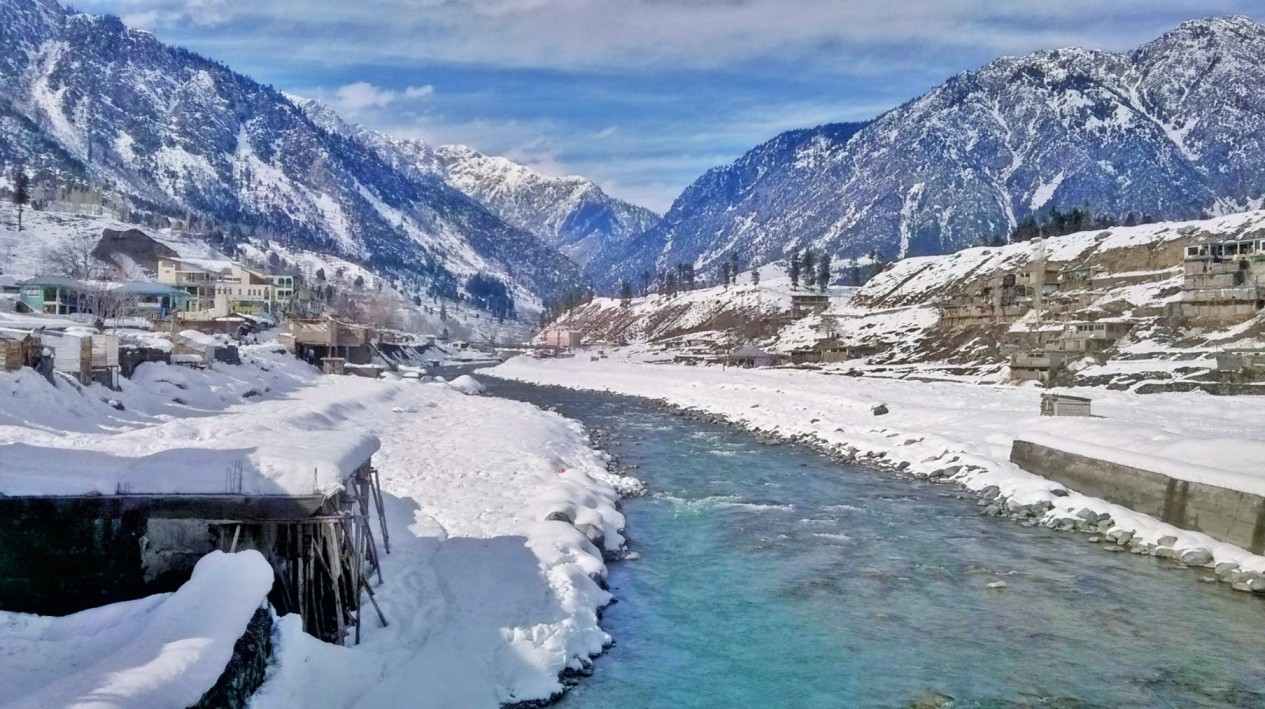
 babusar-top-naran-valley
Babusar Top is the initiating point of the Moon Soon Belt.

FAQs

1. Where is Naran Valley located in Pakistan?

Naran Valley is situated in the Khyber Pakhtunkhwa province of Pakistan, in the northern region of the country.

2. What makes Naran Valley a must-visit destination for travelers?

Naran Valley is celebrated for its breathtaking natural beauty, including lush valleys, serene lakes, and stunning meadows, making it a paradise for nature enthusiasts.

3. What is the best time to visit Naran Valley?

The best time to visit Naran Valley is during the summer months, from May to September, when the weather is pleasant and most tourist attractions are accessible.

4. Are there any famous lakes in Naran Valley?

Yes, one of the most famous lakes is Saif-ul-Mulook Lake, known for its enchanting beauty. Other notable lakes include Lulusar Lake, Ansoo Lake, and Dudipatsar Lake.

5. What adventure activities can one enjoy in Naran Valley?

Naran Valley offers a range of adventure activities such as trekking, paragliding, and jeep safaris, allowing visitors to explore the stunning landscapes.

6. How is the road network to Naran Valley?

The road network to Naran Valley is limited but accessible during the summer season. However, it’s essential to check the road conditions before planning a trip.

7. Are there educational institutions or healthcare facilities in Naran Valley?

Naran Valley primarily serves as a tourist destination, so there are no permanent educational institutions or large healthcare facilities. Basic healthcare facilities are available in Naran.

8. What is the local cuisine in Naran Valley?

Visitors can savor traditional Pakistani dishes and BBQ items, as well as international cuisines in Naran Valley’s local restaurants.

9. Can tourists participate in local festivals and cultural events in Naran Valley?

Naran Valley occasionally hosts local festivals and celebrations, often tied to Islamic events, offering a glimpse into the local culture and traditions.

10. Are there accommodations available for tourists in Naran Valley?

Yes, Naran Valley offers a variety of accommodations, including hotels, guesthouses, and camping options, to cater to different preferences and budgets.

Wind Up Lines

Naran Valley is a beautiful gift of nature. It is one of the most astonishing areas of Khyber Pakhtunkhwa (KPK). Saif-ul-Malook, Lulusar Lake, Dudipatsar Lake, and Babusar Top are renowned around the globe for their spectacular scenery, trekking areas, and water sports.

All About District Indus Kohistan – KPK

Indus Kohistan

Indus or Abaseen Kohistan is a distant district of Pakistan’s province Khyber Pakhtunkhawa (KPK). It is stretching over 34.40 to 30.35 longitude and 50.2 to 75.30 latitude. The district of Kohistan has an area of 7581 square kilometers.

Greek historians Herodotus and Ptolemy named Kohistani areas “Diokaie”. Naran Valley, Andrak, Chor’s mountains, Swat Valley, Nanga Parbat’s area Chilas, Tangir, and Darel set its natural boundary. The climate in the upper and central areas of Kohistan is pleasant in summer and extremely cold in winter.

There is heavy snowfall in the upper regions. The temperature here is below the freezing point. The lower areas that are near the River Indus are too hot and cold in summer and winter respectively. Jalkot, Harban, Palis, Pattan, Khandiya, and Dabir are central areas.

Load more ATTACHMENT DETAILS Dassu_Indus-Kohistan-kpk.
Mighty mountains of Dassu Indus Kohistan

Details of District Indus Kohistan – KPK

Attribute Details
Name District Indus Kohistan
Province Khyber Pakhtunkhwa (KPK), Pakistan
Region Northern Pakistan
Headquarters Pattan
Location Northern areas of KPK
Geography Mountainous with the Indus River running through
Elevation Varies, with some areas exceeding 6,000 meters
Population Approximately 200,000 (as of last available data)
Official Language Pashto, Hindko, and other regional languages
Time Zone Pakistan Standard Time (UTC+5)
Climate Cold and temperate, with heavy snowfall in winter
Major Religion Islam (predominantly Sunni)
Economy Primarily based on agriculture and livestock
Tourist Attractions – Natural beauty, rivers, and valleys
Transportation Limited road network, no airports
Notable Features – Rich cultural heritage – Scenic landscapes
Educational Institutes Limited educational institutions in the district
Hospitals Basic healthcare facilities in major towns
Restaurants Local eateries serving traditional cuisine
Local Dishes Local cuisine with a focus on lamb and rice
Languages Pashto, Hindko, Shina, and other regional dialects
Cultural Festivals Local festivals reflecting Pashtun culture
Local Crafts Traditional handicrafts and textiles

Sites near Indus Kohistan

1- Pattan

The river Indus confluence with the river Chowadara and Palas in this fertile area which is 42km from Basham. One can reach Dabir, Kial Valley, Basham, and Komala via Pattan. There is an inscription in the memory of martyrs near the Petrol Pump. Please pray for the souls who sacrificed their lives for our future.

2- Dasu-Komala

Pattan is 36km forward to Komala. Two cities connect Karakoram Highway (Silk Route) between Basham and Chilas. In them, district Dasu is the central headquarter of Kohistan. There are government offices and rest houses. While Komala is the trade center. The river and mountains turn themselves from Dasu.

 komila_bridge-indus-kohistan-kpk.
Komala (Komila) bridge over Dasu Dam, Indus Kohistan KPK

3- Seo Mosque

This mosque is located in Seo Village near the district capital Dasu. This 250-year-old historical mosque is constructed with wood pillars and beams. The beauty of the mosque is enhanced by engraving beautiful designs on the wood. It is a place of cultural representation in the district of Dasu. Its best trail is from Komala.

seo-mosque-indus-kohistan-kpk
Ancient Seo Mosque in Indus Kohistan KPK

4- Shitial

Beyond Sazin, there are statements in Logrian, Kharoshti, and Barahmen languages inscribed on various stones. These statements belong from the third to the seventh A.D. and before Christ. Some places have engravings of wild animals, Hunn, Sogairin, Moon Idol, and Buddha Stupa.

You will have to cross the bridge on the left side of the river to see the pictures that are 1000 to 5000 years old before Christ. You can also buy local handicrafts from a nearby village.

5- Darel Valley

This beautiful Valley is 82km northwest of Chilas Valley. A jeep track from Shitial Bridge will take you to Darel Valley. It is the administrative headquarter of Gumary Valley.

It is the biggest center of archaeological remains and therefore the archaeological department is there too. Manikal is its central area. The signs of Buddha University are a few distances from Mazot. Mahatma Buddha pictures are carved on large heavy stones.

There are archaeological traces in the Sonikot and Lolokot too. Gomaray has ancient traces and the rest houses. Chinese Tourists Faseen (430) and Yaun Xeng (630) have visited Darel Valley. One can book a PWD rest house from Chilas and Gilgit.

Showing 84 of 786 media items Load more ATTACHMENT DETAILS Pillared-verandah-of-Gayal-Mosque-Darel.
Ancient Gayal Mosque in Darel Valley, Indus Kohistan KPK

6- Harban

There are the names of Buddha Monks on the stones near Harban and in Menargah, Thor, Hod, and Getch on both sides of Karakoram Highway.

FAQs

1. Where is District Indus Kohistan located in Pakistan?

District Indus Kohistan is situated in the Khyber Pakhtunkhwa (KPK) province in the northern areas of Pakistan.

2. What is the geography of Indus Kohistan?

The district is characterized by mountainous terrain and is traversed by the Indus River, which adds to its picturesque natural beauty.

3. What is the population of District Indus Kohistan?

The district had an approximate population of 200,000 residents.

4. What are the major languages spoken in Indus Kohistan?

The primary languages are Pashto and Hindko, with regional dialects like Shina also being spoken by some communities.

5. Are there any notable tourist attractions in Indus Kohistan?

While not a major tourist destination, Indus Kohistan offers natural beauty, serene rivers, valleys, and breathtaking landscapes for those seeking a quieter, off-the-beaten-path experience.

6. What is the climate like in the district?

The region experiences a cold and temperate climate with heavy snowfall during the winter months, making it particularly challenging to access in those times.

7. Are there educational institutions and healthcare facilities in Indus Kohistan?

Educational institutions are limited in the district, and basic healthcare facilities can be found in major towns. However, it’s important to be aware of the limited resources available.

8. What are the local dishes or cuisine specialties in Indus Kohistan?

The cuisine in Indus Kohistan typically features dishes with a focus on lamb and rice, reflecting the local culinary traditions.

9. Can tourists explore the cultural heritage of Indus Kohistan?

Yes, the district has a rich cultural heritage, and you can experience local festivals and traditions that reflect the Pashtun culture.

10. How can one reach Indus Kohistan, and is it easily accessible?

The district has a limited road network, and there are no airports. Traveling to Indus Kohistan can be a bit challenging, and it’s advisable to plan your journey accordingly.

Wind Up Lines

Khyber Pakhtunkhwa is enriched with historical sites, ancient archaeological remains, splendid landmarks, and high mountains. Indus Kohistan is one of the historical towns of KPK. Dasu, Komala, Darel Valley and Seo Mosque, are beautiful historical spots.

About Gilgit Baltistan – A Heavenly Blessed Land

Gilgit Baltistan

Heavenly Blessed Land

Gilgit Baltistan is among the extremely beautiful and charming northern areas of Pakistan. These areas are spreading over capacious land covering up to 72494 square kilometers. And it consists of Hunza, Astore, Gilgit, Ghizer, Diamer, Skardu, and Ghanchy.

The capital of the province Gilgit Baltistan is Gilgit. On first November 1947, the people of this region get rid of the slavery of the Kashmiri emperor without any external aid. On 16th November 1947, with the assistance of Sardar Muhammad Khan Political Agent, Pakistan took it under its control by the will of the common people. While the Baltistan got freedom on 14th August 1947.

Load more ATTACHMENT DETAILS Naltar-valley-gilgit-baltistan-
Charming Naltar Valley of Gilgit Baltistan

These regions with an altitude ranging from 4000 feet to 25,000 feet above ocean level are well known around the globe for sky-high giant mountains, sky-kissing, ice-tipped peaks, long glaciers, and narrow valleys. These landscapes are inviting scientists, tourists, and hikers for a long.

Famous Mountain Peaks, Passes, and Glaciers in Gilgit Baltistan

Deosai is the second highest plateau in the Asia after Pamir Plateau in the north. The famous mount peaks in the world such as K-2 (28,250 feet, the second-highest peak in the world), Nanga Parbat (26,607 feet), and Rakaposhi (25,520 feet) are located in these areas.

Its large glaciers are Siachen, Baltoro, Chogo Lungma, Rimo, Hiapar, and Biafo.

 deosai-national-park-pakistan
Rich green meadows of Deosai National Park

Many historical and ancient passes are here too. These include Babusar, Burzil Qamri (Diamer), Karakoram, Muztagh, Chorbat, Zojila, Saltoro, Thalay, Alampe, Braldu, Basha (Baltistan), Hispar Irshad, Kilik, Mintaka, Khunjerab, Shimshal (Gilgit), Karamber, Broghil, and Shandur Passes. These passes are of significant geographical importance.

Geographical Location of Gilgit Baltistan

It is the region that connects two great states of Asia, Pakistan, and China. On the other hand, it splits the two great states India and Russia. The geographical importance of this zone can be evaluated from the titles given to Gilgit Baltistan.

Hunza is called “the region where three empires meet”. The borderlines of China, Russia, and British India were used to meet in the north of Hunza. It is also entitled “End of the World” and “the Winter Land of Asia”. Now it is called the “Center of the World” because it is the connection point of five countries China, India, Tajikistan, Afghanistan, and Pakistan.

 hunza-valley-gilgit-baltistan.
Natural view along Attabad lake in Pakistan mountains at Hunza valley

There is no monsoon rain in northern areas. The area of natural forests is about 4% of the total land area. The climate is terribly hot in Summer and bitter cold in winter. The hottest month is July and the coldest month is January.

It is heavy snowfall in the districts of Ghanche, Ghazar, Astor, Skardu, Hunza, Nagar, and in low valleys. The ice melts in summer and causes floods in the river Indus.

Beautiful Tourist Spots in Gilgit Baltistan

Nature has blessed these areas with sky-scraping mountains, rivers, brooks, watercourses, glaciers, valleys, and lakes. Upper Kachura, Lower Kachura (Shangrila), Sidpara, Naltar, Shandur, Deosai, Phander, Rama, Gdai, Zircon, (Bonji), Kutwal, Gasho (Jaglot), Gultari, and Borith (Gilmat Hunza), Lakes are worth mentioning because of their exquisiteness and beauty.

Fairy Meadows in Chilas and Sital in Tangir are renowned around the world for their spectacular beauty. May to September is the best season for tourism. But the ice doesn’t melt on the high peaks. This may cause trouble for hiking and trekking.

 shangrila-upper-katchura-lake-skardu
Shangrila Resort near Upper Katchura

Rivers & Springs Flowing in Gilgit Baltistan

Load more ATTACHMENT DETAILS ganish-bridge-hunza-river-gilgit-baltistan
Ganish Bridge over Hunza river Gilgit Baltistan

The noteworthy rivers of this region are Indus, Shyok, Shigar, Astore, Hunza, and Gilgit. All the rivers and brooks of this area confluence with the River Indus. Agriculture and power sector of Pakistan is chiefly based on the River Indus.

There are many hot and cold-water springs in Gilgit, Baltistan, and Diamer. People use these springs’ water for curing different diseases. The springs of Raikot, Bar, Nagar, Barsat, Damas Punial, Gronjur, Darkot, and Murtazaabad (Hunza) are very famous.

National Parks in Gilgit Baltistan

There are four national parks in Gilgit Baltistan. They are named Deosai National Park, Shandur National Park, Khunjerab National Park, and Central Karakoram National Park.

Silk Route Festival

Cultural and trade delegates from Pakistan, neighboring countries, and Central Asian states attend this festival. It is arranged in the summer season due to pleasant weather and a charming environment.

At this festival, government, private, social, regional, and international departments organize their stalls. Local and foreign troupes also perform. Its special programs are held in Gilgit. Its partial programs are organized in Hunza and Skardu.

 silk-route-festival-gilgit-baltistan
Cultural Dance at Silk Route Festival, Gilgit Baltistan

Water Sports

River rafting, canoeing, and kayaking can be enjoyed at these sites. From Jaglot to Thakot in the river Indus, Naran Kaghan in the river Kunhar (Kanhar), from Bahrain to Mingora in the river Swat, Aliabad to Gilgit in the river Hunza, Gopiz to Gilgit in the river Gilgit are sites for water sports. Tours operators of Islamabad and tour operators of related areas can assist you.

Load more ATTACHMENT DETAILS paragliding-in-Karakorum
Paragliding in Karakorum

Wind Up Lines

Gilgit Baltistan is an alluring province of Pakistan. It is the best region for vacations, family trips, festivals, adventurous sports, and trekking. It is due to the beautiful tourist spots like  Diamer  Tangir, Darel, Chilas, Bonardas, Gonarfarm, Raikot, Nanga Parbat, and Fairy Meadows, sky-high mountain peaks, and murmuring rivers.


Famous Sites of GB | Fairy Meadows | Chilas

Famous Sites of Gilgit Baltistan (GB)

Gilgit Baltistan is blessed with breathtaking beautiful Sites. Fairy Meadows Chilas, and Juglot are among them. These sites are known for sky-scrapping peaks, rich green plains, melodious rivers, and murmuring lakes.

 A_horse_grazing_in_the_fields_of_Fairy_Meadows
A horse grazing in the fields of Fairy Meadows

Overview Of some famous sites in Gilgit Baltistan (GB) 

Site Location Features
Naltar Valley Gilgit District – Breathtaking landscapes with lush greenery and alpine meadows. – Known for skiing in winter and vibrant flower displays in summer.
Hunza Valley Hunza District – Surrounded by snow-capped peaks, including Rakaposhi and Ultar Sar. – Historical sites like Baltit Fort and the serene Attabad Lake.
Skardu Skardu District – Gateway to some of the world’s highest peaks, including K2. – Picturesque Shangrila Resort and Upper Kachura Lake. – Skardu Fort offering panoramic views of the valley and Indus River.
Fairy Meadows (Nanga Parbat Base Camp) Diamer District – Stunning views of Nanga Parbat, the world’s ninth-highest mountain. – A starting point for treks to Nanga Parbat Base Camp.
Deosai National Park Skardu District – A high-altitude plateau with unique wildlife, including Himalayan brown bears. – Spectacular landscapes and Sheosar Lake.
Shigar Fort Shigar District – An ancient fort with a rich history and architectural significance. – Located near the town of Shigar, surrounded by stunning landscapes.
Khunjerab Pass Hunza District (Border with China) – The highest paved international border crossing in the world. – Stunning mountainous landscapes and the border point between Pakistan and China on the Karakoram Highway.
Satpara Lake Skardu District – A beautiful freshwater lake surrounded by snow-capped peaks. – Offers boating and a serene atmosphere.
Shandur Polo Ground Ghizer District – Known as the “Roof of the World” and hosts the annual Shandur Polo Festival. – Spectacular landscapes and high-altitude polo matches.
Rakaposhi Base Camp Nagar District – A starting point for treks to Rakaposhi, the 12th highest mountain in the world. – Offers breathtaking views of the surrounding peaks.
Hopper Glacier Nagar District – A stunning glacier surrounded by rugged mountains. – Popular among trekkers and adventure enthusiasts.

Some famous sites in GB

Fairy Meadows

A track from the right side of Raikot Bridge goes to the 9th largest peak in the world and the 2nd largest peak in Pakistan which is Nanga Parbat. This bridge is 61km from Chilas. This peak with a height of 8125 meters is known as the killer mountain.

It is very difficult to ascent this top. Its shape and structure is different on every side but it can be seen clearly from the Diamer, Ropal, and Raikot.

The fascinating site of Fairy Meadows is a base camp for the hikers fond of climbing Nanga Parbat peak. An Austrian hiker Harman Bhal named it “Fairy Meadows” in 1953 because of the stunning tracks and charming scenes on the way to Fairy Meadows.

There are the best-camping sites for tourists going to the basecamps of Nanga Parbat. Jeeps are available near the Shangrila Hotel situated adjacent to Raikot Bridge. Halfway about 8km from Raikot Bridge is full of adventure. The Jeep will take you to Fatori and Tatto Village. You can reach Fairy Meadows in three hours on foot from this village.

 nanga-parbat-trek.
Glowing tents in the starry night of Fairy Meadows are the base camps for Nanga Parbat’s Trekkers

There are facilities for dwelling, dining, and rent village in this captivating valley. People can enjoy horse riding and fishing here. There are the best pastures for cricket, football, and polo match.

Fairy meadows site camps are located at an elevation of 3306 meters. Campfire is arranged for the locals and foreigners at the site camps who come to Fairy Meadows. All the vacationers sing their folk songs by sitting around the fire. They are just tourists irrespective of religion, color, and creed.

This route is open from May to August. After that, it is difficult to reach here due to snowfall. There is a restaurant at the Bial campsite too. It is two kilometers from the main site camp. Beyond 2 hours travel from this camp is the base camp of Nanga Parbat at a height of 4500 meters above sea level.

According to travel correspondent Mustanser Hussain Tarar, the fairies descend here. Fairy Meadows resembles the green areas of Kashmir.

Chilas

 Indus_River_near_Chilas_Gilgit-Baltistan1
Indus River near Chilas Gilgit Baltistan

Chilas is located at the foothills of Nanga Parbat (8125meters) and is at an altitude of 950 meters above ocean level. It is the boundary of Diamer. Chilas at the bank of the river Indus has the status of base camp for the travelers going to Nanga Parbat and Fairy Meadows.

Most of the tourists stay here to see Petroglyphs. Chilas has a dry climate which is extremely cold in winter and terribly hot in summer. A route is directed to Babusar pass from the Thak water channel at a distance of 5km from Chilas.

It is the way to reach Kaghan Valley, Balakot, and Naran from Chilas. Before the Karakoram (Resham) Highway, this route was used to travel from Gilgit to Rawalpindi through Chilas, Babusar, Naran, Kaghan, Balakot, Mansehra, and Abbottabad. This area has hot water springs too.

Chilas fenced by mountains, is 4km from Resham (Karakoram) Highway. Diamer is also famous for Pinus tree forests, Pinon, and grapes.

Nanga Parbat View Point

The main signboard of Nanga Parbat View Point is fixed on the right side before Talechi and beyond Raikot Bridge. You will be spellbound by this clear view of Nanga Parbat. You will enjoy the beauty of this mount for a long distance. There is a Gasho Pashot Lake trek near this viewpoint.

Bunji and Jaglot

Jaglot (also spelled as Juglot) is a cantonment which is located on the Karakoram (Resham Highway). While the Juglot Village is situated in mountains at a distance of 7km from the Resham Highway. The river Indus turns towards Skardu whereas the Resham Highway goes straight.

 jaglot-town-gilgit-baltistan.
Jaglot Town Gilgit Baltistan

A route turns to the Astore Valley from the right side of Talechi. The Astore Valley was a source of contact between the Gilgit Agency and the British Empire. The easiest way to reach Nanga Parbat is through Astore Valley. A trail leads to Sirkon Lake from Bunji Cant.

Gateway to Northern Areas

Chilas serves as a gateway to various northern regions, including Skardu, Gilgit, and Hunza. Travelers heading towards these destinations often spend a night in Chilas, making it a hub for those exploring the wonders of GB.

Indus River Crossing

The town is situated at a point where the Karakoram Highway crosses the mighty Indus River. The view of the swirling waters against the backdrop of rugged mountains is a sight to behold. The bridge over the Indus River at Chilas adds to the dramatic setting, making it a memorable spot for travelers.

Historical Places

Baltit Fort, Hunza

Perched high above the Hunza Valley, Baltit Fort is a historical gem dating back to the 8th century. Renovated in the 1990s, it stands as a testament to the architectural brilliance of the region. The fort offers panoramic views of the surrounding peaks and valleys, making it a must-visit for history enthusiasts and admirers of ancient craftsmanship.

Shigar Fort, Skardu

Shigar Fort, located in the Shigar Valley, is another architectural marvel. Constructed in the 17th century, it once served as the residence of the local rulers. The fort has been converted into a museum, showcasing the history and culture of the region through artifacts, weapons, and ancient manuscripts.

Altit Fort, Hunza

Altit Fort, even older than Baltit Fort, dates back to the 11th century. Restored by the Aga Khan Cultural Service Pakistan, it offers a glimpse into the evolution of architecture in the region. The fort’s intricate woodwork and ancient chambers transport visitors back in time.

Schools in the Region

Community Schools: In the villages surrounding Fairy Meadows and Chilas, there are community schools that cater to the educational needs of local children. These schools play a vital role in imparting education to the younger generation.

Hospitals and Healthcare

Healthcare Hub: Chilas has a hospital that serves as a healthcare hub for the region. It provides medical services to the local population and is equipped to handle a range of health issues.

Ambulance Services: Both Fairy Meadows and Chilas have access to ambulance services to facilitate the transportation of patients in case of emergencies.

Frequently Asked Questions

What makes Fairy Meadows special?

Fairy Meadows is renowned for its breathtaking views of Nanga Parbat, the ninth-highest mountain in the world. The meadow, surrounded by lush greenery, offers a magical setting for nature lovers and adventure seekers.

How do I reach Fairy Meadows?

To reach Fairy Meadows, one must first travel to the town of Raikot and then embark on a jeep ride through a scenic track. The journey is an adventure in itself, providing access to the mesmerizing meadow at the base of Nanga Parbat.

What historical significance does Chilas hold?

Chilas is known for its ancient rock carvings, dating back thousands of years. These petroglyphs depict scenes from daily life, hunting, and religious rituals, offering a glimpse into the rich cultural history of the region.

Why is Chilas a stopover on the Karakoram Highway?

Chilas serves as a crucial stopover on the Karakoram Highway, acting as a gateway to various northern regions, including Skardu, Gilgit, and Hunza. Travelers often spend a night in Chilas while en route to these destinations.

What accommodations are available at Fairy Meadows?

Fairy Meadows offers comfortable huts and campsites for visitors. These accommodations allow travelers to immerse themselves in the tranquility of nature and witness the stunning sunrise over Nanga Parbat.

What are some local snacks to try in the region?

Local snacks in the Gilgit-Baltistan region include Chapshuro (a pastry filled with minced meat), Phaphar (a traditional whole wheat bread), and Mantu (meat-filled dumplings). These snacks provide a taste of the region’s culinary delights.

Are there medical facilities available at Fairy Meadows and Chilas?

While both locations have basic medical aid available, for more serious health concerns, it’s advisable to seek medical assistance in nearby towns. Chilas, in particular, has a hospital that serves the healthcare needs of the region.

What are the historical forts to explore in the area?

Baltit Fort and Altit Fort in Hunza, and Shigar Fort in Skardu are historical forts in the Gilgit-Baltistan region. These forts showcase the architectural brilliance and cultural history of the area.

Can I explore Fairy Meadows on my own, or do I need a guide?

While it’s possible to explore Fairy Meadows independently, hiring a local guide can enhance the experience by providing insights into the local culture, flora, and fauna, as well as ensuring a safe trek to Nanga Parbat base camp.

What role do the ancient petroglyphs in Chilas play in local history?

The petroglyphs in Chilas are significant historical artifacts, providing a glimpse into the daily life, rituals, and cultural practices of ancient communities. These rock carvings are a valuable archaeological treasure in the region.

Wind Up Lines

While the attractions of Fairy Meadows and Chilas lie in their natural beauty and historical significance, the provision of accommodation, dining options, and essential facilities like medical services ensures that visitors can enjoy these places comfortably and safely. The region’s commitment to balancing the allure of its landscapes with necessary amenities enhances the overall experience for those exploring these famous sites in Gilgit-Baltistan.

Famous Beautiful Sites of Astore City – GB

Astore

Astore is an old city at an altitude of 3200 meters above ocean level. Before the creation of Pakistan, this track was used to reach Gilgit from Srinagar Kashmir. District Astore of the province Gilgit Baltistan is 115km from Gilgit City.

Site Name Location Key Features
Rama Lake Elevation: 10,800 feet Surrounded by rich green mountains, snow-covered for 7-8 months, starting point for Nanga Parbat trek.
Tarishing Valley Located 28km from Astore Offers stunning views of Nanga Parbat and snow-tipped peaks, lush green meadows, and hotels.
Rupal Valley Access from Tarishing Valley Known for its diverse flowers, reached after crossing a hill and glacier, resembling Arang Kel.
Sang Sar Valley Easily reached from Astore Features green meadows, blue water lake, cool winds from Siachin range, and a stunning landscape.
View Point Silk Route (Karakoram) Hwy Offers a view of the meeting point of the Himalaya, Karakoram, and Hindukush mountain ranges.

Silk Route  (Karakoram) Highway, turns right towards Astore from Talechi Road. The river Astore flows here along the road. Astore City has some good hotels and a small market. Its central villages are

  • Rama
  • Rahman Pur
  • Gori Kot
  • Bunji
  • Dashkan (Dashkin)
  • Chilum or Chilam
  • Rattu

You can reach Nanga Parbat (Rupal Face), Rupal Valley, Tarishing Valley, Deosai, and Rama Lake from Astore.

 Beautiful-astore-gilgit-baltistan.
Charming Astore Valley Gilgit Baltistan

Furthermore, Chilum, Punji, Daskan, Singh Sar, Rehman Pur, Kala Pani, Minimarg, Dambabho, Domail, and Gori Kot are good tourist spots. One can reach Skardu from Chilam spot via Deosai plains, Sheosar Lake, and Satpara Lake.

You can only travel there by jeep. Minimarg, Rainbow Lake, and some other spots are considered sensitive since they are located near the Indo-Pak borderline. A special permission letter is required for visiting these areas. This letter can be obtained from the relevant army office after providing details.

The landscapes of Astore resemble the beautiful scenery in the American Cow Boy movies. Local language Shina is spoken there.

Famous Beautiful Sites of Astore City

1- Rama Lake

This lake is at an elevation of 10,800 feet above sea level. This lake, surrounded by rich green mountains remains covered with snow for about seven to eight months a year. A track is directed from here to the 8th highest peak in the world Nanga Parbat.

A jeep can be booked from Astore to reach the lake which is 8km from Astore. (A way to lead to Chilam check post on the left of Rama Lake route. You can reach Skardu by the way of Deosai). There is a PTDC motel between the thick green forests at a distance of 3km from Rama Lake.

It is the best place to enjoy two to three-day vacations. It is a good idea to reach the motel via jeep and then travel to the lake on foot. The lake is quite long. There is a rest house of the forestry department which is 3km from Rama Village. You can book it from Gilgit or Rawalpindi.

 Rama_lake-Astore_Gilgit-Baltistanpak.
Rama Lake in Astore, Gilgit Baltistan

2- Tarishing Valley

Nanga Parbat shadows the whole Tarishing Valley and is surrounded by glaciers. Tarnishing, at the foothills of sky-high snow-tipped peaks (9550 feet from sea level), is 28km from Astore. You can reach Tarishing by jeep from Astore.

People can pay per person to reach Tarishing from Astore by jeep. After half an hour, a route is directed to Kargil and Deosai. This track full of adventure will captivate you. You will not get tired of the hectic journey after seeing the charming sights of Rama Peak, Chongra Peak, and Raikot Peak.

Colorful aromatic flowers and luxuriant green grass everywhere will evoke you to stay here for a day or two. There are hotels and camping facilities too.

 tarishing-valley-astore-gilgit-baltistan.
Snowy tracks of Tarishing Valley in Astore

3- Rupal Valley

Travel to Rupal Valley to fully enjoy the Tarishing Valley site. You will be astonished by the valley with flowers of thousands of kinds. You can reach here after crossing a hill and a glacier. Arang Kel of Neelum Valley Azad Kashmir looks like Rupal Valley.

 Tarishing-Village-Rupal-Valley.
Luxuriant pastures of Rupal Valley in Astore

4- Sang Sar Valley

This beautiful valley has green meadows, thick green forests, and a blue water lake. The cold winds from the Siachin mountain range refresh the tourists here. The rainbow sight in the sky mesmerizes the vacationers. Sang Sar Lake is full of small glaciers and trout fish. The ice cubes in this lake look like shining stars. During snowfall, the trees covered in snow look like shy brides covered in a veil. A jeep can be hired from Astore Valley for Sangsar Valley.

5- View Point

There is a large podium on the right side of Silk Route (Karakoram) Highway at the Pari point beyond Juglot. Park the vehicle on one side. Come to the podium via a staircase. A

meeting point of the three great mountain ranges of the World (Himalaya, Karakoram, and Hindukush) has mentioned on an eight feet high and 8 feet wide wall through a picture. You will get a clear picture as you see above of the Gilgit Mountains. This scenery cannot be enjoyed anywhere else in the World.

FAQs

1. Where is Astore located, and what is its significance?

Astore is an old city located at an altitude of 3200 meters above sea level in the Gilgit Baltistan region of Pakistan. It is known for its natural beauty and tourist attractions.

2. What is the historical significance of the route through Astore before the creation of Pakistan?

The article mentions that the route through Astore was used to reach Gilgit from Srinagar Kashmir before the creation of Pakistan. This historical context adds to the region’s significance.

3. What are the prominent villages and areas in Astore City?

Astore City has several central villages, including Rama, Rahman Pur, Gori Kot, Bunji, Dashkan (Dashkin), Chilum, and Rattu. These areas are part of the Astore region.

4. What are the major tourist destinations that can be reached from Astore?

Astore serves as a gateway to several stunning tourist destinations, including Nanga Parbat (Rupal Face), Rupal Valley, Tarishing Valley, Deosai, Rama Lake, and many others. Each of these places has its unique attractions.

5. How can visitors reach Rama Lake from Astore, and what are the notable features of Rama Lake?

Visitors can reach Rama Lake, which is located at an elevation of 10,800 feet above sea level, by booking a jeep from Astore. The lake is surrounded by lush green mountains and remains snow-covered for several months. It also serves as a starting point for reaching Nanga Parbat.

6. What is the best way to plan a stay at Rama Lake, and are there accommodations available?

The article suggests reaching the PTDC motel, located 3 km from Rama Lake, by jeep and then traveling to the lake on foot. Additionally, there is a rest house of the forestry department that can be booked from Gilgit or Rawalpindi.

7. What are the attractions of Tarishing Valley, and how can visitors reach it from Astore?

Tarishing Valley offers breathtaking views and can be reached from Astore by jeep. The valley is known for its proximity to Nanga Parbat, snow-tipped peaks, and a captivating journey through Rama Peak, Chongra Peak, and Raikot Peak.

8. What is Rupal Valley, and how does it compare to Arang Kel in Neelum Valley, Azad Kashmir?

Rupal Valley is known for its diverse flowers and can be reached from Tarishing Valley. The article draws a comparison between Rupal Valley and Arang Kel in Neelum Valley, highlighting the lush pastures and natural beauty.

9. What does Sang Sar Valley offer to tourists, and how can it be accessed from Astore?

Sang Sar Valley is known for its green meadows, blue water lake, and stunning scenery. Tourists can access this valley by hiring a jeep from Astore.

Wind Up Lines

Astore is a beautiful Town in Gilgit Baltistan. Rama Lake, Tarishing Valley, Sangsar Valley, and Rupal Valley are well-known tourist spots.

Skardu – Baltistan | Shangrila Resort | Upper Kachura

Skardu City – Baltistan 

Where mountains speak the sky

Baltistan was called Skardu in the past because of its central headquarter Skardu. Baltistan has the world’s second-highest peak K-2, Masherbrum (7320 meters) peak, Gasherbrum (8355 meters) peak, Broad peak (8047 meters), and 150 peaks of Karakoram Mountain range out of 300 peaks.

Aspect Information
Location Skardu, Gilgit-Baltistan, Pakistan
Skardu’s Significance A picturesque city known for its stunning natural landscapes and as a gateway to some of the world’s highest mountain ranges.
Shangrila Resort A popular tourist destination in Skardu, often called “Heaven on Earth.” It features Shangrila Lake, beautifully landscaped gardens, and the renowned Shangrila Resort Hotel.
How to Reach Shangrila Visitors can reach Shangrila Resort by road or air, with accommodations available in the resort’s hotel and other options in Skardu.
Activities at Shangrila Boating on Shangrila Lake, exploring lush gardens, and taking in breathtaking mountain views. It’s an ideal place for relaxation and nature appreciation.
Upper Kachura A serene area in Skardu, known for the pristine Lower Kachura Lake and its tranquil surroundings.
Access to Upper Kachura Easily accessible from Skardu by road, allowing visitors to explore the beautiful Lower Kachura Lake, enjoy boat rides, and experience tranquility.
Cultural and Recreational Activities Skardu offers opportunities to immerse in the unique culture and traditions of the Baltistan region, as well as outdoor activities like hiking and trekking.
Best Time to Visit The ideal time to visit is from April to September during the spring and summer months, when the weather is pleasant, and natural beauty is at its peak.
Travel Tips Travelers are advised to check local regulations, obtain necessary permits for restricted areas, carry warm clothing, sunscreen, and essential travel documents.
Nearby Attractions Nearby attractions include Deosai National Park, Shigar Fort, and the beautiful Shangrila Resort Gardens, offering more opportunities to explore the region’s natural and cultural beauty.

The world’s largest and most famous glacier “Siachen” after the Pole glacier is here in Baltistan. Stretching between Karakoram and Himalaya ranges, Baltistan has Skardu, Khaplu, Shigar, Kharmang, Hushe, and Gultari Valleys. Parapo, Balay, Marzan, and green tea are among the popular foods of Baltistan.

 skardu-baltistan.
Young Caucasian woman looking at Upper Kachura lake in Gilgit-Baltistan

In the Suburbs of Baltistan

I- Adventure of Skardu Road

A road turns toward Skardu from the Alam Bridge 48km before Gilgit. Skardu is 173km from this point. The Skardu road becomes narrow gradually after splitting from Karakoram Highway.

 Skardu_Road-baltistan
Driving on Skardu Road is a thrilling adventure

It is an adventurous journey between the Karakoram and the Himalayas along the river Indus. It seems difficult to breathe on the Skardu trail for the first time due to the twisting road like snakes, sharp turns of the highway, sky-scrapping mountain ranges, and the river Indus flowing like a thin line below. But, one feels better as you move forward.

II-  Haramosh Valley, Kutwal Lake

At a distance of 25km from Skardu Road, a track lead to Dasu Village from Sassi Village. You can reach there in one hour. From Dasu to Haramosh Valley’s Kutwal Lake is a one-and-a-half-day pedestrian track. So, it’s a three-day journey. If you are a good trekker and have the stamina you can reach earlier.

There is no arrangement for a stay during the journey. You will have to take camping stuff and food with you. Dasu and Iskari have some small restaurants.

 beautiful-kutwal-lake-haramosh-valley-baltistan.
Beautiful Kutwal Lake in Haramosh Valley

A memorial to the martyrs who sacrificed their lives during the construction of the road is built at the Shingas point. This point is 52km from Skardu Turn. A small town Rondu is 30km from Shingas.

Come across the river by crossing the bridge 38km from Dambu Wali Village. Dambu Wali Village is 22km from Rondu. From here towards the right side, a trail is directed to Shangrila Lake. The valley spreads from there. Skardu airport is 22 km beyond this road. And Skardu city is 13 km forward to the airport.

Skardu City

Skardu, the headquarter of Baltistan is at an altitude of 7500 feet above sea level. The Skardu Valley is 10km wide and 40km long. Skardu Base Camp is among the most adventurous and beautiful trekking sites in the World. Skardu is enriched with calm lakes, murmuring waterfalls, sky-kissing snow-capped peaks, and beautiful landscapes.

The world’s second-highest peaks K-2, Siachen Glacier, Batura Glacier, and Biafo Glacier are embracing each other in a unique manner. It is hard to find such a beautiful scene anywhere else in the world. Therefore, climbers from all over the world come here every year to fulfill their hobbies.

 skardu-a-heaven-on-earth
Skardu heaven on Earth

Skardu’s tourism season is from April to October. Peach, apples, apricots, and pear are the best fruits there. This city is located on a very interesting point. The river Indus flows in a calm and serene manner. Skardu is fenced by dry mountains and sand dunes. Wear a sweater before if you are going for an evening walk in Skardu. Do shopping in the old Bazar.

A PIA flight is available from Islamabad for Skardu on a daily basis. And the same plane brings the passengers back to Islamabad. All the flights depend on the weather condition. The flights are canceled if the climate is not favorable. Sometimes, the fights return back to Islamabad without landing at the Skardu Airport due to the lack of required atmospheric pressure.

Traveling at a height of 38,000 feet above the snow-capped mountains is a thrilling experience. According to the global tourism perspective, it is considered among the most beautiful journeys in the World. If you are fortunate to grab a window seat during the Skardu flight, the beauty of the north will mesmerize you.

Lush green valleys, colorful lakes, and snow-clad peaks are awaiting you. Skardu airport is 14km from Skardu City. This track is open throughout the year via Gilgit. Gilgit City is 241km from Skardu with about a 6 to 7 hours drive. A jeep and coster can be booked from Gilgit Bus Stand.

Famous Historical Sites and Tourist Destinations in Skardu

1- Fort Kharphocho Gangope

Raja Bokhany of Makboon family initiated building this fort. The king was a contemporary of Mughal king Babur. But, he died before its completion. His grandson Sher Ali Khan completed it. This fort of the 15th century was constructed near the river Indus bank on a rough rocky hilltop.

It is spreading over an area of two miles. It is said that 12 lac or 1.2 million for making a mud mixture. It is an adventure to reach this fort at the top. Take water along with you. There is a royal polo ground in between the fort. Players are practicing at the noon. It will be a memorable experience to enjoy this royal polo game for you.

A public library and a memorial to the martyrs are adjacent to the polo ground. A stream used to flow in Skardu City. It had a length of 3 miles. It was constructed by queen Gul Khatun of Sher Ali Khan. It was named Ganope after the name of the engineer who built it. There are traces of this stream in the city.

 ancient-kharpocho-mosque-fort-skardu-gilgit-baltistan
Ancient Kharpocho mosque fort at Skardu Baltistan

2- The first organic village in Pakistan

Nansoq, the first-ever organic village in Pakistan is 3km from Skardu City at the confluence of the river Shigar and the river Indus. This village is at the back of the historical Kharphoco fort. British Prince Charles, Lady Camilla Parker, and Prince Agha Karim visited this village in 2006. It is a curious point of Skardu.

 first-organic-village-skardu
First organic village in Skardu

3- Italian K-2 Museum

A museum in the PTDC Motel of Skardu City is established by the contribution of Itlay. This museum has different galleries which portray trekking and hiking in the mountains of Pakistan with the help of charts and pictures. It especially focuses on the peaks that are trekked by Pakistani and global hikers. Documentaries are there too to become familiar with the culture, history, and traditions of Gilgit Baltistan.

 Italian-k2-museum-skardu
Italian Museum of Skardu

4- Lake Katpana 

The beautiful Lake Katpana is 10km away from Skardu City’s Police Line. You can visit historic villages Katpana and Sandos. Spend some time near the grey water lake Katpana. You will see a lot of ducks swimming in this shining water. Thick green woods, desert, and sky-high mounts on its sides present a charming view.

 Katpana-Lake-Skardu-Gilgit-Baltistan.
Reflection of snow-tipped mountains and trees in Katpana Lake, Skardu, Gilgit-Baltistan

5- Shangrila (Paradise on Earth)

A DC3 plane of orient airways took off from the Skardu Airport on 13th October 1954. One of its engines failed and the pilot did a crash landing near the river Indus. All the passengers and the staff remained safe.

Brigadier Muhammad Aslam of North Scouts purchased this plane and took it here. This human heart-shaped lake has a garden, a hotel, and a restaurant. They are established beautifully near the edge of the lake that’s why it is called a part of paradise on Earth.

Accommodation facilities have been provided in the huts of Shangrila Resort situated near Upper Kachura Lake. The outside view from the restaurant and the airplane’s café will enthrall you. Shangrila has gained international recognition because of its charismatic and beautiful geography.

Shangrila is located on the Gilgit road at a distance of 30km from Skardu City. At an altitude of 2500 meters above sea level, this site has 60 lakeside cottages, a zoo, sailing, indoor games, the trout fish farm, café DC three coffee shop (in the airplane), an open-air tandoori restaurant, a gift shop, a Pagoda restaurant, a Lake-view restaurant, helicopter safari services, and other facilities.

6- Upper Kachura Lake

Upper Kachura Lake is beyond Shangrila Lake (Lower Katchura Lake) at 8200 feet above ocean level. It is surrounded by thick fruit trees and sky-high mountains. This lake with deep green color water has a depth of 230 feet. In summer the temperature is usually 15 . The lake completely freezes in the winter. Enjoy boating and sailing on the lake. Restaurants and hotels are there too.

 upper-kachura-lake-skardu-baltistan.
Captivating Upper Kachura Lake of Skardu

FAQs

1. Where is Skardu located, and what is its significance as a tourist destination in Pakistan?

Skardu is a beautiful city in the Gilgit-Baltistan region of Pakistan, known for its stunning natural landscapes and as a gateway to some of the world’s highest mountain ranges.

2. What is Shangrila Resort, and what are its main attractions?

Shangrila Resort is a popular tourist destination in Skardu. It is often referred to as “Heaven on Earth” and is known for its serene surroundings, Shangrila Lake, beautifully landscaped gardens, and the famous Shangrila Resort Hotel.

3. How can visitors reach Shangrila Resort in Skardu, and what accommodations are available in the area?

Visitors can reach Shangrila Resort by road or air. The resort has its own hotel that offers comfortable accommodations, and there are also other lodging options in Skardu.

4. What are the activities and things to do at Shangrila Resort and Shangrila Lake?

At Shangrila Resort, visitors can enjoy boating on Shangrila Lake, explore the lush gardens, and take in the breathtaking views of the surrounding mountains. It’s a great place for relaxation and nature appreciation.

5. Tell us about Upper Kachura and its significance in the Skardu region.

Upper Kachura is a part of the Skardu region and is known for its pristine lakes, including the Lower Kachura Lake. It’s a serene and less-crowded area that offers a peaceful environment for travelers.

6. How can tourists access Upper Kachura from Skardu, and what are the attractions in this area?

Upper Kachura is easily accessible from Skardu by road. Visitors can explore the beautiful Lower Kachura Lake and its surroundings, take boat rides, and enjoy the tranquility of the area.

7. Are there any cultural or recreational activities in Skardu, apart from the natural attractions?

Skardu offers visitors the opportunity to experience the unique culture and traditions of the Baltistan region. Travelers can also enjoy hiking, trekking, and interacting with the local community.

8. What is the best time to visit Skardu, Shangrila Resort, and Upper Kachura for optimal weather and experiences?

The ideal time to visit is during the spring and summer months, from April to September, when the weather is most pleasant and the natural beauty is at its peak.

9. Are there any specific guidelines or tips for travelers planning a trip to Skardu, Shangrila Resort, and Upper Kachura?

Travelers are advised to check local regulations and obtain necessary permits if planning to visit restricted or sensitive areas. It’s also recommended to carry warm clothing, sunscreen, and essential travel documents.

10. Can you provide information on other nearby attractions or day trips that visitors can consider when in the Skardu region?

Visitors to Skardu can explore nearby attractions such as Deosai National Park, Shigar Fort, and the beautiful Shangrila Resort Gardens. These places offer additional opportunities to experience the natural and cultural beauty of the region.

Wind Up Lines

Skardu Valley is an embodiment of natural beauty. There are historical sites too. It is one of the best and ideal city for holidays. You will be enchanted by the beauty of Upper Kachura Lake, Haramosh Valley, Lake Katpana, and Shangrilla Resort.

Chitral Valley – A Serene & Culturally Rich Site of KPK

Chitral

(The land of Tribes)

Chitral is 4840 feet from sea level with an area of 4500 square miles. From the archaeological facts, it is said that these areas were settled before the arrival of Arias. They reached Ganga Jamuna via the routes of Swat and Chitral when Arias left from Central Asia.

Alexander the Great arrived in these areas too. That is the reason why the people of Kafiristan used to call them descendants of Alexander the Great’s soldiers. As time passed, Chitral become independent in 1885.

Chitral-Valley-KPK.j
A beautiful picture of the water stream, forests, and mountains from Chitral, Pakistan

Chitral is linked to all parts of the country via Dir. Public Transport is available from Peshawar, Rawalpindi, Swat, and Dir. There are regular PIA flights from Peshawar  (Kyber Pakhtunkhwa, KPK)  to Chitral. But they depend upon the weather. People can reach from Chitral to Gilgit by Shandor Bypass through a special jeep.

Public Transport can be avail during Shandur Polo Festival. The Tourist season is from May to October. However, it is crowded with holidaymakers from June to September.

Key information about Chitral Valley

Heading Information
Location Chitral Valley is located in the Khyber Pakhtunkhwa province of Pakistan. It is situated in the northwestern region, close to the border with Afghanistan.
Scenic Beauty Chitral Valley is celebrated for its stunning natural beauty. It is surrounded by towering mountains, including the Hindu Kush and the Chitral River. The valley features lush meadows, forests, and clear water streams.
Cultural Diversity The valley is known for its rich cultural diversity. It is inhabited by various ethnic groups, including the indigenous Kho people. Visitors can experience the unique traditions and customs of the local communities.
Tourist Attractions Chitral Valley offers a range of tourist attractions, including the famous Kalash Valleys, which are known for their distinct culture and festivals. The valley also features Shandur Pass, Terich Mir (the highest peak in the Hindu Kush), and the Chitral Fort.
Outdoor Activities Outdoor enthusiasts can enjoy activities like trekking, hiking, and mountaineering in Chitral Valley. The region is a gateway to numerous trekking routes and adventure opportunities.
Kalash People The Kalash Valleys within Chitral Valley are inhabited by the Kalash people, a unique ethnic group with their own language and religious beliefs. Visitors can learn about their culture and attend festivals like Chilam Joshi.
Accessibility Chitral Valley is accessible by road, and there is an airport in Chitral town. The journey offers breathtaking views, with the Lowari Pass being a key route.
Accommodation Accommodation options in Chitral Valley range from budget guesthouses to more comfortable hotels. The availability may vary depending on the season.
Biodiversity The valley is ecologically diverse, with a variety of flora and fauna. It is home to wildlife like the Himalayan Ibex and Marco Polo sheep.
Conservation Efforts Efforts are made to preserve the natural and cultural heritage of Chitral Valley, and visitors are encouraged to engage in responsible tourism practices.

History

The history of Chitral dates back to ancient times. It has been influenced by the Aryans, Persians, Greeks, and the Chinese. The valley was a crucial trade route, and it was often contested by various empires and dynasties.The Kalash Valleys within Chitral are home to the unique Kalash people. The Kalash are believed to be descendants of Alexander the Great’s troops. Their culture and beliefs are distinct, and they practice a polytheistic religion.

Chitral embraced Islam in the 14th century under the influence of Sufi saints. It was later ruled by various Muslim dynasties, including the Katoorids and the Chitrali kings.During the British colonial period, Chitral was a princely state. The region played a role in the Great Game, a geopolitical rivalry between the British and Russian Empires.

Chitral became a part of Pakistan in 1969. Today, it is a district in the Khyber Pakhtunkhwa province.

Famous Tourist Spots in Chitral Valley

Madaklasht – Sishgol Valley

The descending is from Lowari top to Chitral. The historical town of Chitral “Darvesh” can be reached by passing through Ziarat and Ushriyat. Darvesh is the headquarter of Chitral Scouts.

Madaklasht is in the northeast of Darvesh at a distance of 45km. It is an exceptional valley because of its natural beauty. Its snowfalls in this area from 8 to 10 feet. There was a training center for Scouts in the British era. Ice Skating contests were also held.

The people of the valley will welcome you. You can enjoy one day trip to this valley. You can buy handicrafts like handkerchiefs, Mufflers, chokers, and vests.

 Madaklasht-Chitral-KPK-festival.
Snow Sports Festival in Madaklasht Valley Chitral KPK

Chitral City

Chitral City is the headquarter of district Chitral. Mountains are standing in the east and west of Chitral. Chitral has 204 hilltops in its surrounding which are 18,000 feet high. The source of the Chitral River is the Chiāntar Glacier.

The climate is pleasant in summer and bitter cold in winter. The temperature never goes beyond 30  in summer in plain areas and it goes below 0. The river Chitral passes through the center of the city.

Chitral has many splendid buildings such as Chitral Scouts, Shahi fort, Shahi mosque, Polo ground, Governor cottage, Municipal Library, Museum, PIA office, and PTDC Motel. Afghan Café on the corner of Shahi Bazaar is famous for its delicious foods.

Load more ATTACHMENT DETAILS Shandur-Polo-Festival-in-Chitral-KPK
Shandur Polo Festival in Chitral KPK

Shahi Mosque

This mosque has a matchless status from Peshawar to Kashgar because of its painting and flowery embroidery. Its construction started in 1919 and was completed in 1925.

 Shahi-Mosque-in-Chitral-KPK
A scenic view of the grand Shahi Mosque in Chitral

It is in the center of the city and is established with solid bricks, stones, and marble. It is designed on the architecture of the historical mosque Mahabat Khan in Peshawar. The palaces of the former king are in the suburbs of this mosque.

Shahi Fort

This fort is the most ancient site of Chitral and a witness of the fierce battles for thrones. The architecture of the fort reflects the lifestyle, culture, and tradition of Central Asia. There are rare pieces of flowery painting in the male section of the fort.

 Shai-Fort-in-Chitral.
Shahi Fort in Chitral – A beautiful masterpiece of architecture

Chitral Museum

This fort is the spectator of the thousands of years old history of Chitral.  It is established near the Polo Ground in 2003. The artifacts related to the ancient Chitral are arranged systematically in beautiful galleries.

They include sculptures, jewelry, utensils, weapons, stuff related to Kalash Culture, manuscripts of the Muslim rulers, documents, and the stuff related to Islamic Culture, Kho tribe culture, and Chitral culture. You can understand the old culture and lifestyle of the people of Kalash by visiting this museum.

 Chitral-Museum
Chitral Museum – a place where time is transformed into space

Barmo Gulshat

It was the central headquarter of the former rulers of Chitral in the past. It is at a height of 2743 meters from sea level. You can enjoy the scenery of the peak Tirich Mir and the suburb valleys from this point. A jeep can be avail from the Chitral for reaching this point.

Chitral Gol National Park

This park is at a height between 1450 to 5000 meters from sea level. it is stretching over an area of 77.5 square kilometers. It is located on a hill where the royal court was decorated in the summer during the reign of Chitral.

Meadows_of_Chitral_Gol_National_Park-KPK
Luxuriant green meadows of Chitral Gol National Park

You will have to book a special vehicle for reaching this enchanting spot. It was given under the administration of the department of Wildlife a few years ago.

Koghuzi

This area of fruits, flowers, lush green valleys, cascades, and waterfalls is at a distance of 20km from Chitral. A mosque here with beautiful embroidery belonged to the royal era of Chitral. It is unique because of its wood engraving and intricate designs. Another beautiful area of Golin is near Koghuzi.

Koghuzi Chitral
The autumn colors of Koghuzi Chitral

The area of Gaju is in the suburb of Chitral and is famous for grapes. The grapes of this area are dried and are used in medicines. To enjoy the sight of the highest waterfall you will have to go to Dagh village. The river Golden merges into the river Mastuj one kilometer from Koghuzi. A jeep track from this point goes to the golden valley.

Garam Chashma

There are many hot water springs in different places in Chitral but the spring of Tehsil Lat Koh is more famous. It is 45km from Chitral in a village named “Garam Chasma”.

These springs are considered beneficial for different diseases and as pain relievers. There are separate bathrooms for males and females. It is a good picnic spot. Chitral Patti (a jewelry item) and valuable stones can be bought from here.

There are beautiful spots like the governor’s cottage, a beautiful mosque, and a polo ground near Garam Chashma. On the polo ground, Buzkashi (a famous game of Afghanistan) is also played.

governor-cottage-chitral-kpk
Governor Cottage at Garam Chashma, Chitral, KPK

A mountain near this spring is considered a sacred place among the Ismaili group. Their leader Ameer Nasir Khusro u meditated on this mountain for 40 days. You can buy handmade clothes, caps, jackets, woolen shawls, and woolen caps. They will remind you of your trip to Chitral.

Daro Ship Fort

The fort Daroship is called Shahi Qila and Durshive Qila in Khawar (a local language). It is present in a valley in Garam Chashma Chitral.

Tirich Mir (The castle of the king of Ghosts)

 Tirich-mir-Chitral.
Tirich Mir is the highest mountain in the Hindu Kush range

The highest peak of Chitral is Tirich Mir at an altitude of 25,760 feet from ocean level. It is located 135 km from Chitral City.

According to folk tales, it is the habitat of fairies and the King’s Palace is at its peak. That’s why when fairies get angry, they push humans, which kills many climbers. Every year, many local and foreign climbers come to reach the peak of this dangerous mountain.

You will see many tents of hikers in the base camp of Tirich Mir. These tents will urge you to stay here.

Zewargol

Zewargol is located in the Tehsil Norkho of Chitral at the Zewar point. The wildlife present at this spot at a height of 10,500 feet from sea level is not found anywhere else. Therefore, hunting is completely banned here.

Booni

Another beautiful site of Chitral is the Tehsil headquarters “Booni”.  It is located 80km from Chitral.  There are facilities for staying and dining.

This spot with Luxuriant green pastures, mountains, peaceful and healthy environment is a perfect package of enjoyment for tourists. A captivating amalgamation of the river Mastuj and the river Kho takes place in this valley.

 Apricot-trees-in-Booni-KPK-Chitral.
Apricot trees in Booni Chitral

Mastuj

Mastuj City is the center point of northern Chitral at a distance of 100 km from Chitral and at an elevation of 7742 feet from sea level. A route goes to Gilgit from this site via Shandur Bypass. In 1895, Mastuj was formally included in Chitral.  Before this, it was linked to Yasin and Ghizar. Booni, Eshin, and Parwak are central villages.

Mastuj-chitral-KPK.
Confluence of rivers at Mastuj Chitral

Mastuj Fort

This fort is located at the confluence of the river Mastuj and the river Yarkhun. The fort is said to have been built by Kashukat in the 16th century and laid the foundation of the Kashukat state.

Chitral Lake

There are two large natural lakes in Chitral. The Shandur lake is 2.5 miles long and one mile wide near the Polo Tournament. There is no way for water to go out. It is said that there is a well in the middle of the lake from where this water goes to the lower valley springs.

According to a traditional folk tale, an old woman went to Shandur lake with her daughter and flock. One day, the young lady was bathing the sheep. Her bangles got stuck in the horns of the sheep and both of them drowned in the lake. A few years later, the bones of the young lady’s hands and wrists were found in the Laspur Valley at the Harchin spring. The bangles were intact on the sheep’s horn.

The second lake is Karomber Lake. It is located in Broghil or Broghol pass at a height of 13,260 feet and at a distance of 256 km from Chitral. Its length is 3 miles and its width is 1.5 miles. Besides these, many small and large lakes are spreading around the Chitral valley such as karezza lake, Chitti Bae Lake, and Chah Tar Lake.

 Karamber-Lake-Chitral-KPK.j
Camping & trekking at Karamber Lake is a thrilling experience

Handicrafts & Shopping

You can buy Chitrali woodwork, scarfs, silk hankies, stones, jewels, vests, coats, caps, embroidery jackets, gold and silver jewelry, Numday, carpets, and other handicrafts in Chitral and its neighboring areas. Shahi Bazaar and PIA Chowk are good shopping markets.

 Chitrali-Culture-KPK.
Chitrali Woman’s design displayed at Milan Fashion Week

Culture & Tradition

Culture

  • Languages: The people of Chitral speak multiple languages, including Khowar, Chitrali, and Kalasha. These languages are integral to the cultural identity of the region.
  • Kalash Culture: The Kalash people are known for their vibrant culture. They celebrate festivals like Chilam Joshi and Uchal, during which they perform traditional dances and rituals. The Kalash are famous for their distinct attire, music, and customs.
  • Cuisine: Chitrali cuisine features traditional dishes like Diram-foti (a meat and rice dish) and Shash (a popular bread). The cuisine is influenced by the local resources and the harsh mountain climate.
  • Arts and Crafts: The people of Chitral are skilled in traditional crafts like embroidery and woodwork. Their intricate handiwork is often used to create decorative items and clothing.

Traditions

  • Hospitality: Chitralis are known for their warm hospitality. Guests are treated with great respect and are often offered traditional Chitrali tea, a gesture of friendship and goodwill.
  • Rituals and Celebrations: The people of Chitral celebrate various rituals and events throughout the year. These events are marked by music, dancing, and traditional practices that have been passed down through generations.
  • Eid Festivals: Eid festivals, especially Eid-ul-Fitr and Eid-ul-Adha, are celebrated with enthusiasm. Families come together, offer prayers, and exchange gifts during these occasions.
  • Agricultural Traditions: Chitral Valley’s economy is heavily dependent on agriculture. Traditional farming methods and rituals are observed during planting and harvesting seasons.

Frequently asked questions (FAQs) 

Where is Chitral Valley located?

Chitral Valley is located in the Khyber Pakhtunkhwa province of Pakistan, in the northwestern region near the border with Afghanistan.

What makes Chitral Valley a popular tourist destination?

Chitral Valley is renowned for its stunning natural beauty, cultural diversity, and historical significance. It offers a unique blend of landscapes, including lush meadows, mountains, and the famous Kalash Valleys.

What are the must-visit attractions in Chitral Valley?

Key attractions in Chitral Valley include the Kalash Valleys, Shandur Pass, Terich Mir (the highest peak in the Hindu Kush), and the Chitral Fort. The valley also offers opportunities for trekking and outdoor adventures.

What is the culture of the Kalash people in the Kalash Valleys?

The Kalash people in the Kalash Valleys have a unique culture. They follow a polytheistic religion and celebrate various festivals like Chilam Joshi and Uchal. The Kalash culture is distinct and known for its traditional clothing and music.

How can I reach Chitral Valley?

Chitral Valley is accessible by road, and visitors often travel from major cities like Peshawar. The journey offers breathtaking mountain views, with the Lowari Pass being a key route.

Is Chitral Valley suitable for trekking and adventure activities?

Yes, Chitral Valley is ideal for trekking, hiking, and other adventure activities. It serves as a gateway to numerous trekking routes and offers a range of outdoor experiences for adventure enthusiasts.

What is the best time to visit Chitral Valley?

The best time to visit Chitral Valley is during the summer months, from May to September, when the weather is pleasant, and the valley is at its most vibrant. Winter is typically harsh, with heavy snowfall.

Are there accommodations available in Chitral Valley?

Accommodation options in Chitral Valley range from budget guesthouses to more comfortable hotels. However, the availability of accommodations may vary depending on the season, so it’s advisable to plan ahead.

What languages are spoken in Chitral Valley?

Languages spoken in Chitral Valley include Khowar, Chitrali, and Kalasha. Khowar is the predominant language, while the Kalash people have their own unique language.

How can I ensure responsible tourism in Chitral Valley?

To ensure responsible tourism, visitors should respect the environment and local culture. They should follow guidelines for waste disposal and conservation and support local businesses during their visit.

Wind Up Lines

Chitral is enriched with charming lakes, sky-kissing snow-capped mountains, dancing rivers, tranquil lakes,  orchards loaded with fruits, forests full of wildlife, historical building with marvelous architecture, beautiful skilled people, and handicrafts.

A trip to Chitral is a complete package to explore nature, beautiful landscapes, and historical sites

Kalash Valley | Kalash People | Kalash Culture

Kalash Valley

The homeland of fairies

There is a conflict among historians about the Kalash people. They called themselves the progenies of Alexander the Great. According to a widespread anecdote, when Alexander the Great invaded this area, some wounded soldiers of his army along with their families stopped there while passing by. And this tribe has grown from here.

By a second narrative, these people belonged to the province Nuristan of Afghanistan in the last second century before Christ. The religion of the Kalash people is a combination of many cultures and customs. They believe in many gods, goddesses, charity, idolatry, and superstition. Try to live there as tourists and avoid interacting with their religious activities.

 A_typical_house_in_Kalash_Valley
A typical wood house in Kalash valley

Key information about Kalash Valley

Heading Information
Location Kalash Valley is situated in the Chitral District of Khyber Pakhtunkhwa, Pakistan. It is a remote valley in the Hindu Kush mountain range.
Kalash People Kalash Valley is home to the indigenous Kalash people, known for their unique culture and customs. The Kalash are a Dardic indigenous group with their own language, Kalasha.
Religion The Kalash people practice a polytheistic religion, often referred to as a form of ancient animism. They worship various deities, and their religious practices are a central part of their culture.
Festivals The Kalash people celebrate several festivals, including Chilam Joshi, Uchal, and Choimus. These festivals involve traditional dances, music, and rituals, making them a significant part of Kalash culture.
Traditional Attire The Kalash are known for their vibrant and distinct clothing. Women wear long black robes adorned with colorful embroidery, while men typically wear a traditional tunic and headgear.
Dwellings Kalash houses are made of mud and stone, with thatched roofs. These unique structures reflect the traditional architectural style of the Kalash people.
Agriculture Agriculture is a primary source of livelihood for the Kalash. They cultivate crops like wheat, maize, and barley and use terraced fields for farming.
Language The Kalash people have their own language, Kalasha. The preservation of this language is vital to the cultural identity of the community.
Tourism Kalash Valley has gained popularity as a tourist destination due to its unique culture and picturesque landscapes. Visitors can learn about the Kalash way of life and participate in cultural experiences.
Conservation Efforts are made to protect the cultural and natural heritage of the Kalash Valley. Responsible tourism practices are encouraged to maintain the integrity of the region.

History of Kalash Valley

The history of Kalash Valley is shrouded in mystery, with some scholars suggesting that the Kalash people might be descendants of the armies of Alexander the Great who ventured into the region in 326 BC. However, this theory remains debated, and the origins of the Kalash people remain uncertain.

The Kalash people, who refer to themselves as “Kalasha,” have a unique culture characterized by their polytheistic religious beliefs. They practice a form of ancient animism, worshiping a pantheon of deities and spirits, and their religious rituals are integral to their way of life.

The rugged terrain and remote location of Kalash Valley contributed to its isolation from external influences for much of its history. This isolation allowed the Kalash culture to develop independently and maintain its distinctiveness.

Over the centuries, Kalash Valley has been influenced by various neighboring cultures, including Islamic and Afghan cultures. While these influences have left some marks, the Kalash people have largely retained their unique identity and traditions.

Kalash Valley and its inhabitants have faced challenges over the years, including cultural assimilation and encroachment. However, the Kalash people have made concerted efforts to preserve their cultural heritage and maintain their distinct way of life.

The Kalash people celebrate several festivals, such as Chilam Joshi and Uchal, which are colorful and vibrant expressions of their culture. These festivals involve traditional music, dance, and rituals and serve as a window into the Kalash way of life.

In recent years, Kalash Valley has gained attention as a unique and culturally significant tourist destination. This has brought both opportunities and challenges, as increased tourism has raised awareness about the Kalash culture while also impacting their traditional way of life.

Kalash Valley and its inhabitants have faced challenges over the years, including cultural assimilation and encroachment. However, the Kalash people have made concerted efforts to preserve their cultural heritage and maintain their distinct way of life.

Sections of Kalash

Kalash Valley is basically divided into three sections.

  • Birir
  • Rumber
  • Bumburet

Ayun town is 30km from Chitral city. It is the gateway of the Kalash Valley. This whole town is situated on the bank of the river Chitral. There are routes for the areas of Birir(34km), Rumbur(32km), and Bumburet(40km). Bumburet is the capital of the valley. Most of the Kalash people live here.

 Ayun-Valley-Kalash-KPK.
The heavenly beautiful Ayun Valley of Kalash captivates the tourists

Rumbur is on the right side of the Doba or Dobaz Check post while Barir and Bamburet are on the left side. You will have to submit a fee before entering the Kalash valley on the Dobaz check post. The road is wide towards Bumburet. Pehalwanda, Kandesar, and Ahmadabad are Muslim majority areas.

While, most of the residents are Kalash People in Krakal Ansir, Bron, and Tabrek. The populous of Sheikhanda is Muslim. Bumburet has the highest number of hotels and basic necessities of life for tourists.

People rarely turn to Rumbur and Birir because they are not at high altitudes and the weather here is not as cold as in Bumburet. But to understand the Kailash culture, go to all three places for more information.

You can go to Kalash valley from Chitral for one day. It is a better idea to reach Bumburet via Jeep. Stay in a hotel for two to three days. Visit the valley with a guide. The local guide will take you to the houses and worship places of the Kailash people. This will help you to explore more about the Kalash Culture.
Rumbur valley is longer than other valleys. This valley has natural beauty, a beautiful lake, thick woodlands, walnuts, an abundance of grapes, and a Shifa spring. The first-ever Kalash pilot Election Bibi belongs to this area.

In 1974, the prime minister of Greece Papa Nadyo came to Kalash valley and said “Today the memory of Alexander the Great was refreshed”. People can enjoy Kalash dance during the local festival. You can also request your hotel management for a Kalash dance. They will arrange a Kailash dance and you will have to submit charges for it.

The lawn of the hotel is surrounded by fragrant trees, the melodious music of the nearby waterfalls, and the sight of the Kailash dance taking in the cool breeze, what an atmosphere! Just Imagine! The sunrise and sunset, the beautiful night, and the proximity of the cluster of stars are the splendid scenes of Kailash.

Kailashi Culture and Traditions

Most of the Kalash men live out of the town for livelihood. Due to this most of the burden of Kailash rituals has to be borne by most of the women.

The whole village gathered at the place of the deceased. The body of the deceased is brought to the community center. Different kinds of worship and dancing take place. People twirl around the dead body kept in a coffin. Many flocks of sheep and goats are slaughtered.

This continues for many days. In this way, the one who dies goes away but the ones who are left behind are buried under heavy expenses and debts. During their menstrual cycle, the women go to “Bashalini” on the banks of the river. No one can talk to them. Instead of burying their dead, they would put them in a wooden box and leave them with their personal belongings in a nearby forest.

 Beautiful-Kalash-Women
Kalash people’s dance, their dresses, and jewelry fascinate the visitors

It rots there, stinks, and disappears. When the coffins were broken by the rains and climate change, the bones of their loved ones were desecrated, the Muslims there explained to them, so now they too are burying their dead.

Famous Sites and Tourist Spots in Kalash Valley

Bumburet Valley

Bumburet is the largest and most accessible of the three Kalash Valleys. It is dotted with picturesque villages, traditional Kalash houses, and lush green fields. Visitors can stroll through the villages and interact with the Kalash people, gaining insight into their way of life.

Rumbur Valley

Rumbur is another captivating valley with stunning landscapes. It is known for its charming villages and the scenic beauty of the surrounding hills. The Rumbur River flows through the valley, adding to its natural charm.

Birir Valley

Birir Valley is famous for its terraced fields, which are a striking sight against the backdrop of the mountains. The valley offers ample opportunities for hiking and exploration. The Kalash Museum in Birir provides further cultural insights.

Chitral Gol National Park

Located near Chitral, this national park is a short drive from Kalash Valley. It is home to diverse wildlife, including ibex, markhor, and snow leopards. The park’s landscapes include lush meadows and snow-capped peaks, making it an ideal spot for nature enthusiasts.

Shandur Pass

Shandur Pass is often referred to as the “Roof of the World” and is famous for the annual Shandur Polo Festival. The pass offers panoramic views of the surrounding mountains and is an excellent location for trekking and picnics.

Chitral Fort

While not within Kalash Valley, the historic Chitral Fort is a significant attraction in the nearby town of Chitral. The fort reflects the region’s history and provides a glimpse into its architectural heritage.

Cultural Festivals

The Kalash people celebrate various cultural festivals, such as Chilam Joshi and Uchal, which are major attractions for tourists. These festivals feature traditional dances, music, and rituals that offer a unique cultural experience.

Kalash Villages

The Kalash villages themselves are a significant draw. The traditional Kalash houses, often adorned with intricate carvings and decorations, are a testament to the community’s rich cultural heritage.

Trekking and Hiking Trails

Kalash Valley offers numerous trekking and hiking opportunities for those seeking adventure. These trails lead to hidden meadows, high pastures, and offer stunning views of the surrounding mountains.

Museum

In 1994, Greek Pastor Professor Athanasius established a museum in the Bumburet valley to save the Kalash Culture and Greek civilization.

Local Cuisine

Exploring the local cuisine is an integral part of the Kalash Valley experience. Traditional dishes like Diram-foti (a meat and rice dish) and Shash (a popular bread) offer a taste of the region’s culinary heritage.

  • Diram-foti: A traditional meat and rice dish that is a staple of Kalash cuisine. It is typically served during festivals and special occasions.
  • Shash: A popular bread in the region, often enjoyed with local dairy products and honey.
  • Local Herbal Teas: Kalash Valley is known for its herbal teas, made from indigenous herbs and plants, which are believed to have medicinal properties.

Frequently asked questions (FAQs) 

What is the significance of Kalash Valley?

Kalash Valley is renowned for its unique culture, particularly the Kalash people, who have preserved their distinct traditions for centuries. The valley’s cultural richness and stunning landscapes make it a significant destination for tourists and cultural enthusiasts.

What is the history of Kalash Valley?

The history of Kalash Valley is shrouded in mystery, with theories suggesting ancient origins related to Alexander the Great’s campaigns. The valley’s isolation has allowed the Kalash people to maintain their unique culture and traditions.

What are the cultural festivals celebrated in Kalash Valley?

Kalash Valley hosts various cultural festivals, including Chilam Joshi and Uchal, which are characterized by traditional dances, music, and rituals. These festivals are a vibrant celebration of the Kalash culture.

Is Kalash Valley a popular tourist destination?

Yes, Kalash Valley has gained popularity as a tourist destination due to its unique culture and stunning natural beauty. Travelers visit to learn about the Kalash way of life and immerse themselves in the culture.

What is the traditional attire of the Kalash people?

The Kalash people are known for their distinctive traditional attire. Women typically wear long black robes with colorful embroidery, while men wear traditional tunics and headgear.

Are there any challenges to preserving the Kalash culture?

Yes, Kalash Valley has faced challenges related to cultural assimilation and increased tourism. The Kalash people have made efforts to preserve their cultural heritage while embracing the opportunities tourism presents.

Can tourists experience local cuisine in Kalash Valley?

Yes, visitors have the opportunity to enjoy traditional Kalash dishes prepared by local communities. These dishes often include Diram-foti (meat and rice) and Shash (local bread).

How can I visit Kalash Valley?

Travel to Kalash Valley typically involves reaching Chitral and then traveling to the valley by road. It’s advisable to check local conditions and cultural sensitivities before visiting.

Is there any special etiquette to follow when visiting Kalash Valley?

Respect for local customs and traditions is essential. Visitors are encouraged to engage with the community respectfully and participate in cultural exchanges, including meal-sharing, to ensure a positive and enriching experience.

What makes Kalash Valley a unique destination?

Kalash Valley stands out for its preservation of ancient customs, striking landscapes, and the warm hospitality of the Kalash people. It offers a rare opportunity to explore a culture that has maintained its distinctiveness over the centuries.

Wind Up Lines

Kalash Valley is renowned for its spectacular sites, culture, and traditions. People love to visit Kalash because of its natural beauty. Many well-known ministers and personalities visited Kalash and praised it. Prince William and Kate Middleton visited Kalash and enjoyed the Kalahi dance too.

Sudhanoti District – Kashmir | Famous Site – Palandri

Sudhanoti

Azad Kashmir is divided into ten districts. Sudhanoti (Sudhonoti) is one of them. It is famous for Cadet College in Palandri.With rolling hills, meandering rivers, and dense forests that paint a picturesque backdrop, Sudhanoti is a landscape straight out of a dream. It’s a place where the natural beauty seems to have been kissed by the heavens, and where the local culture and traditions have thrived for generations. As you step into Sudhanoti, you embark on a journey of serenity, adventure, and a deep connection with the Himalayan way of life.

Key information about Sudhanoti 

Attribute Information
Name Sudhanoti District
Location Azad Kashmir, Pakistan
Geographical Features Nestled in the Pir Panjal range of the Himalayas, Sudhanoti is characterized by picturesque hills and valleys.
Area Encompasses a significant area and is known for its stunning natural landscapes and cultural heritage.
Administrative Center The district’s administrative headquarters is in Pallandri, a vibrant town that serves as a hub for the region.
Natural Beauty Renowned for its captivating landscapes, including dense forests, flowing rivers, and breathtaking vistas.
Cultural Significance Home to indigenous communities, Sudhanoti showcases a rich cultural heritage, adding to the district’s charm.
Must-Visit Attractions Includes sites like Toli Pir, Salkhala, Dhalian, and the serene Banjosa Lake, which draw visitors from far and wide.
Trekking and Hiking Trails Offers numerous trekking and hiking opportunities that lead to panoramic viewpoints and remote, unspoiled locations.
Weather Conditions Experiences a variety of seasons, with pleasant summers and snowy winters, making it an appealing year-round destination.
Local Cuisine The district offers a taste of Kashmiri and Pahari cuisine, with dishes like Dum Aloo, Rogan Josh, and Saag making a delightful culinary experience.

History

Sudhanoti’s history is intertwined with the broader historical narrative of the Kashmir region. It has witnessed the rise and fall of various empires and dynasties, including the Mauryan and Gupta empires in ancient times, followed by the arrival of various Buddhist and Hindu rulers.

During the medieval period, Sudhanoti, like the rest of Kashmir, became a prominent center for the spread of Islam. The Mughal Empire established its rule in Kashmir, and the region flourished culturally, attracting scholars, poets, and artists.

In the 19th century, the region saw political changes with the emergence of the princely state of Jammu and Kashmir. Sudhanoti became a part of this princely state, which continued under the rule of the Dogra dynasty until the partition of India in 1947.

The partition led to significant transformations in the region, and Sudhanoti, like other areas, experienced the consequences of political changes and the complex socio-cultural dynamics that followed.

Today, Sudhanoti District stands as a testament to its historical journey, where the echoes of the past resonate in the natural beauty and cultural vibrancy that define the region. It continues to be a captivating destination for travelers seeking to explore history and experience the charm of Azad Kashmir.

Fmous places in Sudhanoti

Palandri

It is the district headquarter of Sudhanoti and is situated 97km away from Rawalpindi via Azad Patan.

However, it is 64km from Rawlakot. PWD rest house is on the mountain top and lush green meadows and green hills can be seen everywhere from this peak. All the basic facilities of life are existing here.

 A_view_of_Pallandri_city_and_Cadet_Collage_Pallandri.
A view of Pallandri and Cadet Collage

Trarkhel

Trarkhel, located approximately 129 kilometers from Rawalpindi, accessible through Azad Pattan, is a charming destination with a unique historical significance. In the aftermath of the partition, Trarkhel was declared the capital, and it continues to attract visitors with its PWD rest house and various amenities, making it an appealing spot for vacationers seeking both a glimpse into history and a tranquil getaway.
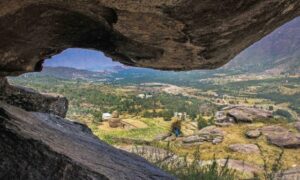
Ancient Temples and Shrines

Sudhanoti is home to various ancient temples and shrines, some of which have historical and architectural significance. These religious sites have witnessed the passage of time and are an integral part of the district’s cultural heritage.

Toli Pir

Toli Pir is one of the most iconic destinations in Sudhanoti. Its lush meadows and pristine landscapes make it a must-visit spot for hikers, nature enthusiasts, and those seeking adventure.

Salkhala

The Salkhala region is known for its scenic beauty, with flowing rivers and dense forests. It’s a place where you can lose yourself in the tranquility of nature.

Dhalian

Dhalian is another picturesque spot that beckons travelers with its unspoiled landscapes and opportunities for exploration.

Banjosa Lake

With its crystal-clear waters and peaceful surroundings, Banjosa Lake invites visitors to enjoy the beauty of Sudhanoti at a leisurely pace.

Schools

  • Government Boys High School, Pallandri
  • Government Girls High School, Trarkhel
  • Al-Raziq School, Khaigala
  • Al-Huda Public School, Sehr Bagla
  • Islamabad Model School, Dhalian

Colleges

  • Government Degree College, Pallandri
  • Government Postgraduate College, Trarkhel
  • Al-Saeed College of Education, Sehr Bagla
  • Azad Kashmir Medical College, Pallandri
  • National College of Arts, Sudhanoti Campus

Restaurants

  • Tasty Bites Restaurant, Pallandri
  • Usmania Restaurant, Trarkhel
  • Gulzar Fast Food, Sehr Bagla
  • Kashmiri Spice Restaurant, Dhalian
  • Grace Hotel and Restaurant, Toli Pir

Hospitals

  • District Headquarters Hospital, Pallandri
  • Azad Kashmir Medical College Teaching Hospital, Trarkhel
  • Bilal Hospital, Sehr Bagla
  • Azad Kashmir Health Center, Dhalian
  • Al-Shifa Hospital, Toli Pir

Frequently asked questions (FAQs) 

What is the geographical location of Sudhanoti?

Sudhanoti is located in the Pir Panjal range of the Himalayas, within Azad Kashmir, Pakistan.

What is the significance of Banjosa Lake in Sudhanoti?

Banjosa Lake is a prominent natural attraction, offering boating and picnicking opportunities, surrounded by lush greenery.
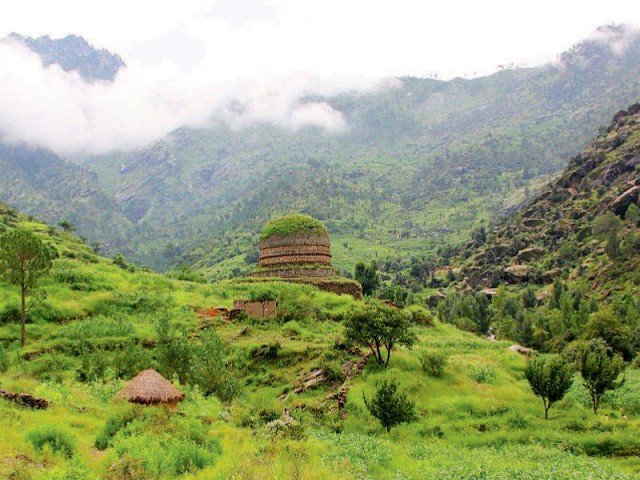
Is Sudhanoti known for its historical sites?

Yes, Sudhanoti boasts historical sites like Pallandri Fort and ancient temples, reflecting its historical legacy.

What cultural experiences can visitors enjoy in Sudhanoti?

Visitors can immerse themselves in the local culture, witnessing the traditions, festivals, and warm hospitality of the indigenous communities.

Are there opportunities for trekking and hiking in Sudhanoti?

Sudhanoti offers numerous trekking and hiking trails, each offering unique adventures and breathtaking views.

What is the local cuisine like in Sudhanoti?

Sudhanoti offers a delightful blend of Kashmiri and Pahari cuisine, with dishes like Dum Aloo, Rogan Josh, and Saag making for a delightful culinary experience.

Is Sudhanoti accessible year-round?

Yes, Sudhanoti is accessible throughout the year, with pleasant summers and snowy winters, making it a versatile destination for travelers.

What are some famous educational institutions in Sudhanoti?

Sudhanoti is home to institutions like Government Degree College, Azad Kashmir Medical College, and Al-Raziq School.

Which hospitals are prominent in Sudhanoti?

Hospitals such as District Headquarters Hospital and Azad Kashmir Medical College Teaching Hospital serve the healthcare needs of the region.

Are there popular dining options in Sudhanoti?

Sudhanoti boasts restaurants like Tasty Bites Restaurant, Usmania Restaurant, and Grace Hotel and Restaurant, offering a variety of culinary delights.

Wind Up Lines

Sudhanoti District, with its natural beauty, cultural richness, and accessibility, offers an experience that is both serene and adventurous. It’s a place where you can reconnect with nature, immerse yourself in local traditions, and create memories that last a lifetime. Sudhanoti is a canvas painted by nature and a tapestry woven with the threads of culture, making it a destination that lingers in the hearts of those who have the privilege of exploring it.

Rest Houses & Contact Details for Tourists in Azad Kashmir

Cities and Contact Details of Azad Kashmir or AJK 

You can contact the relevant departments and hotels for details and bookings. Given Below is a detailed description of the rest houses and distances to different sites and about all the districts of Azad Kashmir.


Cities and Districts

Contact Details

Muzaffarabad 05822-921317- 921421-921158
Rawlakot 05824- 920123
Neelum 05821-920106
Mirpur 05827- 920067
Bagh 05823-920067
Kotli 05826-920421


Tourist Information Centers

Districts

Contact details

Kohala near Kohala bridge 05822-922407
Barakot near Barakot police checkpost 05822- 922701


Tourist Rest House / Huts (District Muzaffarabad)

City

Status

Rooms

Saran Peer Chanasi Tourist Rest House 4
Dana Tourist Rest House 3
Barmala Shaheed Makki Tourist Rest House 3


Tourist Rest House / Huts (Neelum Valley)

Sr#

City

Status

Rooms

1 Kutton Angles Huts 7
2 Neelum Karen Tourist Rest House 6
3 Neelum Karen Tourist Motel 20
4 Dawarain Tourist Rest House 5
5 Sharda  Youth Hostel 5 halls
6 Upper Neelum Tourist Huts 4 Huts and Cafeteria
7 Lower Neelum Private Motel Cafeteria
8 Kel Tourist Motel Luxury
9 Hilmat Private hotel 10


Tourist Rest House / Huts (District Bagh)

Sr#

City

Status

Rooms

1 Sudhan Gali Rest House 6
2 Dhir Kot Tourist Hut 6
4 Neela Butt Rest House 3
5 Las Dana  Rest House 3


Tourist Rest House / Huts (District Poonch)

Sr#

City

Status

Rooms

1 Rawlakot PWD Rest House 3
2 Banjosa Rest House 5
3 Koian Rest House 3
4 Ghori Mar Rest House 6
5 Panyola Rest House 3
6 Tatta Pani Tourist Inn 11


Tourist Rest House / Huts (District Mirpur)

Sr#

City

Status

Rooms

1 Mirpur Tourist Rest House 2
2 Jandi Chontra Tourist Rest House 2


Tourist Rest House / Huts (District Kotli)

Sr#

City

Status

Rooms

1 Sarwar Kotli Tourist Rest House 6
2 Tenda Tourist Rest House 3
3 Khoi Ratta Under renovation
4 Fateh Pur Rest House 3


Jhelum Valley

All the tourist rest houses in Chakar, Daokhan, Chinian (Leepa), and Dana are under renovation. Soon, their reconstruction will be completed. After that, they will be open to tourists. For staying in these tourist rest houses, you can go to any district office during office time.

You can book for rest house in different districts from your nearby district office. But, it depends on the related officers and tourist spots’ conditions.

Moreover, PWD rest houses are also open for vacationers. You can visit the PWD head office of the relevant district for further information. You cannot book different PWD rest houses from one office. You will have to visit each of them for a reservation. But, they will provide good service.

Distance of different Sites from Muzaffarabad Neelum Valley

Spot/Site

Distance in Km

Spot / Site

Distance in Km

Khori 10km Petka 17km
Noseri 38 Chilhiyana 46
Jora 66 Kindle Shahi 74
Salkhala 79 Kutton 79
Jagran 92 Ath Maqam 84
Neelum Karen 93 Upper Neelum 95.5
Dawarian 106 Sharda 136
Sargan 168 Kel 155
Aurang Kel 157 Phalwai 182
Taobutt 199


Distance of different Sites from Muzaffarabad Neelum Valley

Spot/Site

Distance in Km

Spot / Site

Distance in Km

Khori 10km Petka 17km
Noseri 38 Chilhiyana 46
Jora 66 Kindle Shahi 74
Salkhala 79 Kutton 79
Jagran 92 Ath Maqam 84
Neelum Karen 93 Upper Neelum 95.5
Dawarian 106 Sharda 136
Sargan 168 Kel 155
Aurang Kel 157 Phalwai 182
Taobutt 199


Distance of different Sites from Muzaffarabad Jhelum Valley

Spot/Site

Distance in Km

Spot / Site

Distance in Km

Sabri 8km Garhi Dupatta 24 km
Saran 28 Duni Baklan 31
Neeli 45 Chanari 51
Chakothi 59 Hattian 50
Chakar 46 Lon Bangla 56
Dungian 61


Distance of different Sites from Muzaffarabad, Sudhan Gali, Bagh

Spot/Site

Distance in Km

Spot / Site

Distance in Km

Dani 33km Garhi Dupatta 24 km
Chakar 46 Sudhan Gali 59
Bagh 80


Distance of different Sites from Muzaffarabad, Leepa Valley

Spot/Site

Distance in Km

Spot / Site

Distance in Km

Sharyan via Neeli 51km Eshan 70 km
Laminian 58 Leepa 101
Chinian 106


Distance of different Sites from Muzaffarabad, Dao Khan

Spot/Site

Distance in Km

Spot / Site

Distance in Km

Neeli 43 km Laminian 58 km
Eshan 70 Daokhan 75


Distance of different Sites from Muzaffarabad, Dhir Kot via Dana

Spot/Site

Distance in Km

Spot / Site

Distance in Km

Chattar Class 21km Dana Khachali 42 km
Hanis Choki 59 Dhir Kot 68
Neela Butt 76


From Mirpur

Spot/Site

Distance in Km

Spot / Site

Distance in Km

Mangla 16km Chician 17 km
Bhimber 50 Samahni 70
Bagh Sir 64 Gujrat 110
Kotli 128 Islamabad 110


From Kohala

Spot/Site

Distance in Km

Spot / Site

Distance in Km

Islamabad 108 km Dhir Kot 24 km
Neela Butt 32 Arja 46
Bagh 64


Kohala, Palandri Route

Spot/Site

Distance in Km

Spot / Site

Distance in Km

Rawlakot 76km Chota Gala 96 km
Hijra 105 Trarkhel 108
Tatta Pani 134


Azad Pattan, Rawlakot Route

Spot/Site

Distance in Km

Spot / Site

Distance in Km

Palandri 22km Rawlakot via Mang 42 km
Trarkhel 54


Kotli, Khoi Ratta Route

Spot/Site

Distance in Km

Spot / Site

Distance in Km

Nikyal (Fateh Pur) 26 km Tatta Pani 40 km
Khoi Ratta 21


Rawalpindi Kotli Route

Spot/Site

Distance in Km

Spot / Site

Distance in Km

Sansa 100km Kotli 136 km


From Bagh

Spot/Site

Distance in Km

Spot / Site

Distance in Km

Dhir Kot 35km Kohala 65 km


Spot/Site

Distance in Km

Spot / Site

Distance in Km

Rawlakot via Arja 48km Via Shujabad 33km
Trarkhel 80km Plandri via Pattan 110km

 From Rawalpindi

Spot/Site

Distance in Km

Spot / Site

Distance in Km

Rawlakot 105km Palandri 95 km
Muzaffarabad 140 Kotli 135
Bagh 150 Mirpur 125

From Kotli

Spot/Site

Distance in Km

Spot / Site

Distance in Km

Tatta Pani 28km Hijra 50 km
Abbaspur 80 Nikyal 40
Khoi Ratta 30


From Muzaffarabad

Spot/Site

Distance in Km

Spot / Site

Distance in Km

Chanari 51km Chakothi 59 km
Garhi Dupatta 24 Hattian Bala 40
Chakar 50 Bagh Kohala 100


All About Province Khyber Pakhtunkhwa (KPK), Pakistan

Province Khyber Pakhtunkhwa (KPK)

Before being called Khyber Pakhtunkhwa (KPK), this region was called Sarhad, Gandara, Bigram, Pishklawati, and other names. According to the history of the province of KPK (Khyber Pakhtunkhwa), it is the cradle of ancient human civilization.

In fact, it is the biggest center of Buddhism. The archaeological remains of Swat, Takht Bhai, and Charsadda are witnesses of the promotion of Buddhism in this area.

 Bab-e-Khyber-KPK
The historical Bab-e-Khyber

Key information about Khyber Pakhtunkhwa

Attribute Khyber Pakhtunkhwa
Location Khyber Pakhtunkhwa (KP) is a province in Pakistan, situated in the northwestern region of the country.
Capital Peshawar is the provincial capital of KP.
Area KP covers an area of approximately 101,741 square kilometers, making it one of the four provinces of Pakistan.
Population As of the last available census data, KP is home to over 35 million people, contributing significantly to Pakistan’s population.
Geography The province boasts diverse topography, including mountains, valleys, and plains. The towering peaks of the Hindu Kush and the Sulaiman Mountains are prominent features.
Climate KP experiences varying climates, from the mountainous cold of its northern regions to the more temperate climate in its southern areas.
Culture The region is rich in Pashtun culture, traditions, and languages, and it has a profound influence on the art, music, and way of life in KP.
Historical Sites KP is known for its historical significance, with sites like the Buddhist archaeological remains in Takht-i-Bahi, the ancient city of Taxila, and the Badshahi Mosque in Peshawar.
Economy Agriculture, trade, and industry play a significant role in KP’s economy. The province is famous for its production of fruits, particularly apples and apricots.
Education KP is home to numerous educational institutions, including the University of Peshawar and Khyber Medical University.
Healthcare The province provides healthcare services through a network of hospitals, clinics, and medical facilities, ensuring access to medical care for its residents.

A brief History of Khyber Pakhtunkhwa (KPK)

There were thousands of Buddhism monasteries and worship places. Then, the tribal era came. The tribal chiefs of different tribes were used to rule this region in the form of small independent governments.

Mehmood Ghaznavid came into Punjab and KPK after defeating king Jay Pal. In 1191, Shahab-ud-Din Gori included this area in his kingdom. Taj-ud-Din Yaldoz, Qutub-ud-Din Aibek, and Al-Tamsh governed this area too.

In 1261, Khwarazm Shah after being defeated by Changez Khan fled away via the Khyber Pass of the Province KPK. Changez Khan chased him till Peshawar. But he returned back from Peshawar.

After overcoming Khilji, Tughluq, and Ameer Taimoor, Babur defeated Ibrahim Lodhi in 1526, and KPK was included in the Mughal monarchy. It remained divided into different parts till 1848 after the fall of the Mughal regime.

After the Sikh rule, the East India Company included Peshawar, Hazara, Kohat, Bannu, Dera Ismail Khan, and Dera Ghazi Khan in the Punjab Province. Furthermore, Malakand and the other four agencies were also given under the administration of Punjab.

In 1901, viceroy India Lord Curzon parted Peshawar, Hazara, Kohat, Bannu, and Dera Ismail Khan from Punjab and made it a separate province named Northern Western Frontier Province (NWFP).

History is witnessed that Pathans have never accepted the British regime. When the struggle for independence began, Pathans took an active part in every movement for freedom from Britishers. The people of the province also supported the ideology of Pakistan.

In 1930, the Residents of the province raised their voices. On 30th April, hundreds of freedom fighters sacrificed their lives in the Qissa Khawani Bazaar of Peshawar. Despite the unarmed, they ran over the tanks and armored vehicles.

In 1947, When Lord Mountbatten came to Peshawar for an assessment of the situation, about one lac Pathans were carrying the Muslim League Flag near the fort and chanting slogans of “Pakistan Zindabad”. In 1947, a month before the creation of Pakistan, 2874 votes were cast in favor of India and 189,240 for Pakistan.

Tribal and non-tribal areas were under the administration of the Federal government of the province.  They were called Bajaur Agency, Mohmand Agency, Kurram Agency, Aurak agency, Zai agency, Northern Waziristan, Southern Waziristan, tribal areas, and Fata. However, Frontier Region (FR) Peshawar, FR Bannu, FR Dera Ismail Khan, FR Kohat, were the non-tribal areas.

In these areas, the government of Pakistan in coordination with local tribes maintains peace and protects the borders. These people sort out their issues and clashes in Jirga (an assembly of local chiefs and leaders to solve the disputes of tribal people). Now, these areas are part of KPK.

Tourist Attractions in KPK

From the tourism point of view, the province of Khyber Pakhtunkhwa (KPK) is bestowed with high mountain ranges, mountain passes, charming lakes, waterfall, cascades, and a healthy and pleasant environment.

Abbottabad, Nathia Gali, Kaghan valley, Swat valley, Chitral valley, Kafiristan, Koh Suleman, Koh Hindukush, Khyber Pass, Tochi Pass, Gomel Pass, Lowari Pass, Kurram Pass, river Indus, river Kanhar, river Haru, river Swat, river Sarn, and river Chitral are worth mentioning sites.

 tourist-spots-swat-kpk
Swat Valley – The Switzerland of the East

There are numerous minerals in the hilly areas of the province. Swat valley has emerald stones Chitral has coal and mica mines. The gums of elevated mountains are sold as Salajeet a precious medicine.

Nature’s Gifts and Wildlife

Valuable herbs such as Violet, cumin, mica, hyacinth, and poison ivy are common here. In addition to Cedar, pine, bark, and poplar trees, there are wild animals like cheetah, bears, Markhor, and sheep.

Malam Jabba

Skiing Paradise: Malam Jabba is a popular skiing resort situated in the Swat Valley. It offers winter sports enthusiasts a thrilling experience with its well-maintained ski slopes.

Swat Valley

The Switzerland of Pakistan: Known as the “Switzerland of Pakistan,” Swat Valley is celebrated for its lush green valleys, meandering rivers, and the enchanting Malam Jabba.

Takht-i-Bahi

Buddhist Heritage: Takht-i-Bahi is an ancient Buddhist archaeological site with well-preserved stupas, monasteries, and artifacts, providing a glimpse into the region’s rich history.

Peshawar

Cultural Melting Pot: Peshawar, the provincial capital, is a city with a deep cultural heritage. It’s a hub for exploring traditional bazaars, historic sites like the Qissa Khwani Bazaar, and culinary delights.

Taxila

Ancient Remnants: The city of Taxila, a UNESCO World Heritage Site, is home to the Taxila Museum and a treasure trove of archaeological remains from the Gandhara civilization.

Kalam Valley

Heavenly Abode: Kalam Valley is known for its idyllic landscapes, pristine rivers, and alpine forests. It’s a favorite spot for trekkers and nature lovers.

Nathiagali

Hill Station Serenity: Nathiagali is a serene hill station with dense forests, providing a refreshing escape from the hustle and bustle of city life.

Kumrat Valley

Hidden Gem: Kumrat Valley remains one of KP’s hidden gems, with its picturesque meadows, wooden bridges, and a sense of untouched beauty.

Mahodand Lake

Alpine Beauty: Mahodand Lake is a stunning glacial lake surrounded by lush meadows, making it an excellent destination for picnics and boating.

Shahi Bagh

Historical Park: Shahi Bagh in Peshawar is a historical garden with a rich past. It’s a beautiful place to explore, unwind, and connect with the city’s history.

Jalozai Camp

Bird Watching: Jalozai Camp is a birdwatcher’s paradise, known for its avian diversity, offering a unique experience for nature enthusiasts.

Historical Treasures of Khyber Pakhtunkhwa

Peshawar Museum

Archaeological Archive: The Peshawar Museum is a treasure trove of Gandharan art and history, housing sculptures, pottery, and artifacts that shed light on the region’s past.

Udegram Buddhist Monastery

Monastic Marvel: Udegram Monastery, near Mingora, Swat, features an impressive stupa and ancient Buddhist relics.

Jamal Garhi

Ancient Stupas: Jamal Garhi is an archaeological site known for its group of Buddhist stupas and monastic cells, showcasing the region’s Buddhist heritage.

Balahisar Fort

Historic Fortress: Located in Peshawar, Balahisar Fort has witnessed various empires and stands as a testament to the region’s tumultuous history.

Butkara Stupa

Buddhist Relics: The Butkara Stupa, near Mingora, is an ancient Buddhist structure with inscriptions and carvings that offer a glimpse into the past.

Charsadda

Ancient Settlement: Charsadda is an area of historical importance, with sites like Pushkalavati, believed to be the ancient capital of Gandhara.

Bala Hissar Fort

Fortress of Ages: Located in Peshawar, this fort has served various rulers over centuries, from the Greeks to the Mughals, and now stands as a historical landmark.

Khyber Pakhtunkhwa’s historical sites are a testament to its deep-rooted heritage, with a remarkable blend of Buddhist, Greek, and Mughal influences. Exploring these sites offers a journey through time and a better understanding of the region’s diverse history.

Educational Institutions

  • University of Peshawar
  • Ghulam Ishaq Khan Institute of Engineering Sciences and Technology (GIKI)
  • Edwardes College Peshawar
  • Islamia College Peshawar
  • Abbottabad Public School

Restaurants

  • BBQ Tonight Peshawar
  • Monal Peshawar
  • The Charcoal BBQ Restaurant Abbottabad
  • Jalil Kabab House Peshawar
  • Madina Restaurant Swat

Hospitals

  • Lady Reading Hospital, Peshawar
  • Hayatabad Medical Complex, Peshawar
  • Khyber Teaching Hospital, Peshawar
  • Ayub Teaching Hospital, Abbottabad
  • Saidu Group of Teaching Hospitals, Swat

Frequently asked questions (FAQs) 

Q: What is the geographical location of Khyber Pakhtunkhwa?

A: Khyber Pakhtunkhwa is situated in the northwestern region of Pakistan, bordering Afghanistan to the west and north, and sharing boundaries with several other Pakistani provinces.

Q: What are the major cities in KP?

A: Some of the major cities in Khyber Pakhtunkhwa include Peshawar (the provincial capital), Abbottabad, Swat, Mardan, and Dera Ismail Khan.

Q: What is the significance of Peshawar in KP?

A: Peshawar is the provincial capital of KP and is known for its rich history, cultural diversity, and bustling markets. It serves as an important administrative and economic center.

Q: Are there any historical sites in KP worth visiting?

A: Yes, KP is home to several historical sites, including Takht-i-Bahi, Taxila, and Butkara Stupa, which provide insights into the region’s ancient heritage.

Q: What are the famous dishes in KP cuisine?

A: KP is renowned for its flavorful cuisine, including dishes like Peshawari karahi, chapli kebabs, and sajji. These dishes are a must-try for food enthusiasts.

Q: What is the significance of educational institutions in KP?

A: KP is home to prestigious educational institutions like the University of Peshawar, GIKI, and Islamia College, contributing to academic excellence in the region.

Q: Are there any notable healthcare facilities in KP?

A: Yes, KP has well-established healthcare institutions like Lady Reading Hospital, Hayatabad Medical Complex, and Ayub Teaching Hospital, providing medical services and training.

Q: What is the climate like in KP?

A: The climate in KP varies from region to region. In the north, there are cold, snowy winters, while the southern parts experience hot summers. The Swat Valley has a milder climate, making it a popular summer destination.

Q: Can I explore natural beauty in KP?

A: Absolutely! KP is known for its stunning natural landscapes, from the Swat Valley’s lush greenery to the serene Nathiagali hill station. Nature lovers will find plenty to explore.

Q: How do I reach KP from other parts of Pakistan?

A: KP is accessible by road and air. Major cities like Peshawar have airports, and a well-connected road network links KP to the rest of the country.

Q: Are there cultural festivals and events in KP?

A: Yes, KP hosts various cultural festivals and events, including the Kalash Festival in Chitral and the Jashn-e-Khyber in Peshawar, where you can experience the region’s vibrant culture.

Wind Up Lines

Khyber Pakhtunkhwa is considered a hub of tourist spots and recreational destinations. It is enriched with natural beauty, historical landmarks, and natural resources. Its deep-rooted history, culture, traditions, norms, food, and festivals attract the holiday makers.

Beautiful Tourist Spots in Kashmir – Gurez Valley & Taobat

Tourist Spots in Kashmir

Nestled in the heart of the Himalayas, Kashmir has long been synonymous with paradise on Earth. Its breathtaking landscapes, pristine lakes, and lush meadows have lured travelers from across the globe. In this comprehensive guide, we’ll take you on a journey through the most beautiful tourist spots in Kashmir PK. Whether you’re an adventure seeker or a nature lover, Kashmir offers something for everyone.

Aspect Information
Location Region in Northern South Asia
Geographic Divisions Jammu and Kashmir, Azad Kashmir, and Gilgit-Baltistan
Area Approximately 85,806 square miles (222,236 square kilometers)
Borders India, Pakistan, and China
Capital Srinagar (in Indian-administered Jammu and Kashmir)
Major Cities Srinagar, Jammu (in Indian-administered territory)
Official Languages Urdu (recognized in both regions), Dogri, Punjabi (in Indian-administered Jammu and Kashmir), English
Religion Predominantly Islam, Hinduism (minority in Indian-administered territory)
Political Status Contested; India and Pakistan administer different parts, with ongoing disputes
Conflict Long-standing territorial conflict between India and Pakistan
Natural Features Himalayan mountains, numerous rivers, and scenic landscapes
Economy Agriculture, horticulture, handicrafts, and tourism (affected by conflict)
Culture Rich blend of Kashmiri, Indian, and Central Asian influences
Tourist Attractions Dal Lake, Gulmarg, Pahalgam, Amarnath Cave, Mughal Gardens
Climate Cold winters with heavy snowfall, moderate summers
International Disputes Disputes over territorial control and sovereignty
Current Situation Ongoing tensions and political complexities
Notable Fact The Line of Control (LoC) divides the region into Indian and Pakistani-administered areas

Gurez Valley

It is spreading from Kel to Kakai village at an elevation of 8500 from the sea level. Tourists are so lost here that they do not want to go back.

This valley consists of small villages named Phalwai, Sardalai, Hilmat, Tao Batt, Durmat, and Dodgaii. Only Hilmat and Tao Butt are worth watching.

Gurez-Valley-Azad-Kashmir.
The beautiful valley Gurez

Hilmat

This village is 38km from Kel. Hilmat has a rest house and other facilities. People can also enjoy camping there.

Taobutt

Tao Butt is the last village of Gurez Valley near the borderline (LOC) a few kilometers away from Hilmat. The river Neelum at this point enters the occupied Jammu Kashmir from Azad Kashmir.

Tourists come to Taubat for a long time to embrace the natural landscapes. Private hotels and shops are there for residence.

 Taobat-Azad-Kashmir
Roaring water channel of Taobat Valley

Srinagar

Srinagar, the summer capital of Jammu and Kashmir, is a mesmerizing blend of natural beauty and rich culture. The Dal Lake, with its charming houseboats and shikara rides, is a must-visit. Stroll through the Mughal Gardens and savor the local cuisine by the waterfront.

Gulmarg

Gulmarg, with its rolling meadows and snow-covered peaks, is a paradise for nature enthusiasts. In winter, it transforms into a skiing wonderland, while in summer, it offers splendid golfing experiences. The Gulmarg Gondola, one of the highest cable cars globally, offers panoramic views of the Himalayas.

Pahalgam

Pahalgam’s lush green valleys and pristine landscapes make it an idyllic retreat. It’s a perfect base for treks and nature walks. The Betaab Valley, named after the Bollywood movie “Betaab,” is a must-see. Don’t forget to try the local delicacies in Pahalgam.

Dal Lake

Dal Lake is not just a waterbody; it’s a way of life in Srinagar. Stay on a houseboat, enjoy a shikara ride, and witness the floating gardens. The reflection of the surrounding mountains in the crystal-clear water is a sight to behold.

Manasbal Lake

Manasbal Lake is a hidden gem for bird lovers. Surrounded by lush gardens and orchards, it’s home to numerous migratory and local bird species. Bring your binoculars and enjoy a peaceful day of birdwatching.

Wular Lake-Asia’s Largest Freshwater Lake

Wular Lake is a marvel of nature. It’s a hub for water sports like water skiing and boating. The scenic beauty of the lake, with the backdrop of snow-capped mountains, is simply breathtaking.

Sonamarg

Sonamarg, adorned with golden flowers, is the base for some of the most famous treks in Kashmir. The Thajiwas Glacier is a popular attraction. It’s a winter wonderland for snow lovers and a summer delight for hikers.

Amarnath Cave

The Amarnath Cave is a significant pilgrimage site in the region. The annual Amarnath Yatra takes devotees to an ice Shiva Lingam. It’s a challenging trek but a deeply spiritual experience.

Unique Experiences

Awantipora Ruins

Awantipora Ruins are a testament to Kashmir’s rich history. Explore the ancient temples dedicated to Lord Shiva and marvel at the intricate architecture.

Shalimar Bagh

The Shalimar Bagh, built by Emperor Jahangir, is a masterpiece of Mughal garden design. It’s a perfect place for a leisurely stroll amidst terraced lawns and cascading fountains.

Shopping in the Local Bazaars

Don’t miss the opportunity to shop for exquisite handicrafts like Pashmina shawls, saffron, and local spices in the bustling bazaars of Kashmir.

Frequently Asked Questions (FAQs)

What’s the best time to visit Kashmir?

Kashmir is beautiful year-round, but the best time is during spring (April to June) and autumn (September to November) when the weather is pleasant, and the landscape is breathtaking.

Is Kashmir safe for tourists?

Yes, Kashmir is a safe destination for tourists. However, it’s advisable to stay updated on the current situation and follow local guidelines.

Can I trek in Kashmir?

Absolutely! Kashmir offers a plethora of trekking opportunities, from easy walks to challenging high-altitude treks. Make sure to hire a local guide for a safe experience.

What should I wear in Kashmir?

In summers, light and comfortable clothing is suitable. In winters, layer up with warm clothes. Don’t forget to pack a pair of sturdy walking shoes.

How can I reach Kashmir?

You can reach Kashmir by air, road, or train. Srinagar has an international airport, and the region is well-connected by road and rail from major cities.

What’s the local cuisine like?

Kashmiri cuisine is a treat for your taste buds. Try dishes like Rogan Josh, Wazwan, and Kashmiri Pulao for a delightful culinary experience.

Windup-lines

Kashmir, with its picturesque beauty and warm hospitality, is indeed a paradise on Earth. The Beautiful Tourist Spots in Kashmir PK offer an array of experiences that will stay etched in your memory forever. So, pack your bags, prepare your camera, and get ready to explore this enchanting land.

Bhimber | Bab-e-Kashmir | Famous Sites in Bhimber

Bhimber

Situated 50km from Mirpur city, Bhimber is 459 meters above ocean level. This historical city is connected to Gujrat and Kharian and is called “Bab-e-Kashmir”. Mughals emperors used to enter Kashmir from this route.

An old road in Bhimber goes to Srinagar through Peer Panjal. It was constructed by the engineer of Akbar King in 1586 and it is called the “Mughal highway”.

Bhimber-Azad-Kashmir.
Bhimber Azad Kashmir

This region was liberated in 1947 under the supervision of Bargedier Habib-ur-Rehman. It is 48km from Gujrat. An ancient Mughalia well, a mosque, and an elephant gate are historical assets.

Key information about Bhimber 

Attribute Information
Name Bhimber
Location Azad Kashmir, Pakistan
Geographical Features Located in the southwestern part of Azad Kashmir, Bhimber boasts a diverse terrain that includes plains, hills, and rivers.
Climate Experiences a moderate climate, with warm summers and chilly winters, making it a year-round destination.
Historical Significance Bhimber has a rich history, with archaeological sites reflecting the region’s ancient heritage.
Cultural Heritage Home to indigenous communities that celebrate local festivals and traditions.
Economy The economy of Bhimber is primarily based on agriculture, trade, and small-scale industries.
Educational Institutions Bhimber has several schools and colleges that offer educational opportunities to the local population.
Local Attractions The region is known for its natural beauty, serene landscapes, and the historic fort of Khari Sharif.
Accessibility Accessible by road from major cities in Azad Kashmir and Pakistan, making it a convenient destination.

HISTORY

Bhimber’s historical significance can be traced back to ancient times. The region has archaeological sites that suggest it was inhabited during the Indus Valley Civilization, showcasing its ancient roots. During the Mughal Empire, Bhimber was an important center. It was known for its strategic location on the trade routes of the time. The Mughals left their architectural influence, as evident in the historic Khari Sharif Fort. In the 19th century, Bhimber, like many other regions in the area, came under Sikh rule. The Sikhs left their imprint on the culture and architecture of the region.

With the partition of India in 1947, Bhimber became a part of Pakistan. The region experienced changes in administration and political dynamics during this transition.

Bhimber is a place with a diverse cultural heritage. It is home to various indigenous communities that have their traditions and festivals. These cultural elements add depth to the historical and cultural narrative of the region.

Famous Tourist Spots in Kashmir

Jandi Chontra

This hill station is 17km from Bhimber at a height of 1000 meters above sea level. The mountain ranges of occupied Jammu Kashmir and Peer Panjal peaks can be viewed from this hill station. There is a tourist rest house in Jandi Chontra.

Jandi-Chontra-Bhimber.
The sky scrapping lush green trees in Jandi Chontra

Samahni Valley

It is completely surrounded by high mountains at a distance of 28km from Bhimber in the north. Cascades and noisy streams with clear water attract everyone.

Saif Ullah Kashmiri is the best guide to visiting Mughlai inns, archaeological sites, camping, and housing facilities.

Bagh Sir Fort and Lake

Bagh sir has a meaning of water and land of gardens. It had gained special attention from the Mughals due to its calm environment. Bagh sir fort is an ancient fort.

Established on the mountain top, there are different points of view about this fort. The majority of the evidence revealed that it was built by the Mughal monarch.

According to some historians, Mughal king Jahangir sicked here while returning from Kashmir and died here. Later on, his dead body was shifted to Lahore.

Bhagsar fort
Ancient Historical Fort- Baghsar

Some said that this fort was built by Sikhs after defeating the last ruler of Bhimber state Raja Sultan Khan in 1812. This place is 12km from both Samahni town in the east and Jandi Chontra.

Bagh sir is utilized as the central location because of its strategic geography, and calm environment. The public is not allowed in this fort since it is under the supervision of the Pakistan army.

Bagh Sir Lake is at 975 meters height above sea level near this fort.  It is almost 1.5 meters long.

Khari Sharif Fort

he Khari Sharif Fort is a historical gem that dates back to the Mughal era. This fort is an architectural marvel, boasting intricate designs and grandeur. It provides a glimpse into the region’s rich history and is a must-visit for history enthusiasts.

Bhimber Gali

Bhimber Gali is a picturesque mountain pass that offers stunning views of the surrounding landscapes. It’s a popular spot for nature lovers, trekkers, and photographers. The lush green hills and serene atmosphere make it a perfect location for relaxation.

Toli Pir

Toli Pir is a charming hilltop in Bhimber known for its lush meadows and panoramic vistas. It’s an excellent place for picnics and hiking. The view from Toli Pir is simply breathtaking, and it’s an ideal spot to witness a sunset.

Sardari Waterfall

Located near Kharian, the Sardari Waterfall is a natural wonder in Bhimber. The cascade of water amidst a lush green forest is a refreshing and scenic spot for nature enthusiasts.

Dharamsal Temple

This ancient temple is a significant religious site for the local Hindu community. The architecture and ambiance of the temple provide insights into the region’s diverse cultural heritage.

Local Markets

Strolling through the local markets in Bhimber offers a glimpse into the daily life of the community. You can shop for local handicrafts, textiles, and enjoy the vibrant market atmosphere.

Local Festivals

Bhimber hosts various local festivals, such as Basant, which is celebrated with great enthusiasm. Visitors can partake in these festivities and experience the cultural richness of the region.

Schools

  • Government Boys High School, Bhimber: A prominent educational institution that plays a crucial role in providing quality education to the students of Bhimber.
  • Government Girls High School, Bhimber: Ensuring the education of young girls, this institution contributes to the empowerment and development of the region’s female students.

Colleges

  • Government Degree College, Bhimber: Providing higher education opportunities, Government Degree College is a significant institution for students in the region.

Restaurants

  • Bhimber View Restaurant: This local eatery offers a taste of the region’s cuisine, serving traditional dishes in a pleasant ambiance.
  • Kashmiri Delights Restaurant: Visitors can savor authentic flavors of Kashmiri cuisine, including renowned dishes like Rogan Josh and Dum Aloo.

Hospitals

  • District Headquarters Hospital, Bhimber: Offering essential medical services, District Headquarters Hospital serves the healthcare needs of the region.
  • Bhimber Medical Center: Providing healthcare facilities, Bhimber Medical Center caters to the medical requirements of the local community.

Frequently asked questions (FAQs) 

What is the geographical location of Bhimber?

Bhimber is situated in Azad Kashmir, Pakistan, in the southwestern part of the region.

What is the historical significance of Bhimber?

Bhimber has a rich history, with archaeological sites dating back to ancient times, showcasing the region’s ancient roots and cultural heritage.

Are there any famous historical sites in Bhimber?

Yes, Bhimber is home to the historic Khari Sharif Fort, which reflects architectural influences from the Mughal era.

What are the educational institutions in Bhimber?

Bhimber hosts several schools and colleges, providing educational opportunities for the local population.

What is the local cuisine like in Bhimber?

Bhimber offers a delightful blend of Kashmiri and Pahari cuisine, with dishes like Dum Aloo and Rogan Josh among the culinary highlights.

What are the major attractions in Bhimber?

Prominent attractions in Bhimber include the Khari Sharif Fort, Bhimber Gali, Toli Pir, and Sardari Waterfall, which provide diverse experiences for visitors.

Is Bhimber easily accessible?

Bhimber is accessible by road from major cities in Azad Kashmir and Pakistan, making it a convenient destination for those seeking to explore the region.

What festivals and cultural events are celebrated in Bhimber?

Bhimber hosts various local festivals, providing visitors with the opportunity to experience the region’s cultural richness and traditions.

Wind Up Lines

Bhimber is a destination where echoes of the past resonate in the historic fort, archaeological sites, and the daily life of the local population. While specific historical records may be limited, Bhimber’s heritage is embedded in its landscapes, architecture, and the traditions of its people. Visitors to Bhimber have the opportunity to explore not just its natural beauty but also the echoes of history that make the region unique.

Tourist Sites in Sudhan Gali Kashmir – Ganga Choti & Gagra

Sudhan Gali

This area full of natural rainforests is waiting for you at a distance of 8km from Dungian and 18km from Chakar. Sudhan Gali (7000 feet above sea level) can be chosen as a base camp to reach 10,200 feet high peak “Ganga Top”.It is a beautiful site in Azad Kashmir.

A tourist rest house and private guest house with residential facilities are also there. A cricket ground famous as Sir Ground is located there near Ganga peak. A tournament is organized every year in June.

 Sudhan-Gali-Azad-Kashmir.
Horses in the rich green meadows of Sudhan Gali

Key information about Sudhan Gali 

Attribute Information
Name Sudhan Gali Kashmir
Location Azad Kashmir, Pakistan
Geographical Features Situated at an elevation in the Pir Panjal range of the Himalayas, Sudhan Gali offers stunning views and lush landscapes.
Climate Experiences cool summers and snowy winters, making it an ideal destination for all seasons.
Trekking and Hiking Offers numerous trekking and hiking opportunities with scenic trails leading to panoramic viewpoints.
Flora and Fauna Rich biodiversity with dense forests, providing habitat for various species of flora and fauna.
Local Culture Home to indigenous communities with unique traditions and warm hospitality.
Must-Visit Sites Prominent attractions include Sudhan Gali Top, lush meadows, and panoramic viewpoints.
Accommodations Limited accommodations available, including guesthouses for visitors.
Accessibility Accessible by road from various cities in Azad Kashmir, making it a convenient destination.
Natural Beauty Renowned for its captivating natural beauty, with dense forests, serene meadows, and breathtaking vistas.

History

Sudhan Gali, like many places in the region, holds a history intertwined with the broader historical narrative of Kashmir. While its specific historical details may not be extensively documented, it bears the marks of the region’s rich heritage.

The Kashmir Valley, which includes Azad Kashmir, has been a melting pot of cultures and civilizations throughout its history. It has witnessed the rise and fall of various empires and dynasties, from the Mauryan and Gupta empires in ancient times to the spread of Buddhism and Hinduism.

During the medieval period, the arrival of Islam played a significant role in shaping the culture and traditions of the region. The Mughal Empire, which ruled over Kashmir, left a lasting impact on the architecture and way of life.

In the 19th century, the princely state of Jammu and Kashmir emerged, with regions like Sudhan Gali becoming a part of it. This princely state continued under the rule of the Dogra dynasty until the partition of India in 1947.

The partition of India brought significant changes to the region, leading to political transformations and complex socio-cultural dynamics. Sudhan Gali, like other areas, experienced the consequences of these changes.

Today, Sudhan Gali is a place where echoes of the past resonate in the natural beauty and cultural vibrancy of the region. While detailed historical records may be limited, the heritage of Sudhan Gali is embedded in its landscapes, its traditions, and the warmth of its people. Visitors to Sudhan Gali have the opportunity to explore not just its natural beauty but also the echoes of history that make the region unique.

Tourist Sites in Sudhan Gali

Ganga top (Peak)

Situated in the district Bagh, this peak is locally known as Ganga Choti. This hilltop at the height of 10,200 feet in the Peer Panjal mountain range is also called the crown of district Bagh.

If you want to enjoy it to the fullest, take a 7km walk from Sudhan Gali to reach the top. Your every step will take you to the peak. It is the best place in this area to visit.

 Ganga-Choti-Bagh-Azad-Kashmir.
Rich green mountains of Ganga Choti

A bird’s eye view of this charming point can be enjoyed from the top. It is covered with snow in winter therefore, April to September is the best season to relish holidays on this site.

Gagran

This marvelous masterpiece of nature is located at 9000 feet in height. A passenger vehicle will take you to Dohlli village. From there, you can reach this point by walking.

The beauty of this place starts revealing as you move forward. The sky gets overcast and it starts drizzling. The day looks like a dark stormy night. There are grazing fields and meadows above Gagran.

From these meadows, the shining roofs of Bagh city houses can be seen. These meadows are spreading to the snow-capped mountains of Haji Peer. A road in Noon Bangla goes to Border via Haji Peer.

It will be a good idea to hire a guard. It will be a better idea to hire a guard.

Sudhan Gali Top

The Sudhan Gali Top offers breathtaking panoramic views of the surrounding landscapes. It’s a place where you can witness the beauty of the Himalayas, with rolling hills and lush valleys stretching as far as the eye can see.

Lush Meadows

Sudhan Gali is known for its meadows, which come alive with vibrant colors during the spring and summer. These meadows provide a perfect setting for picnics, relaxation, and simply enjoying the serene surroundings.

Trekking and Hiking Trails

The region offers numerous trekking and hiking trails, making it a paradise for adventure enthusiasts. Whether you’re a seasoned hiker or a beginner, there are trails suitable for all levels of experience.

Flora and Fauna

Sudhan Gali is home to rich biodiversity. The dense forests that cover the area provide habitat for various species of flora and fauna. Birdwatching and wildlife enthusiasts will find plenty to explore.

Local Culture

The warm and welcoming indigenous communities in Sudhan Gali offer a glimpse into local traditions and lifestyles. You can interact with the locals, partake in their festivities, and experience their unique way of life.

Schools

  • Government Boys High School, Sudhan Gali: This school caters to the educational needs of the local community and plays a crucial role in providing quality education to the students of Sudhan Gali.
  • Government Girls High School, Sudhan Gali: Ensuring the education of young girls, this institution contributes to the empowerment and development of the region’s female students.

Colleges

  • Government Degree College, Sudhan Gali: Providing higher education opportunities, Government Degree College is a significant institution for students in the region.

Restaurants

  • Sudhan Gali Restaurant: This local eatery offers a taste of the region’s cuisine, serving traditional Kashmiri and Pahari dishes in a rustic and charming ambiance.
  • Kashmiri Delights Restaurant: Visitors can savor authentic flavors of Kashmiri cuisine, including renowned dishes like Rogan Josh and Dum Aloo, in this cozy restaurant.

Hospitals

  • Sudhan Gali Health Center: Offering essential medical services, Sudhan Gali Health Center provides healthcare assistance to the local population.

Frequently asked questions (FAQs) 

What is Sudhan Gali’s geographical location?

Sudhan Gali is located in Azad Kashmir, Pakistan, nestled within the Pir Panjal range of the Himalayas.

What makes Sudhan Gali a popular destination?

Sudhan Gali is renowned for its natural beauty, lush meadows, trekking opportunities, and a tranquil atmosphere that attracts nature lovers and adventure enthusiasts.

Are there trekking and hiking opportunities in Sudhan Gali?

Yes, Sudhan Gali offers various trekking and hiking trails, providing adventure seekers with a chance to explore its scenic landscapes.

What is the best time to visit Sudhan Gali?

Sudhan Gali is accessible throughout the year, with pleasant summers and snowy winters, making it a versatile destination for travelers.

Can I experience local culture in Sudhan Gali?

Yes, the indigenous communities in Sudhan Gali are known for their warm hospitality and unique traditions, allowing visitors to immerse themselves in the local way of life.

Are there accommodations available in Sudhan Gali?

While accommodations are limited, Sudhan Gali offers guesthouses and lodges for visitors seeking to stay in the region.

What are some must-visit sites in Sudhan Gali?

Prominent attractions in Sudhan Gali include Sudhan Gali Top, lush meadows, trekking trails, and viewpoints with panoramic vistas.

Is Sudhan Gali easily accessible?

Sudhan Gali is accessible by road from various cities in Azad Kashmir, making it a convenient destination for those seeking a serene escape into nature.

What is the local cuisine like in Sudhan Gali?

Sudhan Gali offers a delightful blend of Kashmiri and Pahari cuisine, with dishes like Dum Aloo and Rogan Josh among the culinary highlights.

Wind Up Lines

Sudhan Gali is a destination that combines natural beauty with cultural richness, making it an ideal spot for those seeking a serene escape in the lap of the Himalayas. Whether you’re a nature lover, an adventure seeker, or a culture enthusiast, Sudhan Gali has something to offer everyone.

Bagh – Kashmir | Famous Tourist Sites of District Bagh

Bagh – Kashmir

Bagh city is the central headquarter of district Bagh. It is 46 km from Rawalakot and 100km from Muzaffarabad via Kohala at the convergence of the rivers Mahil and Mahalwani.

Since these two rivers flow throughout the year, the climate is pleasant. Bagh is mentioned in a five-thousand-year-old history book “Raj Turangi”.

It is at the foothills of the sub-ranges of Himalaya Peer Panjal, Kafir Khan, Sankhra, Basali, Ganga Choti, and Neza Gali. These mountain ranges are at an average height of 12,000 feet from sea level and they are covered with snow nine months a year.

Bagh-District-Kashmir.
Lush Green Pastures of Bagh Azad Kashmir

 Overview  about Bagh in Kashmir

Attribute Information
Location Bagh, Azad Jammu and Kashmir, Pakistan
District Bagh District
Coordinates 33.9814° N, 73.7803° E
Population Approximately 100,000 (as of my last update in 2021)
Language Kashmiri, Urdu, and English
Geography Surrounded by lush green hills and mountains, with the River Poonch flowing through the city.
Economy Primarily agrarian, with agriculture as the main occupation. Fruits and vegetables are cultivated in the region.
Education Several educational institutions, including schools, colleges, and a degree college.
Transportation Connected by road, and the nearest airport is located in Rawalakot.
Tourism Known for its scenic beauty and is a gateway to various tourist spots in Azad Jammu and Kashmir. Tourists visit for hiking, trekking, and natural beauty.
Notable Landmarks 1. Bagh Fort: A historic fort in the city. 2. Sudhan Gali: A picturesque hill station nearby.

Famous Tourist Sites of District Bagh

Bagh – Kashmir, also known as the “Garden of Paradise,” is a region that seems to have been plucked straight from a fairytale. Its name, Bagh, means “garden,” and once you set foot in this land, you’ll understand why. The lush green meadows, pristine rivers, and snow-capped mountains make Bagh an absolute paradise for nature enthusiasts.

The Serene Beauty of Bagh

Bagh’s natural beauty is nothing short of spectacular. Lush orchards, dense forests, and serene meadows create a mesmerizing landscape. The region is surrounded by the Pir Panjal mountain range, and the soothing sound of the gushing Jhelum River adds to the charm.

Exploring District Bagh

District Bagh, an administrative division within the region, is home to numerous tourist attractions. Let’s delve into some of the most famous ones.

The Famous Tourist Sites of District Bagh

1. Bagh Fort

Bagh Fort, a historical gem, stands as a testament to the rich cultural heritage of this region. Built by Chak rulers in the 19th century, the fort is an architectural marvel. Its intricate designs and grandeur reflect the glory of the past.

2. Leepa Valley

Leepa Valley, a hidden paradise in District Bagh, is a picturesque valley adorned with terraced fields and wooden houses. The valley is known for its stunning landscapes and hospitable locals who are always ready to welcome travelers.

3. Sudhan Gali

Sudhan Gali is a charming hill station that offers breathtaking views of the surrounding mountains and valleys. It’s a popular spot for trekking and picnicking, making it a must-visit destination for adventurers.

4. Baghsar Fort

Baghsar Fort is another architectural gem in District Bagh. This well-preserved fort boasts exquisite craftsmanship and offers a glimpse into the region’s glorious past.

5. Ganga Choti

Ganga Choti, also known as the “Throne of Fairies,” is a trekker’s paradise. It offers thrilling treks and the chance to be surrounded by the unspoiled beauty of the Himalayas.

6. Mughal Road

Mughal Road, an ancient trade route, connects Srinagar to Poonch and Rajouri. It’s not just a road but a journey through history and culture.

FAQs

Is Bagh safe for tourists?

Bagh is generally safe for tourists. However, like any other destination, it’s advisable to take standard precautions and stay informed about the current situation.

What is the best time to visit Bagh – Kashmir?

The best time to visit Bagh is during the summer months, from April to June, when the weather is pleasant, and the landscapes are at their vibrant best.

How do I reach Bagh?

You can reach Bagh by road from Srinagar or Jammu. The nearest railway station is at Jammu, and the nearest airport is Srinagar International Airport.

Are there accommodations available in Bagh?

Yes, Bagh offers a range of accommodations, from budget hotels to guesthouses and resorts. It’s advisable to book in advance during the peak tourist season.

What should I pack for a trip to Bagh?

Pack comfortable clothing, trekking gear if you plan to explore the hills, and don’t forget essentials like sunscreen, insect repellent, and a first-aid kit.

Is photography allowed at Bagh Fort and other historical sites?

Yes, photography is generally allowed at most tourist sites. However, it’s a good practice to seek permission and respect local guidelines.

Windup-lines

Bagh – Kashmir, along with the famous tourist sites of District Bagh, is a hidden gem in the crown of the Indian subcontinent. Its natural beauty and historical significance make it a must-visit destination for travelers seeking an escape into serenity and culture. So, when you’re ready to explore the unmatched charm of Bagh, don’t forget to include these famous sites on your itinerary. Happy travels!

Tourist Spots in Kotli Kashmir – Tatta Pani & Fateh Pur

Kotli

District Kotli is a hilly area. The mountain range rises from here to the mountain of district Poonch. This Kotli district is famous as Madina-ul-Masajid and is located 141 km away from Islamabad.

Occupied Jammu Kashmir, Rawlakot, and Mirpur, are located in its surrounding.

Equipped with the latest facilities, a PWD rest house, and a rest house, this district is located at a height an average height of 1000 meters from sea level.

Kotli-Azad-Kashmir-Pakistan.
A beautiful sight of the city of mosques, Kotli Kashmir

Key info about Kotli

Attribute Kotli, Azad Kashmir
Location Kotli is a district located in Azad Kashmir, Pakistan.
Geographical Features The region is known for its scenic beauty, with lush green hills, fertile plains, and the Poonch River meandering through its territory.
Climate Kotli experiences a temperate climate with hot summers and cold winters, making it a pleasant destination year-round.
Natural Beauty Kotli is celebrated for its picturesque landscapes, serene valleys, and the serene Poonch River, providing a captivating ambiance.
Historical Significance The region has historical and cultural importance, with traces of ancient civilizations and local traditions.
Adventure Activities Kotli offers opportunities for trekking, hiking, and outdoor adventures amidst its beautiful terrain.
Local Culture The region reflects the broader Kashmiri heritage, showcasing local customs, festivals, and traditional architecture.
Accessibility Kotli is accessible by road from various cities in Azad Kashmir, making it a convenient destination for travelers.

Famous Tourist Spots in Kotli Kashmir

Tenda

Tenda is the best viewpoint which is 6km away from Kotli. You can enjoy the charming view of diver Ponch and Kotli city. Keeping in view the importance of this place, AJK tourism department has established a rest house there.

Goi

It is a small village in the district Kotli. Waterfalls are flowing near rivers Mahol and Braila. Dubrian is close to this village. A famous war was fought here in which Dogra army men succeeded to flee away to Jammu Kashmir via the river Mahol.

 Goi-Azad-Kashmir
The sky high trees of Goi Kotli Kashmir

Naik Saif Ali Khan Shaheed

Naik Saif Ali Khan was born on 25th April 1922 in village Khandra of Tehsil Nikyal. On 18th March 1941, he entered the royal core of engineers in the British Indian army. In 1947, after completing his services in the Indian Army, he established Haideri Force in collaboration with Sardar Mohammad with Karelvi.

On 1st January 1948, he established “Sher Riasti” on the order of Lieutenant Kernel Muhammad Sher Khan. He was ranked Platoon commander for his bravery and courageousness. He along with his platoon inflicted heavy losses on the enemy on the front line of Budhakhana.

He got injured and martyred on 26th October 1948. On 14th March 1949, the Defence Council of Azad and Jammu Kashmir awarded him “Hilal-e-Kashmir”. On 30th November 1995, the government of Pakistan declared this award equal to Nishan-e-Haider.

شہادت ہے مطلوب مقصود مومن

نہ مال غنیمت، نہ کشور کشائی

A-memorial-to-Saif-Ali-Shaheed
A memorial to Saif Ali Shaheed

Bethak 

This beautiful place in district Sudhunoti is although a backward area but it is full of natural beauty. You can view the river Ponch and Jammu Kashmir from this point named Char Bhar. A route is directed to this spot from Trarkhel.

Tatta Pani Spring and Tatri Note

There is a water spring at Tatta Pani Point which is 24 km from the road directed to Hijra from Kotli. Sulfur vapors evaporate from this spring due to which its water is too hot.

It is very difficult to stay here in the smell and warmth of Sulphur in the summer season. This spring’s water is beneficial for knee pain and skin allergies. There are bathrooms near this spring that have facilities for cold and warm water.

 Tatta-Pani-Spring-Kotli-Azad-kashmir.j
Tatta Pani Spring Kotli Azad Kashmir

A narrow valley on the left side from Hijra to Tatta Pani Track will take you to the crossing point of Azad and Jammu Kashmir called Tatri note.

Fateh Pur (Nakyal)

This area is located 37 km from Kotli and on the borders of both Azad and Jammu Kashmir due to the partition at the time of the War of Independence (1947-1948).

It is comparatively cooler than other cities in the district since it is at an elevation of 1524 meters from the ocean level. It is considered to be the most beautiful part of Azad Kashmir.

Fateh-Pur-Nakyal-Kotli-Kashmir
The rich green mountains of Fateh Pur Nakyal, Kotli Kashmir

A rest house and other facilities are accessible to the tourists. The Indian army killed innocent Kashmiri since this area is close to the border.

Khuiratta

This site is 30 from Kotli and is famous for its beautiful orchards. Khuiratta is the best traveling spot near the cease-fire line.

Dheri Sahibzadiyan, Bagh Darbar, Mai Toti, Manowaal, Chattar Chalni, and Karjai Dheriare tourists point. The famous fort of Karjai is near Khuiratta. It was built by Maharaja Gulab Singh.

Khuiratta-Azad-Kashmir-Pakistan
Khuiratta Azad Kashmir Pakistan

Gulpur Waterfall and Tharochi fort

This waterfall flows in three steps and is located in Gulpur Town on the Kotli Mirpur Road. It is an ideal place for families and friends. The ancient historic fort is on the nearby hilltop.

Gulpur-Waterfall-Azad-Kashmir-Kotli.
A beautiful sight of Gulpur Waterfall Kotli Azad Kashmir

Poonch River:

Serenading Waters: The Poonch River is the lifeline of Kotli, gently flowing through the region and creating enchanting vistas. Its crystal-clear waters are not just a scenic delight but also offer an opportunity for peaceful riverside strolls and picnics.

Hill View Park:

Scenic Overlook: Hill View Park offers panoramic views of Kotli and its surrounding landscapes. It’s an excellent place to capture the beauty of the region on your camera and enjoy a peaceful escape amid nature.

Toli Pir

Spiritual Retreat: Toli Pir is a revered shrine located atop a hill. The site is not only a place of spiritual significance but also offers stunning views of the countryside. A trek to Toli Pir is a popular activity for those seeking adventure and spirituality.

 Leepa Valley

Alpine Paradise: Leepa Valley, located near Kotli, is an alpine wonderland known for its lush meadows and terraced fields. It’s a fantastic destination for nature enthusiasts, offering breathtaking vistas and a serene ambiance.

Ghori’s Market

Local Bazaar: Ghori’s Market is a bustling local bazaar where you can immerse yourself in the local culture. It’s a great place to shop for traditional handicrafts, souvenirs, and experience the vibrant market atmosphere.

Jagran Nala

Picnic Spot: Jagran Nala is a scenic spot that provides an ideal setting for picnics. The gently flowing stream, surrounded by lush greenery, makes it a charming location to relax and enjoy a leisurely day out.

Schools

  • Kotli Public School: A reputed educational institution known for providing quality education to students in the region.
  • City Public School Kotli: Committed to offering a well-rounded education and fostering academic excellence.
  • Fauji Foundation Model School Kotli: A school managed by the Fauji Foundation, dedicated to educational advancement.

Colleges

  • Government Degree College Kotli: A prominent college offering a variety of undergraduate programs in arts and sciences.
  • Jinnah Degree College Kotli: Providing higher education opportunities and contributing to the region’s academic growth.
  • Abbasi Institute of Medical Sciences: A college that focuses on medical and health sciences education.

Restaurants

  • Al-Zohaib Restaurant: Known for its local and traditional Kashmiri cuisine, offering a delightful culinary experience.
  • Kashmiri Spice Restaurant: Serving a range of Kashmiri dishes, allowing diners to savor the local flavors.
  • Kotli Continental Restaurant: Offering a diverse menu of Pakistani and international dishes.

Hospitals

  • District Headquarters Hospital Kotli: Providing healthcare services, medical treatment, and emergency care to the residents of Kotli.
  • Kashmir Institute of Medical Sciences (KIMS): A well-equipped medical facility offering a range of healthcare services and treatments.
  • Al-Noor Hospital: A medical institution dedicated to delivering healthcare solutions and medical expertise.

Frequently asked questions (FAQs) 

What is the best time to visit Kotli, Azad Kashmir?

The best time to visit Kotli depends on your preferences. Summers offer pleasant weather for exploration, while winters turn it into a winter wonderland, perfect for snow enthusiasts.

How can I reach Kotli from major cities in Pakistan?

You can reach Kotli by road from cities like Rawalpindi, Islamabad, and Lahore. Public buses and private vehicles are common modes of transportation.

What adventure activities are available in Kotli?

Kotli offers opportunities for trekking, hiking, and camping amidst its scenic surroundings. The Poonch River is great for riverside walks and picnics.

Are there any religious sites to visit in Kotli?

Yes, Toli Pir is a revered shrine located atop a hill in Kotli. It holds spiritual significance and offers breathtaking views of the surrounding countryside.

What are the local delicacies of Kotli?

Kotli offers a taste of Kashmiri cuisine, including dishes like Rogan Josh, Dum Aloo, and the traditional Kashmiri Wazwan feast.

Are there any local markets or bazaars in Kotli for shopping?

Ghori’s Market is a bustling local bazaar in Kotli where you can shop for traditional handicrafts, souvenirs, and experience the vibrant local market atmosphere.

Is Kotli suitable for a family vacation?

Yes, Kotli is an excellent destination for a family vacation, with its tranquil natural beauty, accessibility to educational institutions, and healthcare facilities.

Can I find healthcare facilities in Kotli?

Kotli offers access to healthcare facilities, including the District Headquarters Hospital Kotli and Kashmir Institute of Medical Sciences (KIMS), ensuring medical support if needed.

What is the significance of the Poonch River in Kotli?

The Poonch River not only adds to the scenic beauty of Kotli but also offers opportunities for riverside relaxation, picnics, and leisurely strolls.

How can I make the most of my visit to Kotli?

To make the most of your visit to Kotli, plan to explore the natural wonders, immerse yourself in the local culture, and enjoy the tranquility and adventure that this beautiful region offers.

Wind Up Lines

Kashmir has countless fascinating sites. Kotli is one of the beautiful districts of Azad Kashmir. It is well known for the tourist spots and mosques. It is a perfect place for holidaymakers in Kashmir.

Poonch – Azad Kashmir | Famous Places in Poonch

Poonch

It is one of the ten districts of Kashmir. It is surrounded by beautiful landmarks, waterfalls, cascades, and sky-high mountains.

History of Poonch

It is said that it was settled by Raja Bak (574 B.C. to 637 B.C.) of the Nand family. However, according to a second statement, it was established by Raja Mukhat Apede of Karkot in 695 A.D. Chinese tourist Hieun Tsang visited this place too in 631 A.D.

Key information about Poonch 

Attribute Information
Name Poonch
Location Azad Kashmir, Pakistan
Geographical Features Situated in the Pir Panjal range of the Himalayas, Poonch is characterized by rugged terrain and dense forests.
Area Encompasses a significant area and is known for its stunning natural landscapes and cultural heritage.
Accessibility Accessible by road, offering scenic routes and an adventurous journey for travelers.
Natural Beauty Renowned for its captivating landscapes, including hills, valleys, and rivers that create an enchanting backdrop.
Historical Significance Holds historical importance as a former princely state and has witnessed various political and cultural developments.
Cultural Richness Home to indigenous communities, the region boasts a rich cultural heritage, reflected in its traditions and way of life.
Must-Visit Attractions Includes sites like Banjosa Lake, Rawalakot, Toli Pir, and the historical Red Fort.
Trekking and Hiking Trails Offers numerous trekking and hiking opportunities for adventurers, with trails leading to scenic viewpoints.
Weather Conditions Experiences a variety of seasons, including pleasant summers and snowy winters, making it a year-round destination.
Unique Cuisine The local cuisine showcases a blend of Kashmiri and Pahari flavors, with dishes like Rogan Josh and Saag being popular.

Famous Places in Poonch

Rawlakot

This valley is at an elevation of 1615 meters from ocean level and looks like a pearl in the ring. You have to visit this place to see the beauty. In the summer, the pleasant fragrance of numerous flowers on the lush green grass enriches its beauty.

It got fame because of freedom fighter Sardar Muhammad Ibrahim Khan. This city is furnished with all kinds of modern facilities and is only 110km away from Rawalpindi.

It is linked to all the other areas of Pakistan via a highway. Usually, the tourists stay here by making it a base camp. They visit the Banjosa lake and Toli peer areas on daily basis.

 Ralakot-Azad-Kashmir.
Rawlakot Kashmir

Gulshan-e- Shuhada

This point is 4 km on the highway going to Banjosa from Rawlakot. There are signs of an ancient historical temple. A signboard is also there for awareness. The Rawlakot airport is at a nearby place.

Gulshan-e-Shuhda-House-Kashmir-Poonch
A sight of Gulshan e Shuhda House in Poonch, surrounded by lush green trees

Koiyan

This place with a pleasant environment is 17km from Rawlakot fenced by blossoming woodlands. A tourist lodge by the government is also there.

Banjosa Lake

Located in Tehsil Hajira of district Ponch, this lake is 19km from Rawlakot city. It is at a height of 5898 feet from the ocean level. It is the only picnic spot with a proper strategy.

This lake presents a splendid view surrounded by high mountains and opulent green trees. There are boating and sailing facilities for tourists.

The weather remains calm and pleasant in summer. However, there is snowfall in winter at times. For a stay, there are hotels, huts, and PWD rest houses.

You can reach Banjosa Lake in two and a half hours from Islamabad via Rawlakot. There is a resort on the bank of the lake too.

 Lake_of_Banjosa-Azad-Kashmir.
Banjosa Lake, The best picnic spot in Poonch Azad Kashmir

Devi Gali

The beautiful place of Devi Gali is 12 km from Banjosa Lake. It is also a great attraction for nature lover holidaymakers.

Kot Mattay Khan

This site is near Topa on the highway from Rawlakot to Mang. It is a good point to enjoy a picnic in a cool pleasant environment in summer. You can take an aerial view of the valley from here.

Toli Peer

A hilltop is named Toli Peer in the Tehsil Rawlakot of district Ponch. It is at an altitude of 8800 from sea level. It is at a distance of 40km from Rawlakot.

Toli-Peer-Poonch-Azad-Kashmir
A magnificent sight of skyscrapers mountains in Toli Peer Poonch

A beautiful sight of Abbas Pur, Bagh, and river Poonch from Toli Peer. This location is the peak of the three highest mountain ranges.  It is a gift of nature. It is feasible to come here in summer however the climate is cold from October to March.

Ghori Mar

Khai Gala is the way to reach this site which is 30 km away from Rawalakot. You can enjoy an enchanting airborne view of Bagh and Rawalakot from the top. A road from Ghori Mar to Toli Peer will take you to green meadows.

Ghori-MarPoonch-Azad-Kashmir
Ghori Mar Pastures

Cultural Richness

  • Indigenous Communities: Poonch is home to indigenous communities that have nurtured a rich cultural heritage over generations. The culture is reflected in the traditional practices, festivals, and the warmth of the locals.
  • Cultural Celebrations: The region comes alive with vibrant cultural celebrations, such as the annual Loran Mela, where you can experience the lively music, traditional dances, and local cuisine.

A Paradise for Adventurers

Trekking and Hiking Trails: Poonch offers numerous trekking and hiking trails. Each trail presents a unique adventure, leading to scenic viewpoints, secluded valleys, and mesmerizing landscapes.

A Year-Round Destination

Poonch, with its diverse seasons, offers something for everyone. The summers are pleasant, perfect for exploring the natural beauty, while the winters transform the region into a snowy wonderland, ideal for those who seek the allure of snow-covered landscapes.

Schools

  • Government Boys High School Poonch
  • Government Girls High School Poonch
  • Poonch Medical College
  • Islamia Public School Poonch
  • Chenab College Poonch

Colleges

  • Government Degree College Poonch
  • Government Postgraduate College Poonch
  • Kotli College Poonch
  • Army Public College Poonch
  • Poonch Medical College

Hospitals

  • District Headquarters Hospital Poonch
  • Azad Kashmir Medical College Teaching Hospital
  • Poonch Medical College Hospital
  • Al-Khidmat Hospital Poonch
  • Shifa Hospital Poonch

Restaurants

  • Al-Habib Restaurant
  • Nizam’s Restaurant
  • Mumtaz Restaurant
  • Tasty Bites Restaurant
  • Khyber Shinwari Restaurant

Frequently asked questions (FAQs)

What is the geographical location of Poonch?

Poonch is situated in Azad Kashmir, Pakistan, nestled in the Pir Panjal range of the Himalayas.

What is the significance of Banjosa Lake in Poonch?

Banjosa Lake is a picturesque spot in Poonch, ideal for boating, picnics, and enjoying the serene natural surroundings.

Is Poonch a historically significant region?

Yes, Poonch has historical importance as a former princely state, and the Red Fort is a notable historical monument in the region.

What cultural experiences can visitors enjoy in Poonch?

Visitors can immerse themselves in the local culture, enjoying cultural celebrations like the Loran Mela, which features traditional music, dances, and cuisine.

Are there opportunities for trekking and hiking in Poonch?

Poonch offers a range of trekking and hiking trails, providing adventure enthusiasts with opportunities to explore the stunning landscapes.

What is the local cuisine like in Poonch?

Poonch offers a delightful blend of Kashmiri and Pahari cuisine. Popular dishes include Rogan Josh, Saag, and a variety of kebabs.

Is Poonch accessible year-round?

Yes, Poonch is accessible throughout the year, with pleasant summers and snowy winters, making it a versatile destination for travelers.

What are some famous educational institutions in Poonch?

Poonch is home to educational institutions like Government Degree College Poonch, Army Public College, and Poonch Medical College.

Which hospitals are prominent in Poonch?

Hospitals such as District Headquarters Hospital, Azad Kashmir Medical College Teaching Hospital, and Al-Khidmat Hospital serve the healthcare needs of the region.

Are there popular dining options in Poonch?

Poonch boasts restaurants like Al-Habib Restaurant, Nizam’s Restaurant, and Khyber Shinwari Restaurant, offering a variety of culinary delights.

Wind Up Lines

Azad Kashmir is like a heaven on Earth. Poonch is one of the beautiful districts of Kashmir. Rawlakot, Banjosa Lake, Devi Gali, Toli Per, Ghori Mar and Kot Mattay Khan are some famous tourist spots.